


You've found the right nanny. The references are immaculate, the trial went beautifully, and your children already adore her. Then the practical questions arrive. What happens if she slips on the stairs while carrying laundry? What if a dismissal goes badly? What if you employ staff in London, spend summers in the South of France, and keep a second home in Palm Beach?
That's where employment liability coverage stops being a technical insurance phrase and becomes part of running a professional household. If you employ a nanny, housekeeper, chauffeur, chef, estate manager, or domestic couple, you're not just hiring help. You're taking on legal duties, insurance obligations, and reputational risk.
Most families focus on recruitment first, which is understandable. But once you become an employer, the legal and insurance side needs to be handled with the same care as the hire itself. If your household includes multiple roles, start by mapping who is on staff and how they work across residences, schedules, and reporting lines. That's especially important for families building a broader private household team through private household staffing support.
Welcome to the World of Household Employment
A complex household can still be an informal workplace. That's the trap.
Families often hire in stages. First a nanny. Then a maternity nurse during a newborn period. Later a housekeeper, a driver, perhaps a travelling rota nanny or a house manager. The home still feels personal, but legally it has started to function like an organisation. Staff have duties, supervisors, schedules, equipment, workspaces, and in many cases accommodation. That creates liability, even when everyone gets on well.
Why private homes create unusual employer risk
A household isn't a standard office, and that matters. Staff may work around children, stairs, pools, pets, vehicles, cleaning products, and guests. They may travel internationally. They may live in the property. They may report to one parent, both parents, or a chief of staff. Every one of those facts changes your risk profile.
The right way to think about employment liability coverage is simple. It's the structure that protects both the family and the people who work in the home when something goes wrong.
A well-run household doesn't rely on goodwill alone. It relies on contracts, processes, and the right insurance.
Professional households need professional safeguards
High-net-worth families usually insure homes, art, jewellery, vehicles, and travel with precision. Employment risk deserves the same treatment. If you'd never leave a valuable property uninsured, you shouldn't leave the employment relationship uninsured either.
The best outcome is not just claim protection. It's clarity. Proper coverage helps define responsibilities, supports compliance, and reduces the chance that a workplace issue turns into a legal dispute. It also sends the right message to staff. This is a serious, respectful, professionally managed place to work.
Demystifying Your Legal Protections
Most confusion starts because families hear similar terms and assume they mean the same thing. They don't.
Think of employment liability coverage as a three-layered shield. Each layer protects against a different category of problem. If you buy only one layer, you leave another exposed.
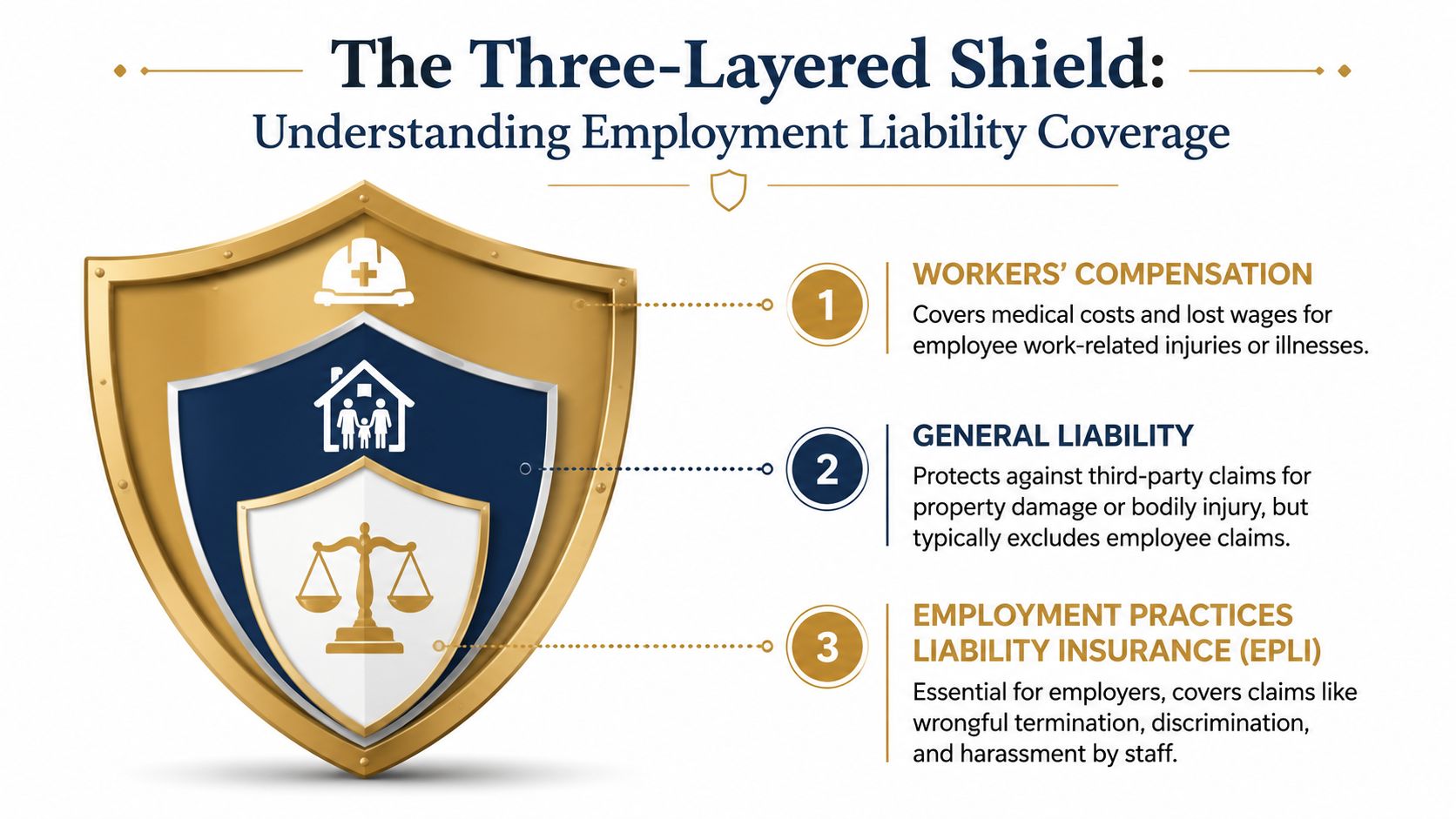
Layer one covers injury and illness
In the UK, that layer is Employers' Liability. It's the policy that responds when an employee is injured at work or becomes ill because of work. If a nanny strains her back lifting a child repeatedly, or a housekeeper develops an occupational illness connected to cleaning chemicals, this is the category you're dealing with.
In the US, the closest equivalent is usually Workers' Compensation, which is handled through a state-based system rather than one national rule. Same broad purpose, different legal framework.
Layer two covers claims by outsiders
General liability often gets mentioned in the same conversation, but families regularly overestimate what it does. General liability is primarily about third-party bodily injury or property damage. It may help if a visitor is injured on the property, but it typically does not solve employee injury claims or employment disputes.
That's why relying on a household or umbrella policy alone is a mistake. Those policies were not designed to handle the full employer relationship.
Layer three covers wrongful employment acts
This is Employment Practices Liability Insurance, often shortened to EPLI or EPL. It addresses allegations such as discrimination, harassment, retaliation, and wrongful termination. These are not injury claims. They're conduct and management claims.
This distinction matters because a major source of confusion is the difference between Employers' Liability and Employment Practices Liability. UK law mandates EL for employee injury or illness, but it does not cover discrimination, wrongful termination, or harassment. In 2024, 68% of UK employment tribunals involved those kinds of claims, yet only 22% of small businesses held EPL coverage, leaving many employers exposed, as noted in the UK guidance on employers' liability insurance.
Practical rule: If your policy only addresses injury, you are not fully protected as an employer.
What families should do with this distinction
When you review your insurance, ask three separate questions:
- If a staff member is physically hurt while working, what policy responds?
- If a staff member alleges unfair treatment, dismissal, discrimination, or harassment, what policy responds?
- If neither answer is clear in writing, why are you assuming you're covered?
Before you hire, it's also wise to tighten your process on recruitment records, references, and screening. A disciplined hiring trail helps reduce disputes later, especially when supported by a proper nanny background check process.
Global Compliance for Your Household Staff
Families with international lives often make one dangerous assumption. They think one good insurance arrangement follows them everywhere. It usually doesn't.
The legal answer depends on where the employee works, where the employer is based, and sometimes where the contract is performed day to day. A London-based family with a nanny travelling to New York and Dubai is dealing with a very different compliance picture from a family employing one live-out nanny in Kensington.
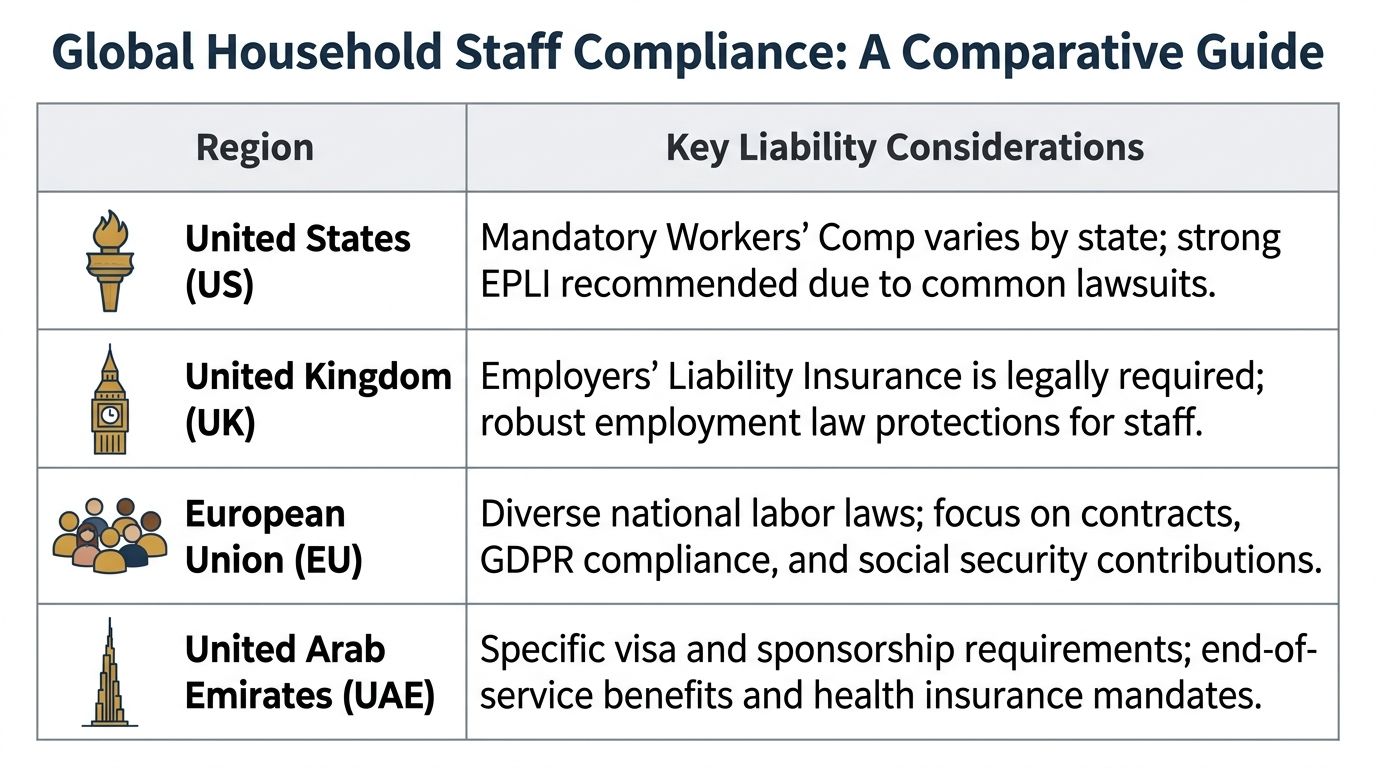
The UK position is clear
The UK is the easiest place to state the rule. Employers' liability insurance is a statutory requirement under the Employers' Liability (Compulsory Insurance) Act 1969, with a minimum cover of £5 million per occurrence. If you fail to maintain it, you can be fined up to £2,500 for every day you're uninsured. While £5 million is the legal minimum, most reputable insurers in 2026 provide £10 million as standard, according to Oury Clark's employers' liability guide.
That rule matters to household employers because domestic staff count. Full-time, part-time, temporary, and volunteer arrangements can all trigger obligations depending on the employment relationship. If you employ in the UK, handle this first.
The US position is fragmented
The US is less elegant. There isn't one national household employment rule that solves everything. Workers' Compensation requirements vary by state, and the threshold for household employers differs from jurisdiction to jurisdiction. EPLI is generally not mandated in the same way, but it is often the smartest optional protection because employment disputes are common and expensive to defend.
For families with US residences, don't buy coverage based on assumptions from another state. A New York arrangement may require a different approach from California or Florida. Multi-state households need state-specific advice, not generic advice.
A useful starting point for cross-border families with US staff is a dedicated US household employee tax guide for elite families, because payroll, classification, and insurance decisions are tightly linked.
International households need local verification
For families employing staff in Monaco, Paris, Zurich, Milan, Dubai, or elsewhere, the principle is straightforward. Local law controls. That includes visa status, sponsorship, social contributions, local injury cover, dismissal rights, and workplace procedures.
If your staff handbook, contracts, or reporting policies need to work across languages and jurisdictions, Translators USA's HR compliance resource is a practical reference for multilingual documentation issues that often get overlooked in international households.
| Region | Core issue for household employers | Best approach |
|---|---|---|
| UK | Mandatory Employers' Liability | Put statutory cover in place immediately |
| US | State-by-state Workers' Compensation rules | Review each state where staff work |
| EU | Country-specific labour and social rules | Use local employment counsel |
| UAE | Visa, sponsorship, and local employment requirements | Confirm compliance before onboarding |
What Your Policy Actually Covers and Excludes
Families rarely get into trouble because they bought no policy at all. More often, they bought the wrong policy, or the right policy with the wrong assumptions.
Coverage only helps when the claim fits the policy wording. That sounds obvious, but it's where expensive misunderstandings happen.
Claims that are usually within the right cover
If a nanny slips on a wet kitchen floor during working hours and suffers an injury, that is generally an injury claim. In the UK, that belongs in the Employers' Liability category. In the US, it usually falls into Workers' Compensation.
If a housekeeper alleges she was dismissed because of pregnancy, race, religion, age, or another protected characteristic, that is not an injury claim. That's where EPLI becomes relevant.
If a family dismisses a chauffeur after a disagreement and the chauffeur alleges retaliation, harassment, or unfair treatment, you are no longer dealing with household administration. You are dealing with employment litigation risk.
Exclusions that cause the real pain
The most dangerous gaps tend to hide in exclusions and endorsements, not headlines. One of the biggest examples is third-party harassment. A nanny may be harassed by a guest, contractor, or someone connected to the household rather than by the employer directly. Many families assume their EPLI handles that automatically. Many policies do not.
In 2024, 31% of harassment claims against UK staffing agencies involved third parties, yet only 12% of EPL policies included the necessary third-party extension, according to Mintz's discussion of employment policy questions. That gap is not theoretical. It's exactly the kind of scenario that can arise in a high-traffic private home with guests, drivers, security teams, and visiting service providers.
If your household hosts events, overnight guests, contractors, or extended family regularly, third-party harassment cover should be reviewed explicitly, not assumed.
Questions to put to your broker
Use this list and insist on written answers.
- Ask about third-party harassment: Does the EPLI wording cover claims arising from guests, clients, contractors, or non-employees?
- Ask about wage disputes: Many employment policies treat wage and hour issues narrowly or exclude them altogether.
- Ask who counts as an employee: Live-in staff, temporary cover, travelling staff, and labour-only workers need to be addressed clearly.
- Ask where cover applies: A policy written for one residence may not automatically respond during travel or at another property.
- Ask about legal defence costs: You need to know whether defence costs sit inside or outside the policy limit.
For families reviewing domestic staff cover in practical terms, a focused guide to insurance for nanny arrangements can help frame the right questions before a broker call. If you want a plain-English example of how insurers describe wrongful employment claims, Liberty Insurance employment practices coverage is a useful reference point.
Budgeting for Complete Peace of Mind
Insurance pricing shouldn't be mysterious. The cost rises or falls based on risk, and household employers can usually predict the main drivers.
In the UK, the average annual cost of employers' liability insurance was £61 for a single office worker and approximately £213 for one worker performing tasks associated with the main line of business, a figure that is more representative for household staff. Those costs relate to the legal minimum requirement of £5 million in cover, and non-compliance can trigger daily fines of £2,500, according to Statista's UK employers' liability cost data.
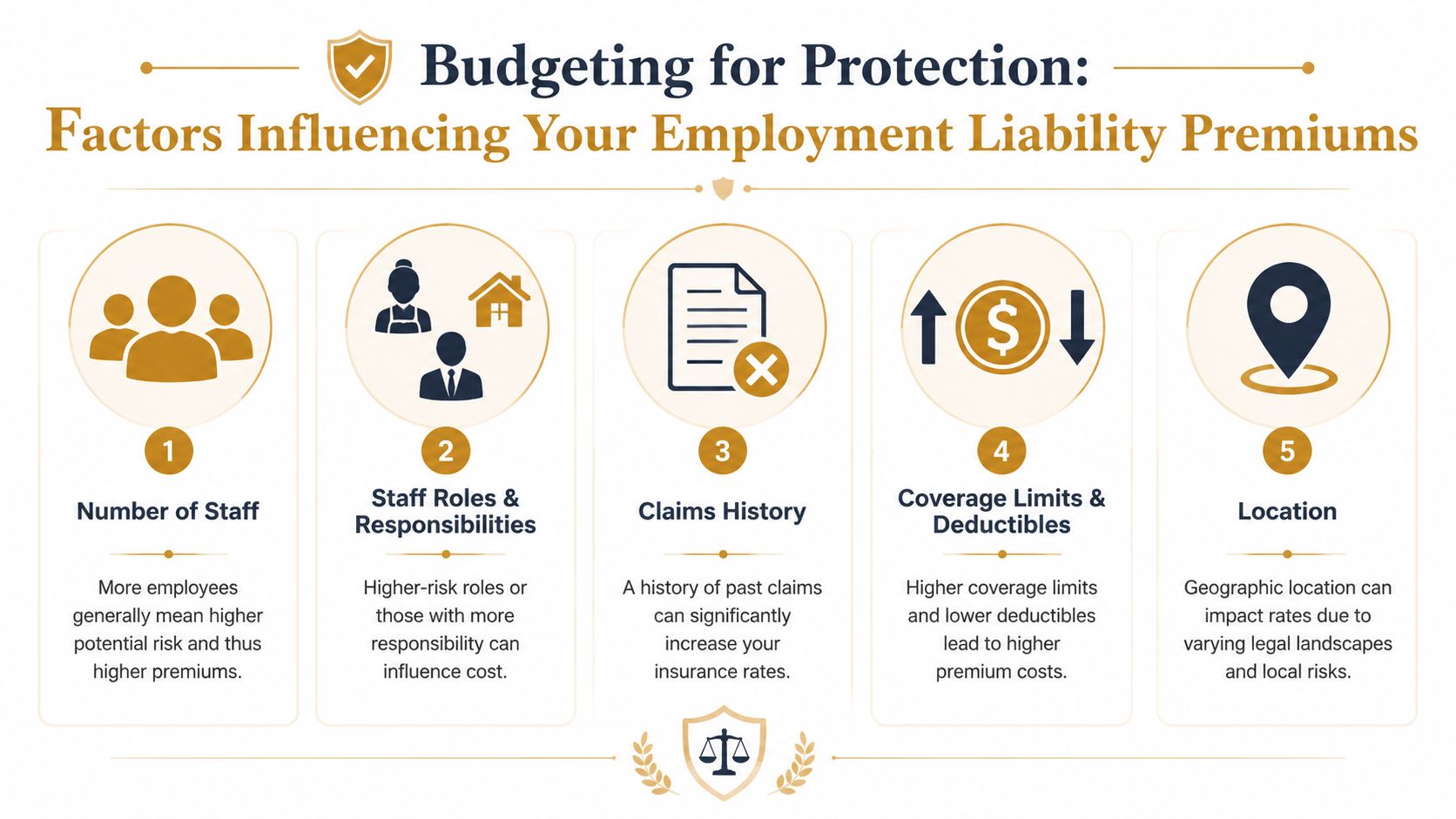
What pushes premiums up or down
A family employing one part-time nanny presents a different profile from a household employing a rota nanny team, chef, chauffeur, and estate manager across multiple residences.
Key pricing factors usually include:
- Headcount: More staff means more potential claims.
- Role complexity: Childcare, driving, cooking, household management, and travel all affect exposure differently.
- Work location: One home is simpler than multiple homes across jurisdictions.
- Claims history: Past disputes or injury claims make underwriters cautious.
- Policy design: Higher limits and broader endorsements usually cost more.
Spend intelligently, not minimally
The wrong instinct is to buy the cheapest policy that ticks a legal box. The better instinct is to buy the policy stack that matches your real household structure.
For UK families, statutory Employers' Liability is a legal requirement. For internationally mobile or high-profile families, EPLI deserves serious consideration because reputational risk often matters as much as legal cost. If your staff work around children, travel frequently, interact with guests, or report into multiple decision-makers, broader cover is worth it.
The premium is predictable. An uninsured or misinsured employment dispute is not.
Your Checklist for Securing the Right Coverage
This is the practical part. Handle it in order.
The six steps that matter
Map your household workforce. List every nanny, housekeeper, driver, chef, tutor, estate manager, maternity nurse, and temporary staff member. Include where they work and whether they travel.
Separate injury risk from conduct risk. Don't ask for one vague insurance solution. Ask specifically for the policies that address workplace injury and employment-related claims.
Use a broker who understands domestic employment. Commercial cover experience alone isn't enough. A private household is its own category.
Review the exclusions first. The biggest problems often sit in what the policy removes, not what the summary page highlights.
Check compliance obligations. In the UK, that includes certificate requirements and making sure the policy is issued by an authorised insurer.
Review annually and after every major hire. A new live-in nanny, a promoted house manager, or a second residence can change what adequate cover looks like.
Questions worth asking before you bind cover
- Will this policy respond if a staff member alleges wrongful dismissal?
- Does it include third-party harassment extensions?
- Does cover apply at every residence and during travel?
- Are temporary and part-time staff included?
- What documentation do I need to maintain?
If you want a legal perspective on risk prevention before claims ever start, Lerner & Weiss APC's legal insights offer practical thinking on the employment practices side.
Frequently Asked Questions About Household Employment
Do I need employment liability coverage for part-time staff?
Yes, you may. In the UK, the legal obligation isn't limited to full-time employees. Under the Employers' Liability (Compulsory Insurance) Act 1969, employers must hold at least £5 million in cover for employees, including apprentices, volunteers, and temporary staff, even if there is no written contract. That obligation starts as soon as you become an employer, as explained by NFP's guide to employers' liability insurance.
Does employment liability coverage follow my nanny when we travel abroad?
Not automatically. Some policies are territory-limited, and others only apply where the employee is ordinarily based. If your nanny travels with you to another country, ask your broker whether the policy extends to temporary overseas work, multiple residences, and local legal claims. Never assume your home-country policy follows the itinerary.
Are family members who help with childcare always covered?
Not always. In the UK, there are limited exceptions in some circumstances involving immediate family members, but families should not guess. If a relative is working in a structured, regular, or paid capacity, get advice and confirm whether insurance and employment obligations apply. Informal family help and formal employment are not the same thing.
Is EPLI worth it for one nanny or one housekeeper?
Often, yes. One employee is enough to create an employment dispute. A wrongful dismissal, discrimination, or harassment allegation can become expensive long before liability is decided. EPLI is often most valuable for defence costs and early response, not just final settlements.
What's the first thing I should do before hiring household staff?
Decide who the legal employer is, where the work will be performed, and what insurance is required in that jurisdiction. Then put the contract, payroll, and insurance in place before the start date. Hiring first and fixing compliance later is how avoidable problems begin.
If you're hiring household staff in the UK, the US, or across multiple residences worldwide, Superstar Nannies can help you build a professional household from the outset, with the right people, the right structure, and the right support around every placement.