

You're probably in the same position I see all the time. You're an experienced nanny, you're already the person families trust most, and you know you're capable of more than general childcare. What you want now is a sharper professional identity, stronger pay, and access to households that don't hire on charm alone.
That's where newborn care specialist training changes your trajectory. If you want to work with discerning families, especially in private, high-expectation homes, you need more than baby experience. You need specialist training, credible certification, polished presentation, and the judgement to support parents during the most delicate stage of family life.
Meta description: Newborn care specialist training in the UK. Learn the exact path, best certifications, costs, and elite career moves to secure top household placements.
Suggested URL: /newborn-care-specialist-training
The Path from Nanny to Newborn Care Specialist
The move from nanny to Newborn Care Specialist is a proper career upgrade. You stop being seen as a broad childcare professional and start being hired for a narrow, high-value window of expertise. Families bring you in for the first weeks and months because they need structure, calm, safety, and guidance.
A general nanny may care for children across ages. A Newborn Care Specialist focuses on infants in the earliest stage, along with feeding routines, sleep shaping, developmental awareness, household rhythm, and parent support. In elite homes, that distinction matters.
Start with your experience, not a certificate
If you haven't already built serious infant experience, slow down. In the UK, the route into this field starts with a foundational minimum of 3–5 years of professional infant care experience, then a specialist certification programme. That same pathway states that 98% of certified specialists successfully secure placements within elite households, and it also makes clear that Infant CPR and First Aid are mandatory baseline credentials (Seaside Staffing's pathway guide).
That should tell you two things. First, this isn't an entry-level pivot. Second, households at the top end aren't looking for enthusiasm alone. They're looking for proof.
If you're still early in your childcare career, build your foundations properly before specialising. A practical starting point is understanding the broader route into professional childcare through how to become a nanny, then narrowing into newborn work once your infant track record is strong.
What elite families actually want
Elite families don't want someone who “loves babies”. Everyone says that. They want someone who can walk into a sleep-deprived household and calmly bring order.
They look for:
- Calm authority. You must reassure without sounding rigid or superior.
- Infant-specific knowledge. Feeding, settling, sleep environment, hygiene, cues, and safety all need to feel second nature.
- Parent support skills. The best specialists support the adults as well as the baby.
- Professional boundaries. You're not there to become emotionally chaotic with the household. You're there to steady it.
Practical rule: If your CV reads like a general nanny CV with “newborn” added at the top, you're not ready to market yourself as a specialist.
The shift in responsibility
This role gives you more autonomy, but that only works if your standards rise with it. You'll often be the person setting expectations around routine, observing newborn behaviour, and helping parents through a period that can feel overwhelming.
That's why the strongest candidates treat this move as professional specialisation, not rebranding. The title matters less than the competence behind it.
Choosing Your UK Newborn Care Specialist Training
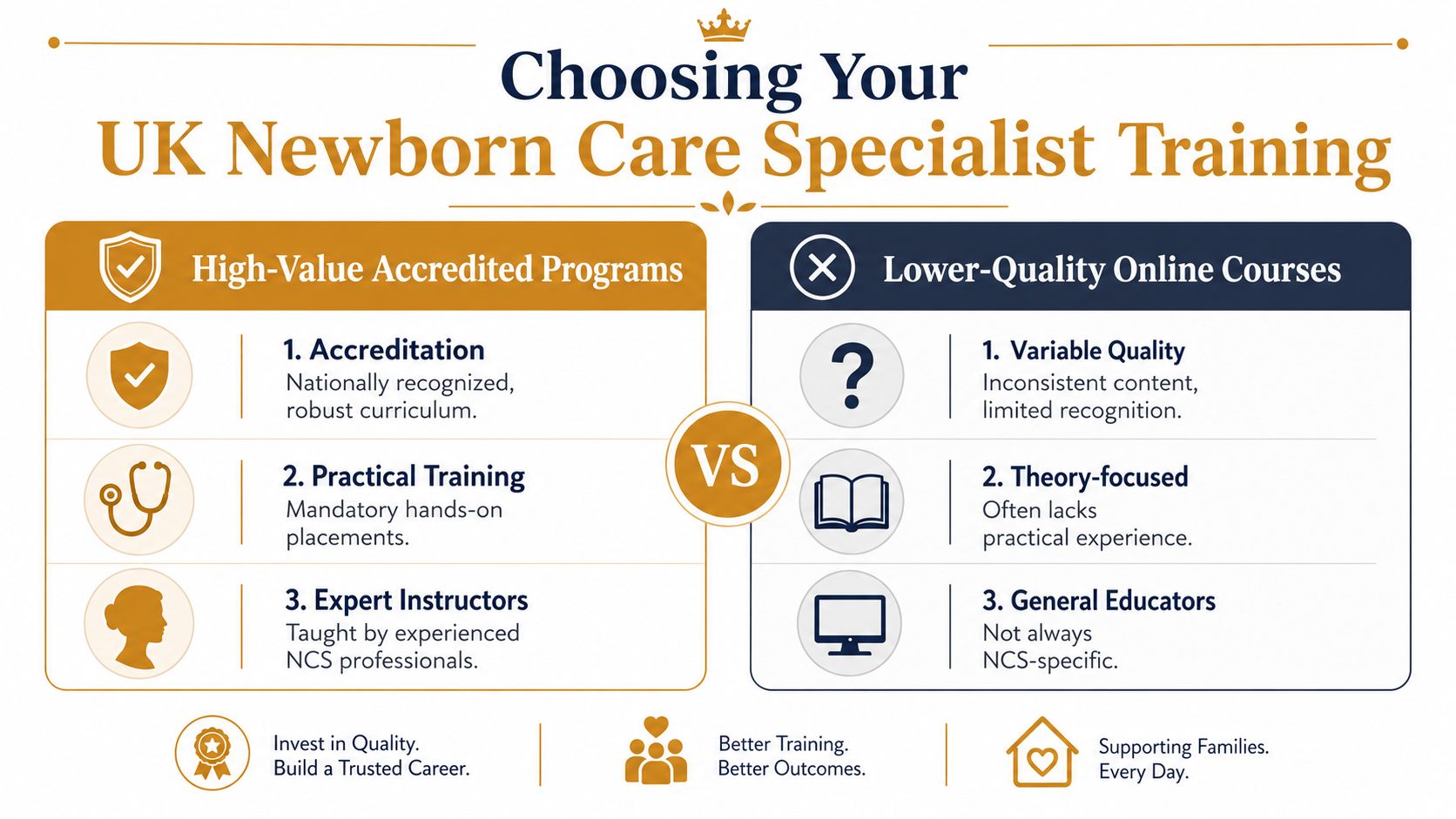
The training market is crowded, and much of it is mediocre. If you choose the cheapest, fastest certificate just so you can say you're qualified, you'll damage your credibility before your specialist career begins.
The right move is simple. Choose quality over speed. Choose accreditation over slick marketing. Choose a curriculum that can stand up to scrutiny from agencies, private employers, and experienced maternity professionals.
What strong UK newborn care specialist training looks like
In the UK, professional training for newborn care specialists often follows a flexible duration model of 4 to 12 weeks, while specialised certificate programmes are designed to build practical knowledge, safety protocols, and emotional support skills for infants in their first weeks of life. At the advanced end, the Level 4 Postnatal and Infant Care Education (PAICE) course is aimed at experienced nannies or maternity nurses who want to specialise in premature infants and complex medical conditions. That course is issued by the Open College Network and Little Ones Courses, requires completion of online assignments within 6 weeks, costs approximately £530, and is delivered via live Zoom sessions over two intensive days from 9:30 AM to 6:00 PM. The certification is described as lifetime-valid (Certificate in Newborn Care details).
That's the sort of training I'd take seriously. It's targeted, assessed, specific to real newborn work, and built for professionals who already have experience.
What to reject immediately
Some courses give you a digital badge, a few recorded modules, and very little substance. That might satisfy a beginner who wants reassurance. It won't impress a serious household.
Recent UK data makes the risk plain. Over 68% of families in London and Manchester express dissatisfaction with current NCS candidates due to insufficient clinical knowledge, and a 2025 evidence review cited in the same discussion suggests that unregulated training contributes to a 23% higher rate of parental anxiety (Newborn Connect Groups discussion).
If your course doesn't push you beyond theory, you'll feel the gap in interview rooms and in clients' homes.
A better way to judge programmes
Use this checklist before you enrol:
| What to check | What good looks like |
|---|---|
| Accreditation | Recognised awarding body or credible professional framework |
| Curriculum | Newborn nutrition, sleep shaping, milestones, common medical conditions, safety |
| Delivery | Live teaching, assessed work, direct tutor input |
| Target student | Experienced childcare professionals, not complete beginners |
| Clinical depth | Real attention to premature infants, NICU transitions, and complex care |
If you're considering a longer-term route into maternal and infant care, it's also worth understanding how flexible midwifery pathways are structured. Not because you need to become a midwife to work as an NCS, but because the best specialists respect the difference between domestic newborn support and clinical maternal care.
For perspective on elite childcare education standards more broadly, Norland College inside the world's most elite nanny training is useful reading. It sharpens your eye for what serious training looks like.
Understanding Certifications and Accreditation
A certificate only has value if the people hiring you believe it means something. That's the key issue.
In private childcare, families rarely assess a qualification the way an academic institution would. They read it as a signal. Does this person take standards seriously? Was their training assessed? Is there evidence they can operate safely and professionally in a high-pressure household?
Course completion is not the same as professional credibility
A simple completion certificate tells me you attended. It doesn't tell me what level you were assessed at, how demanding the programme was, or whether the course provider has any standing.
By contrast, accredited training tells a much clearer story. In the UK context, an awarding body such as the Open College Network signals structure and accountability. In the US, there are also recognised industry credentials. To earn the Newborn and Infant Specialist credential from the US Nanny Association, candidates must complete at least 20 clock hours or 3 credit hours of newborn and infant training, hold 4,000 hours (2 years) of documented paid childcare experience, be at least 21 years old, and provide three employer letters of recommendation (US Nanny Association NIS credential).
That's useful because it shows what serious credentialing looks like. It asks for training, experience, and third-party validation.
Why agencies and families care
The best households don't hire qualifications in isolation. They hire risk reduction.
That's one reason Ofsted registration for nannies remains relevant reading even if your role is newborn-specific. Families trust professionals who understand how regulation, safeguarding, and accountability fit into the wider childcare picture.
Here's the blunt truth. A weak certificate may get you past your own self-doubt. It won't get you through serious vetting.
Accreditation doesn't just decorate your CV. It tells families your training was built to a standard, not improvised for marketing.
Read the fine print before you pay
Before enrolling, check:
- Who awards it. A respected body carries more weight than an unknown provider.
- How you're assessed. Assignments, live sessions, and structured evaluation matter.
- Who it's for. Advanced courses should be aimed at experienced professionals.
- What it qualifies you to discuss confidently. If the course avoids medical complexity, don't expect it to prepare you for high-end roles.
The smartest candidates don't collect certificates. They build a professional profile that makes sense.
The Real Cost and Earning Potential of an NCS
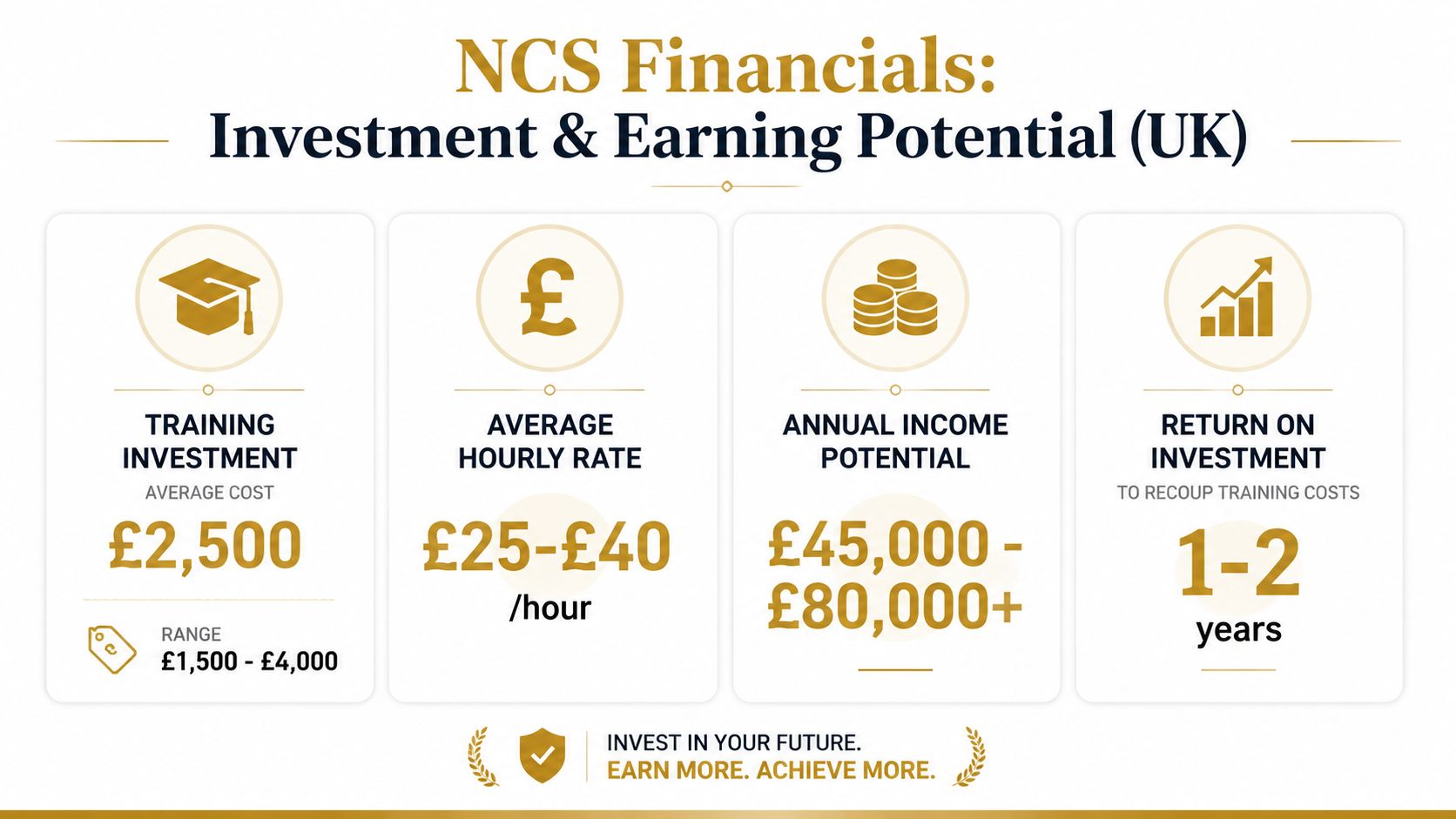
If you're serious about newborn care specialist training, stop thinking like a bargain hunter. Think like an investor.
The question isn't whether the training costs money. Of course it does. The question is whether the training moves you into a more valuable category of work. In this field, good training does exactly that.
The clearest numbers in the UK market
In the UK market, the financial case is strong. One source notes that specialised UK courses such as the Level 4 PAICE cost £530, while mid-range global programmes often range from $700 to $1,500. The same source states that Newborn Care Specialists in the UK earn between £800 and £1,600 per week, with pay shaped by qualifications, experience, and the number of infants in their care. It also notes that these roles often cover short-term contracts lasting from 2 weeks to 3 months (UK training cost and earnings overview).
That's not a vague “better income potential” promise. That's a direct move into a different earning bracket.
What those earnings really mean
Not every specialist will command the top end immediately. Households pay more when you bring confidence, references, and specialist judgement into the room.
Your rate is usually influenced by factors such as:
- Experience depth. Families can tell the difference between newly certified and well-seasoned.
- Complexity of care. More complicated infant needs justify stronger fees.
- Contract structure. Intensive schedules and high-demand placements require more from you.
- Presentation and references. A polished professional with impeccable references gets stronger offers.
If you want a broader benchmark for private postnatal work, maternity nurse salary in the UK helps place NCS earnings in context.
My recommendation on spending
Spend on the course that increases your credibility. Don't overspend on branding and don't underspend on substance.
Here's the order I'd prioritise:
- Infant CPR and First Aid
- A credible specialist newborn care qualification
- Ongoing professional development
- A professionally presented CV and reference file
Bottom line: A few hundred pounds spent on respected training is easier to defend than years spent under-earning because your credentials don't inspire confidence.
Beyond Certification Building Specialist Skills
Certification gets you through the door. It doesn't make you excellent.
That gap matters most in the areas where families feel vulnerable. Preterm babies, NICU transitions, feeding complications, and medically complex early routines separate the merely qualified from the trusted.
The niche that can set you apart
Data from Babyem states that only 12% of UK-based NCS certification courses include hands-on training with neonatal specialists or access to updated NHS premature care guidelines. The same source states that 78% of UHNW families in the UK with infants born preterm report that their current NCS lacks confidence in managing issues such as weaning tubes, oxygen dependency, or developmental feeding plans (Babyem training perspective).
That's a glaring gap in the market. If you want to become more valuable, don't stay broad. Build competence where others stay shallow.
How to build depth after your course
You need exposure, mentorship, and repetition. Theory fades quickly if you don't turn it into judgement.
Focus on:
- Premature infant care. Seek advanced workshops, supervised learning, and reading aligned with current NHS guidance.
- NICU transition support. Learn how to support parents who are bringing home babies after a clinically intense start.
- Feeding confidence. Understand the practical realities of expressed milk, formula handling, reflux concerns, and developmental feeding patterns.
- Professional observation. Train yourself to notice patterns and communicate them clearly without becoming alarmist.
A simple consumer-facing resource like this what to do with a newborn guide can also help you see the kind of basic questions new parents are already asking. That's useful because elite service often means explaining complex matters in simple, calm language.
Build specialist proof, not just specialist interest
Don't just say you're interested in premature babies or complex newborn care. Create evidence.
That can include:
- Targeted references from roles involving young infants
- Additional study records from advanced infant-care workshops
- A sharper CV profile that reflects actual newborn-focused experience
- A clear professional philosophy on safe, calm, evidence-aware support
The best NCS candidates don't stop learning after certification. They become the person families trust when the situation feels more delicate than average.
Presenting Yourself to Elite Households
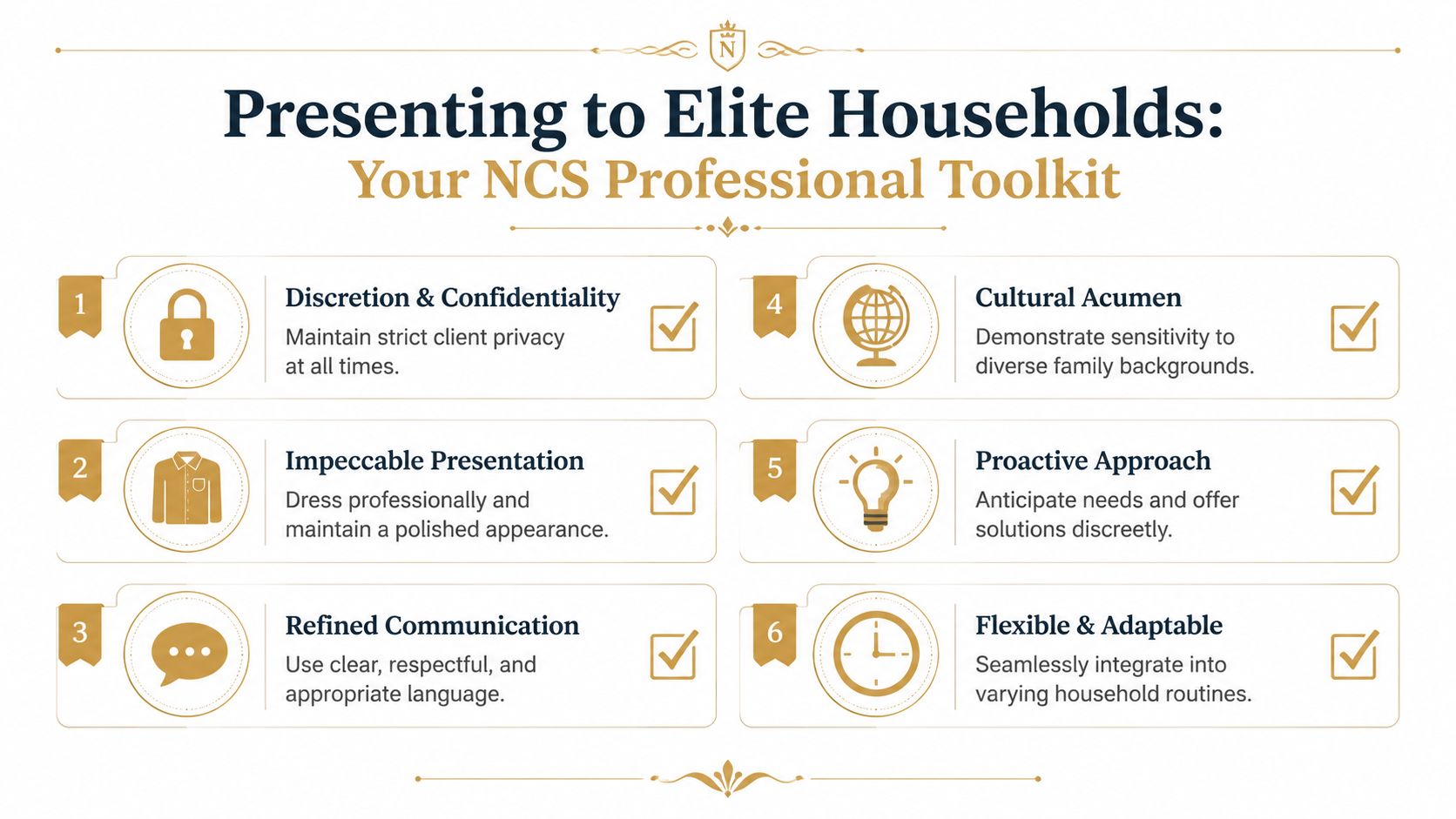
Technical skill is only half the job. Elite households assess how you carry yourself before they assess what you know.
You can be excellent with babies and still lose the role because your presentation feels casual, your language feels loose, or your CV reads like a standard nanny application. In private service, refinement matters.
Build a CV for private households, not nursery roles
Your CV should sound discreet, organised, and specialist-led. Remove fluff. Replace generic childcare phrases with precise newborn responsibilities and outcomes.
A strong NCS CV should highlight:
- Specialist credentials. Put your newborn care specialist training, infant CPR, and relevant advanced study near the top.
- Newborn-specific assignments. Include the age of infants at placement start, contract style, and scope of support.
- Household fluency. Note travel readiness, rota adaptability, discretion, and experience working alongside household staff where relevant.
- References with weight. Private employers want references that reflect trust, consistency, and professionalism.
Interview like a specialist
Don't overtalk. Don't overshare. Don't try to sound trendy.
You should be able to explain your approach to feeding, sleep routines, infant settling, parental communication, and boundaries in clear, polished language. If a family asks a difficult question, answer directly. If something falls outside your scope, say so confidently.
A practical consumer-facing newborn baby care guide is also a useful reminder of the topics parents commonly worry about. If you can speak about those everyday concerns with composure and clarity, you'll interview better.
The unspoken standards of VIP placements
Many otherwise capable candidates often fail for a specific reason. They understand babies, but they don't understand private service culture.
Keep these standards in mind:
| Area | What elite households expect |
|---|---|
| Confidentiality | Absolute discretion, with no casual storytelling about previous employers |
| Appearance | Polished, neutral, appropriate, never attention-seeking |
| Communication | Respectful, concise, emotionally steady |
| Flexibility | Willingness to adapt without becoming chaotic |
| Cultural awareness | Sensitivity to language, customs, staffing structures, and family preferences |
You should also expect NDAs, detailed vetting, and a close look at your online presence. Clean it up. Families hiring at this level notice everything.
Hiring advice: Private households don't just ask, “Can she care for our baby?” They also ask, “Can we trust her in our world?”
Frequently Asked Questions About NCS Training
Do I need to be a nurse or midwife to take newborn care specialist training
No. Newborn care specialist training is typically designed for experienced childcare professionals, especially nannies and maternity nurses who want to specialise further. What matters most is strong infant experience, respected training, and essential safety credentials such as Infant CPR and First Aid.
How long does newborn care specialist training take in the UK
Course length varies by provider and level. UK programmes can run from a few weeks to a few months, and some advanced options are delivered in an intensive format with assessed work completed within a defined timeframe. The best route depends on your experience and how specialised you want your profile to be.
What should I look for in a newborn care specialist course
Look for accreditation, assessed learning, infant-specific curriculum, and evidence that the course goes beyond theory. Strong programmes cover infant nutrition, sleep shaping, developmental milestones, common newborn medical conditions, and safety. If the course is vague about standards, skip it.
Is a cheap online certificate enough to get elite placements
Usually not. High-end households and strong agencies look for credible training, proven infant experience, and a professional presentation that inspires trust. A low-quality certificate may help you start learning, but it rarely carries enough weight on its own for top-tier roles.
Can newborn care specialist training help me earn more than standard nanny work
Yes, it often can. In the UK, specialist newborn work sits in a stronger pay bracket than general nannying because the role is narrower, more intensive, and tied to a high-stakes stage of care. Better training also improves your chances of securing the most desirable placements.
If you're ready to turn strong childcare experience into a specialist career, Superstar Nannies can help you position yourself for high-calibre newborn and private household placements with the discretion, standards, and professionalism elite families expect.