


You're probably reading this because the practical side of life has started swallowing the important side of it. School logistics blur into travel planning. Household suppliers need chasing. Your diary is full, yet the details still sit with you. That's usually the moment people begin searching for personal assistants for hire.
In private service, a good PA isn't a luxury add-on. It's a structural fix. The right person protects your time, reduces decision fatigue, and keeps both visible tasks and invisible obligations moving without noise.
For first-time employers, the confusion rarely comes from whether support is needed. It comes from choosing the right type of support, budgeting properly, and knowing how to assess trust in a role that sits close to your home, family, schedule, and finances. That's where many generic guides fall short. They focus on posting a job ad. They don't address how discreet households hire.
An Introduction to Hiring a Personal Assistant
The phrase personal assistants for hire covers several different roles, and that distinction matters more than most clients realise. If you hire too narrowly, you'll still be overloaded. If you hire too broadly, you risk paying for a catch-all role that was never properly defined.
A household PA usually supports private life. That may include family schedules, contractor coordination, appointments, travel, events, wardrobe logistics, shopping, household inventory, and property-related administration. This person often becomes the operational glue of a busy home.
An executive PA is different. That role tends to focus on business-facing support such as inbox management, meeting preparation, travel itineraries, document handling, diary control, and coordination with colleagues, clients, and advisers.
A hybrid PA sits between the two. In high-functioning households, that's often the most realistic brief. One day may involve moving a board meeting and the next may involve arranging half-term logistics, managing a delivery window, and liaising with a driver or tutor.
Practical rule: Write the job around your actual friction points, not around a generic job title.
That's why a thoughtful hiring process starts with task mapping, not CV browsing. If part of your pressure can be handled remotely, it's also worth understanding where virtual support fits alongside in-person help. This guide on how to hire virtual assistants is useful for comparing which responsibilities can be delegated off-site and which require trusted physical presence.
The role has changed. Expectations are higher, privacy standards are stricter, and the best hires are chosen with far more care than a simple admin job.
The Modern PA More Than Just Admin
The old image of a PA as someone who answers calls, books restaurants, and manages a diary is outdated. In private households, the role has expanded because life itself has become less neatly divided. Home and work overlap. Travel is more layered. Family schedules are more fluid. Trusted support now has to move comfortably across several worlds.
UK demand reflects that shift. The role is moving beyond simple admin, and changing work patterns have increased demand for assistants who can coordinate both home and office logistics, pushing more families towards specialised support such as household managers and lifestyle coordinators, as noted by Tiger Recruitment on private PA recruitment.
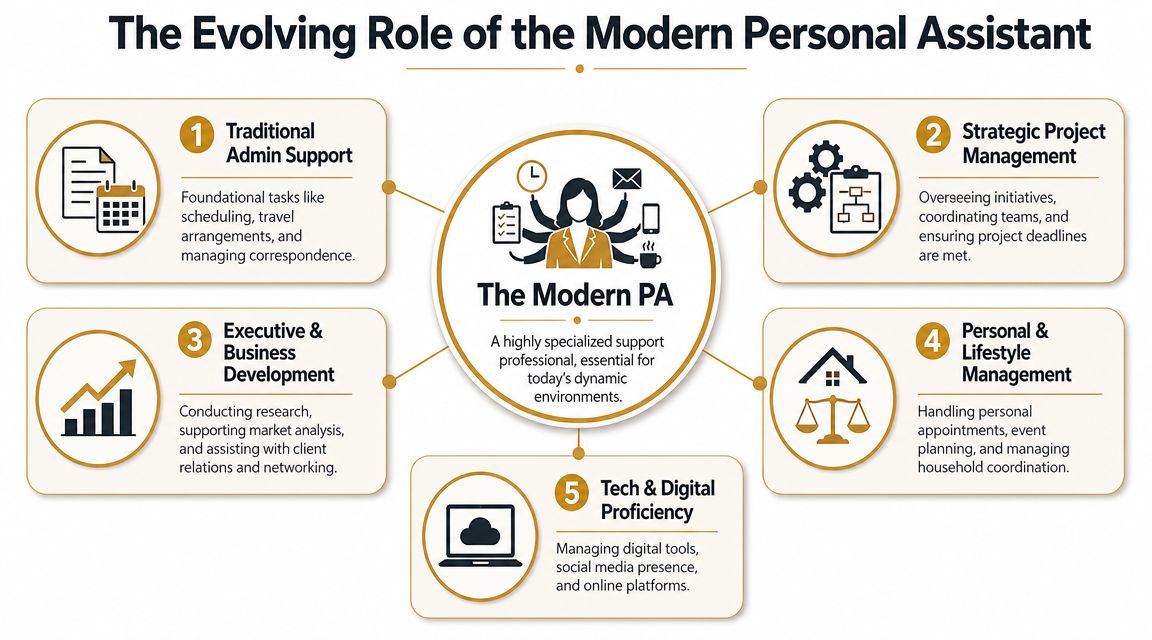
What the role now includes
A modern PA may still handle classic support tasks, but the stronger candidates usually bring much more:
- Operational coordination: Managing competing schedules, vendors, appointments, travel, and follow-up without constant prompting.
- Lifestyle oversight: Keeping personal commitments, family administration, and domestic routines aligned.
- Project handling: Overseeing house moves, refurbishments, events, seasonal planning, or principal-led side projects.
- Digital competence: Working across Google Workspace, Microsoft 365, shared calendars, encrypted messaging, expense tools, and travel platforms.
- Judgement: Knowing when to act, when to ask, and when silence is the right professional response.
For a fuller task breakdown, this guide to personal assistant duties is a practical reference point when building the brief.
A quick self-check before you hire
If several of these feel familiar, you probably don't need “a bit of help”. You need a defined PA role.
- Your calendar is controlled by reaction: You spend the day rearranging rather than deciding.
- Home admin spills into professional hours: Bills, deliveries, contractor calls, school logistics, and personal appointments are handled in work gaps.
- No one owns the details: Travel gets booked, but documents are missing. Events get planned, but confirmations are fragmented.
- You're the single point of failure: If you switch off your phone, too much stops.
The strongest PA placements happen when the client hires for relief and continuity, not status.
Standard PA, household manager, or hybrid
A standard PA suits someone who mainly needs schedule, communication, and life admin support. A household manager is better when the home has multiple moving parts, staff oversight, supplier relationships, and regular property coordination. A hybrid role works when private and professional demands intersect daily and need one trusted operator sitting in the middle.
That distinction is where many searches go wrong. Clients ask for a PA, but describe a household manager. Or they want an executive assistant, but expect them to run domestic life as well. Precision at this stage saves time later.
Deciding When You Need to Hire a PA
Individuals frequently wait too long, attempting to fix overload with better lists, stricter routines, or another app. That can work for a while, but only until complexity outruns organisation. A PA becomes necessary when the issue isn't memory or discipline. It's volume, fragmentation, and the number of decisions still landing on you.

Signs the role is already overdue
A recurring pattern usually appears before clients reach out:
Evenings are spent on life admin
You finish paid work, then start unpaid work. Confirming school pickups, chasing invoices, replying to suppliers, arranging appointments, and rebuilding the next day's diary becomes the second shift.Important details are being missed
Not because you're careless. Because too many low-level but necessary tasks compete for attention at once.Your household runs on memory
If key information lives in your head rather than in a system, you're carrying too much operational weight personally.You avoid making plans because coordination feels exhausting
That's often a strong sign that the admin burden, not the event itself, has become the problem.
The skills that matter in a private environment
Many first-time employers often focus on the wrong things. Software proficiency matters, but it's rarely the deciding factor. In a private setting, success usually comes from the blend of hard and soft skills.
| Skill area | Why it matters |
|---|---|
| Diary and logistics management | Keeps personal, family, and business obligations from colliding |
| Written communication | Protects tone, privacy, and professionalism in emails and messages |
| Research and follow-through | Helps the PA solve problems rather than simply escalate them |
| Discretion | Essential in any role involving homes, children, travel, finances, or personal information |
| Proactivity | Prevents small issues becoming last-minute emergencies |
| Emotional steadiness | Private households need calm judgement, not visible panic |
Hire for trust, judgement, and consistency first. Train systems second.
If you're already redesigning your day around admin instead of outcomes, a PA is no longer a nice idea. It's overdue infrastructure.
The True Cost of a Personal Assistant in the UK
A client will often say, “We can spend £45,000,” and mean salary alone. By the time we price the role properly, the actual annual commitment is higher. That gap catches first-time employers more often than candidate scarcity does.
In the private market, budgeting well is part of hiring well. A serious PA will want clarity on employment status, paid time off, working pattern, and who is handling payroll. Families who only budget for headline salary usually either under-scope the role or lose good candidates late in the process.
What employers often miss
Base pay is only one line item. The primary cost sits in the employment structure around it.
For a UK-employed PA, you need to account for:
- Employer National Insurance
- Workplace pension contributions
- Paid holiday
- Statutory sick pay where relevant
- Payroll administration
- Employment contracts and record keeping
- Cover during annual leave or illness, if the role is business-critical
Those costs are not a technicality. They affect the level of candidate you can attract and whether the arrangement is sustainable after the first few months.
This is also where the high-end market differs from generic job board advice. A standard remote admin PA and a private PA supporting a principal, family office, or fully staffed household do not price the same way. Confidentiality, irregular hours, travel support, gatekeeping, and coordination across residences all increase the level of judgement the role requires. The compensation usually needs to reflect that.
Employed versus freelance cost thinking
Direct employment tends to suit households that need continuity, fixed availability, and tighter control over confidentiality and priorities. Freelance support can work well for lighter diaries, project-based admin, or remote tasks that do not require deep integration into family life.
There is a trade-off.
A freelancer may reduce some of the administrative burden attached to employment, but you are often buying access to time rather than true ownership of the function. Response times may vary. Availability during peak periods may be shared across several clients. In a private household, that matters more than many first-time employers expect.
A sensible budgeting process looks like this:
- Define the role before setting the pay. A diary-focused PA, travelling executive assistant, and household PA are different hires.
- Budget for total employer cost, not salary in isolation.
- Factor in cover and continuity. If the PA becomes central to bookings, family schedules, or bill payments, temporary gaps create risk.
- Decide who will manage compliance. That might be your accountant, payroll provider, solicitor, family office, or a specialist agency.
For households comparing compensation across private roles, this private staff salary guide for 2026 for UHNW families helps frame budgets in a wider household staffing context.
Why transparency matters early
Poor budget planning creates two expensive problems. The brief attracts candidates below the level you need, or you meet the right person and discover too late that the role was undercosted from the start.
Clear numbers make the search more credible.
In practice, the strongest hiring outcomes come from clients who decide early what they are comfortable employing properly, what level of discretion the role demands, and whether they are hiring a true private PA or trying to combine three roles into one salary band. That distinction saves time, protects the relationship, and leads to a better long-term fit.
Agency versus Freelance Finding the Right Path
A family often starts with a simple assumption. Post the role, review a few CVs, meet someone polished, and get help in place quickly. In the private market, that approach can work for a straightforward, low-risk brief. It tends to go wrong when the role touches family routines, financial admin, travel, household access, or confidential personal matters.
The key decision is who will manage the complexity.
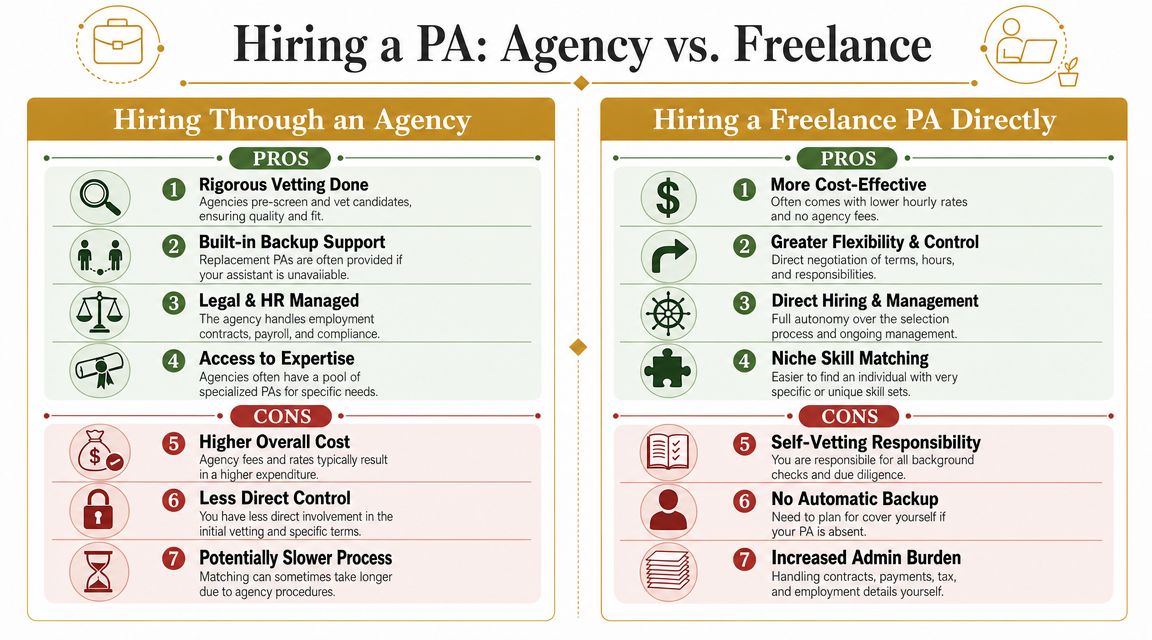
When an agency route makes sense
A specialist agency suits roles that are sensitive, hard to define, or expensive to get wrong. That is often the case in high-value households, where a so-called PA role may involve household coordination, liaising with schools and suppliers, managing staff diaries, booking complex travel, and handling private information with very little supervision.
An agency adds value in four places:
- Search quality: You see fewer candidates, but they are usually better matched to the brief.
- Role definition: The agency can tell you whether you need a classic PA, an executive assistant, a household PA, or a broader hybrid.
- Discretion: The search can stay off public job boards and away from unnecessary visibility.
- Process control: References, interview structure, and offer terms are handled with more consistency.
For clients comparing private home recruitment models, this guide to a household staffing agency for elite residences explains how agency-led hiring works in a residential setting.
Agency hiring does come with a fee. In return, you are usually buying access, filtering, judgement, and a replacement policy if the fit is wrong early on. For many first-time employers, that trade-off is sensible.
When direct hiring may suit you better
Hiring directly can work well if the role is tightly scoped and you already have the time and confidence to assess candidates properly.
That route tends to suit clients who:
- Need support for a narrow brief, such as diary management, booking appointments, or limited weekly admin
- Can interview thoroughly, including testing judgement, pace, and attention to detail
- Have clear systems in place, so the handover is structured rather than improvised
- Can manage the employment side themselves, including references, right-to-work checks, payroll setup, and day-to-day supervision
It is often cheaper at the outset. It is not always cheaper overall.
A direct hire can become expensive if the brief was unclear, the candidate looked stronger on paper than in practice, or the role drifts into a hybrid household post without the right boundaries. In private homes, small hiring mistakes have a habit of becoming personal ones.
The real trade-off
The choice is usually between lower upfront cost and lower execution risk.
With a freelance or direct route, you keep control of the search. You also carry the burden of outreach, screening, benchmarking, and compliance. That may be perfectly reasonable for an experienced employer with a contained brief. It is less comfortable when the role sits close to children, property access, confidential schedules, or private spending.
With an agency, you pay more to reduce avoidable errors. That matters in the upper end of the market, where the best candidates are rarely applying casually and where the distinction between a standard PA and a household-facing support professional is easy to miss if you have not hired before.
One factual example of this model in practice is Superstar Nannies, which places private household staff including personal assistants and related support roles for family and residence-based environments.
The Vetting and Hiring Process Step-by-Step
It is 8:30 on a Monday. School logistics have changed, a dinner has become a twelve-person lunch, and your inbox already contains three messages marked urgent. The candidate who looked flawless on paper may still struggle in that environment. In a private household or principal-led role, hiring well means testing how someone thinks under pressure, how they handle confidential information, and how much guidance they need before they become useful.
That is why the process needs discipline from the outset. In this part of the market, the risk is rarely a lack of applicants alone. The primary issue is misalignment. A strong corporate PA can be wrong for a family office, and an experienced household assistant can be out of place in a heavily business-facing role. Good vetting separates polished presentation from genuine fit.
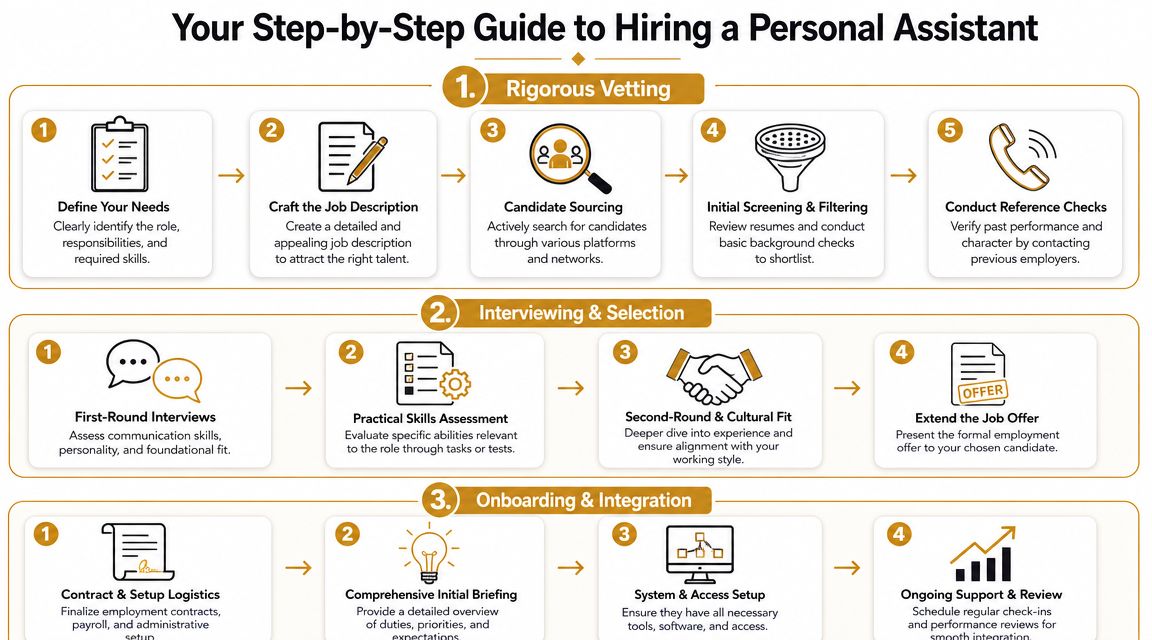
Stage one, vetting before familiarity sets in
The first pass should be methodical. Charm is pleasant. Evidence matters more.
Start by confirming the basics and then go beyond them:
- Identity and right-to-work checks: Complete these early and keep records in order.
- Reference verification: Speak with former employers directly whenever possible. A written reference on its own tells you very little.
- Career timeline review: Check for unexplained gaps, job title inflation, and repeated short tenures without context.
- Background screening: Match the screening level to the role. A PA with access to children, residences, financial information, or travel arrangements requires closer scrutiny than a light-touch admin post.
- Skills testing: Test the work they will do. If the role includes multi-stop travel, gatekeeper duties, household coordination, or event support, use scenarios that reflect that.
A clear brief makes this stage easier and fairer. Clients who need a stronger framework before they meet candidates can review this guide on hiring a personal assistant for private individuals.
One practical point from agency work. The safest candidate is often not the most charismatic interviewer. It is the person whose references, chronology, judgement, and work sample all tell the same story.
Stage two, interview for judgement
A good PA interview is a working conversation, not a chemistry test. Rapport matters, but judgement carries the placement.
Use questions that force the candidate to explain decisions:
- Tell me about a time the same principal gave you two urgent priorities. How did you decide what moved first?
- What do you need in the first week of a role to avoid preventable mistakes?
- If you spotted a recurring issue in my schedule or household routine, how would you raise it?
- How do you protect confidential information when other staff, family members, or suppliers are nearby?
- Which tasks should always be documented rather than held in memory?
Listen carefully to how they answer. Strong candidates talk about systems, escalation points, written confirmation, and risk control. Weaker candidates rely on broad claims such as being organised or good with people, without explaining what they do.
A short task is often more revealing than a second interview. Ask the candidate to reorder a clashing diary, build a travel outline from incomplete information, or draft a supplier email with clear instructions. In five to ten minutes, you can usually see whether they think in a structured way or whether they improvise and hope for the best.
Stage three, offer, contract, and onboarding
Many disappointing hires do not fail at selection. They fail at the start.
Once you have chosen your candidate, set the role up properly. The contract should state role scope, reporting lines, hours, location, travel expectations, confidentiality obligations, holiday rules, notice terms, expense approvals, and how devices, passwords, and data will be handled. In the UK, this part also needs to line up with employment status, payroll, pension duties where applicable, and data handling practices. Those points are easy to overlook if you have not employed private staff before.
Then make the first month usable. Give your PA one reliable source for calendars, contacts, property preferences, children's routines if relevant, supplier details, and any standing approvals. Be explicit about what they can action alone and what still needs sign-off.
Experienced assistants adapt quickly. Even so, no one can infer a household's standards by instinct. Clear onboarding is not hand-holding. It is what allows a capable hire to become dependable fast.
Finding Your Perfect Partner in Productivity
Hiring a PA is rarely about delegating random tasks. It's about rebuilding capacity. The right hire gives structure to your week, consistency to your household operations, and breathing room where everything currently feels reactive.
The essentials are straightforward. Define the role accurately. Budget for the actual cost, not just the headline pay. Vet thoroughly. Interview for judgement. Onboard with clarity. When those pieces are handled well, the search becomes far less daunting and the outcome far more durable.
For families and private principals who want discreet guidance through the process, Superstar Nannies can advise on role definition and private household staffing searches across London, New York, Miami, and other major international locations.
Frequently Asked Questions
What's the difference between a PA and a household manager
A PA usually focuses on personal administration, scheduling, logistics, travel, correspondence, and day-to-day coordination. A household manager typically has broader operational oversight of the home itself, including staff coordination, suppliers, maintenance, systems, and service standards. Some homes need both. Others need a hybrid role with clear priorities.
Can I hire a PA part-time
Yes, if the workload is contained and the tasks can be grouped efficiently. Part-time arrangements work well for diary management, family administration, supplier coordination, and lighter lifestyle support. They tend to fail when the principal expects full-time responsiveness from limited hours. The role has to match the availability.
Should a personal assistant work in person or remotely
That depends on the task mix. Remote support can work well for inboxes, scheduling, bookings, research, and administrative follow-up. In-person support becomes more valuable when the role involves household access, physical errands, vendors, family routines, events, or property oversight. Many successful arrangements use a blended model.
How long does it take to hire a good PA
It varies by brief quality, market conditions, and how specialised the role is. A clear job scope, realistic budget, and decisive interview process will shorten the timeline. Delays usually come from vague expectations, shifting responsibilities, or waiting too long between stages and losing strong candidates.
What should I prioritise in a first hire
Prioritise trustworthiness, discretion, organisational judgement, and evidence of stable performance in similar environments. Technical tools can be taught more easily than temperament. If the person will work close to your home, family, or sensitive information, character and consistency matter at least as much as efficiency.
If you're exploring personal assistants for hire and want discreet, role-specific guidance, Superstar Nannies can help you define the brief, assess the right support model, and guide you through a private staffing search with care.