


The baby is due soon, or perhaps already here. Your household is running at full speed, your phone hasn't stopped, and everyone keeps asking whether you need a maternity nurse, a night nanny, or something called a newborn care specialist.
My advice is simple. If you want calm, order, and expert hands-on support in the earliest weeks, hire a newborn care specialist. Done properly, this isn't indulgence. It's a disciplined decision that protects parental recovery, supports feeding and sleep, and gives your baby a steady start.
The right professional doesn't just hold a baby well. They stabilise the home. They teach. They observe patterns. They help parents make sound decisions without drama or overreach. If you're preparing now, start with practical planning around the nursery, household flow, and the first week home. A straightforward preparation guide like how to prepare for a newborn is useful, and a sensible overview of newborn care essentials can help you separate true essentials from unnecessary purchases.
Introduction Welcoming Your Expert Postnatal Partner
A newborn changes the rhythm of a household immediately. In private homes, that pressure is often sharper, not softer. There may be travel to manage, older children, security protocols, multiple residences, staff to coordinate, and very little appetite for trial and error.
That's why I'm direct about this role. A newborn care specialist is there to support the whole family unit, not only the baby. The best ones bring competence, composure, and structure to a period that can otherwise feel fragmented.
What the role is really for
A strong newborn care specialist does three things exceptionally well:
- Supports parental recovery: They reduce avoidable exhaustion by taking over appropriate baby care tasks with consistency and skill.
- Builds confidence: They teach parents how to read cues, manage feeds, settle the baby, and respond calmly.
- Creates stability: They bring order to nights, logs, routines, nursery organisation, and handovers with other household staff.
Practical rule: Hire for steadiness and judgement, not just warmth. Warmth matters. Judgement matters more at 3 am.
For discerning families, the value is obvious. You are not buying someone to “help out”. You are appointing a short-term postnatal professional who can enter a private environment, respect boundaries, and improve the lived experience of the first months.
Defining the Modern Newborn Care Specialist
A newborn care specialist in the UK should be understood clearly. This is a short-term, high-skill postnatal support role focused on feeding support, sleep routines, soothing, and parent education. Clinical assessment and treatment remain with midwives, health visitors, GPs, or paediatric clinicians, as outlined in this guidance on the role and responsibilities of a newborn care specialist.

What they do well
At their best, newborn care specialists are highly organised non-clinical experts in the practical realities of newborn life. That usually includes:
- Feeding support: Bottle feeding, breastfeeding support within non-clinical limits, winding, cleaning and preparing feeding equipment, and keeping accurate logs.
- Sleep shaping: Not rigid sleep training. Sensible rhythm-building, cue reading, swaddling where appropriate, settling, and safe sleep habits.
- Soothing and regulation: Helping babies transition between feeding, wakefulness, and sleep without overstimulation.
- Parent education: Explaining what's normal, what needs watching, and when to escalate to a clinician.
What they must not do
Many families often get confused, especially if they search for a “night nurse”. A newborn care specialist is not a doctor, midwife, or nurse by default. They should not diagnose, prescribe, or present non-clinical opinion as medical fact.
That boundary matters. In an excellent placement, the specialist knows exactly when a concern belongs inside the home and when it belongs with an NHS professional.
| Role question | Newborn care specialist |
|---|---|
| Medical practitioner | No |
| Focus | Baby care, routines, support, education |
| Timeframe | Short-term postnatal period |
| Main value | Skilled practical support inside the home |
The right specialist makes parents feel more capable, not more dependent.
Distinguishing Between Postnatal Support Roles
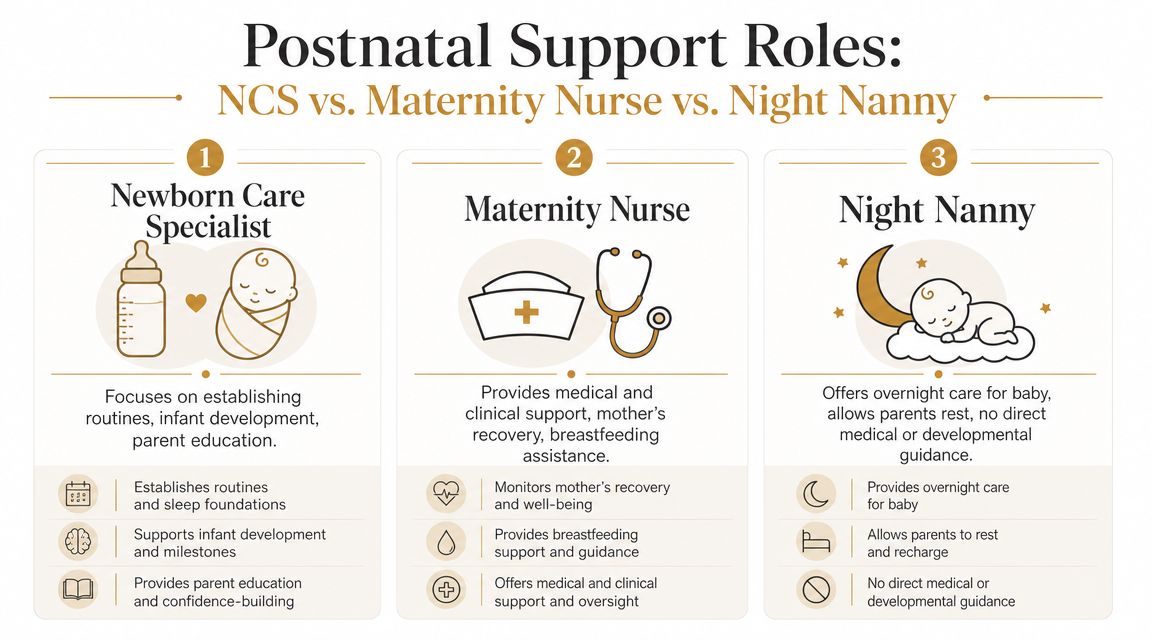
Families often use three titles interchangeably: newborn care specialist, maternity nurse, and night nanny. That's a mistake. If you hire the wrong category, you'll either overpay for skills you don't need or under-hire for the complexity of your household.
How these roles differ in practice
A newborn care specialist is usually the right choice when the brief is household-based infant support, structured nights, feeding guidance, calm routine-building, and parent education.
A maternity nurse may suit a family using traditional terminology, but the market uses that title inconsistently. Some candidates have excellent newborn experience. Some rely on the label without the standards. Always assess the actual background, not the title.
A night nanny is narrower. This role is often centred on overnight baby care so the parents can sleep. That may be enough in a straightforward home, but it often falls short in households that want logs, routine guidance, handover discipline, and broader postnatal support.
A realistic household example
Consider a family returning from hospital to a London residence with a housekeeper, a driver, and security already in place. The mother wants breastfeeding protected. The father is on calls within days. There's an older child with a fixed school routine.
An experienced newborn care specialist can slot into that environment fast. She arrives for the evening handover, checks bottles or pump parts, reviews the nursery setup, tracks feeds, handles nappy changes and settling overnight, wakes the breastfeeding parent only when needed, then returns the baby to sleep and records the night properly. By morning, the kitchen isn't chaotic, the nursery is reset, and the day staff know exactly what happened overnight.
That's a different level of service from ad hoc babysitting.
For families weighing titles carefully, this comparison of maternity nurse vs nanny for newborn support is a useful starting point.
Quick comparison
- Choose a newborn care specialist if you want skilled newborn support with clear non-clinical boundaries.
- Choose carefully with maternity nurse candidates because the title alone tells you very little.
- Choose a night nanny only if your priority is basic overnight cover rather than a broader postnatal plan.
Core Services and Typical Engagement Structures
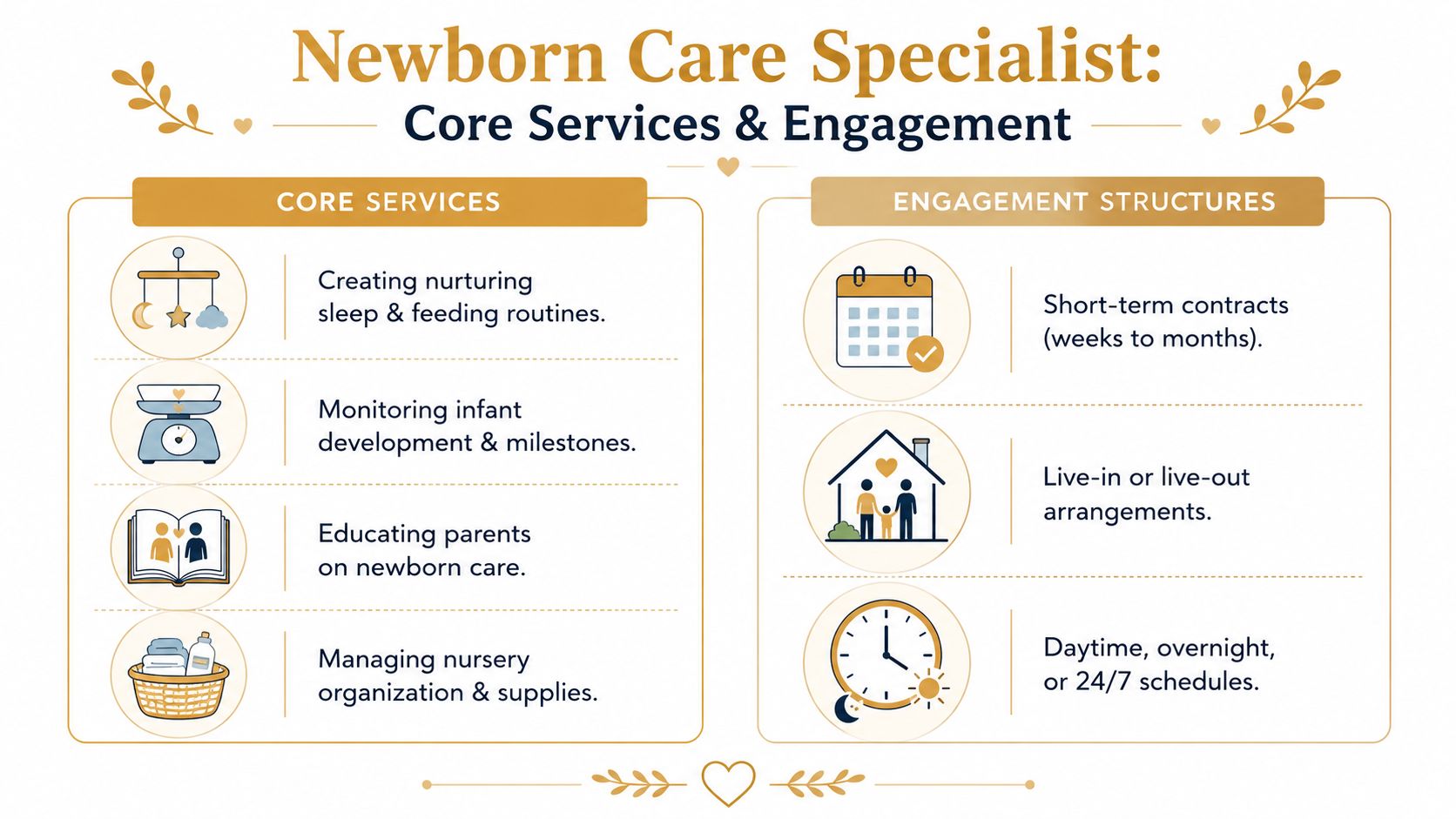
In a well-run placement, the newborn care specialist becomes part of the household rhythm quickly. The role is practical, detailed, and structured. In UK households, placements are typically overnight or 24/7, often starting immediately after birth and usually lasting about 8 weeks to 3–4 months, according to this benchmark on typical newborn-care placements.
Core responsibilities inside the home
A serious professional usually covers a mix of the following:
- Nursery management: Keeping the baby's space organised, stocked, clean, and ready for each handover.
- Feeding flow: Supporting bottle prep, sterilising equipment, maintaining feeding records, and preserving breastfeeding routines where relevant.
- Infant care: Nappy changes, bathing, dressing, soothing, settling, swaddling where appropriate, and calm overnight care.
- Documentation: Daily logs, pattern tracking, handover notes, and observations that help parents and clinicians when needed.
- Parent guidance: Gentle coaching on cues, routines, safe sleep, and practical newborn handling.
Engagement models that actually work
For elite households, standard vetting is not enough, and standard scheduling often isn't either. You need a structure that fits the way your home runs.
Common arrangements include:
| Engagement type | Best for |
|---|---|
| Overnight support | Parents who want uninterrupted recovery and managed nights |
| 24-hour cover | Homes needing seamless care and full routine establishment |
| Rota support | Families requiring continuity across extended days or multiple staff |
| Daytime support | Parents who want coaching and hands-on help while remaining closely involved |
If your home is staffed, choose someone who can work with your existing team without creating friction or confusion.
I strongly advise families to think beyond “Can she do nights?” Ask whether she can operate discreetly around chefs, housekeepers, PAs, drivers, and security. Ask whether she knows how to respect private family space. Ask whether she can read a room, not just a baby.
In this tier of household, emotional intelligence is not optional. It is part of the job.
The Vetting Standard for an Elite Newborn Care Specialist
Basic compliance is only the floor. It isn't the standard. A candidate may have infant care training, references, and a presentable CV, yet still be unsuitable for a private household with profile, staff, travel, and confidentiality concerns.

UK demand for this support is shaped by parental leave patterns, maternal age, and sleep-deprivation risk. Guidance on the profession notes that the median age of mothers is in the early 30s, and for many families specialist night support is less about luxury and more about stabilising feeding routines and parental recovery during a vulnerable period, as discussed in this overview of education requirements for newborn care specialists.
What elite vetting should include
For a UHNW or high-profile household, I would insist on five filters.
- Discretion with evidence: Not vague claims about being private. You want proof of work in confidential environments and references that confirm trustworthiness.
- Household fluency: Experience working alongside staff, understanding chain of command, handover etiquette, and respect for principal privacy.
- Temperament under pressure: A calm manner at night, good judgement when parents are exhausted, and no appetite for drama.
- Boundary awareness: Confidence in the role without pretending to be clinical.
- Verifiable consistency: References should speak to punctuality, reliability, communication, and behaviour inside the home.
Contracts matter as much as chemistry
Families often spend too much time on personality and too little on terms. That's backwards. A warm candidate with a weak contract is a risk.
Your contract should cover:
- Confidentiality: A robust NDA and clear privacy expectations around names, addresses, routines, travel, photographs, and conversations.
- Duties: Exact scope, including nursery tasks, logs, feeding support, and whether travel is included.
- Schedule: Start date, overnight hours or rota pattern, rest periods, and accommodation if live-in.
- Professional boundaries: Clear language on escalation to medical professionals and the limits of non-clinical support.
- Termination terms: Notice periods, immediate termination triggers, and conduct expectations.
For families who want a benchmark for screening standards, this guide to the nanny vetting process for discerning families is a useful reference.
Privacy isn't protected by assumption. It's protected by process.
I'd also say this plainly. If a candidate talks too freely in interview about former employers, don't hire her.
Navigating Contracts Costs and Interview Questions
Many articles become vague at the point that matters most. They say “ask about experience” and “make sure you have a contract”. That isn't enough. You need to know how a candidate thinks, how she handles pressure, and whether she understands the legal and professional limits of the role.
A key hiring issue is scope. A newborn care specialist is not a medical professional and cannot diagnose conditions or prescribe medication. Interview questions should test whether the candidate knows how to escalate concerns to UK clinical support such as NHS midwives or health visitors, rather than acting as a substitute, as noted in this guidance on newborn care specialists and their importance.
Interview questions worth asking
Use questions that force clear answers.
“If a baby seems increasingly jaundiced, what do you do?”
You want a structured answer that stays within non-clinical boundaries and escalates promptly.“How do you support breastfeeding without taking over the process?”
Good candidates understand support, timing, positioning help, equipment prep, and careful observation.“Tell me about a household with several staff members. How did you manage communication?”
This tests diplomacy, hierarchy awareness, and professionalism.“What would you log overnight, and how would you hand that over in the morning?”
Strong candidates are specific and organised.“How do you handle parents who are exhausted and disagreeing at night?”
You are testing calm judgement and emotional intelligence.
For families hiring in private environments, this guide on how to interview a nanny for a high-net-worth family contains useful screening ideas that also apply to newborn specialists.
Red flags I wouldn't ignore
- Overstepping medically: Any candidate who casually suggests diagnosing reflux, tongue-tie, or other conditions is a concern.
- Poor confidentiality instincts: If she shares too much about former homes, she'll share too much about yours.
- Rigid ideology: Newborn care requires judgement. Extreme views on feeding, sleep, or parental roles rarely work well.
- Weak paperwork habits: If she dislikes logs, handovers, or clear boundaries, expect disorder.
On costs and engagement terms
Rates vary widely by experience, schedule, travel expectations, and the complexity of the household, so I won't pretend there is one universal figure. There isn't. What matters more is value alignment.
Pay for proven judgement, relevant household experience, and discretion. Put every term in writing. If you are arranging overnight or 24-hour support, define the pattern precisely. If travel is possible, include it now, not later. If privacy matters, your NDA should reflect your household's situation, not a generic template downloaded in haste.
Conclusion Your Partner for a Peaceful Beginning
The right newborn care specialist brings far more than extra hands. They bring structure, reassurance, and professional discipline to the most delicate period of family life. That only works when the role is understood properly, the boundaries are respected, and the vetting is exacting.
For elite households, the difference is rarely found in job titles alone. It sits in discretion, judgement, household fluency, and the ability to support parents without overstepping into clinical territory.
If you want your first months with a new baby to feel calmer, more private, and more competently managed, treat this hire with the seriousness it deserves. A careful search now prevents avoidable stress later.
Frequently Asked Questions
When should I book a newborn care specialist
Book as early as you can once you know you want professional postnatal support. The strongest candidates are usually secured in advance, especially for immediate post-birth starts, overnight placements, and households with complex scheduling or travel expectations.
How does a newborn care specialist fit alongside NHS support
They complement, not replace, NHS care. The UK already has a substantial public framework for early support, and families often use private help because NHS contact is necessarily time-bound. In England, the health visiting service delivered about 6.5 million contacts in 2019/20, including around 784,000 contacts for babies aged 0–12 months, according to this summary of the Healthy Child Programme and health visiting support.
Is this service only relevant for a small number of families
No. The need is broader than many people assume. The Office for National Statistics recorded 615,557 live births in England and Wales in 2023, and the total fertility rate was 1.44 children per woman, as reported in this overview of UK live births and postnatal service context. The role exists because many families want more extended hands-on support in the first 3–4 months than the public system can routinely provide.
Can a newborn care specialist help with twins or more complex newborn situations
Yes, many can support multiples and more demanding postnatal setups, provided the brief is clear and the candidate has relevant experience. If a baby has premature or complex medical needs, make sure the professional's experience matches that reality and keep clinical care with the appropriate medical team.
What's the single most important thing to check in interview
Check judgement. Training matters, references matter, and presentation matters. But judgement is what protects your baby, your privacy, and the tone of your home.
If you want discreet, carefully vetted postnatal support, contact Superstar Nannies for a confidential consultation. We'll help you define the brief, assess the right type of newborn support for your household, and identify candidates who understand privacy, professionalism, and the level of care your family expects.