


Your Palm Beach house is staffed, your calendar is split across residences, and the children's routine now involves tutors, travel, security protocols, and shifting handovers. At that point, a standard nanny usually stops being enough.
An estate nanny in Palm Beach is a different hire entirely. You're not filling a childcare gap. You're appointing a trusted professional who can protect routine, manage complexity, and operate smoothly inside a private household where mistakes become very visible, very quickly. If you're hiring for a family office style household with multiple moving parts, the role has to be designed properly from the start.
Most hiring problems in this market aren't caused by a lack of candidates. They're caused by vague briefs, muddled reporting lines, and families trying to combine three jobs into one. That's fixable. Start with a clear role, benchmark the package intelligently, and use a process built for discretion and longevity. If you need local market support, Palm Beach nanny agency services can help structure the search around estate-level expectations rather than ordinary placement standards.
Your Guide to Hiring an Estate Nanny in Palm Beach
A family might begin with a straightforward nanny search and realise halfway through interviews that their real need is far broader. The children split time between Palm Beach and another residence. One child has tutoring. Another travels with the principals during parts of the season. Household staff need clean communication. Security wants travel schedules confirmed properly. Suddenly, “warm and experienced” is nowhere near enough.
That's the point at which the estate model makes sense. An estate nanny Palm Beach search should be treated as a strategic household hire, not a casual parenting decision. The person you bring in will affect the children's consistency, the staff dynamic, and the daily stress level inside the home.
When a normal nanny brief stops working
A conventional nanny brief usually focuses on age range, nursery duties, school collections, and developmental support. An estate brief needs more.
You likely need someone who can:
- Run children's logistics across properties without constant principal oversight
- Coordinate professionally with tutors, chefs, housekeepers, drivers, and assistants
- Travel well and adapt to changing routines without becoming chaotic
- Maintain discretion in a household where privacy matters as much as competence
If the role includes multiple residences, seasonal movement, and integration with senior household staff, hire for estate capability first and nursery skills second.
The real hiring challenge
The challenge isn't finding someone who loves children. Many candidates do. The challenge is finding someone who can do elite childcare in a high-structure environment without friction, ego, or confidentiality concerns.
That means the role must be defined with unusual precision. If you skip that step, the market will punish you with poor fit, quick turnover, and endless renegotiation after the nanny starts.
Defining the Modern Estate Nanny Role
An estate nanny is not a standard nanny with a more glamorous title. It's a hybrid role with childcare at the centre and estate-level coordination around it. That distinction matters because families often confuse this hire with a governess, house manager, or travelling nanny and then wonder why the placement feels off.
Core distinction: an estate nanny's primary responsibility is still the child, but the job is performed inside a more complex operating environment that demands logistical discipline, inter-staff judgement, and complete confidentiality.
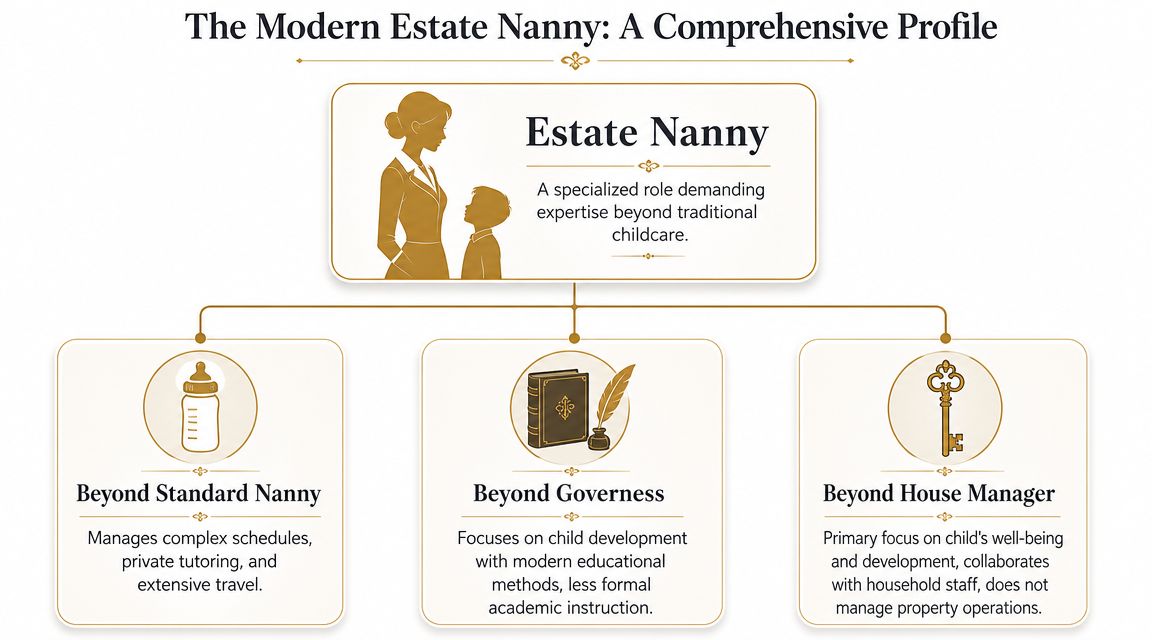
What separates this role from other private staffing positions
A governess leans further into education. A house manager oversees household operations. A standard nanny may be excellent with children but not equipped for the pace and complexity of a fully staffed residence.
An estate nanny sits in the middle of those worlds. The role often includes:
- Schedule control for school, activities, tutoring, therapies, and travel transitions
- Travel readiness including packing children efficiently, managing in-transit routines, and maintaining continuity abroad
- Staff coordination so the chef knows meal needs, the driver has accurate timings, and the housekeeper understands nursery priorities
- Behavioural steadiness because children in high-profile households often react to travel, pressurised schedules, and changing environments
- Confidential conduct in homes where vendors, guests, and staff all need boundaries
If your property team uses digital systems to manage access, guest flow, or service coordination, tools such as remote access control for property managers can help reduce confusion around who enters what space and when. That matters when childcare routines intersect with estate operations.
The competencies that actually matter
Families often overvalue polish and undervalue systems thinking. That's a mistake. For this role, I'd prioritise the following:
- Logistical mastery. Can the nanny keep children's routines stable across different homes and travel schedules?
- Inter-staff diplomacy. Can they work well with senior domestic staff without creating territorial tension?
- Judgement under pressure. Can they solve problems discreetly, without escalating everything to the principals?
- Absolute confidentiality. Not performative discretion. Real discretion.
- Child-centred focus. However complex the estate becomes, the nanny can't drift into becoming an assistant with a nursery add-on.
For families seeking this exact calibre of role definition, high-end nanny services in Palm Beach are usually a better fit than general childcare recruitment.
Benchmarking Compensation in the Palm Beach Market
Families often ask for a single market number. That's the wrong question. The right question is what package will secure the level of judgement, flexibility, and discretion your household requires.
For UK-based decision makers, London is a useful benchmark. A 2025 to 2026 salary guide notes that professional nannies in London typically earn £40,000 to £60,000 per year, while premium or specialist placements can exceed £60,000 annually, particularly in staffed households and roles requiring specialised experience, rota schedules, bilingual skills, or newborn expertise, according to this London and premium nanny salary benchmark. That's relevant because it reflects the wider professionalisation of domestic childcare. Estate-level hires command a premium when the scope is specialist.
Don't price this role like ordinary childcare
If the role involves confidentiality, travel, rota cover, or coordination across properties, treat compensation as a package, not just a salary line. Families get into trouble when they compare an estate nanny to a standard day nanny and assume the difference is cosmetic.
The package should account for:
- Base childcare scope
- On-call or overnight expectations
- Travel days and away-from-home disruption
- Accommodation, if live-in
- Overtime policy
- Specialist skills, such as bilingual support, newborn knowledge, tutoring support, or special educational needs experience
The fastest way to lose a strong candidate is to offer a premium title with a standard nanny package.
Palm Beach nanny compensation tiers
The table below is a planning framework, not a statement of verified market-wide US salary data. Use it to shape discussions with counsel, payroll providers, and your recruiter.
| Role | Typical Duties | Estimated Annual Salary (USD) | Common Benefits |
|---|---|---|---|
| Standard full-time nanny | Childcare, routine support, nursery duties | Varies by experience and scope | Paid holiday, sick pay, guaranteed hours |
| Travelling nanny | Childcare plus regular travel support and packing | Higher than standard roles | Travel pay, private accommodation when travelling, itinerary planning support |
| Rota nanny | Shared coverage, handovers, schedule continuity | Premium package expected | Structured rota, handover time, recovery periods |
| Estate nanny | Childcare across residences, staff coordination, logistics, discretion | Premium package expected | Accommodation if relevant, travel compensation, confidentiality clauses, clear overtime terms |
| Specialist estate nanny | Estate role plus newborn, bilingual, SEN, or tutoring support | Top end of premium package range | Enhanced package, travel coverage, private space, review structure |
For broader package planning, this private staff salary guide for 2026 is a useful starting point.
What actually commands a premium
Three things raise compensation quickly.
First, complexity. Multi-property coverage is more demanding than one well-run primary home.
Second, availability structure. Rota work, overnight support, and travel-heavy schedules narrow the candidate pool.
Third, risk profile. If the nanny must operate around principals, guests, security teams, and sensitive household information, you are buying discretion as much as childcare.
A Rigorous Vetting Process for Ultimate Peace of Mind
Informal hiring channels are fine for ordinary roles. They're not fine for a Palm Beach estate hire. When someone will know your children's routines, enter private spaces, travel with the family, and work alongside other trusted staff, a casual referral is not due diligence.
That's why I strongly favour an agency-led, multi-stage process. Not because agencies are automatically superior, but because this role needs documentation, structured reference checking, and scrutiny that most families won't have the time or distance to handle properly themselves.
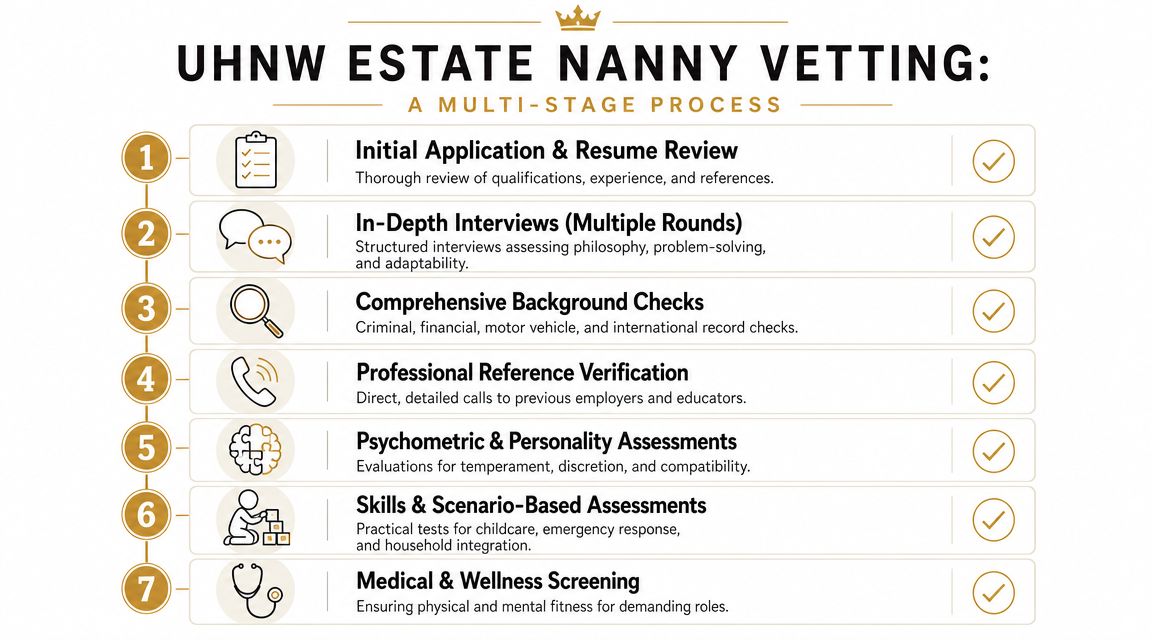
The checks I consider non-negotiable
A polished CV proves almost nothing. What matters is whether the candidate's history stands up under pressure.
Your process should include:
- Document verification. Identity, eligibility to work, and certifications should be checked formally.
- Detailed reference calls. Not just confirmation of dates. Ask about discretion, adaptability, boundaries, and behaviour in high-pressure households.
- Employment chronology review. Gaps aren't necessarily a problem. Unclear explanations are.
- Driving and travel suitability. If the role involves children in cars or frequent movement, this cannot be assumed.
- Safeguarding review. Paediatric first aid, child safety judgement, and previous incident handling should be explored carefully.
- Digital footprint assessment. Social media habits matter in private homes.
- Scenario testing. Give candidates realistic situations involving travel delays, rota handovers, illness, or conflicting instructions from staff.
What references should actually reveal
Weak reference calls produce vague praise. Strong ones reveal patterns.
Ask former employers questions such as:
- Did the nanny stay calm when plans changed unexpectedly?
- How did they communicate with other staff?
- Did they respect privacy instinctively, or only when reminded?
- Would you trust them on an international trip with children again?
- What type of household would suit them least?
A candidate can be excellent and still be wrong for your household. Vetting is about fit, not just clearance.
If you want a benchmark for what a formal screening process should look like, this guide to the nanny vetting process for discerning families gives a useful framework. Superstar Nannies also handles nanny and household staffing searches with structured screening for private family environments.
Why families regret shortcutting this stage
They hire charisma. They miss rigidity, poor boundaries, weak staff chemistry, or overconfidence around children. Then they're renegotiating expectations within weeks.
A disciplined process feels slower at the start. It's usually faster than replacing the wrong person.
Crafting a Compliant Contract for Your Estate Nanny
A strong contract prevents most of the conflict families later call “misunderstanding”. In reality, the problem is usually poor drafting. If you want this hire to last, the role has to be documented with unusual clarity.
For families hiring from the UK, compliance discipline matters early. UK domestic worker guidance requires written terms and clear pay records, and one of the biggest risks is role creep, where nanny duties gradually expand into household management without the contract being updated, creating disputes over hours, pay, and accommodation, as explained in this guidance on hiring a nanny with compliance in mind.
Clauses I would insist on
A serious estate nanny agreement should spell out the role in practical language, not vague lifestyle language.
Include:
- Duties. Separate childcare tasks from estate support. If you want travel prep, vendor coordination, or liaison with tutors, write it down.
- Hours and availability. Define working time, passive presence, sleep arrangements if live-in, and what counts as on-call duty.
- Travel terms. Set expectations for domestic and international travel, rest time, itinerary changes, and privacy while away.
- Confidentiality. A proper NDA should sit alongside the employment contract, not replace clear conduct expectations.
- Accommodation rules. If the role is live-in, document private space, guest rules, use of household facilities, and boundaries around off-duty time.
- Transport and property use. Set out whether the nanny may use family vehicles, staff entrances, guest houses, or staff dining spaces.
- Review and revision mechanism. If the role changes, the contract must change with it.
The issue families underestimate
Most disputes don't begin with salary. They begin when a family says, “Can you also handle this?” enough times that the nanny's job becomes unrecognisable.
Practical rule: if a task supports estate operations more than direct childcare, decide whether it belongs in the nanny contract or another staff member's remit.
Keep the contract aligned with the household chart
The nanny needs one reporting line. In some homes that's a principal. In others it's a chief of staff, estate manager, or family assistant. Ambiguity creates friction fast. If the nanny receives conflicting instructions from three adults, the contract won't save the relationship unless authority was clear from day one.
Ensuring Long-Term Success and Retention
Families love to talk about finding the right person. The harder task is keeping them. In this market, retention depends less on image and more on whether the job is sustainable.
A high-end placement source notes that elite households often lose talent when working conditions are poor, and that stable rotas, clear confidentiality rules, and protected sleep and recovery time matter significantly for long-term retention, according to this discussion of retention in high-end nanny placements. I agree with that completely. In practice, those three issues predict longevity better than expensive perks.

Build a role someone can stay in
An estate nanny doesn't leave only because another family offers more money. They leave because the job becomes chaotic, intrusive, or professionally disrespectful.
Focus on these operational habits:
- Stable handovers. If you use rota coverage, insist on clean written updates and realistic transitions.
- Defined communication. Decide who can issue instructions and how last-minute changes are conveyed.
- Protected downtime. Off-duty means off-duty. If the nanny is constantly interrupted, recovery disappears.
- Private space. In live-in roles, this is not a luxury. It is basic professional respect.
- Seasonal planning. If Palm Beach is only part of the annual rhythm, discuss movement between residences well in advance.
Onboarding matters more than families think
The first month should be highly structured. Introduce the nanny formally to key staff. Clarify household etiquette. Explain how the principals like to receive updates. Confirm emergency procedures, gate access, approved drivers, children's routines, allergies, schooling details, and guest protocols.
Then hold regular reviews early. Not stiff corporate appraisals. Useful conversations.
Try a rhythm like this:
- Week one check-in for practical issues and access gaps
- Early month review for routines, staff integration, and child adjustment
- Quarterly conversation on performance, travel planning, and evolving needs
Children settle faster when the adults around them stop improvising.
Respect is the retention strategy
Good nannies stay where they are treated as professionals. That means clear boundaries, prompt payroll, consistent expectations, and sensible scheduling. A household can be demanding without being draining. The families who understand that keep excellent staff for far longer.
Frequently Asked Questions About Hiring an Estate Nanny
Should I hire a nanny, rota nanny, or estate nanny for Palm Beach?
Choose based on operating complexity, not status. If the children live mainly in one residence with predictable schedules, a traditional nanny may be enough. If you need coverage across multiple homes, heavy travel, staff coordination, and smooth handovers, you need an estate nanny or a rota structure. Don't upgrade the title without upgrading the remit and package.
How should UK families handle a UK-based nanny working internationally?
This gets complicated quickly. A common issue for UHNW families is that a UK-based nanny may still trigger UK employer responsibilities around PAYE, National Insurance, and right-to-work checks, while cross-border travel can affect payroll treatment, visa position, and employment rights depending on where the work is performed, as outlined in this overview of international nanny employment issues for UK families. Get legal and payroll advice before the role starts, not after the first travel schedule is booked.
Is it better to hire directly or through an agency?
For a simple local role, direct hiring can work. For an estate role, I'd usually choose a specialist agency or retained recruiter. The gain isn't convenience alone. It's process quality. You need structured briefing, controlled candidate flow, formal references, and better filtration around discretion and household fit. Estate hires fail when families are forced to judge highly polished candidates without enough background.
What is the biggest contract mistake families make?
They let the role drift. The nanny starts with childcare, then gradually absorbs diary support, procurement, travel administration, pet coverage, and staff liaison without a formal rewrite of duties or compensation. That creates resentment and legal risk. Review the contract whenever the household structure changes.
What keeps an estate nanny in place long term?
Stability. The strongest candidates want a household that is organised, respectful, and clear. If the rota is predictable, confidentiality rules are sensible, reporting lines are clean, and the children's routine is protected, retention becomes much easier. If the family is generous but chaotic, turnover stays high.
If you're planning an estate nanny Palm Beach hire and want help defining the role, vetting candidates, and structuring a package that fits a multi-property lifestyle, contact Superstar Nannies for a confidential consultation.