


A familiar Palm Beach problem starts subtly. The children's calendar becomes more complex, one parent is travelling more often, the household has additional staff to coordinate, and the person who once covered after-school care is no longer enough for the standard you need at home.
At that point, most families aren't looking for a babysitter. They're looking for structure, judgement, discretion, and continuity. That's what high-end nanny services Palm Beach families usually need when life becomes logistically demanding and privacy matters as much as childcare itself.
The difficulty is that the premium market often looks polished from the outside while hiding major differences in process. One candidate may be warm but not operationally strong. Another may have an excellent CV but no real experience working inside a staffed residence. A third may interview well yet struggle with travel, confidentiality, or handovers with a house manager and chef. Good outcomes rarely come from instinct alone. They come from a careful brief, disciplined vetting, and a proper integration plan.
Your Guide to Finding Elite Childcare in Palm Beach
A Palm Beach family often reaches this stage after a noticeable shift in household pressure. School pickups turn into driver coordination. One child needs academic structure while another needs calm, developmentally tuned care. Parents want flexibility for travel, but they also want boundaries, professionalism, and someone who can move confidently within a private home.
That's where high-end nanny services Palm Beach families rely on start to differ from ordinary hiring. The role is no longer just about covering hours. It's about placing the right professional into a home where standards are high, routines are layered, and poor hiring decisions become expensive very quickly.
What changes when the role is high stakes
In a premium household, the nanny may need to do more than manage play, meals, and bedtime. They may need to:
- Work alongside existing staff such as a house manager, chef, driver, or security team
- Handle changing schedules without losing consistency for the children
- Travel with ease while keeping routines intact
- Protect privacy in a socially visible environment
- Adapt their communication to both hands-on and highly delegated parenting styles
The best high-end placements don't feel improvised. They feel calm, clear, and well run from day one.
The families who hire well usually treat the search as a professional recruitment process. They define the brief carefully, budget realistically, vet thoroughly, and onboard the nanny as part of the household team rather than as a last-minute solution.
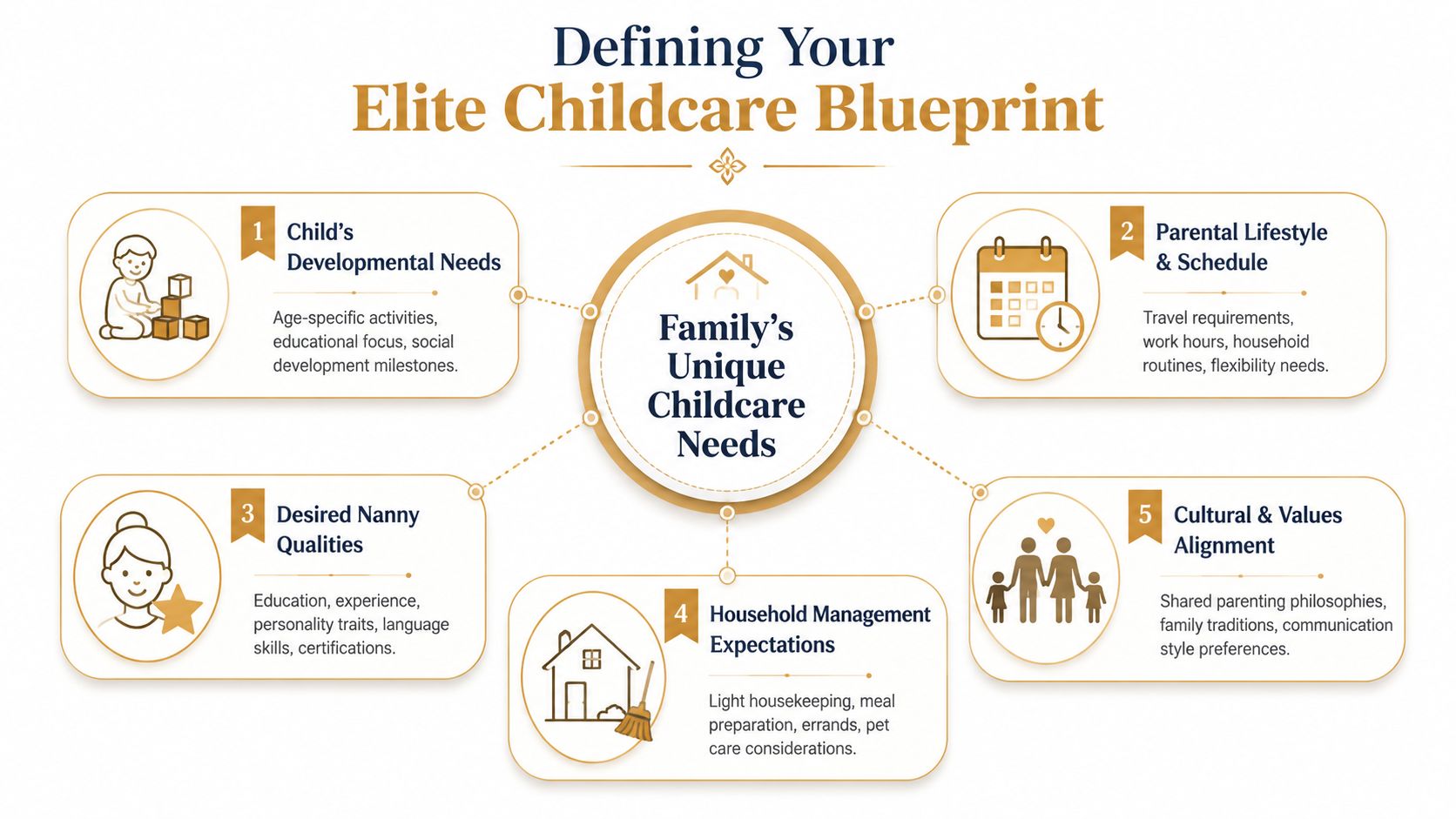
Defining Your Family's Unique Childcare Blueprint
A Palm Beach family calls after a difficult season. The children are cared for, but the days still feel disjointed. School bags are packed by one person, travel plans are handled by another, the house manager assumes the nanny will cover certain tasks, and the nanny assumes those tasks sit elsewhere. That kind of confusion usually starts before the search even begins, with a role brief that is too broad to support a precise hire.
The strongest placements start with a written operating brief. In practice, that means defining the job around your children, your household structure, and the points where mistakes would carry the highest cost.
Many families begin with “full-time nanny” as shorthand. It rarely stays that simple. A child starting formal school may need a nanny who can hold routines, coordinate school communication, and manage after-school decompression. A family rotating between Palm Beach, New York, and Europe may need someone who can pack intelligently, manage jet lag transitions, and work within established travel security protocols. In a fully staffed home, the better hire is often the candidate who understands reporting lines, respects existing staff roles, and communicates cleanly with a house manager or chief of staff.
Questions that sharpen the brief
Start with the children. Then define the environment in which the nanny will have to perform well every day.
- What does each child need right now? Emotional steadiness, developmental structure, school support, language exposure, newborn confidence, or calm behaviour management.
- What does the calendar look like? Fixed hours, late finishes, weekend coverage, seasonal moves, yacht time, or frequent travel.
- How independent should this person be? Some parents want active collaboration throughout the day. Others want a professional who can run the children's schedule, keep records, and escalate only when needed.
- Who else is in the household team? House manager, PA, chef, driver, tutor, security, or night staff. The nanny has to know where their remit starts and stops.
- What privacy standards apply? If the family is visible, the role may require NDAs, strict phone and photo rules, discretion around guests, and careful judgment in public settings.
- What cannot fail? Morning departures, medication routines, school handovers, travel day logistics, or communication with parents and senior staff.
Role clarity protects the hire.
It also affects which title fits. Some households need a nanny. Others need a rota nanny, nanny-governess, newborn care specialist, or temporary travel support. Those are different jobs with different candidate pools. Families comparing options often benefit from reviewing a private staff salary guide for UHNW families, because compensation and title tend to drift when the brief is unclear.
A written childcare blueprint should include daily duties, authority levels, communication rules, and travel expectations. I also advise families to document handovers with other staff, approval rules for purchases and outings, confidentiality requirements, and what happens when plans change at short notice. If international travel is part of the role, specify passport readiness, visa support, packing responsibility, child documentation procedures, and who manages schedule changes on the ground.
Practical rule: If the role cannot be explained clearly in writing, a serious candidate cannot assess it properly, and your agency cannot recruit for it with precision.
Budgeting for Premier Nanny Care in Palm Beach
Families often ask the wrong opening question. They ask, “What's the hourly rate?” when the better question is, “What compensation package will attract and keep the right person for this specific role?”
That distinction matters in the premium market. High-end nanny services Palm Beach families compare globally are shaped by the same forces seen in elite private staffing elsewhere. UK private household recruitment data suggests that experienced live-in nannies commonly sit in the high-£40k to £70k+ range, with rota, bilingual, Norland-trained, and travel-ready nannies commanding a premium, according to UK benchmark guidance for top-tier live-in nanny compensation. That doesn't create a direct Palm Beach salary rule, but it does clarify the level of investment serious families should expect when the brief is complex.
What actually drives compensation
A premium nanny package rises when the role includes one or more of the following:
- Rota coverage that requires sustained handovers and high stamina
- International travel with genuine operational responsibility
- Bilingual capability that the family values as part of upbringing
- Newborn or infant expertise where confidence and technical care matter
- Live-in structure with unusual hours or changing seasonal patterns
- Formal training pedigree such as Norland, which remains a recognised benchmark in the UK market, where Norland College was founded in 1892, as noted in this overview of premium nanny positioning and Norland's historic standing
Build the full budget, not just salary
Families should cost the role as a complete employment package. That usually includes:
| Budget item | What to think through |
|---|---|
| Base pay | Align pay with the real brief, not a simplified title |
| Schedule design | Decide whether hours, overnight support, and travel time are already built into the package |
| Benefits | Health support, paid leave, bonuses, and other retention tools |
| Household logistics | Vehicle use, accommodation if live-in, and role-related expenses |
| Professional longevity | Annual review structure and what progression looks like |
A weak budget usually produces one of two outcomes. Strong candidates decline early, or the family hires someone whose experience doesn't match the household.
For broader context on structuring premium offers, this private staff salary guide for UHNW families is a useful reference point when comparing childcare roles against wider household staffing.
Sourcing and Engaging Elite Nanny Candidates
Public job boards create visibility. They do not create quality control.
In high-stakes homes, the best candidates are often selective about where they appear, how their profile is presented, and which families they will consider. That's one reason specialist agencies remain central to premium placements. The value isn't just access. It's the combination of curation, discretion, and process discipline.
Why an agency process is different
Industry guidance for nanny-agency operations recommends tracking family satisfaction, on-time shifts, cancellations, incidents or complaints, turnover rate, cost per hire, nanny retention, and total billable hours, as outlined in agency operations guidance on placement KPIs and trust signals. That tells you something important. Serious agencies don't treat placement as a one-off introduction. They measure whether the match holds up in real life.
A specialist search also helps families avoid a common Palm Beach problem. A polished candidate can look ideal on paper yet be wrong for a formal household, a highly visible family, or children who need a more nuanced emotional approach.
What strong sourcing looks like in practice
A credible search tends to include:
- A narrow shortlist rather than a large pile of CVs
- Role-specific matching based on household style, not generic childcare experience
- Quiet outreach to candidates who may not be actively advertising
- Managed communication so confidentiality is protected early
- Clear presentation of the role including hours, expectations, travel, and reporting lines
When children need extra emotional support, sourcing should also reflect that. Families who are balancing transitions, school pressure, or anxiety-related behaviour may find it helpful to review practical strategies on cognitive support for child anxiety so the nanny brief includes the right temperament and communication style from the start.
For a closer look at what world-class sourcing should involve, this guide to elite nanny recruitment and candidate selection sets a strong benchmark.
The Rigorous Vetting Process for Your Peace of Mind
A premium placement is only as strong as its vetting. Charm is not a screening method. Neither is a polished CV, a recommendation forwarded by a friend, or a quick online check.
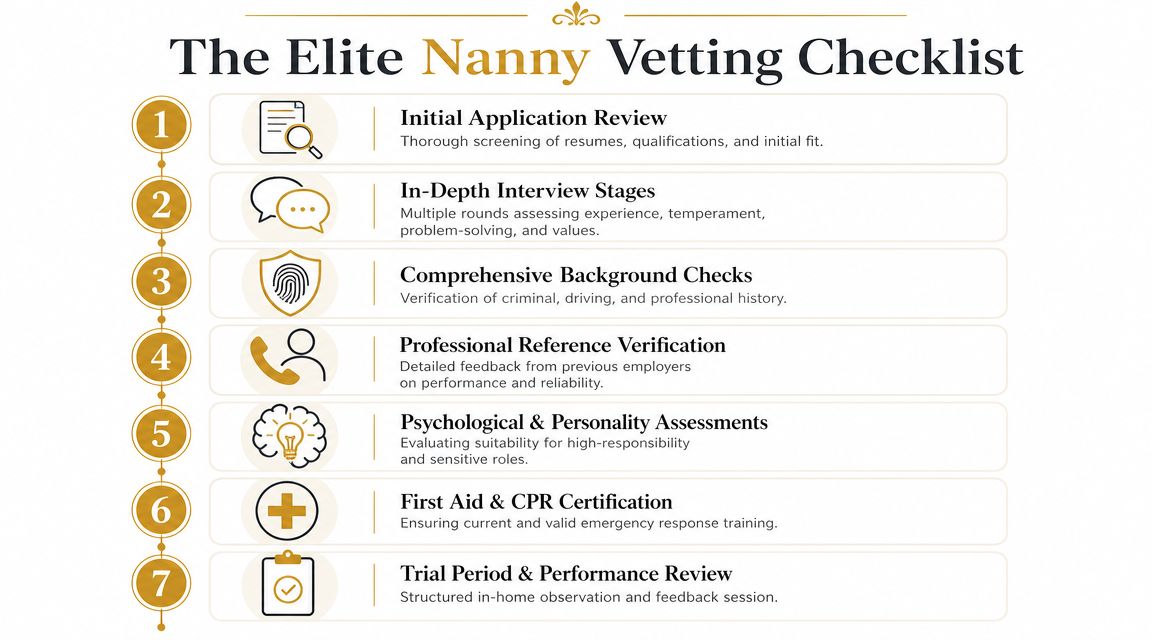
Specialist agencies consistently report that skipping background checks and failing to verify references are among the most common family hiring mistakes. They recommend a structured sequence of identity and right-to-work verification, enhanced references, and a formal background check before interviews, as detailed in this guidance on avoiding common nanny hiring mistakes.
The checks that matter most
A proper vetting sequence should test identity, legality, competence, and judgement.
Identity and work status first
Before chemistry interviews, confirm the candidate is who they say they are and can legally accept the role as structured.Reference interviews, not reference emails
A written note rarely tells you enough. Speaking directly with former employers reveals reliability, discretion, adaptability, and why the role ended.Formal background screening
This should be handled professionally and matched to the realities of the post, including any driving responsibilities or international movement.Role-fit interviewing
Ask how the candidate has handled travel days, parental handovers, boundaries with principals, and coordination with other staff.
Red flags families often miss
The most expensive mistakes are often subtle.
- Vague chronology on a CV that never gets challenged
- References that sound positive but thin
- Excellent childcare instincts with weak household judgement
- Comfort with children, but not with discretion
- Willingness to say yes to anything rather than setting realistic expectations
A serious nanny should welcome serious vetting. Strong candidates don't fear a thorough process because they know it protects them as well.
Trial days matter too, but they should come after the formal checks, not before them. A successful trial shows operational fit. It shouldn't be used to replace due diligence.
Families who want a fuller benchmark can review this detailed guide to the nanny vetting process for discerning households.
Contracting Onboarding and Household Integration
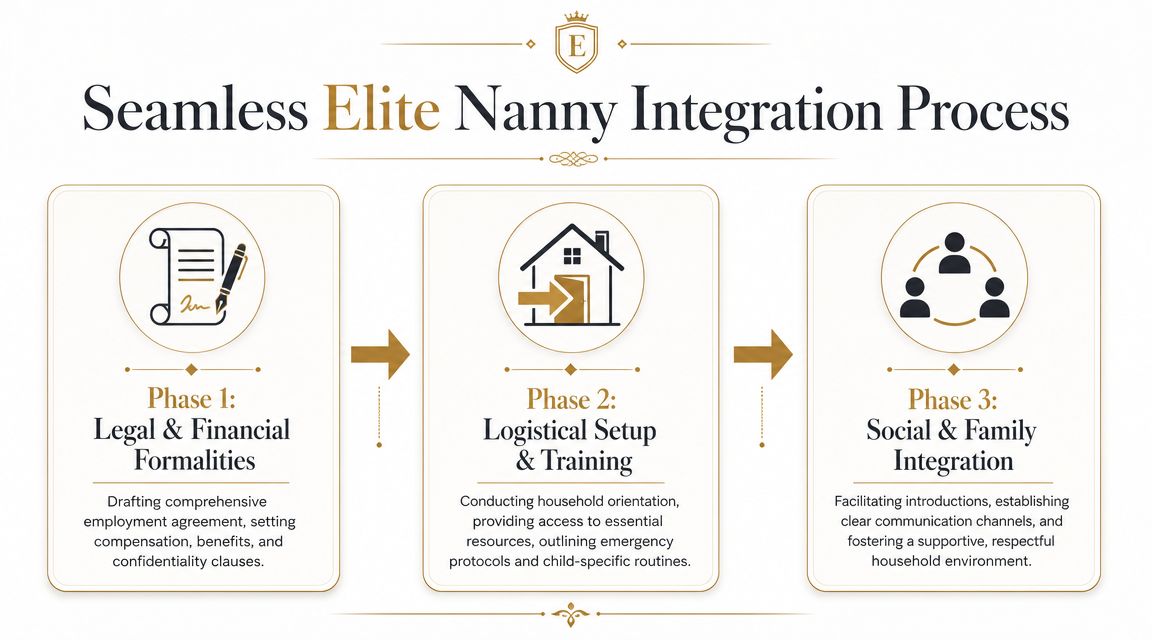
A successful hire can still fail in the first month if the contract is vague, the onboarding is improvised, or the nanny enters a household without clear lines of communication. In premium homes, these three elements belong together.
UK private household staffing practice shows that premium childcare roles are often part of a broader domestic team. Agencies routinely recruit for rota nannies, governesses, and maternity nurses alongside estate staff, which indicates that childcare works best when it is integrated into the full household model, according to guidance on fully staffed household recruitment and childcare integration.
Put the agreement in writing
A good contract protects both family and nanny. It should cover compensation, hours, overnight expectations, travel rules, confidentiality, notice terms, use of vehicles, social media boundaries, and who has authority to change the schedule.
For families with privacy concerns, a strong confidentiality framework matters. This guide to private staff non-disclosure agreements for UHNW families is useful when formalising the role.
Build a real onboarding plan
The first weeks should never rely on verbal handover alone. Create a written orientation pack that includes:
- Household routines for mornings, school transitions, meals, naps, and evenings
- Emergency procedures including medical contacts, preferred hospitals, and security protocols
- Communication rules on updates, escalation, and what should be reported immediately
- Child-specific notes on allergies, anxieties, friendships, tutors, and extracurricular rhythm
Introduce the nanny as part of the team
If your home already has staff, define reporting lines early. The nanny should know who handles groceries, transport scheduling, laundry systems, guest preparation, and property logistics. That avoids duplication and resentment.
Households run smoothly when each professional knows their lane, respects the others, and understands who makes final decisions.
The social side matters too. Children need to see the nanny welcomed by parents and respected by staff. That gives the new hire authority without creating distance. In the best homes, onboarding is calm, deliberate, and consistent.
Advanced Solutions for the Modern UHNW Family
A Palm Beach family may need a nanny in residence on Monday, on a yacht by Thursday, and in Europe by the school break. At that level, the question is not whether a candidate is warm or experienced. The question is whether the role has been built to withstand travel, privacy exposure, changing schedules, and coordination with the rest of the household.
I advise families to treat advanced childcare support as an operating model, not a single hire. The right structure depends on where pressure sits. Sometimes the issue is coverage across long parental hours. Sometimes it is international mobility. Sometimes it is the friction that starts when a nanny enters an established home with housekeepers, drivers, security, tutors, and rotating guests.
Match the role to the pressure point
A strong placement starts by identifying the household problem in plain terms. Then the role can be configured correctly.
- Rota nanny for families who need consistent care across extended hours, multiple residences, or heavy parental travel
- Travel nanny for families who want routines maintained across flights, hotels, villas, and resort stays
- Maternity nurse or newborn specialist for the early months, when feeding, recovery, and infant care require technical judgment
- Governess or tutor-led profile for homes where educational management, etiquette, and academic coordination are part of the brief
- Night nanny or night nurse support for periods when overnight care is affecting parental capacity or household stability
The trade-off is straightforward. The more specialised the role, the narrower the candidate pool and the more precise the contract must be. Families often save time by defining that complexity at the outset rather than correcting a vague brief after a failed placement.
Build travel and privacy protocols before the first trip
In UHNW homes, travel exposes weak process fast. A nanny cannot be expected to manage an international itinerary on instinct alone. Written travel protocols should cover passport custody, visa lead times, medical authorisations, rooming expectations, per diems or reimbursable expenses, on-duty and off-duty hours, and the chain of command if plans change mid-journey.
Privacy requires the same level of discipline. NDAs are only one part of the framework. Families also need explicit rules on photography, social media, geolocation sharing, guest interaction, discussions in public settings, and what happens if children are approached at events or photographed by press.
Consequently, many households either protect the placement or undermine it. If a nanny is expected to preserve normalcy for children while coordinating with security, PAs, drivers, and estate staff, those interfaces have to be defined in advance.
Families arranging holiday travel often benefit from reviewing childcare needs alongside the itinerary itself. If you are planning your elite family getaway, decide early whether the nanny is travelling as sole charge support, part of a wider staff structure, or in tandem with tutors, newborn cover, or security-led movement protocols.
The best advanced solution reduces handoffs, closes privacy gaps, and gives the children a stable rhythm wherever the family is living.
Conclusion: Your Partner for Long-Term Household Harmony
High-end nanny services Palm Beach families rely on aren't defined by polished branding or a quick match. They're defined by a disciplined process. The strongest outcomes come from a clear childcare blueprint, a realistic compensation plan, careful sourcing, rigorous vetting, and structured integration inside the home.
That process protects more than your diary. It protects your children's routine, your household culture, and your privacy.
When the role is important, details that seem small at the start often determine whether the placement succeeds over time. Clear reporting lines, travel protocols, confidentiality terms, and proper onboarding are not extras. They're what make the hire sustainable.
Frequently Asked Questions about High-End Nanny Services
| Question | Answer |
|---|---|
| What makes high-end nanny services different from standard nanny hiring? | The difference is usually in the process and the scope of the role. Premium placements involve more precise briefing, deeper vetting, stricter confidentiality expectations, and a stronger focus on household integration, travel, and continuity of care. |
| Do Palm Beach families always need a live-in nanny? | No. Live-in works well for some homes, especially those with early starts, long evenings, or frequent travel. Other families are better served by live-out, rota, or specialist support. The right structure depends on schedule, privacy preferences, and household complexity. |
| When should a family hire a rota nanny instead of one full-time nanny? | A rota arrangement usually makes sense when the household needs sustained high-level coverage, regular travel, or dependable handovers without overloading one person. It can also suit homes that need consistency across long days and changing parental schedules. |
| How important is confidentiality in a premium nanny contract? | It's central. In visible or fully staffed households, confidentiality should be written into the agreement and reinforced during onboarding. Clear rules around social media, guests, travel, and family information reduce risk and avoid misunderstandings. |
| What should families ask references about? | Ask about reliability, discretion, communication style, handling of pressure, relationships with parents, and how the nanny managed transitions. Also ask why the role ended. That often reveals far more than a general endorsement. |
If you're planning a high-stakes childcare hire and want personalized guidance, contact Superstar Nannies for a discreet consultation on sourcing, vetting, and placing the right nanny for your household.