


A child is falling behind, the school calendar keeps changing, and the family's next trip is already in the diary. The household manager is trying to protect lessons from travel, sport, social commitments and last-minute changes, while the principal wants an academic solution that doesn't turn the home into a classroom factory.
That's when a private tutor at home deserves serious consideration. The decision isn't only about grades or entrance examinations. In a fully staffed household, the tutor becomes part of the child's daily environment, which makes vetting, discretion, safeguarding, temperament and operational fit just as important as subject knowledge.
When an In-Home Tutor Becomes the Right Answer
The clearest sign is rarely one poor mark. It's the combination of academic pressure, calendar disruption and a family's need for continuity.
A Year 6 pupil may be working towards an 11+ examination while missing lessons for international travel. A strong Year 8 pupil may have lost confidence after relocating between schools. A teenager preparing for public examinations may need concentrated support, but not another journey across London after a full day of lessons and activities.
In each case, an after-school tuition centre may solve the academic problem while creating a logistical one. The child still has to travel, the tutor has limited visibility of the wider routine, and the family has less control over timing and privacy. Home-based tuition removes much of that friction.
The signals worth taking seriously
Look for patterns rather than isolated incidents:
- Falling attainment: The child's work is becoming less secure, particularly in a core subject.
- Interrupted attendance: Travel, sport, family commitments or relocation have created gaps that school support cannot easily close.
- A defined examination deadline: An 11+, 13+ Common Entrance or other admissions process requires disciplined preparation.
- A change in confidence: The child understands more than their written work suggests, but anxiety or poor organisation is affecting performance.
- A complex household calendar: The family needs lessons to work around travel, security arrangements, activities and parental schedules.
The arrangement can be daily and visiting, several fixed sessions each week, or live-in where the educational remit is broad and continuous. The right model depends on the child's age, academic objective and the household's working pattern.
Recruiter's recommendation: Don't hire a tutor because the family feels guilty about a single result. Hire one when the child needs a coherent plan that school, parents and household staff can support consistently.
A private tutor at home is therefore a household-staffing decision as much as an education decision. The family is inviting a professional into private spaces, routines and conversations. The person must improve learning without disturbing the household's balance.
What a Private Tutor at Home Actually Does
A private tutor at home is an educator who delivers individualised teaching within the family residence. The arrangement may be a daily live-in position, a daily visiting role or scheduled after-school tuition.
The tutor normally plans lessons, teaches, marks work, records progress and prepares the child for agreed academic objectives. Depending on the brief, they may also liaise with the school, communicate with parents and contribute to decisions about examination preparation.
UK demand is substantial. Sutton Trust polling records private tutoring among 29% of secondary school students in England and Wales in 2026, compared with 18% in 2005, with uptake reaching 25% in Year 11 and 45% in London. The same research records a continuing income gap, with tutoring used by 23% of pupils in the worst-off households and 30% in the best-off households. These figures are reported in the Sutton Trust's private tutoring research.
Tutor, governess or online teacher
The distinctions matter.
| Arrangement | Primary remit | Main advantage | Principal limitation |
|---|---|---|---|
| Private tutor at home | Subject teaching and academic planning | Focused instruction in a controlled setting | Usually narrower than a full pastoral role |
| Governess | Education embedded in family life, often with pastoral and travel duties | Continuity across lessons, routines and travel | Requires a broader household brief and stronger lifestyle fit |
| Online tutor | Remote subject teaching | Access to a wider talent pool and flexible scheduling | Less physical presence and less insight into the child's home routine |
A governess may travel with the family, oversee cultural and educational activities, and support the child beyond formal lessons. An online tutor can be excellent for a specialist subject, but the family gives up the immediate presence that helps a tutor notice fatigue, distraction or changes in confidence.
For families comparing subject-specific options, the MasteryMind comparison page for physics and maths tutors can help clarify the difference between choosing a specialist for one discipline and commissioning a broader academic programme.
The practical scope should be agreed before interviews. Ask whether the tutor will produce weekly plans, mark every assignment, attend school meetings, prepare mock papers, provide written reports and coordinate with a housemistress or educational consultant. Ambiguity at the start becomes friction later.
Why Elite Families Choose Home-Based Tuition
The academic case is credible, but it isn't a blank cheque. The Education Endowment Foundation summary cited in government reviews associates one-to-one tuition with about five additional months' progress on average, while small-group tuition is associated with around four months' additional progress in a year. These figures appear in the Poverty Alliance review of mentoring and tutoring evidence.
That evidence supports structured tuition. It doesn't prove that every expensive tutor will produce the same result, or that removing a child from normal classroom learning is always wise. Parents still need to test the educational judgment behind the appointment.
The advantages are practical as well as academic
A home tutor can adapt the pace immediately, revisit a misunderstood concept and build a programme around the child's actual gaps. The tutor can also work around travel and family logistics without turning every missed lesson into an administrative problem.
For a high-profile household, privacy may carry equal weight. Lessons can take place in the library or study rather than a public centre. The family can manage access through existing security procedures, and a child doesn't need to become a recognisable regular at a local tuition venue. Those arrangements must be handled lawfully and proportionately, with the child's welfare taking priority over image management.
The model can also suit children with specific learning profiles who find larger settings tiring or distracting. That decision should involve appropriate educational advice, not assumptions made by a parent or tutor.
The trade-offs families should acknowledge
- Tutor dependency: A child may become reliant on one adult's prompting instead of developing independent study habits.
- Variable quality: Academic credentials don't automatically demonstrate strong teaching.
- Reduced peer contact: Individual lessons cannot reproduce discussion, collaboration or healthy academic comparison.
- Over-scheduling: More tuition can worsen fatigue if the child has no protected time to rest.
- Premature intervention: A child at a strong school may need confidence and better routines, not intensive remedial teaching.
My recommendation is to set a defined objective and review point. If the tutor can't explain what will change in the child's work, habits or confidence, the family is buying availability rather than a professional intervention. Families considering the wider educational rationale may also find this analysis of maximising academic potential through private tutors useful.
Qualifications and Vetting That Matter Most
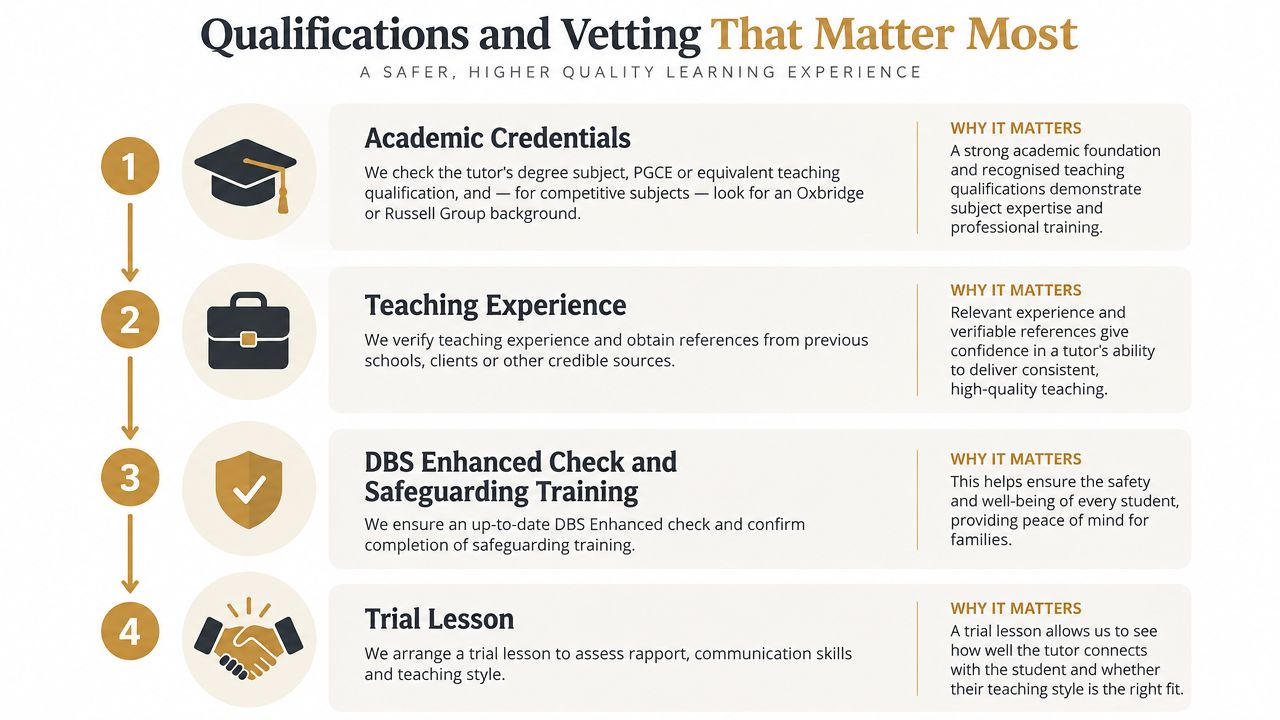
Vetting should follow a sequence. A polished CV and a prestigious university do not replace references, safeguarding checks or a trial lesson.
Start with academic credibility
For competitive admissions, examine the tutor's degree subject, teaching qualification and familiarity with the relevant examination system. A PGCE or equivalent teaching qualification can demonstrate formal preparation, while an Oxbridge or Russell Group background may be relevant for particular subjects and selective admissions. It should never be treated as a substitute for teaching ability.
Request evidence of teaching experience, including one-to-one tuition, age groups taught and the subjects covered. Ask for sample lesson plans. A capable tutor should be able to explain how they diagnose a gap, teach the concept, test understanding and adapt if the first approach fails.
References need context. A reference from a comparable private household is more useful than a generic character statement because it can address discretion, punctuality, communication, boundaries and performance under pressure.
Then complete the safeguarding and employment checks
In England, private tutors aren't subject to a general legal registration or regulation regime. Camden's parent guidance places responsibility on the parent appointing the tutor and advises families to report concerns about inappropriate or abusive behaviour to the local safeguarding hub or the police. The guidance is available in Camden's information for parents on tutors and out-of-school learning.
A DBS check isn't legally mandatory for every private tutor. However, families should understand precisely what check has been completed, when it was issued and whether the role requires additional safeguarding scrutiny. Devon guidance notes that many organisations recommend vetting and that Camden guidance says DBS checks should be repeated every three years. NSPCC guidance also highlights criminal-record checks for people aged 16 or over who may work in roles involving contact with children. Review the NSPCC guidance for tutors alongside the family's own safeguarding policy.
For internationally mobile staff, ask whether an International Child Protection Certificate is appropriate, and verify teacher prohibition status in England through the Teaching Regulation Agency where relevant. Confirm right to work and any visa conditions before the appointment begins. These checks are jurisdiction-specific and should be handled with professional employment advice where needed.
Finally, review professional memberships, the Tutors' Association code of conduct, public liability insurance and professional indemnity insurance. Complete a social-media audit, agree confidentiality obligations and observe a trial lesson with the household manager or principal present. The family's guide to private tutor qualifications provides a useful framework for that review. For additional practical guidance, consult these tips for finding a private tutor.
A Typical Session, Week and Term in Practice
Consider a Year 7 pupil preparing for 13+ entry. The child attends school normally, has a demanding sports schedule and needs support in mathematics and English without sacrificing family time.
A 90-minute session might begin with a five-minute recap of the previous lesson. The tutor then spends around 20 minutes teaching new material, followed by 15 minutes of guided practice. The child works independently for roughly 30 minutes while the tutor remains nearby, intervening when necessary. The final ten minutes review mistakes and set a manageable piece of homework. The remaining time allows for transitions and questions.
That outline isn't a universal formula. Its value lies in giving the child a repeatable rhythm and giving the parents something concrete to review.
The week needs a deliberate shape
A family may schedule two to four sessions across the week, depending on the examination objective and the child's capacity. A Saturday session can be used for a mock paper, timed comprehension or a longer piece of written work, but it shouldn't automatically become an additional full school day.
The tutor should communicate briefly with the school or housemistress after each session where the family and school have agreed that arrangement. Communication needs boundaries. The tutor shouldn't bypass parents, and the school shouldn't receive unfiltered commentary about the child's private life.
At term level, the process starts with a diagnostic assessment and a learning plan containing agreed targets. Parents receive fortnightly progress reports, with a formal review at half-term. The review should answer three questions:
- What has improved: Which skills are now more secure?
- What remains blocked: Is the obstacle knowledge, confidence, organisation or motivation?
- What changes next: Should the frequency, subject focus or teaching method change?
Discretion should be operational, not merely promised. Lessons may take place in the library rather than a visible classroom, and written feedback should be stored securely rather than on broadly shared cloud accounts. The household manager should control access, retention and circulation of academic records.
Fees, Contracts and the Tax Reality for UK Families
Families often focus on the hourly fee and overlook the engagement structure. Before discussing a rate, confirm whether the tutor is employed directly, operates as a genuine independent business or is supplied through an agency.
The only verified tax threshold relevant here is HMRC's trading allowance. A UK tutor generally doesn't need to register if tutoring income is £1,000 or less in a tax year. Once income exceeds £1,000, the tutor must register as self-employed and complete Self Assessment, with registration due by 5 October after the end of the tax year in which tutoring began, as outlined in this UK private tutor tax guide.
That rule concerns the tutor's income. It doesn't decide whether a household has employed the person for tax and employment purposes. If the family controls the hours, place of work, duties and manner of teaching, the relationship may require specialist advice. Don't assume that an invoice or limited company automatically settles the question.
Cost components to discuss openly
| Component | Typical range or rule |
|---|---|
| Lesson fee | Agree in writing according to subject, experience and scope. |
| Travel | Clarify whether travel time and expenses are included. |
| Trial lesson | Confirm whether it's chargeable and whether the family can observe it. |
| Holiday and examination periods | Agree treatment before the timetable becomes urgent. |
| Tax administration | Establish whether the tutor is self-employed or whether the household needs employment advice. |
| Contract review | Specify notice, confidentiality, holiday cover, data handling and fee reviews. |
Cash in hand is not a professional arrangement. A family should retain invoices, payment records and the written agreement, then obtain advice from an accountant or employment specialist on PAYE, National Insurance and other obligations. The Superstar Nannies guide to nanny tax obligations is relevant to the broader household employment context, though tutor status still requires individual assessment.
The contract should cover cancellation, sickness cover, travel with the family, access to the residence, communications with the school, ownership of teaching materials, confidentiality, data protection and termination. A fee-review mechanism prevents a difficult renegotiation during an examination period.
Working With a Specialist Tutor Placement Agency
Self-search gives the family direct control, but it also leaves the principal or household manager responsible for advertising, screening, references, safeguarding administration, negotiation and replacement. That workload becomes disproportionate when the brief involves international travel, unusual hours, a sensitive family profile or a specialist academic objective.
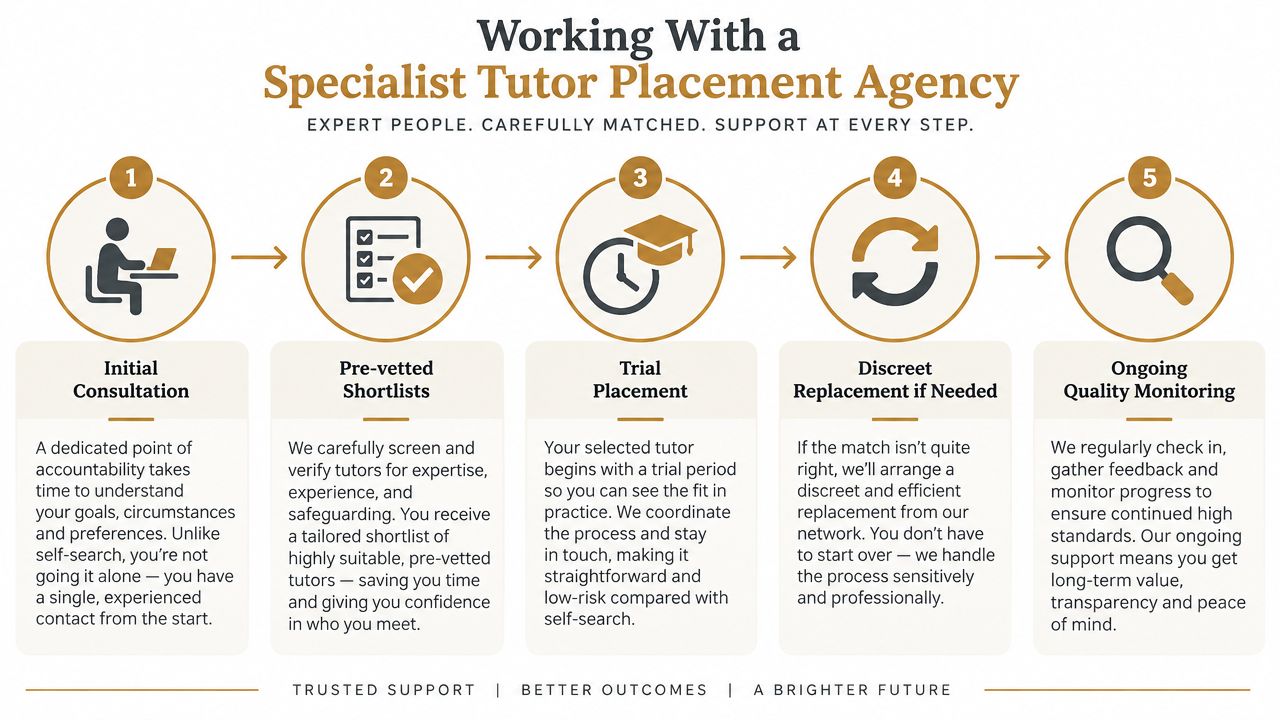
A specialist agency should provide one accountable contact, a properly interpreted brief and a shortlist shaped around the child and household rather than a stack of attractive CVs. The agency should also be willing to say no when the arrangement is unrealistic.
What a discreet placement process looks like
- Confidential intake: The consultant speaks with the family principal, household manager or authorised representative about the child, curriculum, schedule, travel, access protocols and reporting lines.
- Candidate profiling: The agency assesses academic background, teaching record, references, safeguarding documentation, availability and temperament.
- Trial lessons: The child experiences the tutor's teaching style, while the family observes rapport, authority, warmth and adaptability.
- Contract support: Duties, hours, confidentiality, travel, notice and payment arrangements are recorded before the start date.
- Post-placement review: The agency checks the relationship during the probationary period, with reviews at 30, 60 and 90 days where that structure is agreed.
When the agency fee is justified
An agency earns its place when the cost of a poor fit is high. That includes an international relocation, SEND-related requirements, Oxbridge preparation, a multi-staffed residence or a family where confidentiality is paramount.
The agency shouldn't forward a CV and disappear. Ask who handles concerns, how replacement is approached, whether the consultant understands household hierarchy and how information is protected. A provider such as Superstar Nannies' private household staffing service can be considered where the tutor needs to operate alongside other private household professionals.
Replacement is particularly sensitive. The process should protect the child from unnecessary disruption and protect the tutor from an abrupt or humiliating exit. A professional agency manages both.
Questions Elite Families Ask Before Signing
Late-stage questions often reveal whether the family has designed a workable role or is hoping one exceptional person will absorb every unresolved problem.
What safeguarding process applies?
Ask what checks have been completed, when they were issued, what safeguarding training the tutor has undertaken and who receives a concern. The household should have a clear reporting line that doesn't depend on the tutor deciding whether an incident is serious enough to mention.
A tutor must know who can enter the study, how one-to-one sessions are supervised and what boundaries apply. Any camera policy should be documented, lawful and proportionate. Families shouldn't install surveillance casually, and tutors shouldn't be expected to work under undisclosed observation.
How will confidentiality work?
The agreement should cover family information, photographs, travel plans, school details, conversations overheard in the residence and social-media conduct. An NDA can support confidentiality, but it doesn't replace good judgment or safeguarding obligations.
Ask whether the tutor will use personal devices, where academic records will be stored and who can access them. Written reports should reach the agreed recipients only.
What happens around holidays, travel and illness?
Set expectations before the first trip. Confirm whether the tutor travels, whether lessons continue remotely during travel, how sickness cover is arranged and what happens when the family changes plans. A tutor who isn't available for every journey may still be the right tutor. The family needs a realistic plan, not permanent availability promised during an enthusiastic interview.
Who manages the school relationship?
Define whether the tutor contacts teachers directly, attends meetings, receives school reports or supports examination administration. Parents retain responsibility for major decisions, including entries and applications, unless they formally delegate specific tasks.
If the child loses motivation, the tutor should investigate rather than add work. Fatigue, an unsuitable target, a weak relationship or an unaddressed learning difficulty may sit beneath the refusal to study.
What does a fair exit look like?
Agree the trial period, notice provisions, payment during cancellation, handover of records and replacement process. The best tutors will decline a role if the hours, travel, confidentiality demands or expectations are unreasonable. That polite refusal is often a stronger sign of professionalism than instant agreement to everything.
Families should also remember that private tutoring in England isn't covered by a general legal registration regime. Suitability checks therefore sit squarely within the family's appointment process, and concerns must be escalated through the appropriate local safeguarding route or the police, as set out in the earlier Camden guidance.
Superstar Nannies can help families define the brief, assess private tutors and coordinate a discreet appointment that fits the child's academic needs and the household's routines. Visit Superstar Nannies to discuss in-home tutoring, governess and wider private household staffing requirements with an international recruitment team.