


A family may secure the villa, confirm school placements and align the yacht calendar with half term, yet still find the nanny appointment to be the most demanding part of the move. Hiring a nanny in Monaco is not a simple transfer of an existing domestic role to a more attractive climate. It requires the family to manage bilingual childcare, international travel, premium educational expectations and a distinct employment jurisdiction at the same time.
A successful nanny Monaco placement begins when the household brief, compliance pathway and employment package are treated as one integrated project. The right candidate must suit the children, complement the principals' lifestyle and standards, and satisfy Monaco's administrative requirements. The wrong appointment often fails before the first day, usually because duties were defined too loosely, documentation was incomplete or the package did not reflect the realities of a high demand role.
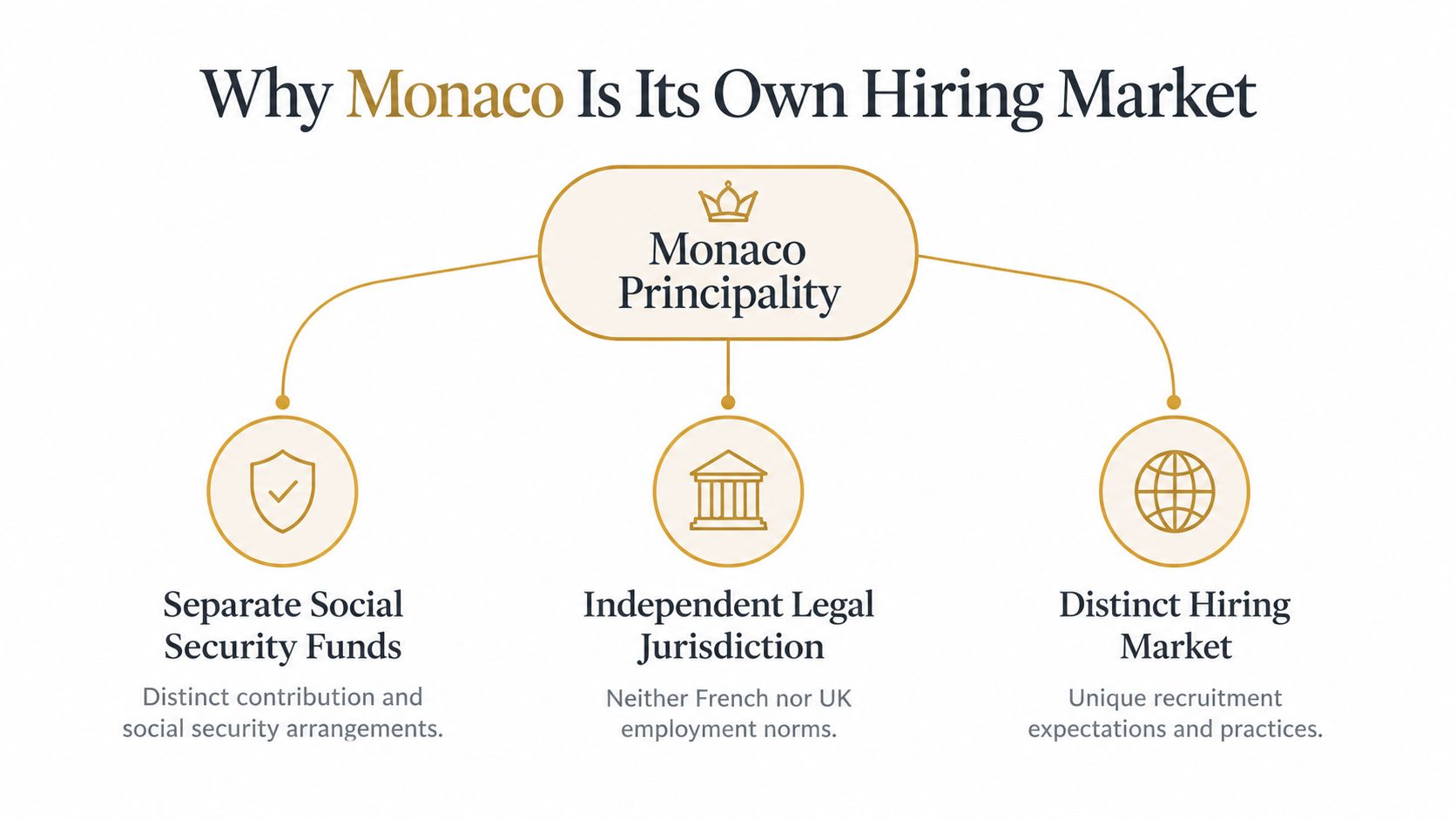
Why Monaco Is Its Own Hiring Market
A family arriving from London may bring established nursery routines, familiar school terminology and clear household standards. Monaco introduces its own employment administration, residence considerations and social security obligations. Add a yacht schedule, French language communication and movement between residences, and a standard nanny search quickly becomes inadequate.
Monaco is not simply a French childcare market in a different location. The principality operates its own public service process, and private household employers must deal with Monaco's Social Security Funds when hiring domestic staff. That distinction matters whether the family is relocating permanently, spending the summer on the Riviera or dividing time between Monaco and another residence.
The household brief drives the candidate profile
The most valuable candidates understand that childcare in Monaco can extend beyond nursery pickup and bedtime. A role may involve:
Bilingual communication: English and French with children, parents, schools and local professionals.
British educational preparation: Support for children preparing for assessment tests linked to London preparatory-school entry.
International mobility: Travel with the family, yacht movements and transitions between jurisdictions.
Staffed-household coordination: Clear handovers with housekeepers, chefs, drivers and household managers.
Discretion: Calm, polished conduct around guests, principals and public-facing family commitments.
UK recruitment listings document this pattern. One Greycoat Lumleys listing sought a live-in nanny for a family relocating to Monaco to care for a 9-month-old child, with French and English specifically required. Another UK-listed Monaco vacancy sought a British professional nanny and native English speaker to support a child preparing for assessment tests for entry to a London preparatory school in September 2022.
Practical rule: Define the role by jurisdiction, language, travel pattern and educational scope before defining it by salary.
A family seeking a nanny in Monaco should therefore decide whether it requires an infant specialist, a bilingual career nanny, a governess, a travel nanny or a top qualified rota professional. These labels describe materially different capabilities. A candidate with strong nursery experience may still lack the discretion, flexibility and international documentation required in a private Monaco household.
For a structured search, Superstar Nannies' Monaco nanny agency service can be considered alongside direct sourcing and specialist head hunting. The central point remains unchanged: Monaco requires a search designed specifically for Monaco, not a generic southern European shortlist.
Legal Steps for Hiring Through Monaco's Official Process
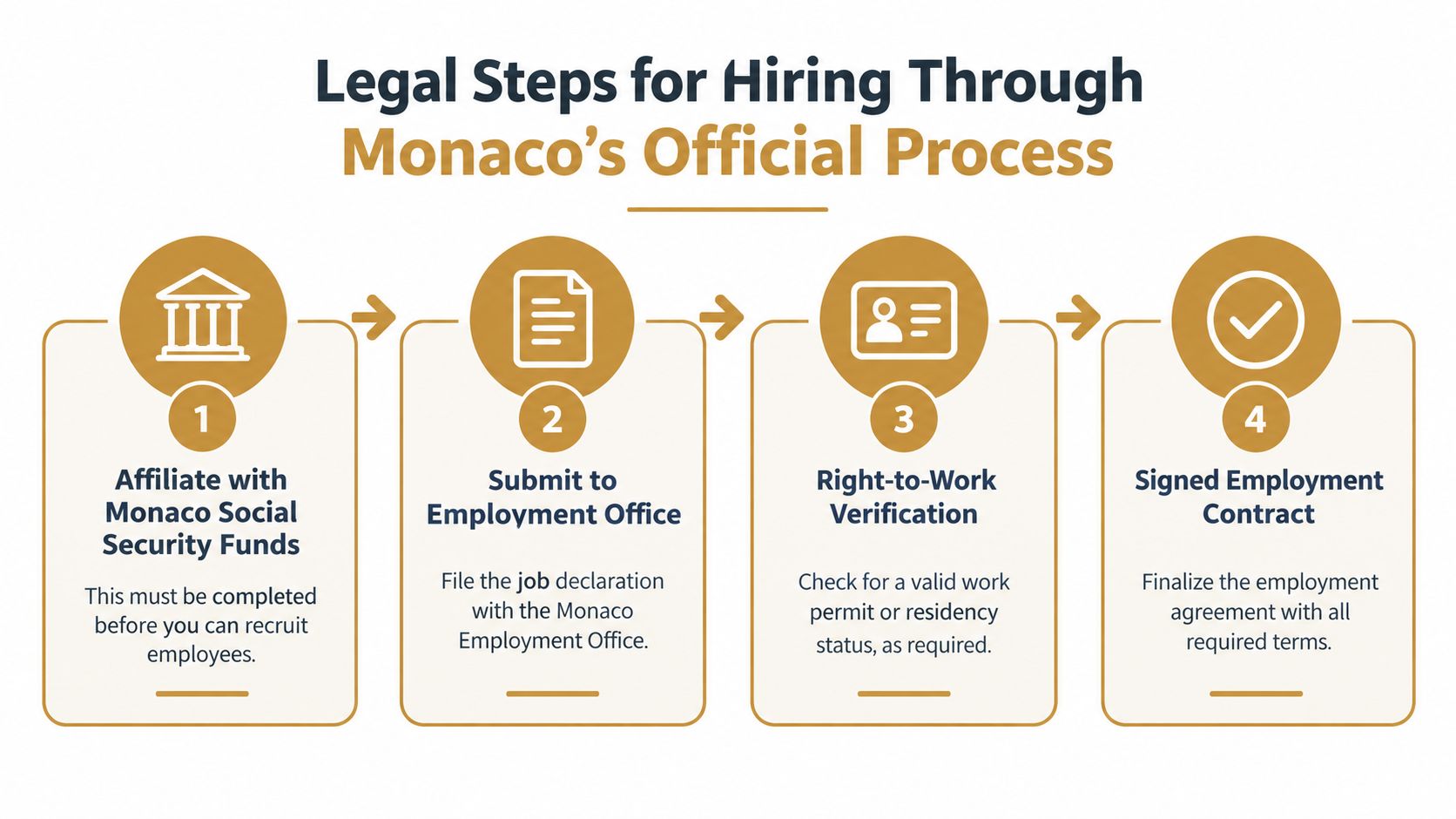
The process should begin with Monaco's official requirements, not with assumptions carried over from France or elsewhere. Monaco's guidance identifies nannies and children's nurses as domestic staff and requires a private household employer to affiliate with Monaco's Social Security Funds before hiring.
A family bringing in a rotating nanny should approach the process in sequence, ensuring each document is in place before moving to the next stage.
Four steps to complete in the correct order
Affiliate with Monaco's Social Security Funds. The household employer establishes the relevant affiliation before recruitment. This creates the administrative basis for employment and contributions in Monaco.
Prepare the employment and identity file. The employer must provide identifying and residence documentation, then submit the employment information to Monaco's Employment Office. The file should clearly distinguish the family's residence, the nanny's nationality and whether the nanny will live in Monaco or commute.
Secure authorisation to hire and a work permit. Monaco's process requires permission to hire and work authorisation documentation. A British national may face additional immigration considerations after Brexit, so a British passport should not be treated as automatic permission to work in Monaco.
Pay the registration fee and retain the record. The official process includes a €5 registration fee. Monaco's government employment guidance should be used as the administrative baseline, rather than a French household employment checklist.
The most common practical error is allowing the candidate to begin while paperwork is still being finalised. A family may have secured the candidate, prepared accommodation and agreed a travel schedule, but the placement still requires documented authorisation.
Separate the family's scenarios
The compliance file changes according to the arrangement. A nanny living in Monaco raises a different residence discussion from a nanny commuting from France. A seasonal principal residence, yacht linked household and permanent Monaco home may also create different operational questions. Those facts should be made explicit in the brief.
The decision file should include the employer's residence status, the nanny's nationality, intended address, working pattern, childcare duties, travel expectations and the entity paying the nanny. A Monaco employment adviser or payroll specialist should confirm the route before the contract is signed.
A premium placement remains an employment relationship. A private setting does not remove the need for authorisation, registration or accurate records.
Agency, Head-Hunter or Direct Hire
There are three credible sourcing routes, and no single option is right for every household. The best choice depends on whether the family prioritises a ready made compliance workflow, access to a highly specific profile or maximum control over the search.
| Criterion | Bespoke Agency | Head-Hunter | Direct Hire |
|---|---|---|---|
| Vetting depth | Structured checks, references and documented process | Strong for targeted senior profiles, but scope varies | Entirely dependent on the family |
| Discretion | Usually managed through controlled introductions | Very discreet for known networks | Can be difficult to protect across broad advertising |
| Replacement cover | Often available under agreed terms | Must be negotiated | Usually absent |
| Language and cultural matching | Strong when the agency knows the household brief | Excellent for rare language or education profiles | Possible, but time intensive |
| Cost relative to package size | Justifiable where risk and complexity are high | Suitable for scarce, senior candidates | Lowest visible cost, highest owner workload |
A bespoke agency is appropriate when the family wants candidate identification, screening, references and placement administration handled together. A head hunter is often the better choice when the brief is unusually narrow, such as a Russian speaking governess, an experienced rota nanny or a candidate with a specific independent school background. Direct hire may suit a principal with an experienced head of household and the capacity to manage documentation, payroll and replacement risk internally.
Match the route to the household
Consider a Miami family rebuilding a London trained rota team around a Monaco base. If the family already understands the rota structure and has strong internal administration, a direct approach may produce strong candidates. If the family needs several profiles compared discreetly, an agency offers better coordination. If it needs one rare bilingual professional who can manage school communication and travel, a head hunter may be the more precise instrument.
The hidden cost of direct hire is not limited to the recruiter's time. It includes the risk of inconsistent references, unclear employment status, missed work authorisation and the absence of a replacement plan if the candidate withdraws.
Recruiters coordinating multiple interviewers, diaries and time zones may also find how SyncThemCalendars helps recruiters useful for keeping the process organised. It will not replace judgement, but it can reduce avoidable scheduling friction.
For most international Monaco placements, the best route is the one that protects the family's attention. The lowest visible cost is rarely the least expensive option once a weak hire disrupts school continuity, travel and household operations.
Vetting and Safeguarding That Withstand Scrutiny
A clean certificate is not, by itself, a complete safeguarding decision. In a private household, the defensible standard is a documented process that tests identity, chronology, competence and judgement.
Use four gates, not one background check
First, verify the person. Confirm identity, employment chronology, qualifications and international right to work documents. Unexplained gaps should be investigated rather than overlooked in a polished CV.
Second, obtain the appropriate DBS check. Where eligibility and the role permit it, use an enhanced DBS check with children's barred list information. The check is a control, not a conclusion.
Third, validate recent references independently. Obtain at least two recent employer references, using contact details sourced independently rather than relying solely on the candidate's preferred email address. Ask whether the nanny had sole charge responsibility, managed travel, handled emergencies and worked effectively within a staffed home.
Fourth, test practical judgement. Use scenario questions covering supervision, online safety, emergency response, indicators of neglect and escalation. A paid trial or observed task should use written scoring criteria.
The supplied image URL above contains a mismatch with the mandatory URL, so the exact required asset is included here:
Common failures deserve written risk decisions:
Overseas references can't be verified: pause the appointment until independent confirmation is obtained.
The reference confirms dates but not duties: treat the childcare scope as unverified.
Paediatric first aid has expired: require renewal before sole charge.
A clean DBS is treated as proof of suitability: continue with competence and reference checks.
England's inspection benchmark offers useful context. 95% of full inspections of England's Early Years Register completed from 1 September 2023 to 31 August 2024 judged safeguarding arrangements effective, according to UK government nanny safeguarding guidance. That figure is an inspection benchmark, not a nanny placement success rate, and a private family should not use it to lower its own standard.
For a structured approach to comparing candidate evidence, the Synopsix assessment framework can help a household formalise scoring. Keep consent, verification dates, verifier identity, questions, answers and risk decisions in a restricted access recruitment file. International background checks from Superstar Nannies can be included in the agency led route.
Compensation, Packages and Rota Design
Monaco packages should be benchmarked against the actual demands of the role, not against a gross salary found online. Net pay, accommodation, taxation, social contributions, travel and working time rules do not translate neatly between jurisdictions.
A documented recruitment listing published in September 2023 advertised £4,000 to £5,000 net per month, or approximately £48,000 to £60,000 net annually, for a Monaco nanny role. The schedule was Wednesday through Sunday, 9:00 a.m. to 7:00 p.m., representing 50 scheduled hours per week. The package included a private bedroom in Monaco and accommodation during international travel. The nanny cared for a toddler and occasionally three school aged children, prepared healthy food, managed routines and errands, arranged activities and playdates, and travelled with the family. The historical Monaco vacancy listing is a useful reference point, not a universal rate card.
Pay for the demands, not the title
For UHNW families, the package should reflect the true scope of the appointment. A live in package may justify a different structure from a live out role because accommodation forms part of the offer. A rota nanny requires clarity on travel days, handovers, accommodation during off site assignments and what happens when the family changes location. Bilingual ability, infant expertise, driving, swimming, tutoring, yacht familiarity and experience in fully staffed homes should be assessed separately rather than folded into a vague premium.
Career rota nannies at the top of the market will assess not only compensation, but also the operational quality of the role. They will expect precise scheduling, defined boundaries, proper rest, professional accommodation and a principal who understands the demands of high performance childcare in a private environment.
Write the package line by line:
Net salary: State the currency, payment date and whether the figure is net or gross.
Accommodation: Describe the private bedroom, bathroom access, privacy and arrangements during travel.
Travel: Confirm flights, travel days, luggage, visas and accommodation outside Monaco.
Hours and rota: Define active duty, overnight expectations, standby periods, handovers and rest.
Benefits: Address leave, insurance, meals, phone use, training and any clothing requirements.
A family can use this guide to crafting an elite nanny compensation package to structure the offer. The family should not promise an attractive net amount and leave the tax treatment unresolved. The candidate is evaluating the full working arrangement, not only the headline figure.
Contracts, Payroll and Cross-Border Compliance
If the family controls the nanny's hours, duties and pay, the arrangement should be treated as employment. Describing the person as self employed will not change the practical reality of the relationship.
For household employers, GOV.UK guidance on au pairs and household employment states that household employers may need to register as employers, operate payroll, deduct and pay Income Tax and National Insurance, provide employers' liability insurance and meet statutory obligations such as sick pay and maternity pay. Cash payment does not remove those responsibilities.
Build the contract around the real household
The contract should identify the employer, work location, role, duties, hours, rota, salary basis, accommodation, leave, travel, notice, probation, confidentiality, safeguarding and expenses. It should also state who controls travel arrangements and how schedule changes are approved.
Employment status guidance cited by Coram PACEY identifies regular hours, a set weekly or monthly wage, duties directed by the family and work performed mainly for one household as indicators of employee status. Those features are common in fixed rota and live in Monaco placements. Coram PACEY's employment-status guidance helps explain why the label alone is not decisive.
A principal should obtain advice on which payroll obligations follow the employer and which Monaco requirements attach to the work location and local employment process. Appoint a Monaco side payroll partner where appropriate, and keep one controlled file containing the contract, payroll records, authorisations, references, insurance and changes to duties.
Contract test: If the family cannot explain who pays, who supervises, where the work occurs and what happens during travel, the contract is not ready.
Use Stewart Accounting Services' employment contract advice as a practical drafting reference, then obtain jurisdiction specific advice before signature. Families can also review Superstar Nannies' nanny contract templates as a starting point for the clauses a professional household expects.
Your 30 Day Monaco Nanny Readiness Plan
A Monaco placement moves more efficiently when the family prepares decisions in sequence. The following plan gives a relocating principal or head of household a practical timetable without suggesting that every work authorisation case proceeds at the same administrative speed.
Week one, define and verify
Write the role around the children's ages, school, languages, travel, residence and rota. Decide whether the brief requires an infant nanny, bilingual career nanny, governess, travel nanny or rota professional. Begin identity, chronology, qualification and right to work checks before personal preference takes over.
Create a candidate scorecard with separate ratings for childcare competence, communication, discretion, travel readiness, safeguarding judgement and household fit. A prestigious employer name should not outweigh missing evidence.
Week two, interview and observe
Run structured interviews, then use practical scenarios. Ask the candidate to explain how they would manage a delayed flight with tired children, an allergy concern, an online safety disclosure or a disagreement about school expectations.
A trial scorecard can use simple written observations:
Supervision: notices risks and maintains appropriate attention.
Communication: speaks clearly with children, parents and staff.
Routine management: keeps transitions calm and organised.
Judgement: escalates concerns instead of concealing them.
Discretion: protects family information and behaves professionally.
Week three, lock the appointment
Agree salary, accommodation, rota, travel, leave and duties in writing. Complete the Monaco Social Security and Employment Office pathway, confirm work authorisation, and obtain advice on payroll and insurance. A family should not build non refundable travel plans around an appointment that still lacks permission to work.
Week four, onboard properly
Prepare the home, emergency contacts, school calendar, medical information, household protocols and rota handover. When the nanny travels from the UK with children, obtain written permission from everyone with parental responsibility before departure. GOV.UK guidance on taking a child abroad explains that a consent letter is usually sufficient evidence, and taking a child overseas without the required permission can constitute child abduction.
The first-day handover should cover passwords through the correct secure channel, driving arrangements, medication, pool or water safety, staff reporting lines and daily communication. A discreet placement works because the family's standards become operational instructions, not assumptions.
Superstar Nannies provides discreet international nanny and private household staffing support for Monaco connected families, including bilingual, live in, rota, travel and education focused profiles. Visit Superstar Nannies to discuss your household brief, compliance timetable and the candidate profile that will work in practice.