


The most popular advice about live-in housekeeping is also the most damaging: find someone willing to sleep at the property, then treat their presence as flexibility. That approach confuses accommodation with availability. A resident housekeeper is a professional employee with a private life, defined duties and a working pattern that must be designed as carefully as the household's service standards.
For an elite residence, the quality of the bedroom, the precision of the schedule and the respect shown for privacy will influence retention as much as the role's duties. Families in New York, Palm Beach, Miami, Los Angeles and internationally should decide first whether they need residential continuity, then build a fair employment structure around it.
What Live-In Housekeeping Actually Means
A family hires a live-in housekeeper for a busy property with frequent guests, several floors and an unpredictable travel calendar. The housekeeper moves into a private room and quickly becomes familiar with the household's preferences, from the way linens are folded to the order in which guest suites are prepared. That familiarity is valuable, but it doesn't turn every hour spent on the premises into working time.
Live-in housekeeping is not live-out housekeeping with a bed attached. It's a distinct employment model combining active domestic service with protected personal time. Active duties may include cleaning, laundry, ironing, wardrobe care, errands, guest preparation and household organisation. Personal time means the employee can close the door, rest, sleep, receive a visitor according to agreed household rules and leave the property without being treated as absent from duty.
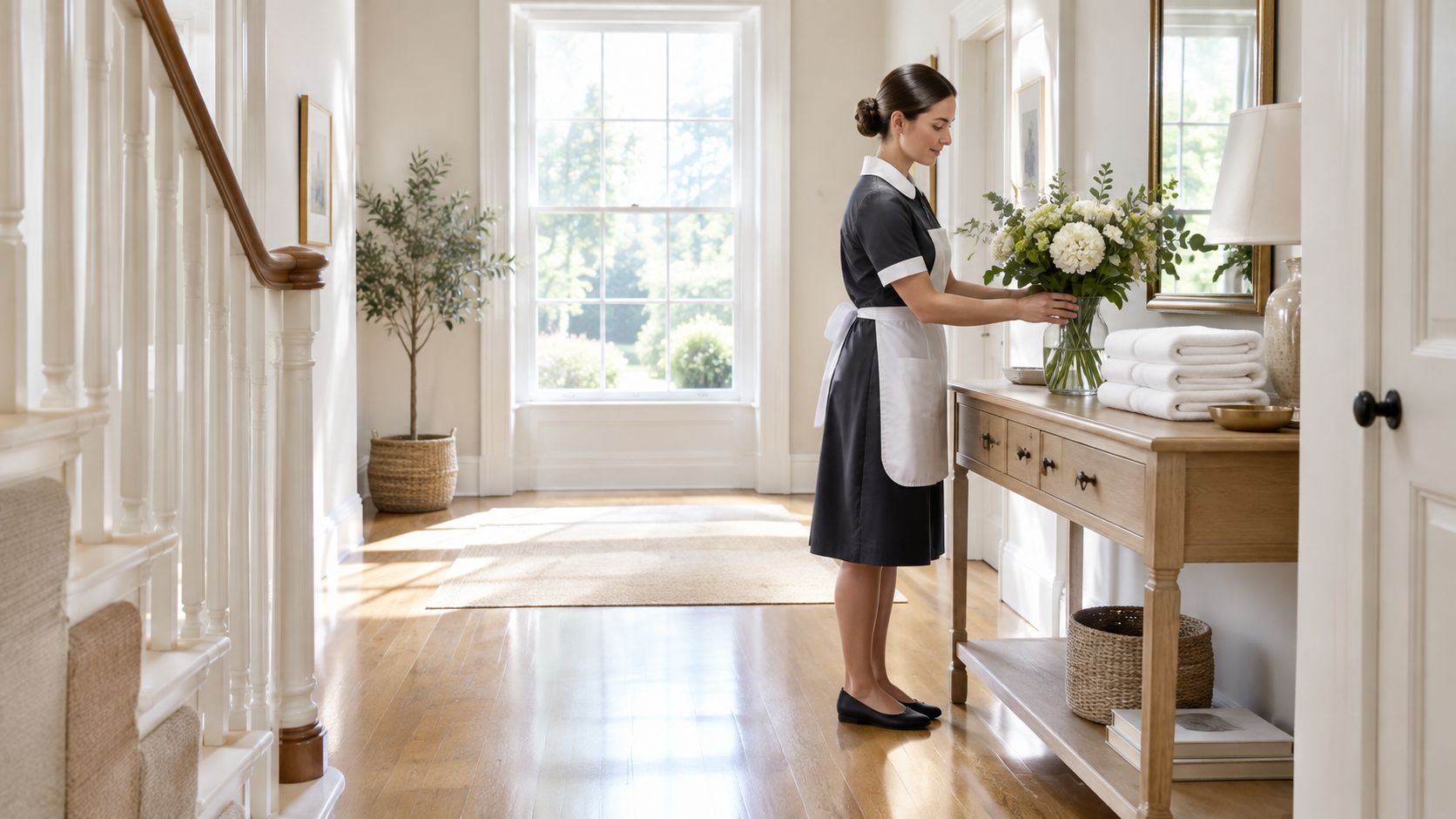
The role needs a professional definition
Families should write the position around outcomes, not vague availability. “Keep the house immaculate and be flexible” sounds premium, but it leaves both parties guessing. A stronger specification describes the property, service priorities, laundry and wardrobe expectations, guest protocols, travel between residences, reporting lines and the occasions when extra work may be requested.
A housekeeper may be responsible for preparing a residence before a family arrives, resetting it after departure and maintaining standards while the family travels. That's different from being expected to answer every request immediately. If you're comparing the scope of household cleaning with commercial hospitality operations, guidance on hotel cleaning from Solomon's Facilities Management can help clarify why different environments require different procedures.
Presence must never replace boundaries
A private bedroom creates proximity, not unlimited labour. The contract should separate scheduled duties, on-call requirements, overnight disturbance and genuine emergencies. It should also state who can issue instructions, how requests are prioritised and what happens when the family hosts guests or moves between properties.
Families can use this practical overview of what a housekeeper does to distinguish routine housekeeping from additional responsibilities. That distinction protects the employee from role creep and protects the family from paying for a position that was never clearly defined.
Practical rule: If a family can't explain when the housekeeper is off duty, the role isn't ready to advertise.
The History Behind Residential Housekeeping
Residential housekeeping in Britain was built around a housing model as much as a labour model. In 1901, approximately 1.5 million people were employed as domestic servants, and one in three women in paid employment worked as servants, according to BBC historical coverage of domestic service. The workforce also skewed young. Almost 50% of servants were under 25. For many households, service meant the employee lived inside the property and organised daily life from within it.
That arrangement shaped the role for generations. Maids, cooks, laundresses, butlers, valets, gardeners, chauffeurs and governesses all formed part of the residential workforce. The household did not just provide wages. It provided the room, set the routines and controlled access to privacy. That old structure still influences expectations now, especially in homes that assume presence automatically means availability.
A large workforce with demanding expectations
Domestic service remained a major employer through the interwar years. Servant numbers fell to 1,335,389 in 1921, then rose to 1,554,235 in 1931. Working time was heavy too. Servants often worked more than 70 hours per week, while many young factory and shop workers were below 50 hours by the 1920s, as shown in historical analysis from the University of Oxford.
Those figures matter for one reason. They explain why some families still inherit an outdated idea of live-in service, a worker on site, in the house, and therefore always callable.
That approach belongs in the past. Once accommodation and employment were fused, the worker's private time was often treated as secondary to the household's convenience. A modern live-in role should be designed the opposite way. Private accommodation, defined working hours and real off-duty time are not administrative extras. They are what stop a residence from recreating the weakest parts of domestic service history.
Why the model still exists
Residential domestic service declined after the Second World War as clerical, retail, welfare and industrial work expanded. Yet live-in housekeeping did not disappear, because some private households still need continuity across large homes, regular entertaining, travel and seasonal occupancy.
The modern case for the role is practical. A resident professional can maintain standards during absences, prepare a property before arrival and keep household systems consistent. But the role only works well when the accommodation, privacy and working-time design are handled properly. Get that architecture wrong and retention suffers. Get it right and the house runs calmly.
How Live-In Housekeeping Works Day to Day
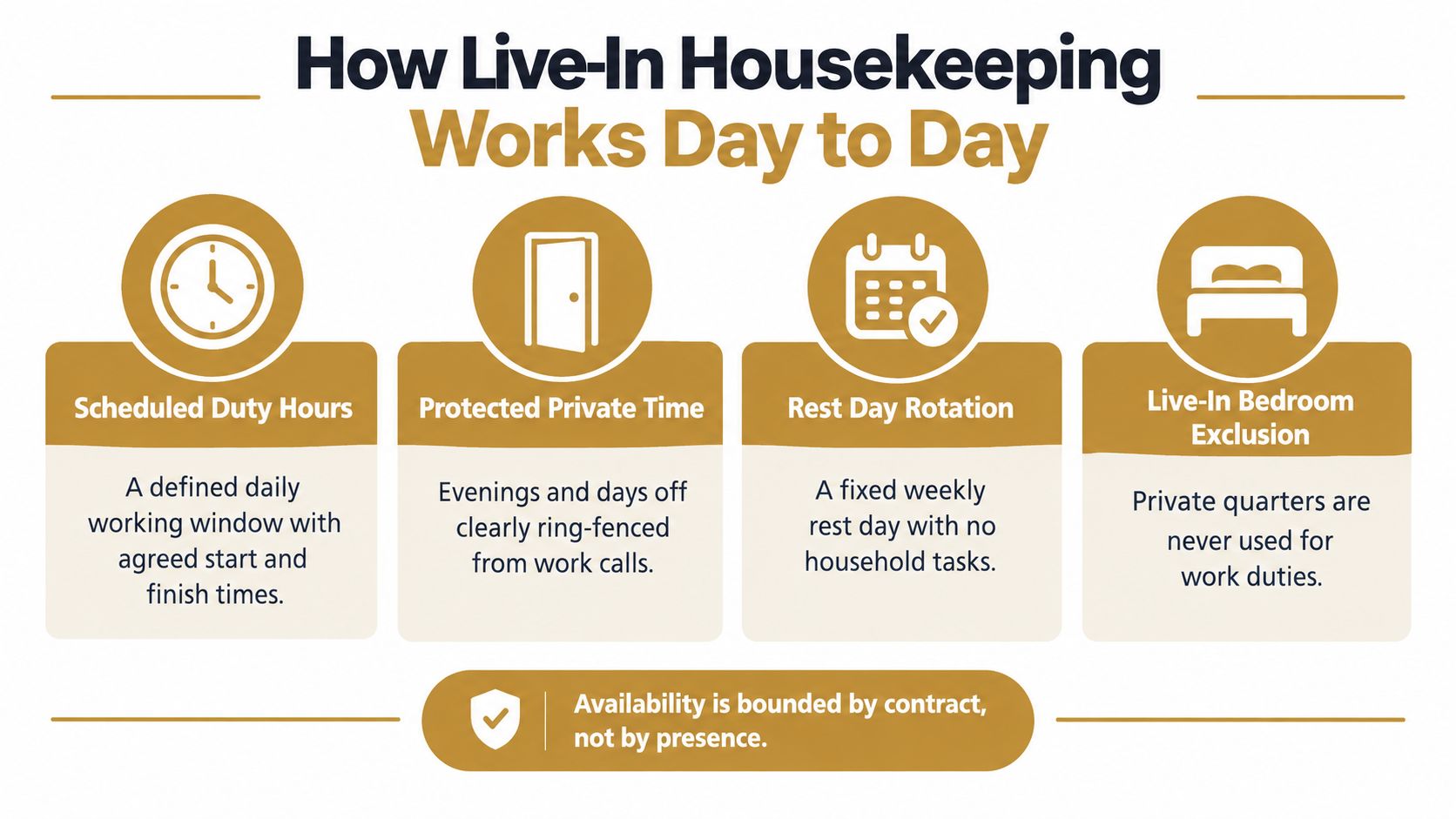
A workable day begins with a defined duty window, not an assumption that the housekeeper is available whenever a family member is awake. Start by listing every recurring task, then place each task inside an agreed working schedule. Cleaning, laundry, ironing, wardrobe management, errands, guest preparation and household support should be visible on the plan.
Build the schedule around active duty
A useful schedule identifies the work that requires the employee's attention and separates it from time spent at the property for personal reasons. It should cover:
- Active housekeeping: Cleaning, laundry, service, errands and any required childcare or guest support.
- Personal time: Periods when the housekeeper is free from household instructions and may leave the property.
- Sleep and overnight expectations: Whether overnight presence is purely residential, whether disturbance is anticipated and how an emergency call-out is recorded.
- Rest days and leave: Fixed days off, holiday arrangements, sickness procedures and travel expectations.
The contract should also explain how last-minute work is authorised. A family may need urgent guest-room preparation, but that request should be treated as work, not absorbed into an undefined evening. Clear planning is also useful when assessing cultural alignment and communication habits. A practical hospitality hiring guide from MyCulture.ai offers relevant questions for evaluating how professionals respond to service expectations and workplace culture.
Make the document usable
Don't create a schedule that looks polished but fails in real life. Test it against an ordinary weekday, a guest weekend, a travel day and an emergency. If the housekeeper must move between residences, state how travel time and travel costs are handled. If children or guests may request support, state whether that is part of housekeeping or requires a separate role specification.
The duties of a housekeeper should be reviewed alongside the daily timetable. A written duties list without hours creates ambiguity, while hours without duties create operational gaps.
Availability is bounded by contract, not by presence.
Live-In Versus Live-Out Housekeeping Options
The right arrangement depends on the household's rhythm, not its status. A live-in housekeeper suits a residence that needs continuity, regular preparation across irregular schedules or a trusted professional close to the operation. A live-out housekeeper may be the better choice when duties fit neatly into daytime hours and the family wants a firm physical separation between work and home.
| Factor | Live-In Housekeeping | Live-Out Housekeeping |
|---|---|---|
| Cost structure | Includes pay for work performed and may include accommodation arrangements that require careful documentation | Centres on wages or salary for scheduled work, without employment accommodation |
| Flexibility | Supports continuity around travel, guests and changing household routines, within agreed hours | Works well when the family can plan duties around a reliable arrival and departure pattern |
| Privacy | Requires a genuinely private bedroom, clear visitor rules and protected off-duty time | Creates a natural boundary once the employee leaves the property |
| Lifestyle fit | Suits professionals comfortable with residential employment and families prepared to protect private space | Suits professionals who prefer a separate home life and households with predictable coverage needs |
| Management risk | Blurred boundaries can create resentment if presence is mistaken for availability | Last-minute needs may be harder to cover if they fall outside scheduled hours |
Choose based on the calendar
Review the family's actual calendar before choosing. Frequent arrivals at several residences, late-night travel and extensive entertaining may justify live-in support. A single property with concentrated daytime cleaning may not.
Families should also compare the accommodation burden. Live-in employment requires a room, facilities, privacy rules and a payroll approach for accommodation. Live-out employment avoids those obligations but may require more planning around commuting, access and coverage.
A specialist private housekeeper agency can help a family define the role before deciding which model fits. The recommendation should follow the household's operational needs, not the assumption that live-in automatically delivers superior service.
Accommodation Standards Every Household Should Meet
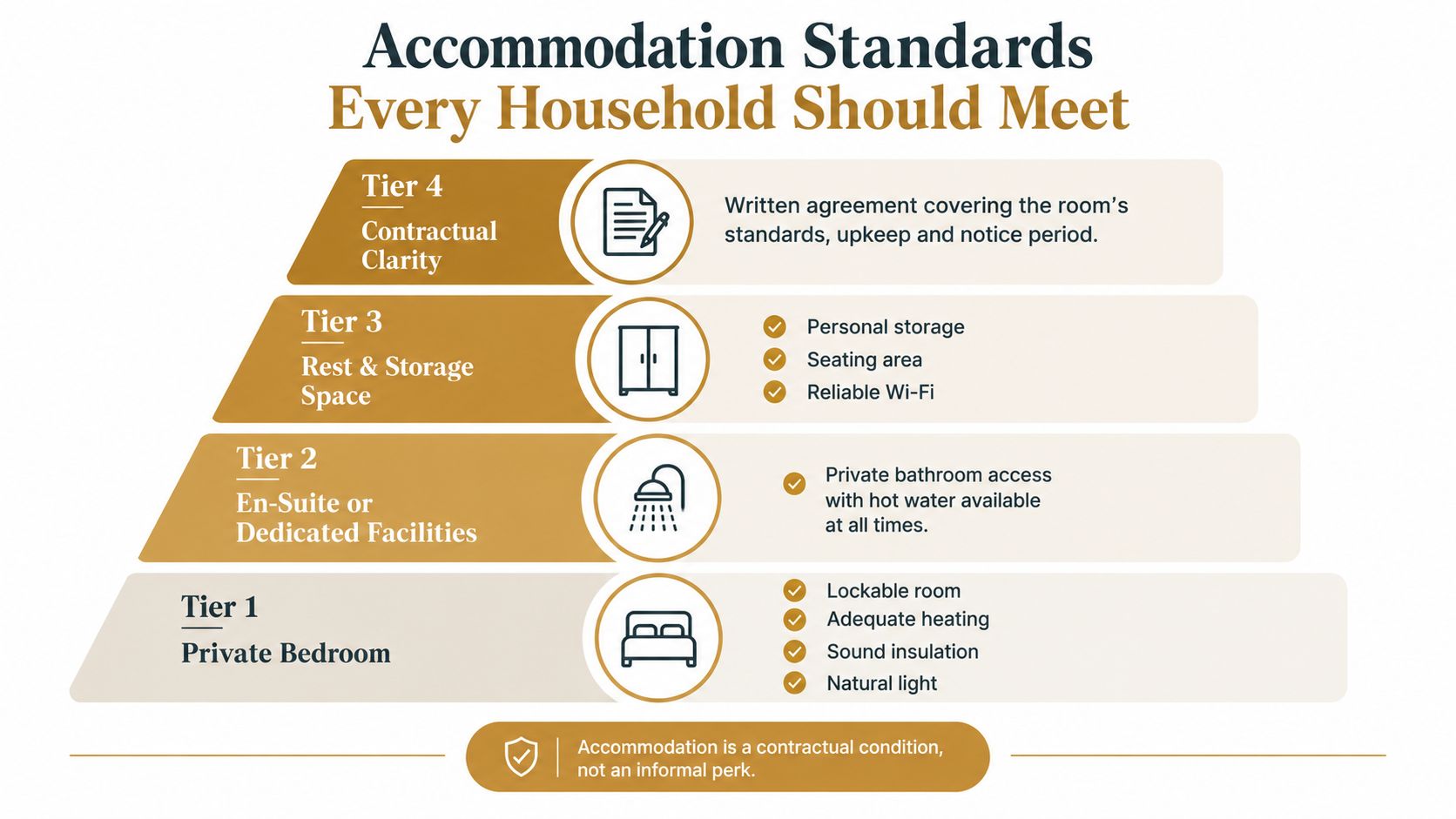
A bedroom is not a casual perk added to a salary package. It's part of the employment environment, and its quality tells a professional whether the family understands residential work. The room should be private, lockable, adequately heated, quiet enough for sleep and large enough for personal belongings.
Start with privacy and practical use
A suitable room needs more than an attractive bed. Check the door lock, natural light, ventilation, heating, sound levels, storage, seating and reliable internet access. The employee should know whether the bathroom is private, shared or dedicated for staff use, and whether the kitchen can be used during personal time.
Households should also agree on room entry. Family members, children, contractors and other staff shouldn't enter private quarters without notice except for a genuine emergency. Visitor rules should be reasonable, written down and applied consistently.
A detailed guide to ultimate guest bedroom prep provides a useful starting point for assessing bedding, storage and presentation. A staff bedroom doesn't need to imitate a guest suite, but it should meet a professional standard of comfort and dignity.
Put the condition in writing
The agreement should describe the room and facilities at the start of employment, along with responsibility for upkeep, repairs and notice if the accommodation changes. If a family expects the employee to move between properties, each residence should have a comparable private arrangement or the contract should explain the alternative.
The UK position is particularly important for international households. UK immigration guidance requires written terms and, where the worker lives in, adequate maintenance, accommodation and a separate bedroom. The Health and Safety Executive guidance for domestic work also explains that directly employed domestic servants aren't covered by the Health and Safety at Work Act 1974, making clear contractual controls around chemicals, lifting, equipment, accidents and emergencies essential.
Accommodation standard: A room becomes part of a fair employment package only when privacy, use and upkeep are clear.
Designing Fair Compensation and Clear Boundaries
Compensation should follow time worked, not the number of hours a housekeeper is physically present at the property. UK evidence submitted to the Low Pay Commission records the risk of fixed weekly or monthly pay producing an effective hourly rate below the National Minimum Wage when long hours go unrecorded. The practical answer is a time-and-duty schedule supported by signed timesheets and regular payroll reconciliation.
For a UK live-in housekeeper aged 21 or over, the statutory National Living Wage is £12.71 per hour from 1 April 2026, across England, Wales, Scotland and Northern Ireland, according to the UK Government's National Minimum Wage guidance. Families must check the rate applicable to the worker and arrangement, then calculate pay against actual working time.
Build a transparent payroll process
The contract should identify:
- Contracted hours: The normal working pattern and expected start and finish times.
- Additional work: How overtime, emergency call-outs and overnight disturbances are approved and recorded.
- Leave and rest: Days off, holiday entitlement, sickness and required uninterrupted rest.
- Deductions: Any lawful deductions, including how accommodation is treated.
- Multiple residences: Travel between properties, packing, arrival preparation and time spent relocating household operations.
Accommodation can affect minimum-wage calculations through the statutory accommodation offset. From 1 April 2026, the offset is £11.10 for each day accommodation is provided, as set out in the relevant UK legislation. The rules can apply whether rent is deducted from wages, charged separately after wages are paid or included in the employment package. Any amount above the permitted offset can reduce pay counted towards compliance.
Treat boundaries as a retention system
A strong package combines fair pay, credible rest and suitable accommodation. Remove one element and the arrangement becomes unstable. A generous salary won't repair a housekeeper's trust if the bedroom is entered without notice, while attractive accommodation won't compensate for unpaid active duty.
Families considering live-in housekeeper salary guidance should use it alongside legal advice and a written time record. International hires need particular care with immigration terms, wage compliance and accommodation documentation. The UK Government also states that domestic workers' minimum-wage entitlement depends on the legal facts of the arrangement, so live-in status alone doesn't create unlimited availability.
Why Live-In Housekeeping Remains Valuable for Private Households
The assumption that presence equals availability undermines the very value families seek. A live-in housekeeper is valuable because they provide continuity, not because they can be summoned without limits. They learn how a residence operates, maintain standards during family travel and prepare spaces around arrivals, departures and entertaining.
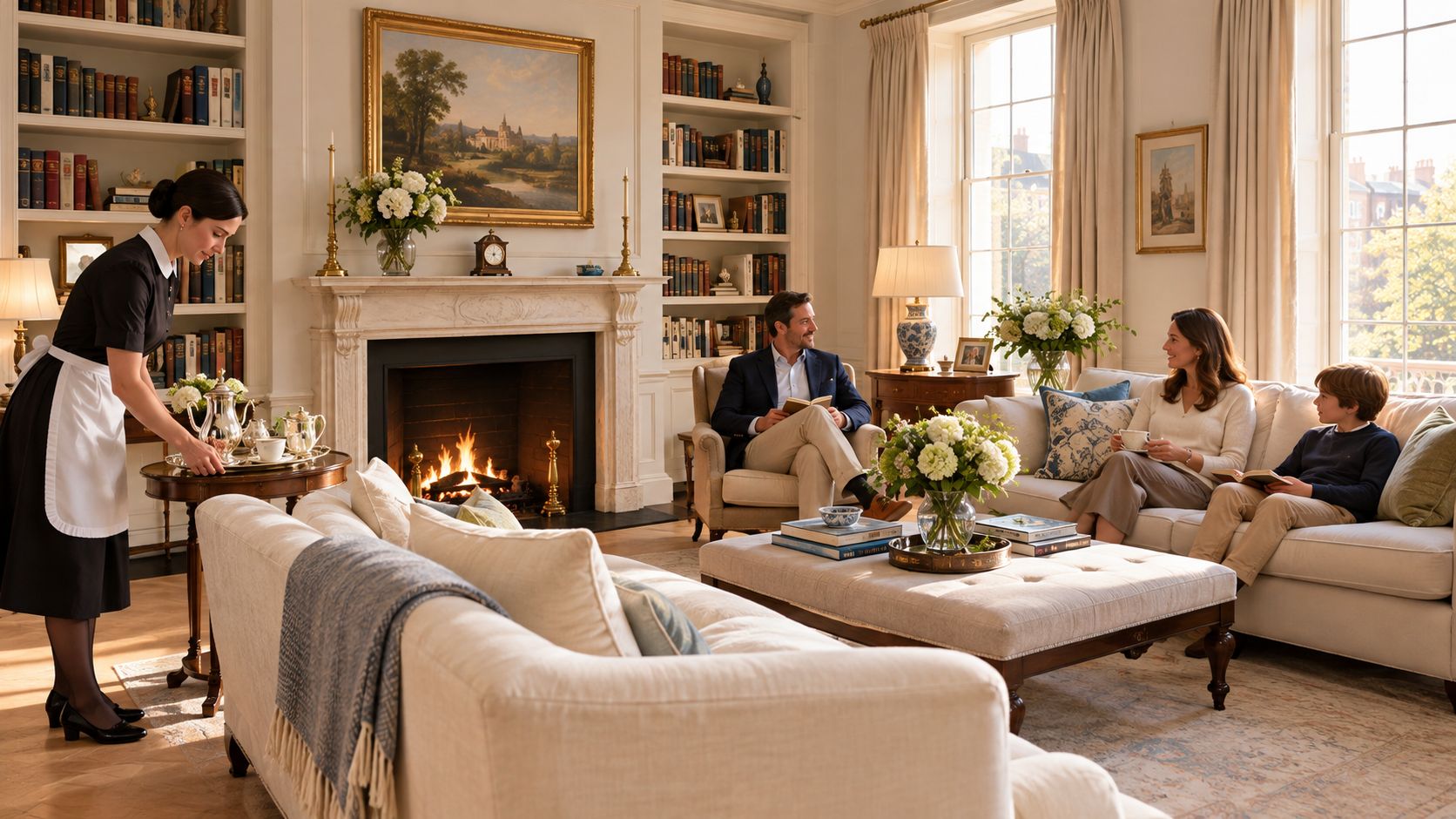
Presence creates operational knowledge
A resident professional may notice that a guest suite needs a different linen setup, that a wardrobe requires seasonal rotation or that a property needs preparation before the family's arrival. That knowledge reduces repeated explanations and supports consistent service across residences.
The arrangement also suits families whose needs don't fit a conventional commuting pattern. Travel between properties, private entertaining and changing household routines can make continuity valuable, provided the schedule remains realistic. The family gets a stable point of responsibility, while the employee gets a role with defined standards and a livable environment.
Design the role for a career professional
Experienced housekeepers are more likely to commit when the position reflects professional respect. That means accurate duties, written hours, proper rest, a private bedroom, clear reporting and a sensible process for exceptional requests.
The historical model of domestic service relied on blurred lines. A contemporary household should do the opposite. The family should be able to say exactly when the housekeeper is working, what success looks like and how private time is protected. That structure doesn't reduce responsiveness. It makes responsiveness sustainable.
Superstar Nannies places live-in housekeepers for private households, including professionals handling deep cleaning, laundry, wardrobe management and household organisation. The agency also supports live-in housekeeper-nanny placements where housekeeping and childcare responsibilities are combined, provided the family defines both roles clearly from the outset.
For discreet support with a properly scoped live-in housekeeper placement, visit Superstar Nannies. The agency can help your family define duties, accommodation expectations and working boundaries before introducing suitable private household professionals.