

If you're looking at cabin crew jobs on private jets, you're probably drawn to the same things most strong candidates are drawn to. Beautiful aircraft. International travel. A smaller, more polished service environment. Work that feels closer to luxury hospitality than a standard airline rota.
That instinct isn't wrong. It's also incomplete.
Private aviation rewards people who can deliver calm, exacting service in a highly visible environment where every detail is noticed and very little is forgiven. One poorly handled request, one loose comment in the wrong setting, one lapse in preparation, and your reputation can narrow quickly. In the UHNW world, technical competence gets you considered. Discretion, judgement, and consistency get you hired again.
Your Gateway to the World of Private Aviation
A candidate often starts in the same place. She has worked hard in commercial aviation or luxury hospitality, she knows she can handle pressure, and she wants to move into a more rarefied part of the market. She sees cabin crew jobs on private jets and assumes the leap is mostly about polish.
It isn't. It's about fit.
On a private aircraft, you're not one member of a large service machine. You may be the only person in the cabin. That changes everything. You're responsible for safety, timing, presentation, guest comfort, communication with the flight deck, and the tone of the onboard experience. Clients notice whether you anticipate needs discreetly or perform obviously. The best crew make premium service feel effortless, even when the day has been anything but.
That's why candidates who do best usually understand the wider logic of elite recruitment before they ever apply. The standards are similar to other high-trust household and lifestyle roles, where privacy, compatibility and judgement matter as much as formal credentials. If you want a useful parallel, this guide to what a luxury staffing agency does for discerning families explains the kind of environment many private aviation clients also expect.
What separates this world from airline service
Commercial aviation teaches structure. Private aviation tests adaptability.
A strong private jet cabin crew member needs to move comfortably between roles such as:
- Safety professional who can complete checks, brief passengers properly, and stay composed in an emergency
- Luxury host who can deliver refined service without becoming theatrical
- Problem-solver who can absorb last-minute changes without showing strain
- Trusted presence who knows when to speak, when to step back, and what never leaves the aircraft
Private aviation isn't an upgrade from airline service in the usual sense. It's a narrower profession with higher trust, less margin for error, and far more personal scrutiny.
Laying the Foundation for a High-Flying Career
Most applicants underestimate the baseline. Cabin crew jobs on private jets are not entry-level hospitality roles. The strongest candidates usually arrive with proven service discipline already built somewhere else.
A recent industry guide notes that the most competitive candidates typically need 2–3 years of prior commercial cabin crew or luxury hospitality experience, and specialist corporate flight attendant training is usually a 5–10 day programme costing $2,000–$5,000 according to BlackJet's guide to private plane stewardess jobs. In practice, that means the market expects evidence, not just enthusiasm.
The non-negotiables
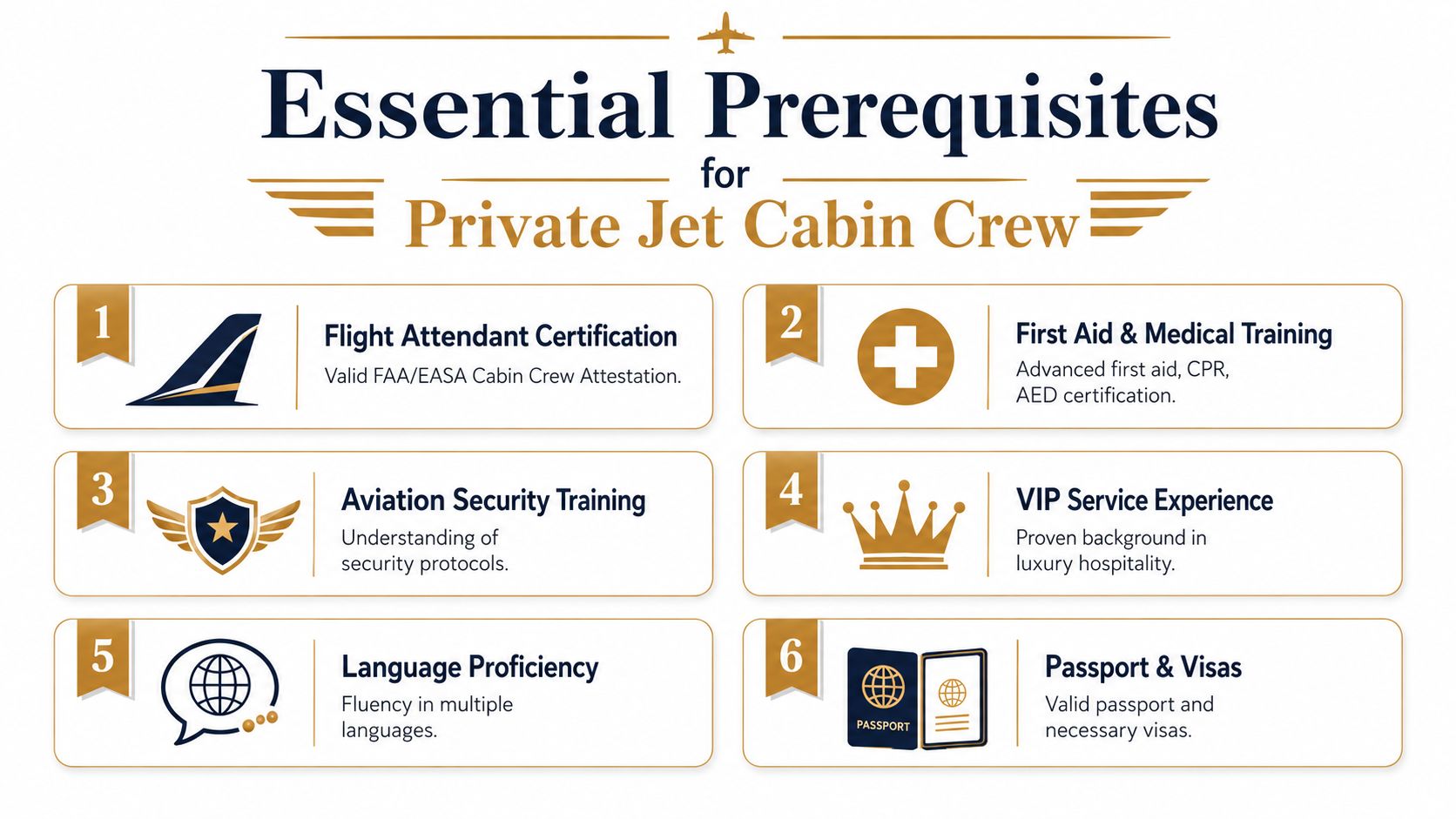
You need a foundation that shows you can operate safely in aviation, not just serve well.
That usually includes:
- Recognised cabin crew background with training that proves you understand aircraft procedures and onboard discipline
- Current first aid readiness including CPR and AED competence, because medical confidence matters in a small-cabin environment
- Security awareness and the maturity to work around high-profile travellers without becoming overfamiliar
- Valid travel documents because last-minute international movement is part of the role, not an exception
- Polished service history from airlines, five-star hotels, luxury villas, or yachts
- Strong communication including calm English and, where possible, additional languages
What operators actually value
The mistake many candidates make is over-investing in aesthetics and under-investing in credibility. A beautiful CV and immaculate grooming won't offset weak safety grounding. Nor will a luxury retail background on its own.
Employers want proof that you can do the less glamorous parts of the role with precision:
| What works | What doesn't |
|---|---|
| Demonstrated cabin discipline | General claims about being “passionate about travel” |
| Premium service in structured settings | Hospitality experience with no high-pressure service component |
| Current certificates and organised documents | Out-of-date paperwork and vague timelines |
| Evidence of calm under pressure | A profile built mainly around glamour |
Practical rule: If your background says “good with guests” but not “safe in aviation”, you're not yet market-ready.
The experience route that opens doors
Candidates from commercial airlines often have the advantage of routine, safety standards and passenger handling. Candidates from luxury hospitality can still break in, but only if they can show transferable service at a very high level and add the aviation-specific training that closes the risk gap.
For many people, the strongest plan is simple:
- Build real service mileage in commercial cabin crew or elite hospitality.
- Add specialist private aviation training once your profile is credible.
- Target roles that value crossover talent rather than trying to leap too far too soon.
If you're already exploring adjacent elite staffing paths, it helps to understand how employers screen premium candidates across the wider market. These private household staff jobs show the same pattern. Trust, polish and reliable references matter at every level.
Crafting Your Application for the VIP Sector
A standard CV is rarely enough for this market. It may show where you worked, but it often fails to show how you work. In private aviation, that gap matters.
When a recruiter reads your application, they're not only asking whether you can plate a meal properly or manage a cabin turn. They're asking whether you will protect the client's privacy, remain calm around wealth, and represent the operator without needing hand-holding. Your documents have to answer those questions before anyone meets you.
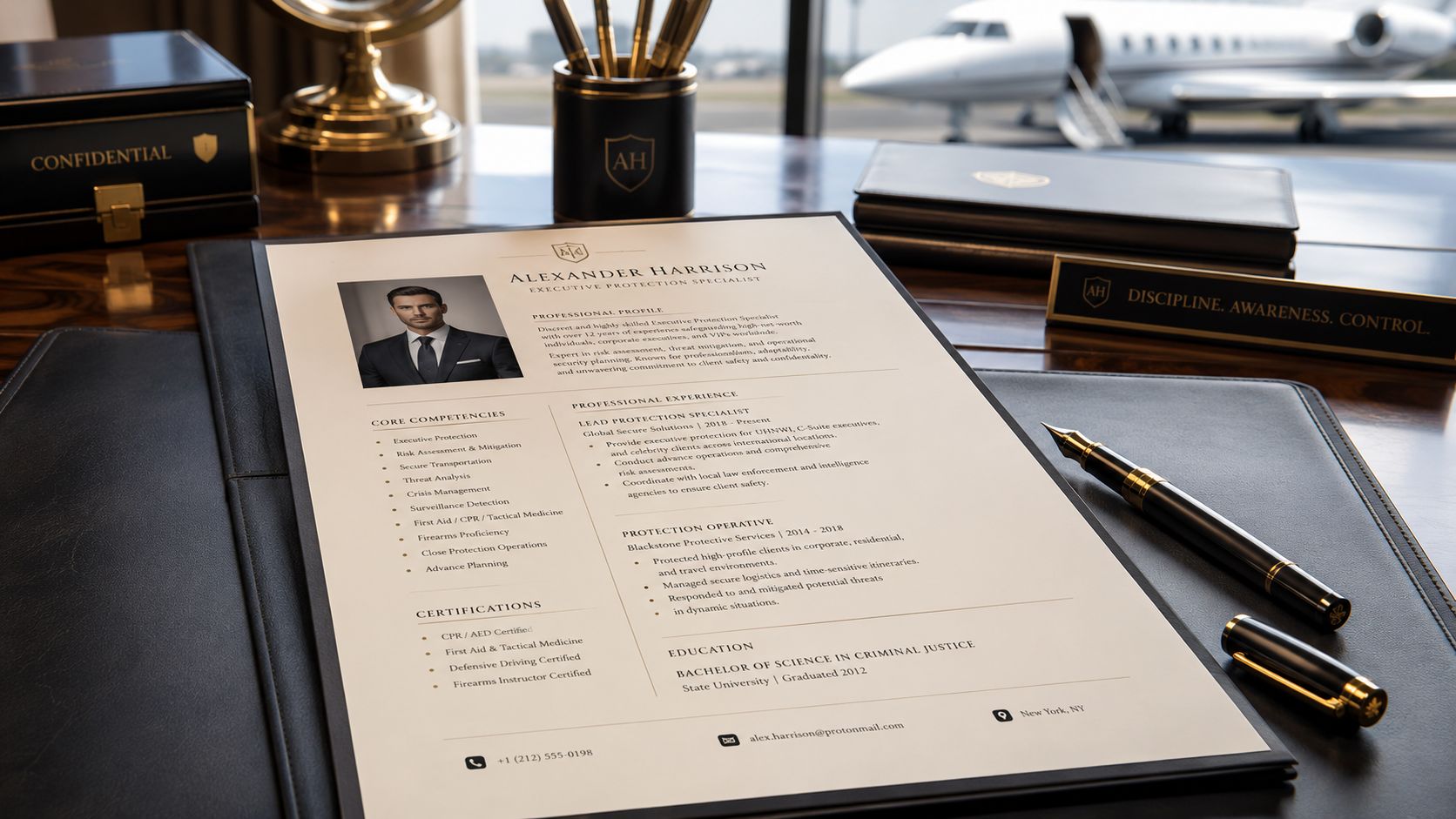
Your CV needs to read like a private aviation profile
That means stripping out generic language and replacing it with signals of judgement and professionalism.
A stronger application usually includes:
- Role-specific framing that makes clear you understand private aviation is bespoke, discreet and operationally demanding
- Relevant environments such as premium cabins, five-star properties, luxury yachts, villas, or family office travel support
- Examples of complexity including dietary requests, cultural sensitivity, itinerary changes, and coordination under time pressure
- Clean presentation with no clutter, no novelty design, and no overdone personal branding
“Excellent people skills” says very little. “Managed VIP guest requests discreetly across fast-changing service environments” says much more.
The cover letter still matters
Most weak cover letters repeat the CV. The stronger ones show judgement.
Use yours to establish three things quickly:
- Why this sector suits you
- What part of your background transfers cleanly
- Why you understand the standards are higher, not merely more luxurious
That tone matters. You're not applying to be impressed by the lifestyle. You're applying to support it professionally.
The best applications sound composed. They don't oversell. They don't gush about glamour. They read like someone who already understands the room.
Your digital presence has to match your paper profile
Recruiters will often look beyond the CV. If your LinkedIn is careless, sparse or full of oversharing, it weakens confidence immediately.
Keep your online presence:
- Professional in wording and imagery
- Discreet with no client references, tail numbers, or suggestive travel posts
- Consistent with your CV dates, role titles and service level
- Subtly polished rather than highly performative
The private market notices restraint. A profile built around lifestyle signalling can make an otherwise capable candidate look risky.
Mastering the Interview and Assessment Process
Interviews for cabin crew jobs on private jets are rarely just interviews. They're judgement tests.
A recruiter may ask about catering, service style or difficult passengers, but the underlying question is usually different. Can you prioritise safety without becoming rigid? Can you absorb pressure without showing irritation? Can you handle proximity to wealth without losing perspective?
Private aviation hiring follows a safety-first / hospitality-second workflow. Recruiters first verify aviation safety training, first-aid, CPR and AED readiness, plus emergency procedure knowledge before they assess service skills, as reflected in private jet cabin crew job descriptions on Indeed.
What they're really testing
Scenario questions are common because they reveal instinct.
You may be asked how you'd respond if a client changed catering at the last moment, arrived with an undeclared guest, or rejected the planned service flow. A polished answer isn't enough. Interviewers want to hear prioritisation, communication, and calm sequencing.
They also listen for your understanding of discretion. Strong candidates don't describe it as “keeping secrets”. They describe it as professional containment. You see things, hear things, and carry sensitive information without making yourself part of the story.
How to prepare properly
A surprising number of applicants prepare only for the service side. That's too narrow.
Work through these areas before interview day:
- Safety recall so you can speak clearly about procedures and onboard readiness
- Service judgement so your answers feel bespoke rather than scripted
- Professional boundaries especially around VIP familiarity, children, assistants, and entourage dynamics
- Composure because rushed or overly eager delivery can damage otherwise good answers
If you want to sharpen your responses without sounding rehearsed, tools like AI-powered interview coaching can help you practise scenario answers and tighten weak phrasing before a live interview.
A private aviation interview often turns on one simple impression. Would I trust this person in a high-pressure cabin with a sensitive client and no supervision?
Navigating the Job Market and Landing Your Role
The private aviation job market is smaller than many candidates expect, and much of it runs on reputation. Public listings exist, but some of the best opportunities move through specialist recruiters, operator networks, pilot referrals, and trusted word of mouth.
That's why a broad, untargeted search usually produces poor results. Cabin crew jobs on private jets reward precision. You need to know where your profile fits and pursue those lanes properly.
Where serious candidates look
Established operators set a high bar. VistaJet states it requires a minimum of three years of corporate cabin crew experience and values backgrounds from five-star hotels or luxury yachts, as outlined in VistaJet's flight attendant careers page. That tells you something useful. The market does hire crossover talent, but it expects it to be refined and credible.
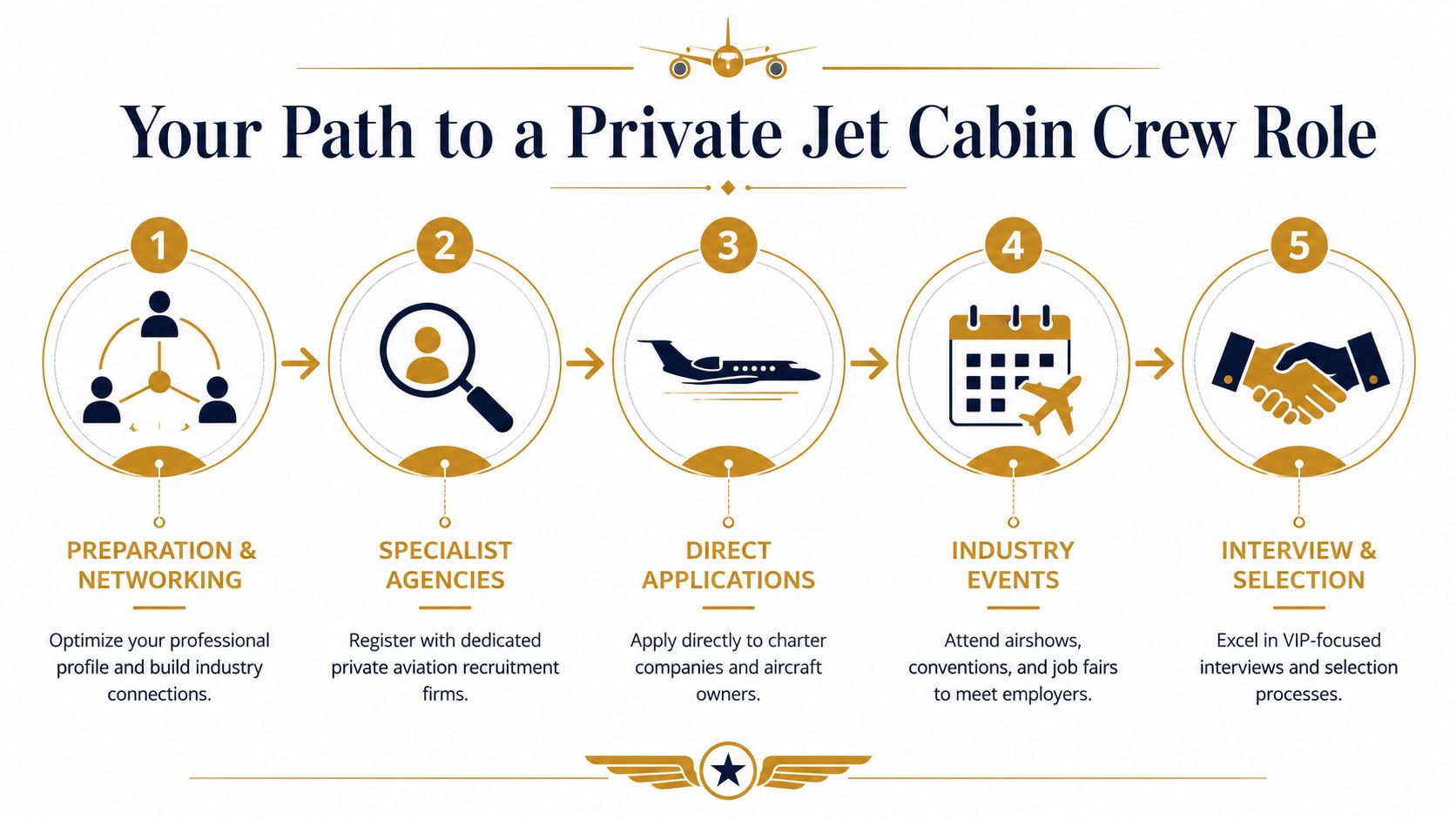
Your search is usually strongest when spread across a few focused channels:
- Specialist recruiters who understand private aviation and wider UHNW staffing standards
- Direct operator applications when your profile already matches their threshold
- Professional networking with pilots, crew and operations contacts who know your work
- Carefully managed LinkedIn activity that supports visibility without oversharing
If you're using LinkedIn more deliberately, these LinkedIn job search strategies are useful for tightening your profile and improving how recruiters find you.
How to tell a good route from a bad one
Not every opportunity is worth your time.
A reputable route usually looks like this:
| Green flags | Red flags |
|---|---|
| Clear role brief | Vague promises about luxury travel |
| Professional screening process | Informal messages with little role detail |
| Questions about training and references | Fast pressure to commit without due diligence |
| Realistic standards | Claims that anyone with “good energy” can do it |
For candidates targeting elite roles more broadly, it also helps to understand how top-end recruitment firms operate across adjacent categories. This guide to private staffing agencies for elite households gives a useful benchmark for the discretion and vetting standards serious employers expect.
Networking without becoming visible in the wrong way
Discreet networking is not self-promotion. It's credibility-building.
Stay in touch with former colleagues. Ask for introductions carefully. Attend relevant industry events when appropriate. Be remembered for reliability, not for trying too hard to be seen. In this market, quiet professionalism travels further than constant visibility.
The Reality of Life at 40,000 Feet
This career can be rewarding, but glamour is the least useful way to understand it.
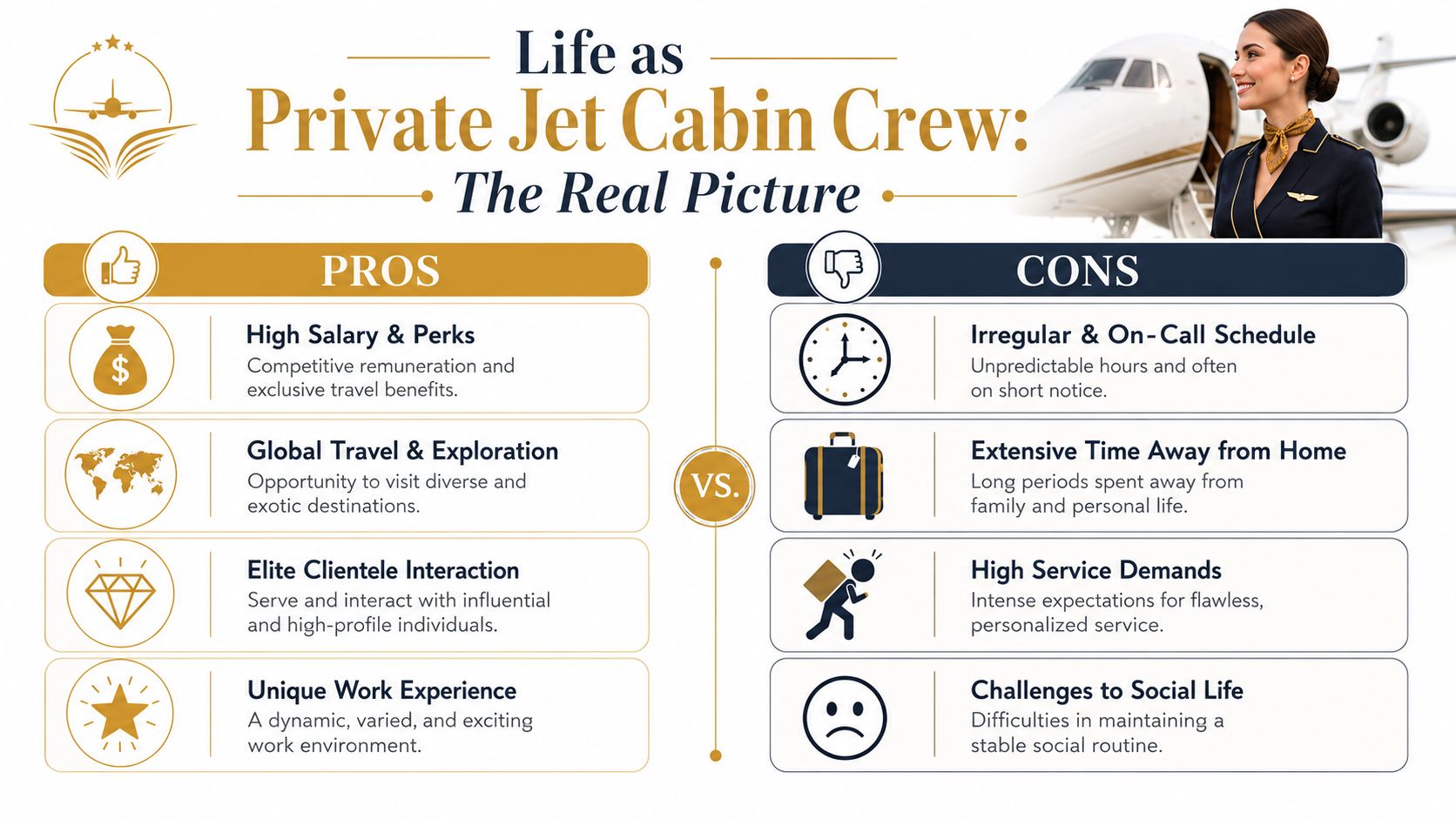
A recent industry guide says full-time private jet cabin crew commonly earn $60,000–$120,000+ annually, while freelance roles can pay $500–$1,500 per flight day according to BlackJet's private aviation career guide. For wider context, the U.S. Bureau of Labor Statistics reports that flight attendants had a median annual wage of $67,130 in May 2024 in the broader market, as shown in the BLS flight attendant occupational outlook. The pay differential reflects specialisation, flexibility and the demands of the role.
What the role gives you
At its best, private aviation offers a very distinctive professional life.
You may gain:
- Higher earnings potential than mainstream cabin crew work
- Close-up experience of elite service standards that transfers into other UHNW roles
- A varied working environment with changing routes, clients and service styles
- A powerful professional network if you build a strong reputation over time
For candidates who also come from the marine world, there's a similar lifestyle pattern in elite travel staffing. This perspective on luxury yacht crew and elite team building shows why crossover candidates often adapt well.
What the role asks in return
The trade-off is personal stability. This isn't a neat diary job.
Expect:
- Last-minute itinerary changes
- Time away from home
- Long, irregular days
- High emotional discipline
- Clients whose expectations are exacting, sometimes unspoken
The service standard is also different from commercial work. You may be expected to personalise the experience without becoming familiar, to remember preferences without making a display of remembering them, and to remain warm without ever becoming casual.
Some candidates can deliver beautiful service once. The career belongs to those who can do it repeatedly, under pressure, while staying discreet and easy to work with.
Boundaries matter
One of the less discussed skills in private aviation is professional distance. Clients may be warm, informal, and appreciative. That does not make the relationship casual.
The best crew stay consistent. They don't become impressed, offended, chatty, or emotionally entangled. They protect the atmosphere of the cabin by being dependable, contained and unfailingly courteous.
Frequently Asked Questions About Private Jet Cabin Crew
Can I get a private jet cabin crew job without airline experience
Yes, but it's harder.
The market increasingly prefers prior corporate cabin crew experience, yet candidates from superyachts or five-star hospitality can still be viable if they pair that background with the right safety training, as reflected in UK-focused private jet flight attendant listings. The key is transferability. Luxury exposure alone isn't enough. Employers need confidence that you can function safely in an aviation environment and handle the pace, documentation and discretion the role requires.
What kind of mindset helps most in this sector
Three qualities matter more than candidates often realise.
First, containment. You need to keep your reactions private. Second, anticipation. You should notice needs early and solve discreetly. Third, ego control. The role is visible, but it isn't about being noticed. Candidates who need praise, excitement or constant affirmation often struggle. Those who take satisfaction in precision and calm service usually last much longer.
Are freelance roles a good way in
They can be, but they're not automatically easier.
Freelance work suits candidates who already have current documents, a strong network and the confidence to move between operators or owners without much hand-holding. It can build excellent experience and expose you to different service cultures. It also requires you to stay organised, adaptable and consistently available. If your references or readiness are weak, freelance work tends to expose that quickly.
What makes a candidate memorable in the right way
Usually not what they think.
Recruiters remember candidates who are prepared, measured, discreet, well-documented and easy to trust. They don't remember the most glamorous answer. They remember the person who understood safety, answered directly, presented neatly, and gave the impression that nothing confidential would ever leave their care. In the UHNW world, reassurance is a premium skill.
Is this a long-term career or a stepping stone
It can be either.
Some people build a substantial long-term career in private aviation. Others use it to move into training, service leadership, family office travel support, luxury concierge work, or related UHNW staffing positions. The deciding factor is usually not talent alone. It's whether your lifestyle, resilience and personal boundaries match the reality of the work over time.
If you're exploring cabin crew jobs on private jets and want guidance from a team that understands discretion, elite standards and high-trust placements, Superstar Nannies supports exceptional professionals and discerning families across the private staffing world. Reach out to discuss your next move or the calibre of candidate your household requires.