


Your townhouse is ready for guests, but the seasonal residence has an unresolved heating fault and the country property needs approval for drainage work. The housekeeper, security lead and gardener are all doing their jobs well. Yet the decisions still reach you, separately, without a clear view of what matters most or what the estate can safely defer.
That's the situation in which a director of estate becomes worth considering. The question isn't whether your household needs a grander title. It's whether someone should hold clear responsibility for the properties as a whole, beyond the quality of daily service.
Why Families Hire a Director of Estate
Consider a household morning across several properties. At the townhouse, the house manager is preparing for visitors. At the seasonal residence, a contractor wants permission to replace equipment. At the country property, the gardener has noticed water collecting near an outbuilding.
Each person has a reasonable request. Nobody has compared the consequences, checked the wider spending plan or established whether the proposed work overlaps with something already commissioned. The principal becomes the meeting point for every unresolved decision.
The weakness isn't necessarily in the staff. It's in the space between their responsibilities.
When excellent service isn't enough
A beautifully presented home can still have poorly coordinated property management. The family sees clean rooms, thoughtful service and well-kept grounds, while the less visible questions remain unsettled. Who decides whether to repair or replace ageing equipment? Who checks whether a contractor's recommendation fits the long-term plan?
A director of estate is the senior person appointed to bring buildings, grounds, utilities, people and budgets into a managed whole. In the model described here, the director reports to the principal or family office rather than sitting entirely within the daily household routine.
Think of a conductor who doesn't play every instrument. The director doesn't need to repair the heating, supervise every dinner or personally assess every tree. They need to understand how the different activities fit together, recognise when specialist judgement is required and make sure somebody owns the outcome.
Practical rule: Hire for the decisions that currently have no clear owner, not for the prestige of the title.
Recognising the need for senior oversight
The case becomes stronger when a family's arrangements create persistent coordination problems:
- Conflicting priorities: Different properties compete for attention, with no agreed basis for deciding what comes first.
- Repeated referrals: Staff keep asking the principal to resolve matters that should sit within an established management structure.
- Unclear accountability: Everyone has completed their own task, but nobody can explain whether the overall problem is resolved.
- Dependence on personal knowledge: Important arrangements exist in conversations or individual inboxes rather than an accessible household record.
Multiple homes can make these problems more apparent, but property count alone shouldn't determine the appointment. A technically complex residence with extensive grounds and substantial projects may need more senior oversight than a straightforward portfolio.
Trust and discretion remain essential. They don't replace a plan, delegated authority or a record of important decisions.
For the principal, the useful outcome is clarity: what the post should cover, whom it should report to, how it differs from existing household roles and whether the complexity justifies it. The problem this role is hired to solve is fragmented ownership of the estate, not insufficiently polished service.
How the Director of Estate Title Took Shape
The modern title has a useful history because it explains the difference between managing individual jobs and taking responsibility for property over time. Its UK institutional roots point towards senior stewardship, not a more elegant name for maintenance supervision.
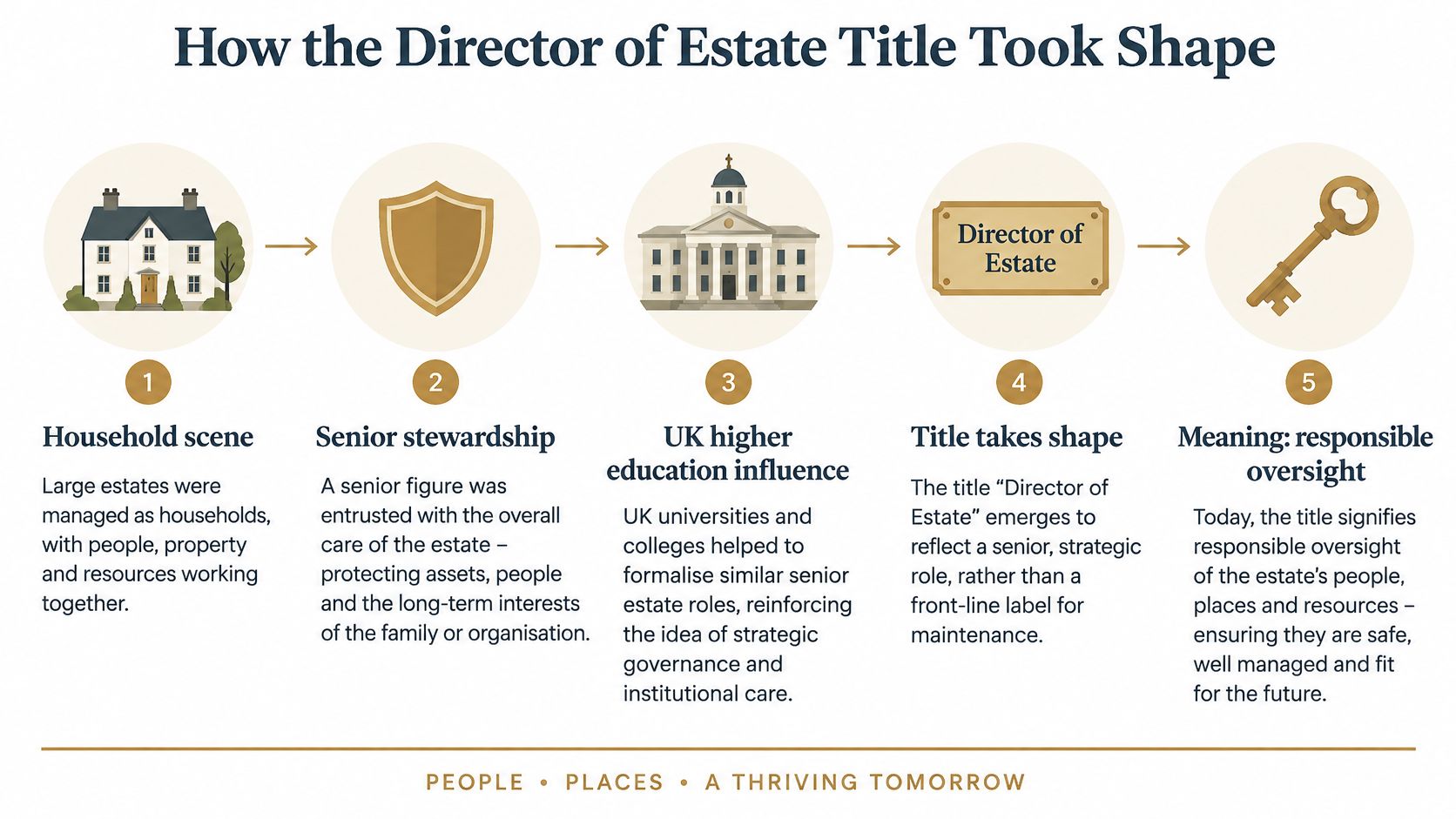
According to the Association of University Directors of Estates' history, the modern Director of Estates title emerged from post-war university expansion: during the 1950s, bursars or equivalent senior officers commonly handled estates responsibilities, while national building discussions took place through special sessions at the annual conference of University Finance Officers; specialist buildings and development posts followed as institutions expanded, the Director title became increasingly common during the 1980s and was the most common designation for heads of university estate departments by the decade's end, and professionalisation continued in 1992 when the Association of Building Officers and the Polytechnic Building Officers Group merged to form the association.
From delivering buildings to looking after an estate
The important change wasn't just the wording on an office door. Universities needed people who could oversee construction, capital programmes and property operations as their buildings and activities grew.
The responsibility then widened. Delivering a new building wasn't enough if the institution couldn't maintain it, use it effectively or adapt it to changing needs. Estates leadership came to encompass long-term maintenance, rationalisation, facilities management and alignment between property assets and institutional strategy.
That distinction translates readily into a private home. Completing a refurbishment answers one question: has the project been delivered? Stewardship asks others: can the household operate the new systems, maintain them sensibly and support the family's intended use of the property?
The title's development is illustrated below.
What a private family should take from that history
A family doesn't need to reproduce a university management structure. Nor should institutional experience automatically qualify someone for a private household appointment. A director must also understand privacy, family preferences and the judgement required when working around an occupied home.
The historical lesson is about breadth and time horizon:
- Performance: Does the property work as the family needs it to, rather than merely look finished?
- Resilience: Can essential services continue when equipment fails or circumstances change?
- Development: Do proposed alterations support the intended future use of the home?
- Operational use: Can staff run the estate without unnecessary complexity or dependence on a particular supplier?
For example, a proposed leisure-building refurbishment shouldn't be assessed only through finishes and construction costs. The director should also consider access for maintenance, operating requirements, staff capability and what the family intends to use.
That's the standard implied by senior stewardship. The role connects today's decisions with the estate the family will have to operate tomorrow.
What a Director of Estate Is Accountable For
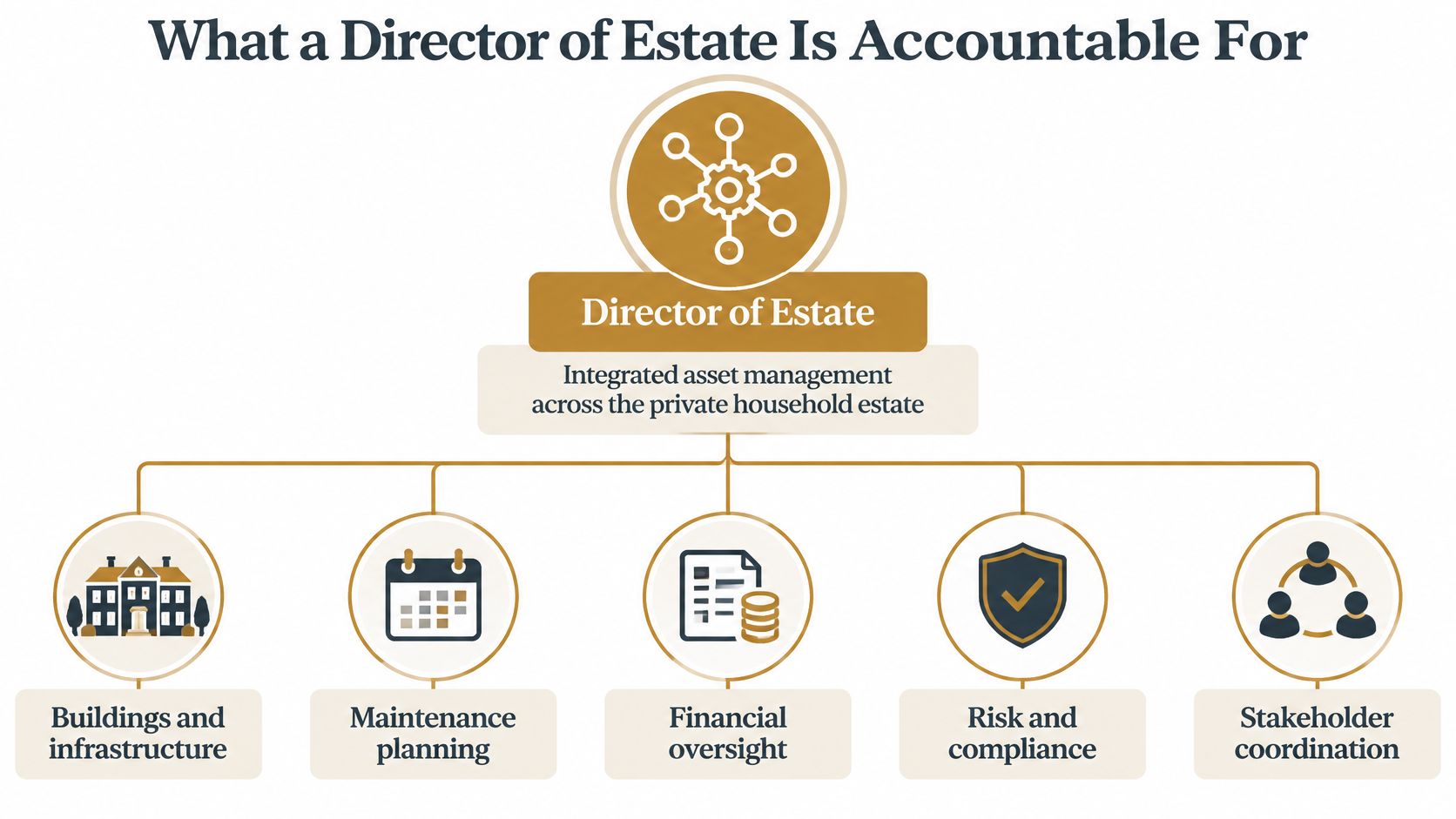
The director should own an integrated asset-management system, not just a longer repairs list. In plain language, that means knowing what the estate contains, what condition it's in, what needs attention and who has authority to act.
The UK Government's Estate Management Competency Framework assigns senior estates roles responsibility for developing and delivering an asset-management plan, managing projects, maintaining health-and-safety compliance, leading staff and aligning resources with strategy, with the plan reviewed annually. For a private household, this provides a useful management model rather than a household-specific legal standard.
Build the plan around the property
A private estate's rolling plan should bring together buildings, grounds, utilities, security, staffing, preventative maintenance, capital works and relevant regulatory obligations. The family's intended use should shape it: a residence occupied seasonally needs different preparation from a home occupied continuously.
The central working record is an asset register. This should be more useful than a list of equipment names:
- Condition and criticality: Record the asset's state and the consequences if it fails.
- Maintenance and replacement: Note planned service dates, replacement forecasts and unresolved defects.
- Responsible parties: Identify the supplier, internal owner and person authorised to commission work.
- Inspection evidence: Keep relevant certificates, reports and outstanding actions with the asset record.
Generators, water systems, lifts, fire systems, access controls and heating plant should be considered by risk, not by how visible they are to the family. A worn decorative finish and an unreliable water pump don't deserve the same response just because both appear on a maintenance list.
Make authority as clear as responsibility
For the reporting structure to work, the director should report to the principal or a designated family-office lead. House, grounds, security and project leads can then report into the director within their agreed scope.
Written delegated authority should distinguish routine expenditure, exceptional expenditure and emergency action. It should also identify who can appoint contractors, change project scope and approve payment. A family can retain approval over significant commitments without being asked to authorise every operational detail.
The broader explanation of what estate management involves helps establish the services underneath this senior accountability. The director's particular responsibility is to make those services function together.
The scheduled review should use condition surveys, defects, energy consumption, incident records, contractor performance and budget variance to adjust the next investment cycle. If a heating system repeatedly fails despite servicing, the director should reassess the replacement decision rather than keep approving the same repair.
This creates a practical feedback loop: evidence changes priorities, priorities change the plan, and the principal can see why spending decisions have changed.
How a Director of Estate Differs from Other Roles
A director of estate and a house manager may work closely, but they shouldn't be interchangeable appointments. The clearest distinction is between running the household's daily life and directing the estate's long-term property performance.
Titles aren't a substitute for a job description. For a private appointment, the family should define scope, reporting lines and approval powers before deciding what to call the post.
Private Household Roles Beside a Director of Estate
| Role | Primary focus | Typical reporting line | Decision rights |
|---|---|---|---|
| Director of estate | Property strategy, capital priorities, compliance assurance and team and contractor performance | Principal or family-office lead | Estate-wide decisions within written delegated authority |
| Estate manager | Land, grounds and day-to-day property operations | Principal or director of estate | Operational spending and supplier coordination within the agreed remit |
| House manager | Domestic routines, staff rotas and household standards | Principal or director of estate | Daily household decisions and approved domestic budgets |
| Butler | Service, hospitality and household protocol | Principal or house manager | Service delivery and supervision within the household structure |
| Family-office lead | Financial policy, ownership objectives and approval of major commitments | Principal or family governance structure | Financial approvals and policy, as authorised by the family |
These are useful design distinctions, not fixed definitions that every household must adopt. An experienced estate manager may already hold a broad strategic brief. Equally, appointing a director doesn't remove the need for someone to organise the practical rhythm of the home.
The detailed guide to an estate manager's role in a UHNW household provides context for deciding whether that existing position needs clearer authority or whether a separate senior post is warranted.
Read the scale without copying it
Institutional specifications demonstrate how broad the director title can become: a 2025 University of Birmingham specification described approximately 200 estates staff, with planned 2024/25 expenditure of £90 million in capital spending and £38 million in revenue spending, approximately £128 million combined; the University of the West of Scotland director specification described four Scottish campuses and one London campus, an operational budget of approximately £5 million and estates and buildings staff costs of approximately £3 million.
These aren't private-household salary benchmarks, staffing recommendations or suggested budgets. The relevant comparison is the breadth of organisational leadership, financial control and property responsibility.
Within a home, the difference becomes clearer through an ordinary project. A house manager might arrange access around the family's schedule and protect household routines during works. An estate manager might coordinate the contractor's attendance and site activity. The director would determine how the project fits the wider estate priorities, with the family office approving commitments reserved to it.
The right title is the one that matches the authority the family is prepared to delegate.
If the principal wants someone to coordinate domestic staff but retains every property and capital decision, a director title may promise more than the position can deliver. If the family needs someone to make reasoned trade-offs across residences, projects and specialist advisers, a purely domestic management brief may be too narrow.
Records, Risk and Reporting to the Principal
A principal shouldn't have to inspect a plant room to understand whether the estate is under control. They should be able to ask a direct question and receive a concise answer supported by records.
Public-sector estates leadership guidance emphasises accurate, complete and current property data alongside portfolio risk management, compliance, contract standards, financial stewardship and investment prioritisation. The private-household application is straightforward: without reliable asset and cost information, a director may prioritise the most persistent request rather than the most important work.
A dashboard that supports decisions
A proposed monthly dashboard should distinguish normal activity from matters requiring intervention. It shouldn't become a collection of reassuring colours without supporting evidence.
Useful measures include:
- Maintenance balance: Planned work compared with reactive repairs, with explanations for recurring failures.
- Compliance actions: Open statutory matters, responsible advisers and unresolved findings.
- Contractor delivery: Performance against agreed service standards, defects and overdue remedies.
- Financial control: Project cost variance, committed expenditure and decisions awaiting approval.
- Operational exposure: Utility consumption, insurance incidents, vacancies and security or continuity concerns.
Each measure needs an owner, a threshold, a corrective action and an escalation route. For example, an overdue inspection action should identify who is resolving it, what interim arrangements are necessary and when the principal or family office must be informed.
Staff reporting should be equally proportionate. The approach to household staff performance metrics can support clear expectations without treating a private home like an impersonal production line.
Keep evidence behind the summary
The director should maintain a risk register that considers probability, impact, detectability and recovery time. A fault that is difficult to notice and slow to recover from may justify more attention than a more frequent inconvenience.
That assessment can inform backup power, water resilience, severe-weather arrangements and substitute suppliers. The director should record the basis for those choices, including specialist advice and any risk the principal knowingly accepts.
Under Part 5 of the Leasehold and Freehold Reform Act 2024, provisions concerning estate-management charges include an accounting-period report by the report date and owners' rights to specified information within the manager's possession. A legal adviser should confirm commencement, applicability and the requirements affecting a particular arrangement; these provisions shouldn't be treated as automatically applying to every wholly private residence.
For shared infrastructure or formal charges, records of expenditure, services, chargeable works and management decisions deserve particular care. Even outside that context, organised documentation helps a director respond to insurer enquiries and explain how a decision was reached.
Assurance test: A completed task and evidence that it was completed are different things.
The principal's reporting pack should therefore connect summaries to inspection evidence, approvals, contracts and incident records. Access should remain controlled, particularly where documents reveal family movements, security arrangements or sensitive property information.
Decarbonisation and Technology Decisions
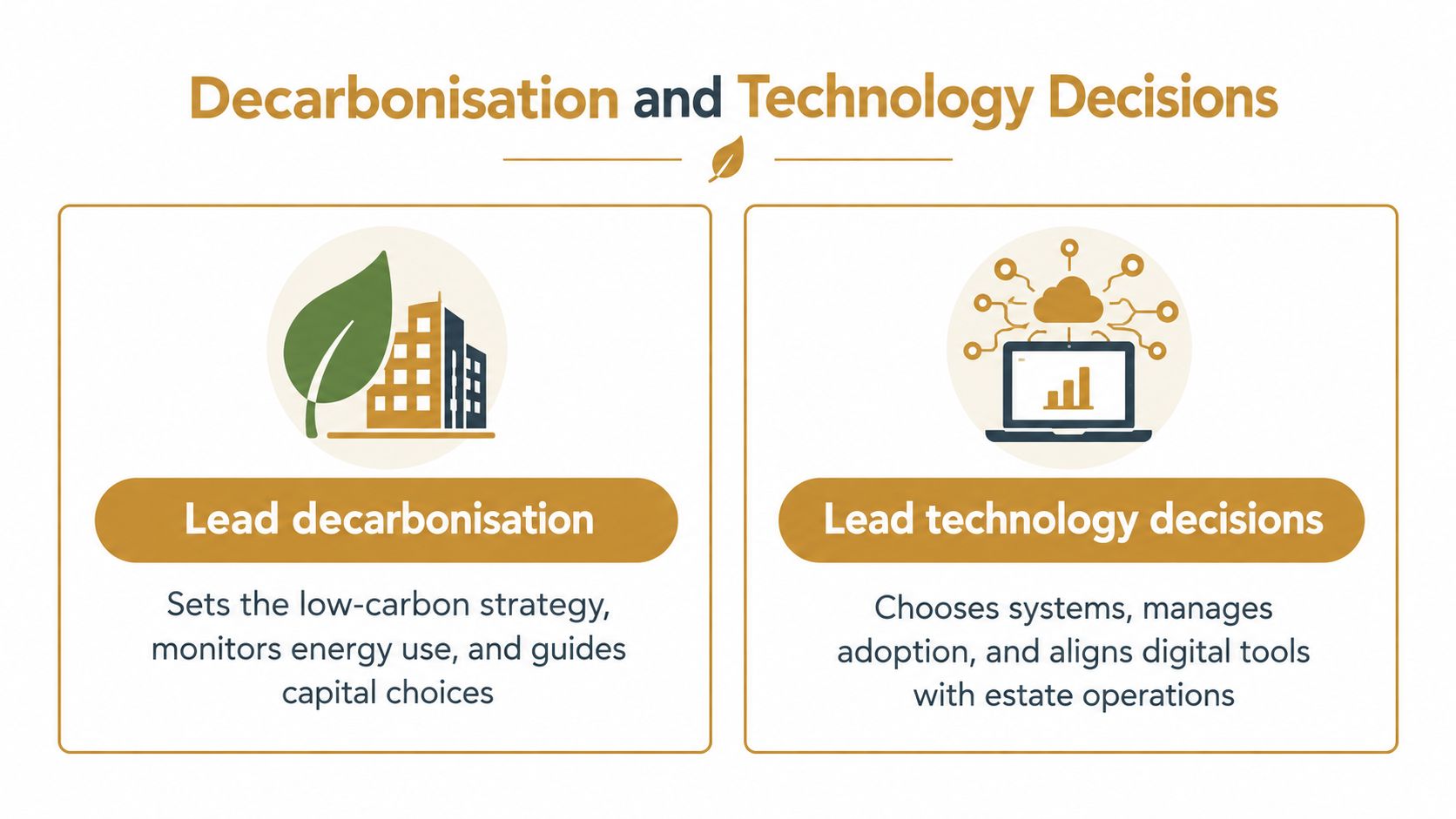
Should the director lead an estate's energy and technology programme, or supervise the contractors? The useful answer is that the director should govern the programme without pretending to be every technical specialist.
Hiring someone with a sustainability interest isn't enough. A proposed heat-pump installation, controls upgrade or fabric improvement needs a defined purpose, credible assumptions and a clear understanding of the property.
Commission expertise rather than assume it
The NHS London Procurement Partnership's estates and facilities market intelligence report identifies a UK requirement of roughly 400,000 energy-transition jobs, an estimated shortage of about 200,000 suitably skilled workers, and 52% of surveyed built-environment professionals identifying carbon auditing as a key unmet skill; it also reports increased automation use among UK property agencies, with nearly 80% saying automation is cheaper than increasing headcount.
Those findings describe wider markets, not guaranteed household savings. They support a careful approach to appointing expertise and testing commercial claims.
For an older house, the director should establish reliable utility and maintenance information, challenge payback assumptions and make protection of the building's character part of the scope. Appropriately qualified or accredited specialists should undertake technical assessment where required.
The family can choose how to obtain that capability:
- Build limited in-house expertise: Train appropriate staff to collect readings, recognise abnormal operation and use systems correctly. The director retains scope and budget oversight.
- Retain an external consultant: Use independent expertise to assess options and challenge proposals. The director supplies reliable data and coordinates decisions.
- Appoint specialist contractors: Commission defined design, installation or maintenance work, with clear acceptance criteria and handover obligations.
A contractor's ability to install equipment isn't the same as independent confirmation that the equipment is the right solution. Where that distinction matters, the director should make it visible before the family commits.
Make technology answer a household need
Smart-home controls, access systems and energy-management tools should begin with an operational problem. Perhaps staff can't identify which heating zones remain active in an unoccupied wing. Perhaps access permissions are difficult to withdraw when a supplier changes.
Before selecting a system, the director should establish who owns the data, who can access it remotely and how permissions will be removed. The family should also understand cyber risks, software support, vendor lock-in and what happens if the service provider stops supporting the product.
Human oversight matters just as much. Staff need an intelligible handover, practical training and a way to operate essential functions when the usual interface fails.
The decision test is simple: does the proposal improve the estate's operation without creating an unacceptable new dependency? The director should be able to answer that before presenting a purchase recommendation.
How to Choose a Director of Estate
The strongest candidate won't necessarily be the most polished person in the room. A private household needs someone who can work discreetly around family life while recognising when a property matter requires formal advice, documented approval or immediate escalation.
The remit may touch residences, land, contractors, security, vehicles, staffing, budgets and sustainability. Building compliance, planning questions, environmental obligations and continuity risks require a different depth of judgement from hospitality alone.
Test how the candidate thinks
The Falmouth Fairfax overview of UK real-estate hiring reports that payrolled employment grew only 1% between July 2024 and July 2025, while more than half of hiring agencies reportedly received fewer than five qualified applicants per vacancy. That isn't a private-household recruitment forecast, but it is a reason to assess transferable operational competence carefully.
A structured interview should ask for anonymised material or a worked exercise, never confidential documents belonging to a previous employer.
- Sample asset register: Ask the candidate to explain which fields matter and how they would investigate missing information.
- Delegated-authority map: Give them an urgent repair scenario and ask what they could approve, what they would escalate and what they would record.
- Supplier-control example: Explore how they assess competence, agree scope, check insurance and deal with unsatisfactory work.
- Incident response: Ask how they would protect people, stabilise the situation and coordinate qualified help.
- Principal briefing: Have them summarise an unfamiliar property problem in plain language, including options, uncertainty and a recommendation.
Listen for the boundaries of their expertise. A capable director should know when to involve a surveyor, lawyer, insurer or engineer, and should remain responsible for coordinating the advice rather than offering an unsupported technical conclusion.
Verify the substance behind the presentation
Use employment history verification to examine whether the candidate held the responsibilities described. References should distinguish between participating in a project and owning its budget, decisions and outcome.
For homes with valuable collections, specialist appointments deserve their own diligence. The Colorado Art Services hiring tips offer a relevant supplementary resource when preparing questions for a prospective art handler, separate from assessing the director's wider estate competence.
Before appointment, settle what must be recorded for audit and insurance purposes: approvals, adviser recommendations, supplier checks, incident actions and exceptions to normal procedure. The candidate should understand that confidentiality controls access to records; it doesn't justify leaving important decisions undocumented.
For a search spanning London, New York, Miami, Palm Beach or Los Angeles, distinguish household fit from local technical knowledge. A family's service expectations may travel between homes, but the director must obtain appropriate advice for each property's jurisdiction. The hiring decision should favour someone who can combine respectful private service with evidence-based property leadership.
Superstar Nannies offers discreet private household recruitment, helping families define estate leadership needs alongside house managers and other senior household roles. Visit Superstar Nannies to brief the team on your properties, intended reporting line and essential compliance duties, so the search tests competence as carefully as household fit.