


You're not hiring a cleaner. You're deciding whether a home runs on drift, or on control. In a staffed residence, the head housekeeper sits at the centre of the day, deciding what gets done, in what order, by whom, and to what standard. If that seat is empty, principals end up managing small failures all week.
A strong Head House Keeper protects the rhythm of the house. A weak one turns every turn-down, guest arrival, and inventory miss into a family problem. The right hire gives you visible order without noise, which is exactly what high-end homes need.
A Day Inside a Fully Staffed Residence
The first job is not cleaning. It's reading the house before anyone else wakes up. The head housekeeper checks the principal's calendar, looks at guest arrivals, and decides which suites need turnover before the day starts. Then she aligns with the chef on dining rooms, service timing, and any same-day entertaining, because a dinner party changes the entire cleaning sequence.
That same morning, she is already managing friction between departments. If a nanny handover overlaps with a deep clean, she shifts the rota so the family's routine stays intact. If public rooms need an early inspection, she gets them done before the household becomes visible. This is the point most principals miss, housekeeping is not a pile of tasks, it is the scheduling logic that keeps the property calm.
Practical rule: if the house depends on one cleaner “just knowing what to do,” the system is already too loose.
A proper head housekeeper also thinks in standards, not chores. She notices where the house is drifting, which rooms are being rushed, and which supplies are running low before anyone complains. If you want a useful external reference for the discipline behind turnover work, the short-term rental cleaning checklist is a practical example of how sequence and consistency matter in any high-expectation property.
For families building a full household team, the right support structure matters as much as the individual hire. A wider view of private household staff helps clarify where housekeeping sits alongside childcare, service, and estate support.
Where the Head Housekeeper Role Comes From
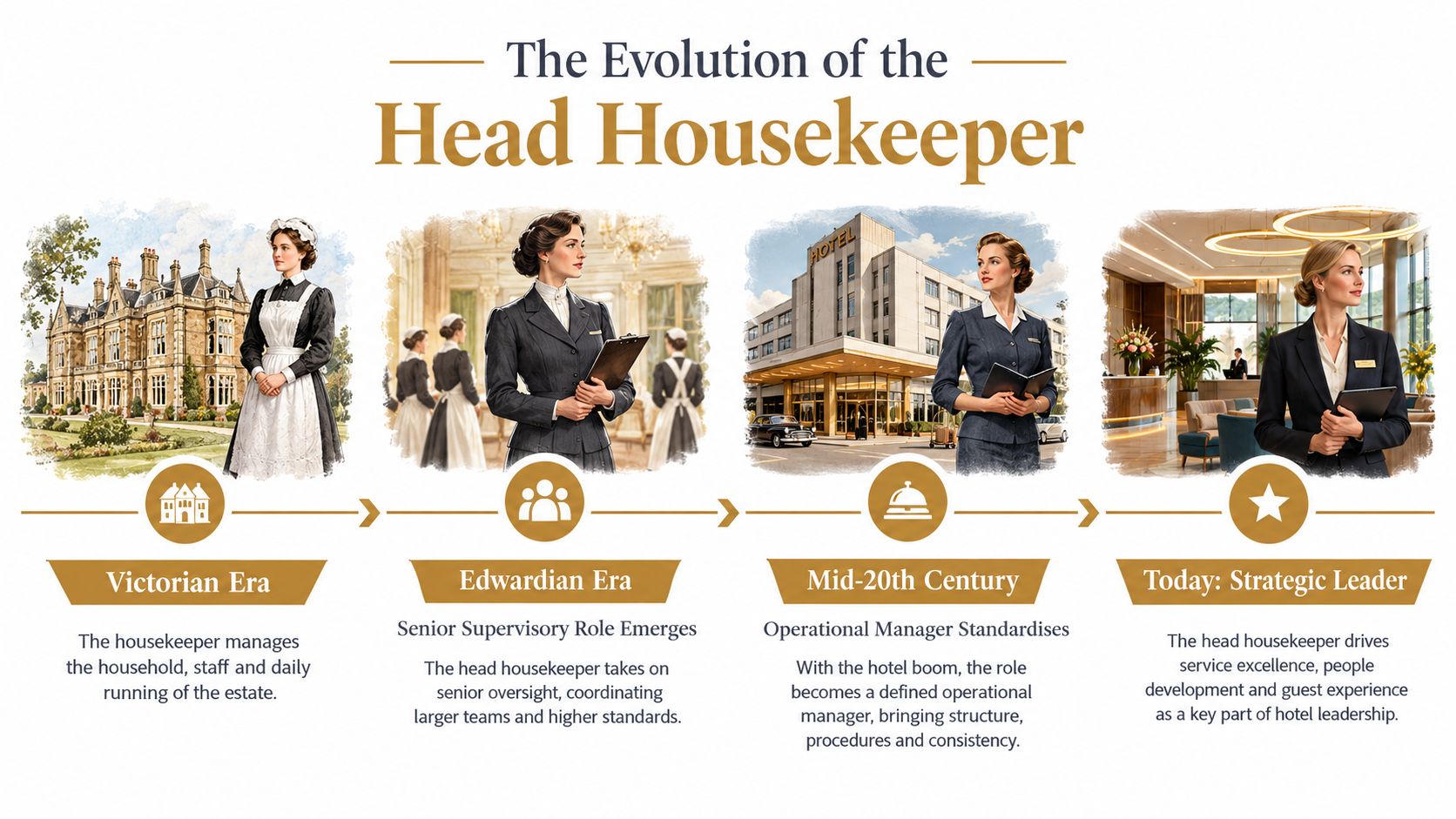
The title carries weight because it grew out of a serious labour system, not a modern branding exercise. In Britain, domestic service was once one of the country's largest employment sectors. Historical analysis shows that in 1891 approximately 41% of the female workforce worked as servants, and by 1931 that had fallen to 24%, while domestic service still employed around 1.6 million people and remained the largest single female employment sector History & Policy.
That scale mattered. The head housekeeper was typically the senior woman responsible for the female domestic staff, including housemaids, parlourmaids, laundry maids, and kitchen employees. She wasn't a lead cleaner with a nicer title. She was an operational authority inside a large private residence, responsible for standards, supervision, inventory, and discipline.
Why that history still matters now
By the early twentieth century, domestic service had already become an entry route for many young women, while experienced staff could move into supervisory roles. Research on British domestic service notes that almost 50% of servants were under 25, which helps explain why the senior housekeeper role became a position of experience and control rather than simple labour Past & Present via Oxford Academic.
The contraction of live-in service didn't erase the role. It narrowed it, professionalised it, and made it more managerial. That's why the title still fits large homes in London, New York, Palm Beach, Miami, and Los Angeles today, especially where discretion, staff coordination, and repeatable standards matter more than brute cleaning effort.
A modern head housekeeper inherits the logic of a historic supervisory role, but in a smaller, more specialist team.
What the Head Housekeeper Actually Owns
A good principal needs a clean line between housekeeping operations and everything else. The head housekeeper owns rota preparation, zoning, duty allocation, inspection, staff training, inventory control, and daily standards. She also owns the practical frictions that slow a house down, like defects, repairs to escalate, missing stock, and lost property procedures.
The work that gets underestimated
The hardest part is usually not the cleaning itself. It's the coordination. If a household has rotating guests, children's schedules, travel days, and frequent entertaining, the head housekeeper has to sequence the entire day so rooms are ready when people need them and out of sight when they do not. That's why a competent candidate should be able to plan by shift, not just react room by room.
The other underestimated area is communication. She has to speak with chefs, nannies, governors or governesses, chauffeurs, gardeners, and estate management without creating noise in the house. Confidentiality around family movements matters as much as linen control. The person in this seat sees patterns before anyone else does, which is exactly why principals should treat the role as trusted management.
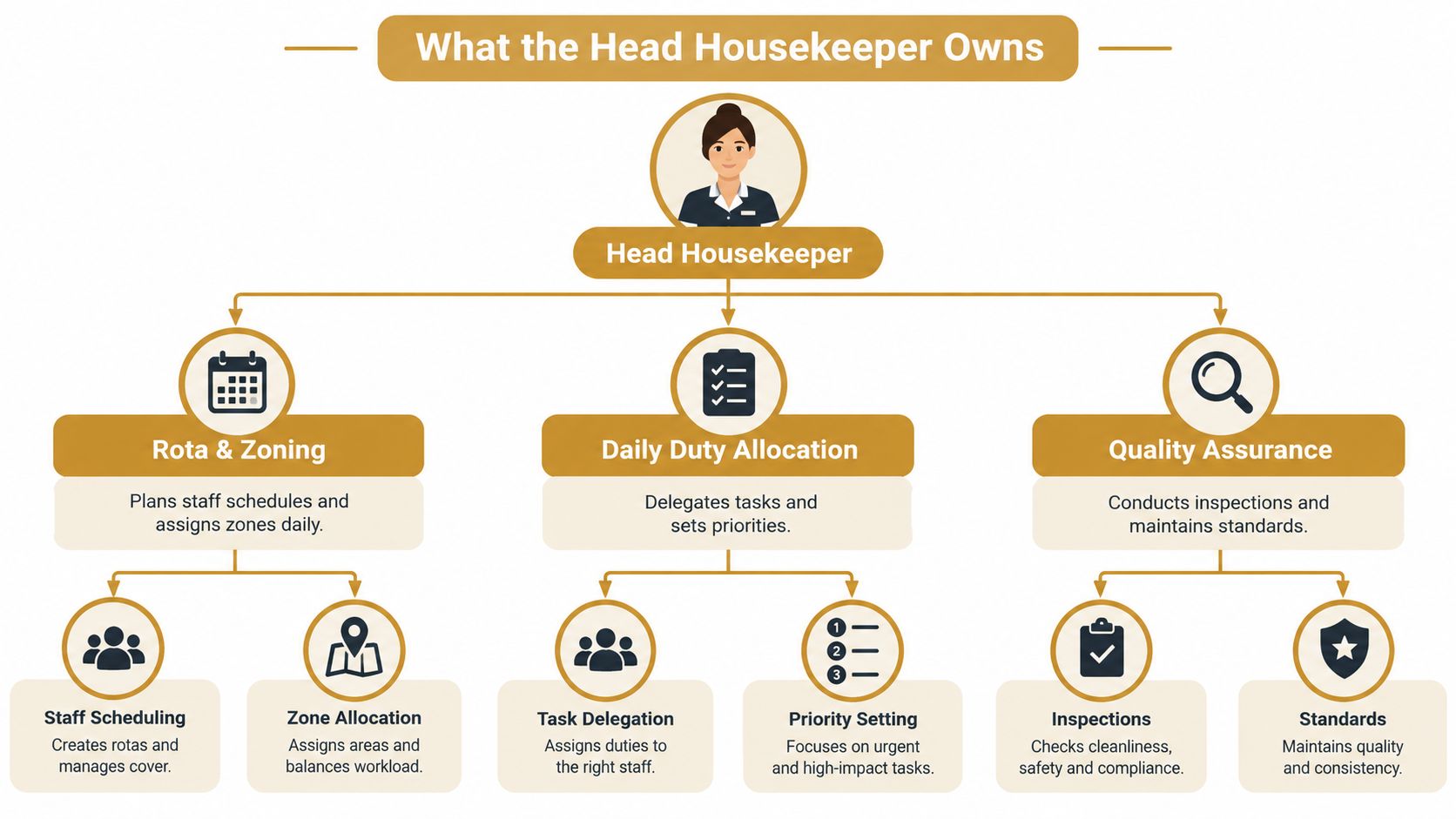
A useful leadership lens is the guide to ownership in leadership, because the job only works when the person in post takes responsibility for outcomes, not just activity.
For a more practical role outline, the duties of a housekeeper gives a broader service view, but the head housekeeper sits above routine delivery and into supervision.
The Operating System Behind Consistent Standards
Consistency comes from a system, not good intentions. A residence should be zoned by shift, so each team member knows which rooms, floors, or service areas they own and which standards apply there. That makes the house easier to inspect and easier to correct, because the same issue can be traced back to the same zone and time window.
What the system has to catch
The inspection process should be built to catch risks on stone, wood, lacquer, silver, and textiles before they become visible damage. It should also record defects for escalation, because a loose handle, stained skirt, or missed deep-clean cycle is not just a housekeeping issue, it is a management issue. If the house depends on memory instead of written checks, quality drifts fast.
The strongest heads of housekeeping review workload against occupancy, entertaining, travel, and staff availability. That's where the role starts to look less like cleaning and more like operations planning. A household that understands this won't ask, “Who can wipe that down?” It asks, “What part of the rota failed, and how do we stop it failing again?”
| Operating Area | Typical Outputs | Failure Mode If Neglected |
|---|---|---|
| Rota planning | Clear duty coverage, sensible shift flow, fewer handover gaps | Staff overlap, missed rooms, uneven workload |
| Zoning | Defined ownership by area or floor | Duplication, confusion, unfinished tasks |
| Inspections | Room checks, defect logs, standards verification | Problems discovered too late |
| Inventory | Linen, guest supplies, consumables tracked properly | Shortages, emergency buying, service disruption |
| Escalation | Logged repairs and contractor follow-up | Small defects becoming household complaints |
For process discipline, the SOP guidance from Facility Management Insights is a useful model for why written procedures outlast ad hoc habits.
The same logic should be reflected in staff performance metrics, because standards improve faster when the principal can review output, not just presence.
Head Housekeeper vs House Manager vs Senior Cleaner
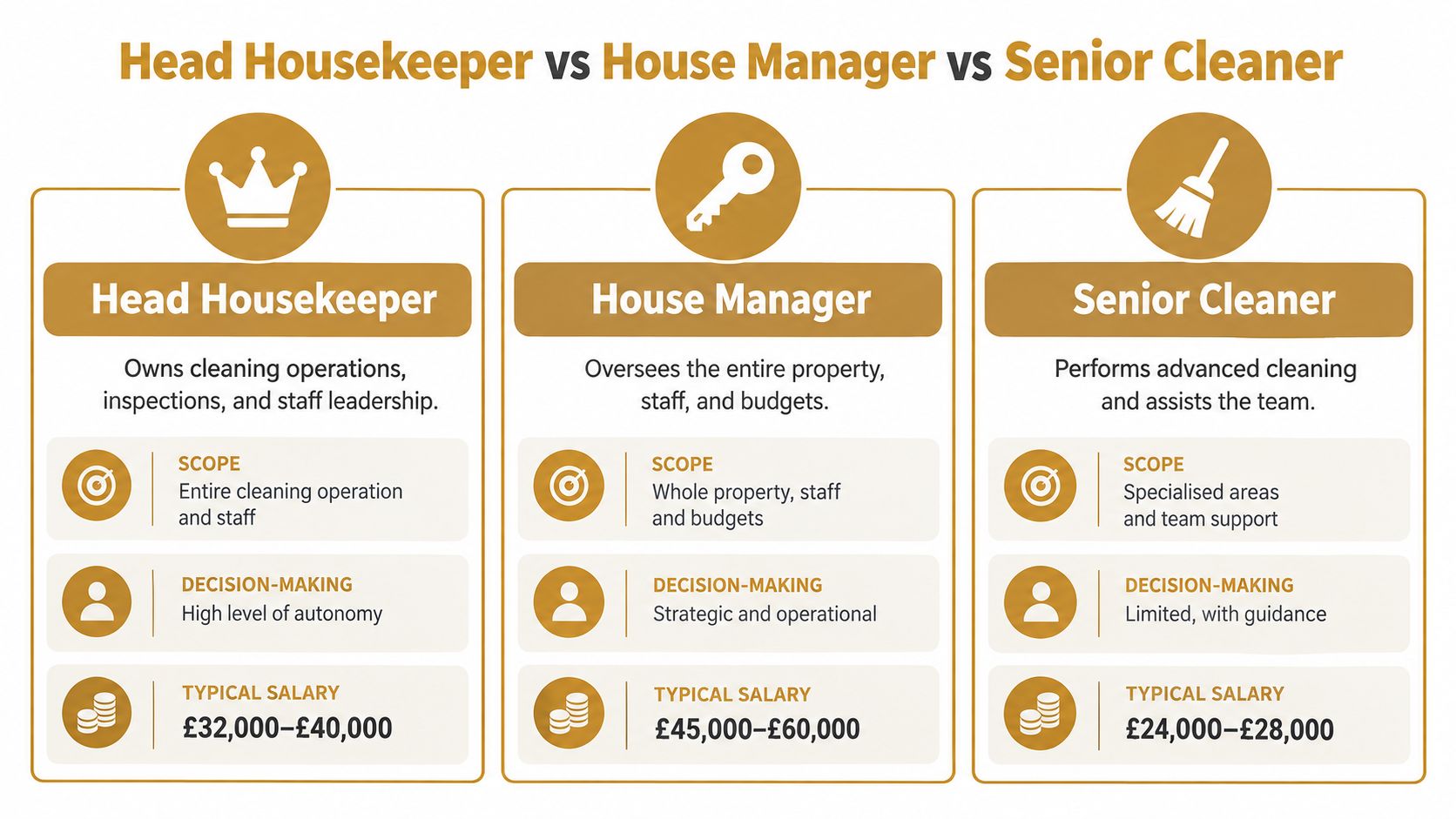
These roles are often mixed up, and that mistake costs families money and control. The head housekeeper owns housekeeping operations, supervision, inspections, stock, and quality. The house manager owns broader property coordination, budgets, staff oversight across departments, and the principal's day-to-day interface. The senior cleaner or lead housekeeper does advanced hands-on work and may mentor others, but doesn't usually carry departmental authority.
Which hire fits which house
A head housekeeper fits best when the property has enough scale to need inspection, rotas, and standards management, but not enough complexity to justify a full house manager. A house manager makes sense when the residence has multiple departments, high entertaining volume, or a serious budget and project load. A senior cleaner fits when the team needs strong delivery, but not a separate layer of authority.
If the principal is still answering supply questions, chasing room checks, or resolving staff overlap, the household is past senior cleaner territory.
The practical rule is simple. If the house needs someone to do the work, hire a cleaner. If it needs someone to lead housekeeping, hire a head housekeeper. If it needs someone to run the whole property, hire a house manager.
Legal Status, Working Hours, and Safety Duties
The biggest mistake is assuming every head housekeeper sits under the same legal arrangement. That's not true. The Health and Safety Executive says a domestic servant employed directly by a householder is generally excluded from the Health and Safety at Work Act, while a self-employed worker or someone employed by an agency is covered by workplace health and safety duties HSE.
That difference changes how the household manages risk. If the housekeeper is agency-supplied or self-employed, the principal needs to think about assessments, insurance, incident reporting, and accountability in a much stricter way. If the person is directly employed, the household still has employment, tax, and contract obligations, even where the health and safety framework sits differently.
Safety, chemicals, and working time
A proper head housekeeper role should include COSHH awareness, product registers, safe storage, PPE use, equipment checks, and incident reporting. UK occupational standards also require staff to choose appropriate chemicals, follow manufacturer instructions, use PPE, verify equipment safety, and keep the work area and storage controlled UK Standards. For live-in or overseas domestic workers, GOV.UK also sets out a 20-minute uninterrupted break when working more than six hours, 11 hours of rest between working days, at least one full day off each week or two days every two weeks, and 5.6 weeks of paid holiday annually, pro-rated where appropriate GOV.UK.
A head housekeeper who handles chemicals, specialist equipment, or contractor access should never be hired on vague trust alone. The contract has to spell out authority, rest time, reporting lines, and emergency procedures. If a principal asks an agency the right questions upfront, the answer will reveal whether they're buying a cleaner or a managed household function.
Hiring a Head Housekeeper Who Can Actually Lead
Start with a written specification that separates hands-on ability from supervisory skill. If the candidate can clean beautifully but can't organise a rota, lead an inspection, or handle a staff disagreement, she's not the right hire for this seat. The job spec should say what outcomes matter, not just what tasks happen.
What to test in interview and trial shift
A useful trial should include a rota exercise, a walkthrough inspection, and a stock report. Ask the candidate to assign priorities for a busy day, identify defects in a room by inspection, and explain how she would escalate a maintenance issue without disrupting the family. If she has prior hotel or yacht experience, treat it as useful context, not proof of household leadership.
Use references properly. Ask prior employers about discretion, reliability, standards, and whether the person improved the operation or completed tasks. A long domestic CV is not the same thing as management ability, and families learn that the hard way.
For interview structure, the interview questions for a housekeeper can help sharpen what you ask before day one.

What should be in place before the first day
- Confidentiality agreement: Protects family privacy, routines, and movements.
- COSHH induction: Covers cleaning materials, storage, and incident escalation.
- Household codes: Sets standards for conduct, communication, and discretion.
- Emergency procedures: Explains fire, security, medical, and contractor response.
The first 30 days should show control of the rota and confidence in the house. By 60 days, stock, inspection, and escalation habits should be visible. By 90 days, the household should see a stable rhythm, not just effort.
What an Exceptional Head Housekeeper Delivers
An exceptional head housekeeper gives a principal four things: predictable standards, defensible compliance, continuity through staff turnover, and calm handling of entertaining, travel, and multi-residence logistics. That combination is what separates a competent cleaner from a real household operator.
The principal-side checklist is simple. The specification must name the authority the role has. References need to probe discretion and leadership, not just friendliness. Compliance paperwork should be in place before the first shift. Review cadence should be set early, so standards are measured before they drift.
If you are building, correcting, or upgrading a staffed home, speak with Superstar Nannies about a discreet head housekeeper placement that fits the way your household runs. The agency places household staff for families in New York, Miami, Palm Beach, Los Angeles, London, and other major centres, with a focus on confidential, custom searches.
If you need a head house keeper who can run housekeeping like an operational function, not a private errand service, talk to Superstar Nannies. They place experienced household staff for UHNW families and can help you define the role, screen for real leadership, and move quickly with discretion. Visit Superstar Nannies to start a confidential search.