


Hiring through an agency can shift employment liability, safeguarding accountability, and a lot of the paperwork away from the family, while a direct hire places those responsibilities squarely on the household. In Britain's domestic labour market, 1.6 million people were still employed in domestic service by 1931, even after the share of women working as servants had fallen to 24% from about 41% in 1891, which is why this is a specialist labour market, not a casual hiring lane.
| Agency model | Best fit | What the family needs to know |
|---|---|---|
| Direct hire | Families who want to employ and manage staff themselves | The family carries payroll, insurance, and most compliance duties |
| Agency placement | Families who want structured sourcing and screening | The agency should define its role, fees, and post-placement support clearly |
| Hybrid model | Households that need help sourcing but want direct employment | Responsibility must be written down role by role |
| Specialist household staffing agency | UHNW homes, travel-heavy roles, rota teams, private estates | Depth of screening and clarity on legal boundaries matter most |
Why Domestic Staff Recruitment Agencies Matter for Elite Families
A New York family calls at 7 a.m. because the nanny is out, the house manager is leaving, and travel starts in two days. The instinct is to solve the problem fast, but speed is the wrong headline. The question that matters is who is carrying the legal and operational risk once someone walks through the door.

Controlled intermediaries, not casual matchmakers
The strongest domestic staff recruitment agencies act as controlled intermediaries. They don't just send over a résumé, they define the role, confirm the household's expectations, and put candidate screening into a process that can be checked later. That matters in homes with children, travel, multiple residences, or a private staff structure where one weak hire affects everyone else.
British recruitment history helps explain why this market looks the way it does today. Agencies were already placing domestic staff in the early twentieth century, and by the 1930s the sector had become concentrated in London and focused on domestic and hotel workers, a pattern that still informs elite household staffing now (history of British recruitment services).
Practical rule: if an agency can't explain its placement model in plain language, it probably isn't giving you a real operating structure.
What premium agencies should separate from generic recruiters
A household staffing agency should do more than search a database. It should separate residential roles from daily roles, childcare from housekeeping, and live-in placements from rota coverage, because the skill set and risk profile are different. That's especially important when the household needs a bilingual nanny, a newborn-care specialist, or a house manager who can coordinate several staff members.
For families comparing service depth, a useful starting point is the agency's own household support model, including its tailored family support. In practice, the better agencies show their work through documented sourcing, role scoping, and a placement process that matches the household's actual rhythm, not just its urgency.
Comparing Domestic Staff Recruitment Agencies by Specialism
The agencies worth speaking to are usually the ones that know exactly what they do well. A general recruiter can work for broad hiring, but a family looking for a rota nanny in Palm Beach or a house manager in Los Angeles needs a specialist with deeper sourcing and a clearer replacement process.
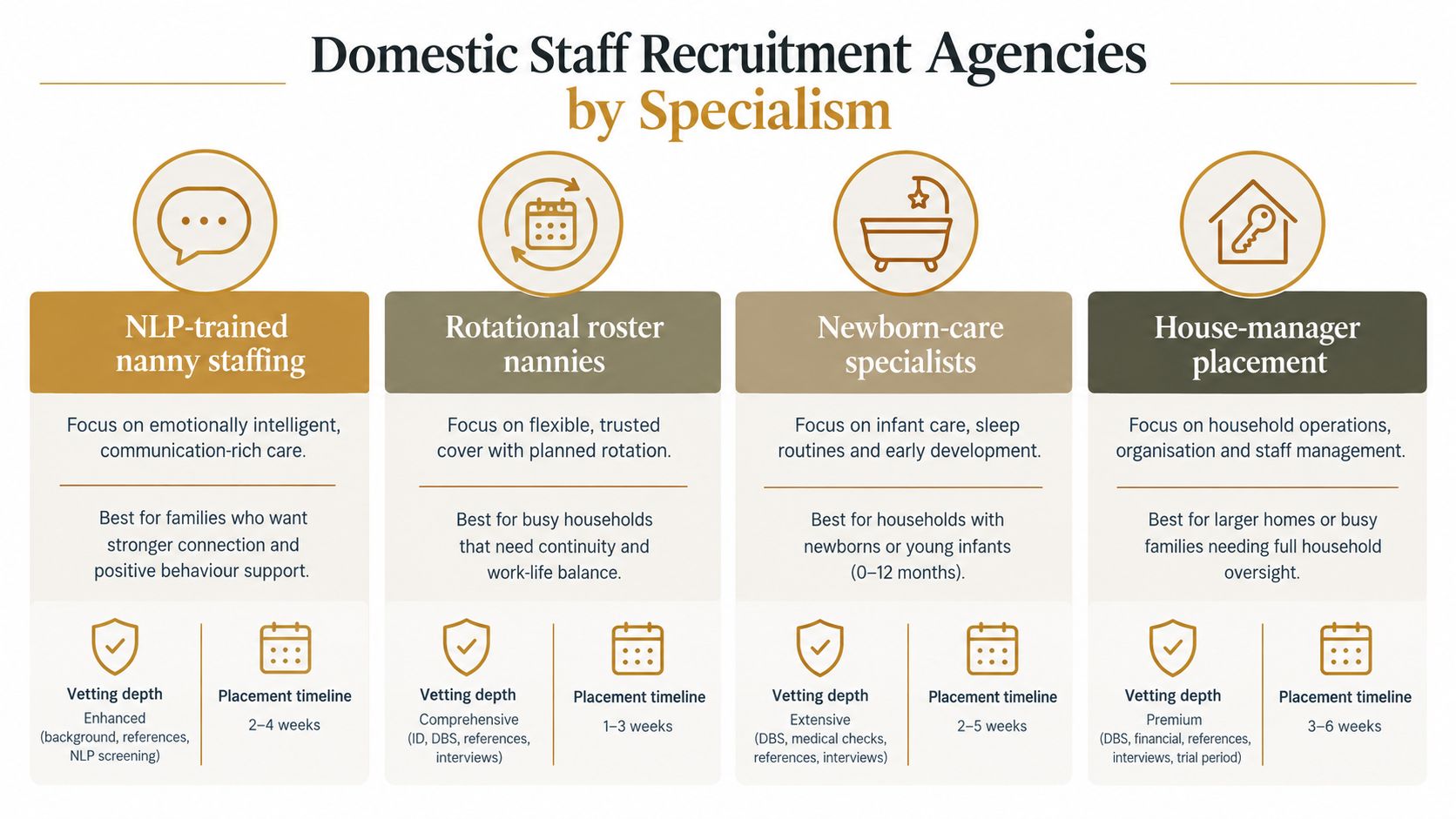
The role category matters more than the agency label
Nanny staffing with communication training should be judged by how well the agency understands communication, child development, and family dynamics. For a household role, that means screening for calm judgement, discretion, and the ability to de-escalate tension in front of siblings, not relying on branding language.
Rotational roster nannies need a different operating model. The agency has to understand continuity across shifts, handover quality, and whether the candidate pool has worked in rota environments before. That is not the same as placing a single live-out nanny.
Newborn-care specialists require sharper scrutiny still. A good agency should know how to validate night-work stamina, infant-care experience, and the ability to support parents without creating confusion around authority in the home.
House-manager placement is its own category, because the role often sits between operations, property, and people management. The agency should be able to discuss staff coordination, vendor oversight, travel logistics, and how the candidate handles escalation without becoming overbearing.
Specialist agencies usually show the difference in the replacement conversation. They talk about role depth and household complexity, while weaker firms talk only about availability.
What depth looks like in practice
The agency should be able to show whether it has real coverage in New York, Miami, Palm Beach, and Los Angeles, not just broad claims of national reach. It should also be clear about whether it places bilingual household nannies, private educators, or home staff across mixed estates. For families comparing butler and estate roles as well, a dedicated resource such as butler recruitment agency can help clarify where one specialist ends and another begins, including its bespoke family support model.
Vetting Standards Every Agency Should Meet
Elite households should expect vetting to look more like an audit trail than a sales pitch. If the agency can't explain what it verifies, when it verifies it, and how it records the result, the screening process isn't strong enough for a home with children, travel, or private security concerns.
The file should prove the person is placeable
At minimum, the agency should be able to document identity, right-to-work evidence, reference checks, employment-status assessment, safeguarding screening, and a written summary of pay and conditions before placement. For overseas domestic workers, written terms and lawful pay are particularly sensitive, because Home Office guidance requires agreed employment terms in writing and evidence covering pay, time off, and holiday entitlement (overseas domestic workers guidance).
The strongest agencies treat those checks as part of the placement itself, not as admin afterthoughts. That matters because agencies in the UK are operating within a defined statutory framework, including the Employment Agencies Act 1973 and the Conduct of Employment Agencies and Employment Businesses Regulations 2003, which set the tone for transparent terms and worker protection (UK legislation on employment agencies).
Ask for proof, not reassurance
A useful benchmark is whether the agency can explain role-specific screening without drifting into vague language. Families hiring for children should ask how it validates childcare history, how it checks travel-readiness, and whether it has a clear process for safeguarding concerns. The same standard should apply to household roles that involve private residences, access to valuables, or overnight work.
For a practical parallel, even pet and house-sitting guidance can be useful because it centres on trust, access, and accountability. A resource such as questions to ask a pet sitter is helpful because it reinforces the right habit, asking structured questions before handing someone the keys.
If an agency won't define what “thorough vetting” means in writing, don't assume it means much at all.
Superstar Nannies' own explanation of its screening process at high-profile staffing vetting process is a good example of how transparent a premium provider should be about this stage.
When Speed Is a Risk in Household Staffing Placements
Fast placement feels reassuring when the household is under pressure. The problem is that speed can hide weak reference checks, incomplete travel documents, or a rushed role brief that doesn't match how the home actually runs.

Rushed placements usually leave fingerprints
When an agency pushes for immediate acceptance, families should look for the same warning signs every time: vague job scope, thin reference detail, and a contract that arrives before the household has finished asking questions. In international households, that can also mean weak visa awareness or a failure to confirm whether the proposed schedule is workable.
The issue is not that urgency is always bad. It's that urgency often compresses the steps that protect everyone once the placement starts. That is especially dangerous in live-in roles, travel-heavy roles, and jobs involving children, because the failure cost is much higher than in ordinary recruitment.
Better agencies slow down where it counts
The better agency will still move quickly, but it won't collapse the screening sequence. It will verify fit, check whether the candidate's availability is sustainable, and make sure the family understands the role before any signing happens. That is the difference between a true placement partner and a résumé-forwarding service.
A strong sign of discipline is how the agency speaks about contracts. If the conversation starts with “we can get someone to you tomorrow” and ends there, the process is too thin. If the agency starts with the placement structure, then moves to terms and responsibilities, that is a healthier model.
Legal Boundaries and Liability Between Agencies and Families
The biggest mistake elite families make is assuming the agency carries all the responsibility once a candidate is introduced. It doesn't. The key question is whether the agency is the employer, the introducer, or a hybrid service, because that determines who handles payroll, pensions, holiday pay, statutory leave, right-to-work checks, and employers' liability insurance.
Agency placement changes the risk map, but it doesn't erase family duties
Where a worker is directly employed by a private householder, the family usually carries the employment burden. Where the arrangement runs through an agency or another business, the legal framework shifts, and the Health and Safety Executive notes that domestic workers employed by an agency or another business are covered by that framework and the agency's employers' liability arrangements (HSE domestic work guidance). That distinction matters for live-in nannies, housekeepers, chauffeurs, and other roles that look similar on paper but carry very different legal consequences.
A family should ask one blunt question before signing anything: what exact responsibilities remain with us after placement, and what sits with the agency? That question should be answered role by role, not through a standard brochure. Misclassification can also be a problem, because calling someone self-employed doesn't automatically settle their legal status.
Compare the service against the liability it removes
A premium placement fee only makes sense if it reduces risk in ways the family can understand. That means the agency should be clear about whether it is handling candidate compliance, drafting the employment structure, or just introducing a worker and stepping back. If the household has several staff members, rotating shifts, international travel, or multiple residences, the value of defined accountability rises sharply.
Superstar Nannies sits in this kind of structured placement market, where the service model matters as much as the candidate list. For an elite household, the decision isn't just “who can do the job”, it's also “who is legally carrying what after the placement begins”.
Cost, Fees, and Hidden Charges in Agency Placements
Families often judge agencies by the headline fee, then discover the true cost sits in the terms. The better test is what the fee covers, whether replacement support is included, and whether any part of the process is pushed onto candidate workers in a way that blurs accountability.
Transparent pricing beats a cheap-looking quote
A sound placement fee should cover sourcing, screening, interview coordination, and some level of placement support. In higher-trust domestic hiring, it may also include help with role scoping, documentation, and alignment between employer and employee before the start date. If those items are broken out later as extras, the original quote was not transparent.
The legal boundary matters here too. UK rules prohibit agencies from charging work-seekers for obtaining employment, which means the pricing structure should be clear from the start (Conduct of Employment Agencies and Employment Businesses Regulations 2003). If an agency is vague about who pays for what, treat that as a warning sign.
Families should benchmark value, not just price
The right fee depends on the household structure. A live-out nanny search in one city is not the same as a multi-role estate placement with travel and rota coverage. Ask whether replacement terms are limited, whether the agency stays involved after signing, and whether compliance work is included or billed separately.
For a due-diligence lens that translates well to household staffing, why due diligence matters is worth reading because the principle is simple, check what has been verified before money changes hands. The point is not to chase the cheapest agency. It is to avoid paying twice, once in fees and again in a failed placement.
How to Choose the Right Domestic Staff Recruitment Agency
The right agency is the one that matches your household structure, not just your sense of urgency. A family with one school-age child in Miami needs a different placement model from a multi-property household with newborn care, travel, and rotating staff.
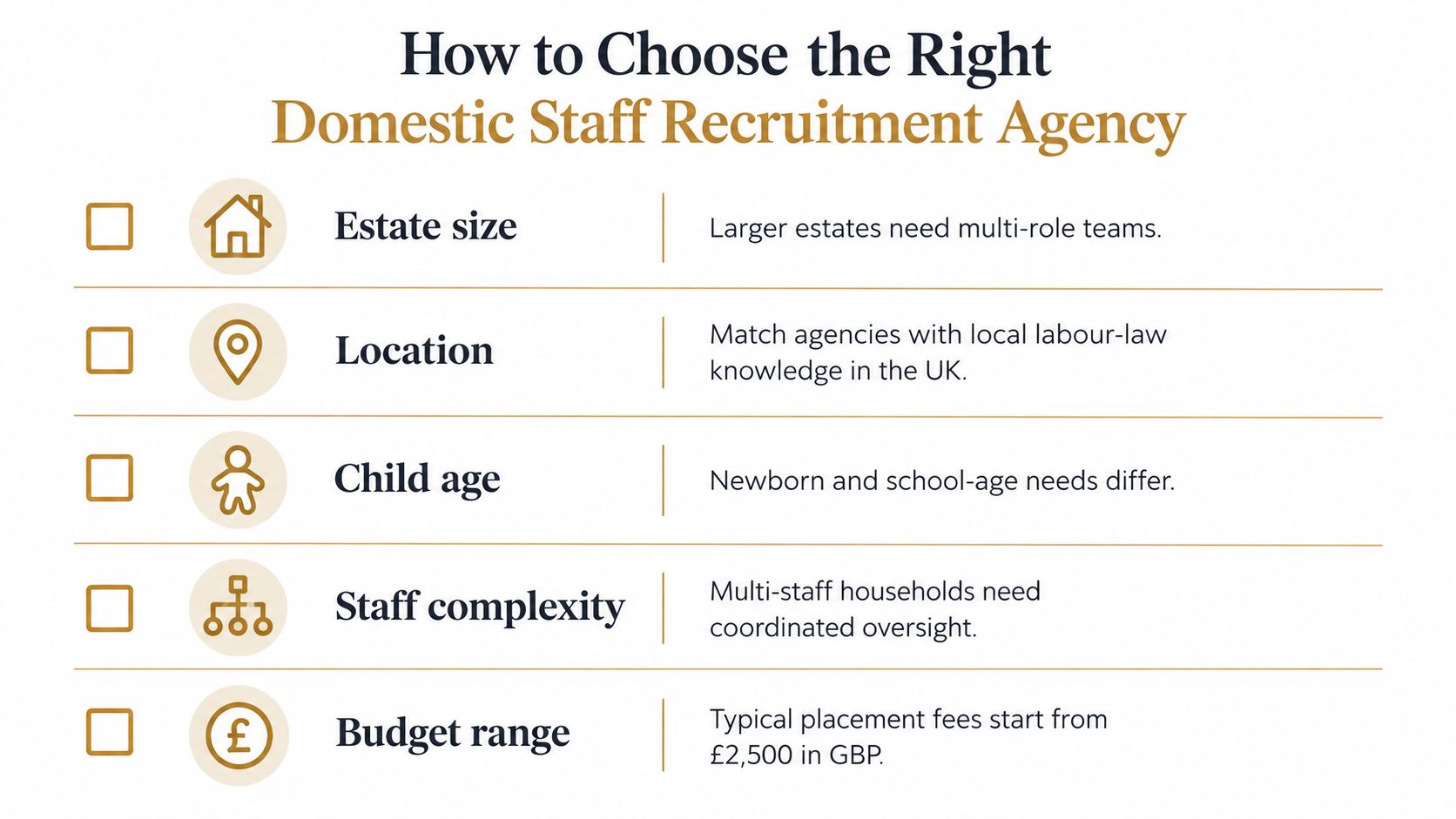
Match the agency to the actual household
Estate size matters because larger homes usually need more coordination, not just more candidates. A house manager search, for example, needs different oversight from a simple nanny placement.
Location matters too. In the UK, labour-law knowledge is part of the decision, and international households should expect the agency to understand how local rules affect the role.
Child age changes the brief completely. Newborn care, toddler routines, and school-age support are not interchangeable.
Staff complexity is a real dividing line. A single hire is one process, a multi-staff household is another.
Budget range should be defined before the search starts, because placement fees and support levels vary. In the UK, a typical placement-fee conversation often starts from £2,500, but the true test is whether the fee matches the service depth and responsibility being taken on.
Use a simple decision check before signing
Before you sign a placement agreement, ask whether the agency can explain its vetting, define its legal boundary, and give you a clear replacement policy. If the answer to any of those is fuzzy, the agency is asking you to take on more risk than you probably realise.
A family can also compare its options against household staff recruitment agencies if it wants to understand where nanny staffing ends and broader household staffing begins. Good agencies don't just send candidates, they help the household make a clean, lawful, and sustainable hiring decision.
Superstar Nannies supports elite families who need discreet, legally aware household staffing across the UK, the US, and international homes. If you're comparing domestic staff recruitment agencies and want a structured placement process for nannies, newborn care specialists, house managers, or other private staff, visit Superstar Nannies to start a confidential enquiry.