


A London household usually starts searching for a housekeeper at a point of pressure. Perhaps the family has relocated from abroad, bought a second property, welcomed a baby, or moved an ageing relative into the home. Sometimes the trigger is simpler: one partner stops commuting and realises that the house is being managed through a chain of ad-hoc cleaners, missed deliveries, unfinished laundry and disappearing weekends.
That decision isn't a luxury upgrade. A capable housekeeper gives the household a consistent operating rhythm, but the right arrangement depends on budget, property, privacy, working pattern and the amount of responsibility the family is ready to delegate. The wrong hire creates more supervision, not less.
A direct hire through personal recommendations can work for a straightforward household. An agency becomes worth its fee when you have several properties, existing staff, security concerns, complex travel, or a need to identify a suitable candidate within weeks rather than months. Families beginning with a direct search can also use this practical guide on how to find a housekeeper to clarify the role before speaking with recruiters.
When a London Family Starts Looking for a Housekeeper
The first mistake families make is defining the need as “cleaning”. A London housekeeper is often hired because domestic life has become fragmented. Different people handle cleaning, laundry, groceries, maintenance appointments and family errands, yet nobody owns the overall standard. The family still carries the mental load, even when several people enter the home each week.
A proper consultation starts by identifying what is failing. Is laundry being returned without a system? Are household supplies running out? Does the family need someone to prepare guest rooms before an arrival, liaise with tradespeople, organise wardrobes or support children between school and activities? Those details determine whether you need a weekly cleaner, a sole-charge housekeeper, a housekeeper-PA hybrid or a larger household team.
The pre-agency warning signs
Before contacting an agency, write down the recurring friction rather than the ideal job title. Look at:
- Property demands: Number of floors, bedrooms, entertaining areas, staff areas, pets, delicate materials and outdoor spaces.
- Family rhythm: School runs, travel, weekends, formal entertaining and periods when the home is empty.
- Current support: Cleaners, nannies, chefs, drivers, gardeners, household managers and contractors.
- Decision authority: Who briefs the housekeeper, approves purchases and handles performance discussions?
- Privacy requirements: Which rooms, documents, calendars and family details must remain confidential?
A strong housekeeper can manage a home independently, but independence depends on a clear brief. “Keep everything perfect” isn't a job description. A family should specify priorities, reporting lines, expected availability and the boundaries between housekeeping, childcare and personal assistance.
Recruiter's rule: If the family can't explain what success looks like during an ordinary week, the agency can't match the role accurately.
An agency earns its fee by reducing avoidable risk. It can turn a vague need into a workable position, compare the household with realistic market expectations and identify candidates whose experience matches the property. That matters particularly in London, where the labour pool is substantial but specialist placements still require discretion, references and experience in high-service homes. The British Cleaning Council reported 42,300 housekeepers across the UK, alongside 64,900 cleaning or housekeeping managers and supervisors, with both occupational groups falling between 2020 and 2021. Its research also identifies London as Great Britain's largest concentration of these jobs, with the published London series rising from 7,100 to 14,125 across the trend shown in the report. The British Cleaning Council research document gives useful context for families assessing candidate supply.
What a London Housekeeper Agency Actually Does
A full-service housekeeper agency doesn't just forward CVs. It translates the household's daily reality into a role that a professional can accept, perform and sustain.
A housekeeper may oversee cleaning schedules, laundry, ironing, wardrobe care, grocery provisioning, household supplies, flower arrangements, guest rooms and supplier access. Some roles include light family administration, school runs or diary support, but those duties must be agreed before the search begins. A candidate hired for a formal housekeeping position shouldn't discover on the first morning that the family expects childcare, cooking, dog walking and PA work without adjustment to the terms.
A housekeeper isn't a weekly cleaner
A weekly cleaner generally works to a limited schedule and defined cleaning list. A housekeeper takes responsibility for the condition and flow of the home. That can include noticing that a cashmere item needs a different wash cycle, preparing a bedroom for guests, recording stock levels or coordinating a repair while the family is away.
The distinction affects recruitment. A good cleaner may not have the judgement, wardrobe knowledge or communication style needed in a private household. Equally, an experienced estate housekeeper may be frustrated by a role that only offers surface cleaning and no autonomy. Matching responsibility to capability prevents early dissatisfaction on both sides.
What the agency should manage
A reputable London recruiter should be able to explain:
- Candidate sourcing: Whether it is drawing from an established professional network, advertising, direct approaches or a combination.
- Screening: How interviews, identity checks, right-to-work checks, references and DBS procedures are handled.
- Role calibration: Whether salary, schedule, accommodation and duties reflect the London market.
- Employment support: Whether the family receives help with written terms, payroll coordination and onboarding.
- After-placement support: What happens if expectations diverge or the placement ends early.
London offers several agency models. Online platforms may suit occasional cleaning, while freelance recruiters can be effective for a narrow search. A private-staffing consultancy is more useful when the household needs a live-in professional, rota cover, a housekeeper couple or several staff members working under one household manager.
The best agency is not necessarily the one with the longest candidate list. It's the one that asks difficult questions early, refuses to present unsuitable people and tells the family when its requested duties, schedule or budget don't align.
Service Formats and Which Household Style Covers Them
The service format determines the lifestyle cost as much as the salary does. Live-in support may provide continuity and flexibility, but it changes the privacy of the home. Live-out support creates a clearer boundary, but the family must plan around commuting and contracted hours. Rota staffing offers resilience for travel and large estates, while a team structure makes sense only when the property and service standard justify multiple employees.
| Format | Typical Property | Hours Pattern | Indicative Salary (£/year) | Best Fit For |
|---|---|---|---|---|
| Live-in housekeeper | Large London residence, townhouse or family home with suitable private accommodation | Full-time pattern with agreed off-duty periods and time away from the home | Benchmark varies by duties, seniority and package | Families wanting continuity, early starts or flexible household coverage |
| Live-out housekeeper | London flat, townhouse or family home where staff accommodation isn't available or desired | Daily or agreed weekly schedule, with commuting outside working time | Benchmark varies by experience, borough and responsibilities | Families wanting a defined home and work boundary |
| Rota or relief housekeeper | Country house, multi-property household or internationally travelling residence | Extended working blocks followed by scheduled time off | Premium depends on rota, travel and scope | Families needing dependable cover during travel or intensive occupancy |
| Housekeeping team | Large or fully staffed property with separate service departments | Coordinated shifts, often under a lead housekeeper or household manager | Individual package depends on seniority and team structure | Homes requiring formal service, multiple bedrooms or regular entertaining |
| Domestic couple | Estate or property requiring housekeeping plus driving, grounds or maintenance support | Joint schedule with separate and shared responsibilities | Combined package depends on both partners' skills and accommodation | Estates seeking broad operational coverage from two people |
Live-in or live-out
A live-in housekeeper is not automatically better value. The family provides accommodation, but the worker still needs genuine privacy, agreed working hours and time away from duty. A bedroom near the main family areas, informal requests late at night and unclear expectations can turn an attractive role into a poor retention proposition.
A live-out housekeeper suits families who value separation between staff and family life. London travel, start times and the candidate's location become important, particularly for early-morning routines. Pay should reflect the duties and borough, not just the title. Indeed reports an average London housekeeper rate of £15.46 per hour, based on 892 salaries, with a reported range of £12.71 to £21.79. It also lists higher local averages in Kensington and Chelsea, Hampstead and Chelsea. Indeed's London housekeeper salary data illustrates why a generic national figure can mislead.
Rota, teams and couples
Rota staffing is sensible when the home has long periods of occupancy, international travel or a demanding service calendar. It isn't a solution for a family that only needs consistent weekday housekeeping. A team creates resilience and speed, but it also requires supervision, payroll administration and a clear division of duties.
Domestic couples are particularly practical for estates where one partner can manage housekeeping while the other handles driving, grounds or maintenance. They should be assessed individually, not treated as interchangeable labour. Families considering continuity within a private residence can review the requirements for live-in housekeepers before selecting this format.
How Placement and Vetting Work in Practice
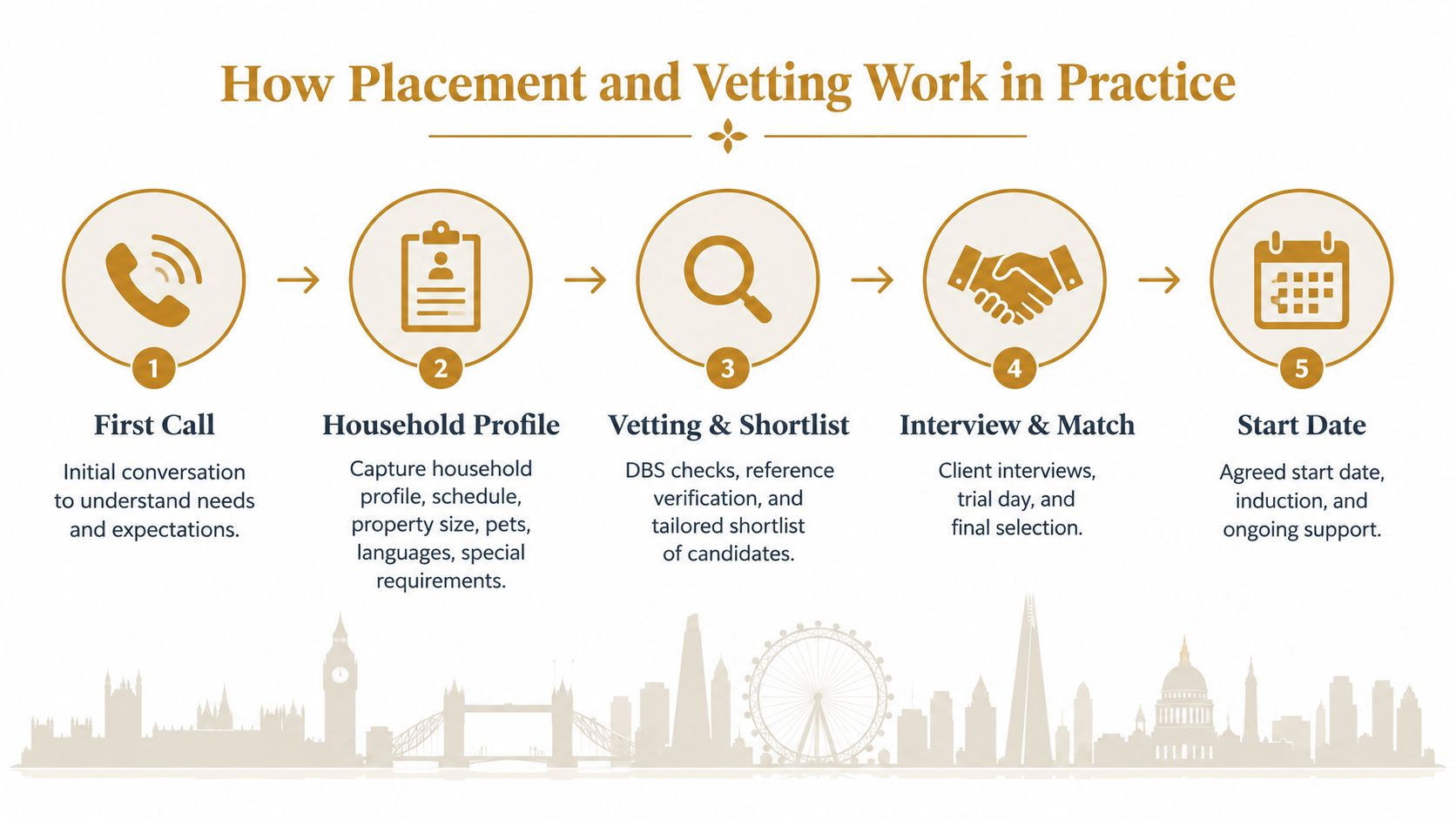
A serious placement begins with a detailed household consultation, not a generic candidate email. The recruiter should ask about the property, schedule, pets, languages, children, allergies, laundry systems, entertaining, formal service, travel and existing staff. The agency also needs to establish whether the housekeeper will work alone or report to a household manager, estate manager or lead housekeeper.
The placement sequence
- First consultation: The recruiter clarifies the household's priorities, practical constraints and essential requirements.
- Role specification: Duties, hours, accommodation, reporting lines, salary expectations and start date are written down.
- Candidate screening: The agency interviews suitable professionals and tests their experience against the actual home, rather than the job title alone.
- Verification: Identity, right to work, references and DBS requirements are reviewed before a candidate is recommended.
- Selection and start: The family interviews shortlisted candidates, arranges a suitable trial where appropriate, agrees terms and prepares an induction.
The shortlist should be relevant rather than large. A recruiter may pre-interview six to ten candidates, check at least two recent references linked to verifiable employers, verify identity and right to work, and arrange an enhanced DBS check where the role and duties justify it. These figures are placement standards specified for this search, not guarantees that every agency follows them.
For planning, a live-out search may take three to six weeks, while a live-in search may take six to ten weeks, depending on the brief, availability and notice periods. Those timelines should be treated as realistic planning ranges rather than promises.
A reference isn't complete because someone answered the phone. Ask what the candidate was employed to do, who they reported to, why they left, whether duties expanded and whether the employer would rehire them.
Trial days require care. The family should set a lawful paid arrangement, define the tasks and avoid using a trial as free labour. After selection, the agency can help resolve notice periods, accommodation, pay, duties and handover documents before the first day.
London Housekeeper Costs and What Drives the Price
Families should compare the total cost of employment, not the weekly figure in a candidate profile. London pay varies by seniority, borough, household complexity and discretion. ONS-based occupational data places the median gross annual pay for cleaners and domestics at £27,812 in London, compared with £24,130 across the UK, while another ONS-linked source reports £28,118 for London housekeepers and related occupations against £25,335 nationally. These benchmarks are useful context, but a private household role may sit above or below them depending on responsibility. London occupational salary data shows why national averages shouldn't anchor a specialist search.
The household also carries employer responsibilities. National Insurance, pension arrangements, holiday pay, payroll administration, overtime, travel and equipment can all affect the final cost. Live-in accommodation forms part of the package, but it doesn't erase wage obligations.
| Service Format | Weekly Gross Salary | Employer On-Cost, NI, Pension, Holiday | Typical Recruitment Fee |
|---|---|---|---|
| Live-out sole housekeeper | Depends on experience, borough and scope | Add employer costs, payroll, holiday and agreed extras | Often one to two gross weekly salaries |
| Live-in housekeeper | Depends on seniority and accommodation package | Add employer costs and confirm lawful accommodation treatment | Often one to two gross weekly salaries |
| Rota or relief housekeeper | Usually higher where travel, long blocks or specialist service applies | Add employer costs, travel and rota-related expenses | May be higher for a specialist search |
| Housekeeping team | Each employee has an individual package | Multiply employer costs across the team and include supervision | Depends on the number and seniority of hires |
| Domestic couple | Combined package based on both partners' capabilities | Include accommodation, payroll and role-specific expenses | Depends on the couple's combined profile |
The live-in calculation
Accommodation should be treated as a benefit with practical value, not as a substitute for proper pay. HMRC guidance reflected in employer guidance states that from 1 April 2024, National Minimum Wage coverage includes non-family workers living in a family home, and the 2026 rate for workers aged 21 and over is £12.71 per hour. UK domestic staff minimum wage guidance should be checked alongside current official advice before an offer is made.
Recruitment fees commonly sit at one or two gross weekly salaries for a standard private-staff placement, with specialist or UHNW searches potentially structured differently. The written proposal should state whether the fee includes advertising, candidate screening, trial coordination, replacement terms and post-placement support.
Budget for less visible items too. Uniforms, laundry allowances, travel cards, mobile phones, payroll fees, trial-day costs, overtime and DBS rechecks can all alter the annual figure. Families comparing ordinary cleaning arrangements may also find pricing help for cleaning owners useful for understanding how cleaning scope differs from private household employment.
For a household considering a live-in package, the live-in housekeeper salary guidance is a sensible starting point, but the final offer should follow the actual duties, hours, accommodation and experience required.
Compliance, Discretion and Vetting Standards
Compliance is where a polished placement can become an expensive problem. A reputable housekeeper agency should explain the employment model, identify who employs the worker and provide written terms covering duties, pay, hours, holiday, notice and termination.
The Employment Agencies Act 1973 prohibits an agency from requesting or receiving a fee from a person seeking employment for finding them work. The Employment Agencies Act 1973 is directly relevant to candidate-facing charges. A housekeeper shouldn't be told to pay for access to vacancies or to secure an introduction.
What families should expect
- Pay records: The employer should make correct wage arrangements and provide regular, itemised payslips.
- Working time: The contract should address hours, rest, overnight expectations, on-call arrangements and overtime.
- Immigration compliance: An overseas domestic worker must have the correct permission to work. A tourist visa isn't a legitimate route for employment.
- Data protection: Household addresses, family schedules, travel plans and candidate documents should be shared only with appropriate consent and controls.
- Reference integrity: Dates, duties, reporting lines and reasons for leaving should be checked, not merely recorded.
Government guidance for overseas domestic workers states that the employer must pay at least the National Minimum Wage, may make only limited deductions such as accommodation, must provide regular payslips and cannot claim an Immigration Rules exemption from minimum wage. The government's overseas domestic worker guidance should be reviewed for the relevant circumstances.
Discretion goes beyond asking a candidate to sign a confidentiality clause. UHNW households should expect anonymised shortlists, controlled circulation of profiles, secure document handling and clear instructions about photography, visitors and social media. Families should also respect candidates' privacy. A recruiter who casually shares one client's details with another isn't demonstrating the standard you want inside your home.
Families needing cross-border recruitment can use international background-check support as part of a broader verification process, while remembering that no single check replaces professional references and careful interviews.
Choosing the Right Agency and Why Superstar Nannies
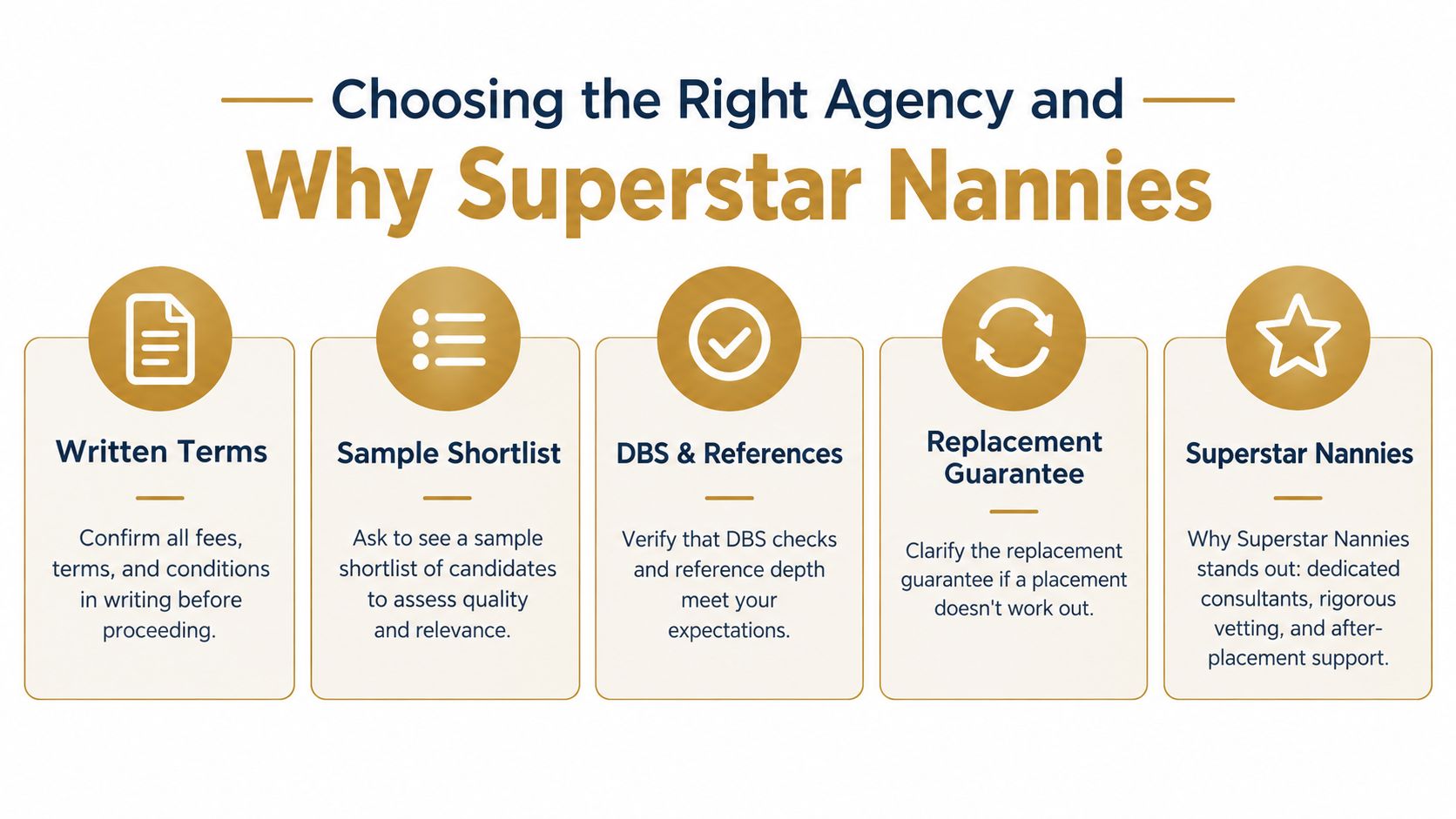
A quick agency review should produce clear answers, not polished generalities. Before signing, ask for the following in writing:
- Fee structure: Confirm when the fee becomes payable, what it covers and whether VAT or payroll charges apply.
- Sample shortlist: Ask to see the level of detail included in candidate profiles, including duties, dates, references and availability.
- Vetting process: Clarify DBS handling, right-to-work checks, identity verification and the depth of reference conversations.
- Replacement terms: Find out whether a replacement guarantee exists, how long it lasts and what conditions apply.
- Household fit: Ask who will manage the search and how the agency evaluates cultural fit, discretion and communication style.
A family should also ask how the agency handles a role that changes after placement. If the initial brief says sole housekeeper but the family later adds childcare, formal entertaining and travel, the agency should help reset expectations rather than leave the employee to absorb the expansion.
Superstar Nannies offers private household staffing for families seeking experienced housekeepers, including live-in and live-out placements across the UK. Its broader service covers fully staffed households, so a London family can discuss a housekeeper alongside nannies, house managers, butlers, chefs, chauffeurs or domestic couples when those roles need to work together.
That model suits UHNW and VIP families who prioritise confidentiality, cultural fit and continuity over the lowest possible fee, while still expecting transparent costs and proper UK compliance. Families researching neighbourhood standards and property operations may also find a prestigious neighbourhood home advisory useful when planning staffing around a London residence.
The agency is worth the fee when it reduces the family's administrative burden, protects privacy and improves the odds of a durable match. It isn't worth paying for if the recruiter can't explain the checks, the employment terms, the replacement position or the actual service delivered after the invoice is paid.
Superstar Nannies can help you define the right London housekeeping structure, source discreet live-in, live-out or team candidates, and coordinate the vetting and placement process around your household. Visit Superstar Nannies to discuss your property, schedule and staffing requirements with the recruitment team.