


A family is ready to hire a live-in nanny. The CV is polished, the references are glowing, and the candidate appears to have worked continuously in private homes. Then the dates shift between the application form and a referee's email. One employer confirms a different job title, while another reference comes from someone who never managed the candidate. The concern isn't just that one detail is wrong. It's that the household no longer knows which parts of the candidate's history can be trusted.
Employment history verification for a private hire should therefore be treated as a document-led reconciliation exercise, not a quick reference call. The strongest process combines identity validation, right-to-work evidence, HMRC or payroll documentation, direct referee conversations, and a clear review of gaps, overlaps and overseas roles. This approach is particularly important when a nanny, governess, maternity nurse, tutor or household manager will work unsupervised, live on the premises or have access to children, keys, finances and private family information.
Why Employment History Verification Matters for Private Households
A standard reference call asks whether a candidate worked well for a previous employer. Proper employment history verification asks a wider set of questions: Did the candidate work there, in the role claimed, during the dates stated, and in the location described? It also tests whether the referee has genuine authority to comment.
Private households face a higher level of exposure than many conventional workplaces. A nanny may be alone with children, a house manager may coordinate contractors and suppliers, and a butler or chauffeur may have access to residences, vehicles, travel arrangements and confidential schedules. A CV that sounds credible doesn't establish that the person performed the responsibilities described.
Practical rule: A reference is evidence of an opinion. Employment history verification is evidence of a timeline.
Polished letters can be useful, but they're often limited. A former colleague, family friend or informal household contact may write warmly about a candidate without being able to confirm payroll dates, reporting lines or the full scope of the role. An open letter addressed “to whom it may concern” is especially weak because it may not identify the writer's position or provide a route for independent confirmation.
A disciplined workflow compares multiple sources rather than trusting the most attractive document:
- Identity evidence: Confirm the person's name, date of birth and current address using the relevant UK process.
- Employment evidence: Reconcile dates and employers against HMRC records, payslips, P60s or reliable business documentation.
- Referee evidence: Contact the employer or direct manager independently and ask structured questions.
- Role evidence: Confirm what the candidate did, not merely the title printed on a CV.
Families seeking broader household help for working parents may also benefit from applying the same discipline across childcare and domestic positions. A household staffing decision should be based on a coherent, independently supported history, not a beautifully presented file.
Setting Up the Verification Workflow
Begin with written candidate consent. The consent should authorise contact with former employers, direct managers, named referees and relevant record bodies. It should explain what information will be requested and how the household or agency will store the result. Verbal permission isn't a dependable audit trail for a sensitive placement.
The UK right-to-work check is a separate legal checkpoint. Before employment starts, the employer must check the applicant's right to work, confirm valid documents with the applicant present, and keep copies showing the date of the check. Eligible applicants may use the official Home Office share-code route. Families unfamiliar with the process can review practical guidance on right to work checks for employers, while treating GOV.UK requirements as the controlling source.
Build the file before making calls
A well-organised verification pack normally contains:
- The signed consent form, including permission to contact the current employer where appropriate.
- The candidate's CV and application form, with every employer, title, date, location and reason for leaving recorded consistently.
- HMRC evidence, where the candidate authorises access to relevant PAYE records.
- Original supporting documents, such as payslips or P60s, used to corroborate employment dates rather than accepted as the only proof.
- A standard referee questionnaire, covering role, dates, reporting relationship, reason for leaving and whether the employer would consider re-employment.
- A secure verification log, recording who made each contact, when, through which channel, and what was confirmed.
The nanny vetting process for discerning families should be adapted to the role and jurisdiction. A nanny who worked for a private family may not have a conventional HR department, so the recruiter must establish whether the named referee was the actual employer, a household manager or a colleague.
Don't ask referees to fill in a vague form and return it without a call. Written confirmation is useful, but a direct conversation often reveals whether the person understands the candidate's duties and dates. Findings should be restricted to the people responsible for the hiring decision and stored in a controlled system, not circulated through informal family messaging groups.
Reconciling Three Years of Employment
The UK Baseline Personnel Security Standard provides a useful benchmark for structured recent-history checking. It requires organisations to verify at least three years of disclosed employment, academic and/or qualification history, and permits evidence from HMRC PAYE records or employer references. It also requires references or evidence for gaps of six months or more, continuous or cumulative, within the previous three years. See the BPSS policy published by the UK Government for the formal standard.
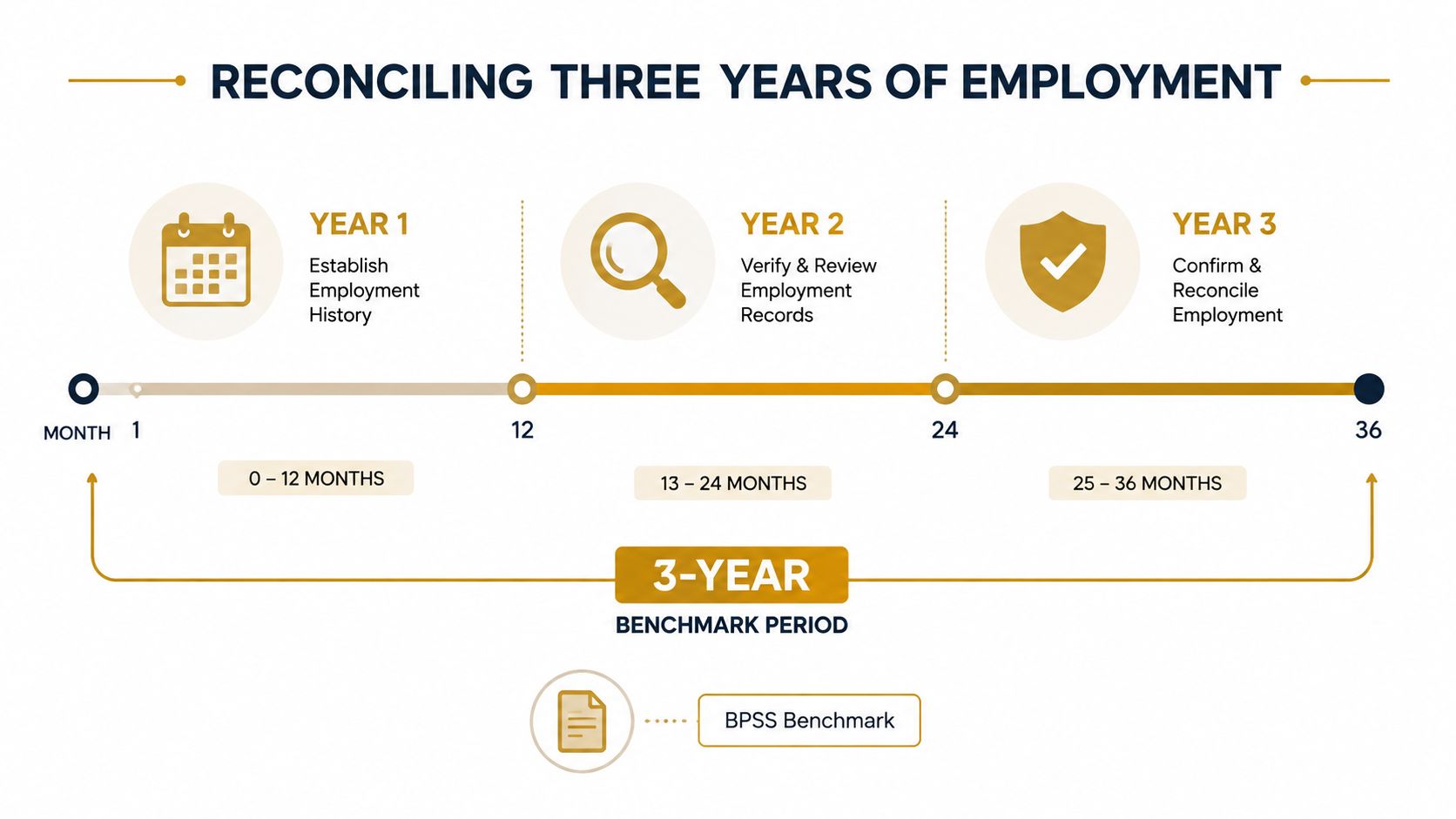
The practical method is to create one master timeline, then test every entry against independent evidence. The CV is the starting hypothesis, not the conclusion.
Read the timeline for contradictions
For each role, record:
- Employer and location
- Start and end dates
- Job title and actual duties
- Reporting manager or household principal
- Evidence available
- Source contacted and response received
A gap longer than the BPSS threshold needs an explanation and supporting evidence. A gap of more than 28 days may also deserve an early question in a private staffing process, even where it doesn't trigger the BPSS requirement. That is a recruitment control, not a claim about a universal legal threshold. Overlapping dates can indicate legitimate concurrent work, such as weekend cover or a rota arrangement, but they can also reveal undisclosed employment. Ask the candidate to explain the overlap in writing and verify it with both parties.
UK records won't independently establish every overseas role. For an international candidate, request a direct employer letter, a reliable local employment record, or other jurisdictionally appropriate evidence. An apostilled document or sworn affidavit may help where formal authentication is available, but it doesn't remove the need to check the issuing organisation and speak with a credible contact.
Self-employment requires a different trail. HMRC records may support the period, while Companies House information, VAT records, accountant confirmation, banker evidence or client references may help establish the business activity. A candidate who can't produce payroll evidence isn't automatically unsuitable, but unexplained claims supported only by LinkedIn should not be treated as verified.
For families hiring across borders, international background checks should sit alongside, not replace, this employment timeline.
Red Flags and Common Verification Mistakes
The most common mistake is treating a signed reference letter as proof of everything the candidate has claimed. It may confirm that someone remembers the candidate positively. It may not confirm the exact dates, salary records, reporting relationship or responsibilities that matter to a private household.
A recruiter should challenge the evidence when:
- The referee lacks authority: The writer is a friend, former colleague or junior employee rather than the direct manager or employer.
- The role is vague: “Household support” may conceal a narrower position than “house manager”, or a short-term assignment may be presented as permanent employment.
- Dates move: The CV, application form, referee response and HMRC evidence don't align.
- Contact details change: The candidate switches email domains, provides a personal address for a supposed corporate referee or resists independent contact.
- The referee speaks in generalities: Someone who allegedly managed the candidate can't describe routines, responsibilities, reporting lines or the reason for departure.
- Payroll evidence is absent without explanation: This matters particularly when the candidate claims a long-term employed position.
A single enthusiastic testimonial from a well-known household carries little weight if nobody can establish that the writer employed the candidate. The status of the household doesn't authenticate the document. For high-trust placements, a phone or video call with a verified employer or direct manager is usually more informative than a letter alone because the recruiter can test details and ask follow-up questions.
A practical evidence hierarchy
- Payroll evidence reconciled with dates, such as HMRC information, payslips or P60s.
- Direct confirmation from the employer or line manager, using independently sourced contact details.
- A structured written reference, sent directly by the referee.
- Business, professional or client records for genuine self-employed work.
- Candidate-supplied letters, considered supporting evidence only.
- LinkedIn endorsements and informal recommendations, useful for context but weak as primary proof.
The nanny background check service should be understood as one part of a wider due-diligence process. A clean criminal-record result doesn't validate a CV, and a consistent work history doesn't replace safeguarding checks.
Two Real Placement Scenarios
The following examples are anonymised recruitment scenarios illustrating the workflow, not named case studies.
In a butler search, the candidate submitted a detailed CV covering five years of private service. Consent was obtained first, right-to-work evidence was completed, and the documents were gathered before any decision was made. The employment timeline reconciled cleanly with HMRC history and employer records. One three-month gap was explained by a documented sabbatical in New Zealand. Direct calls with the line managers confirmed the dates, duties and reason for leaving, so the family proceeded once the references had been logged.
The process worked because each source answered a different question. The documents established continuity, while the calls established that the candidate had performed the claimed work.
A governess search produced a different result. Two referees gave enthusiastic praise, but neither could provide a complete payroll trail. A third contact, identified through the former employer's administrative records, confirmed that the candidate had worked elsewhere during a six-month period that had been presented as exclusive employment. The candidate couldn't provide a credible explanation, and the household's safeguarding policy treated the undisclosed overlap as a dealbreaker.
Without document-led reconciliation, the second candidate might have advanced on the strength of two warm testimonials. The issue wasn't resolved by asking for a more persuasive letter. It was resolved by identifying the missing source, confirming the dates and applying the family's decision threshold consistently.
Compliance, Retention and Jurisdictional Differences
UK households should separate the checks rather than treating one document as universal proof. Right-to-work verification must be completed before employment begins, while DBS screening and employment history checks answer different safeguarding and credibility questions. The DBS process requires identity evidence through its three-route checking process, including confirmation of the applicant's name, date of birth and current address. Child-facing roles may qualify for enhanced checks, which can include relevant locally held police information.
For private individuals employing personal or self-employed workers, GOV.UK states that a copy or digital photograph of a DBS certificate isn't acceptable. The original certificate must be seen. The DBS Update Service can allow an organisation to carry out a free, instant status check on an existing Standard or Enhanced certificate after viewing the original certificate. A DBS check also isn't a complete international criminal-record search, so overseas history requires separate consideration.
The retention position needs care. Recruitment agencies may have specific obligations for references and right-to-work records. REC guidance states that references must be retained for one year after the introduction or supply of a work-seeker to a client, while right-to-work records must be kept for two years after employment or engagement ends. Right-to-work records must also remain unalterable. Families and agencies should obtain current data-protection advice before setting their own retention schedule, rather than applying an arbitrary rule to every document.
| Jurisdiction | Right-to-work check | Criminal record regime | Candidate consent | Record retention |
|---|---|---|---|---|
| UK | Complete the Home Office or document route before work starts and retain dated evidence. | DBS applies to eligible roles, with separate checks needed for overseas history. | Obtain consent for employer, referee and record-body contact. | Follow applicable agency and data-protection requirements, including REC periods where relevant. |
| United States | Follow the applicable federal and state employment authorisation process. | Criminal-record rules vary by jurisdiction and screening method. | The FCRA gives candidates disclosure and consent rights where it applies. | Apply the relevant federal, state and privacy requirements. |
| European Union | Apply the relevant national right-to-work rules. | GDPR operates alongside additional national criminal-record rules. | Obtain a lawful basis and appropriate candidate information. | Follow GDPR principles and national requirements. |
Families should use the UK right-to-work verification service for the UK component, then obtain jurisdiction-specific advice for placements in the United States, Europe or elsewhere. Live-in and international hires may require authenticated overseas documents, such as an apostilled police certificate, but the employer remains responsible for building a lawful and proportionate process.
Frequently Asked Questions
How can overseas employment be verified without a UK referee?
Start with the overseas employer, not a UK substitute. Obtain written confirmation from an independently verified business address, request an authenticated employment document where appropriate, and conduct a direct call with someone who can explain the candidate's dates and duties. If the employer cannot be reached, ask for accountant, client or professional evidence. Exclude the candidate when a material role remains unsupported and the explanation changes or cannot be independently tested.
What if the candidate was self-employed or paid in cash?
Self-employment can be verified through HMRC records, Companies House information, VAT or business documentation, accountant confirmation and direct client references. Cash payment alone doesn't prove dishonesty, but a claimed long-term role with no documentary trail requires stronger corroboration. If the candidate can't identify credible clients, records or referees, don't treat a personal statement as equivalent to employer evidence.
Do LinkedIn profiles and reference letters count as primary evidence?
No. They're useful leads, but they shouldn't carry the same weight as payroll records or direct employer confirmation. Ask the candidate to explain any difference between LinkedIn, the CV and formal documents, then contact the employer independently. A reference that arrives only through the candidate should be treated as supporting material until the writer's identity, authority and contact details have been confirmed.
How long do HMRC employment records remain accessible?
GOV.UK's employment-history service lets individuals access current and past five years of employment through an HMRC personal tax account or the HMRC app. That may not cover an older role, and it doesn't by itself describe duties or explain every gap. For earlier history, request direct employer evidence, payroll documents or credible professional references. Don't reject a candidate solely because an older role isn't visible in the HMRC service.
Can Xref or RefNow replace reconciliation?
Digital platforms can make consent, questionnaires and reference records easier to manage, but they don't independently prove every employment claim. Review who completed the reference, whether the contact was an authorised employer or manager, and whether dates match the wider timeline. If a platform returns a vague or incomplete result, close the gap with payroll evidence or a direct call. A candidate should be excluded when a material discrepancy remains unexplained after reasonable verification.
Superstar Nannies can coordinate direct employer references, CV employment checks, identity validation and broader screening for families hiring nannies and private household staff internationally. Visit Superstar Nannies to discuss a discreet, role-specific verification process before making an offer.