


The most popular advice about private personal assistant careers is only partly useful. Strong organisation, polished communication, and confidence with office software matter, but they won't prepare you for a household where one phone call can involve a family diary, several properties, international travel, domestic staff, sensitive relationships, and an urgent change of plan.
Private service rewards a different kind of professional. Families hire people who can anticipate needs, protect confidential information, stay composed around privilege, and make complicated arrangements feel effortless. The guide below separates private household work from corporate administration, explains realistic UK pay benchmarks, and shows how candidates can move towards household and family-office support.
Private PA vs Corporate PA What You Need to Know
Private personal assistant careers demand a different working rhythm from corporate administration. A corporate PA generally supports an executive within an office or business, handling calendars, meetings, correspondence, expenses, and business travel. A private household PA works directly for an individual or family, combining diary management with lifestyle coordination, property logistics, personal errands, and travel support.
The employer's priorities shape the job. Private work shifts attention from business systems to people. The PA must read family dynamics, protect boundaries, anticipate practical consequences, and make sensible decisions without detailed instructions for every task.
A household manager sits further towards operational leadership. The position may involve supervising staff, managing household budgets, appointing vendors, overseeing maintenance, and keeping one or more residences running smoothly. Treating every role as a “PA” can mislead candidates and families, since responsibility, availability, and decision-making authority vary substantially.
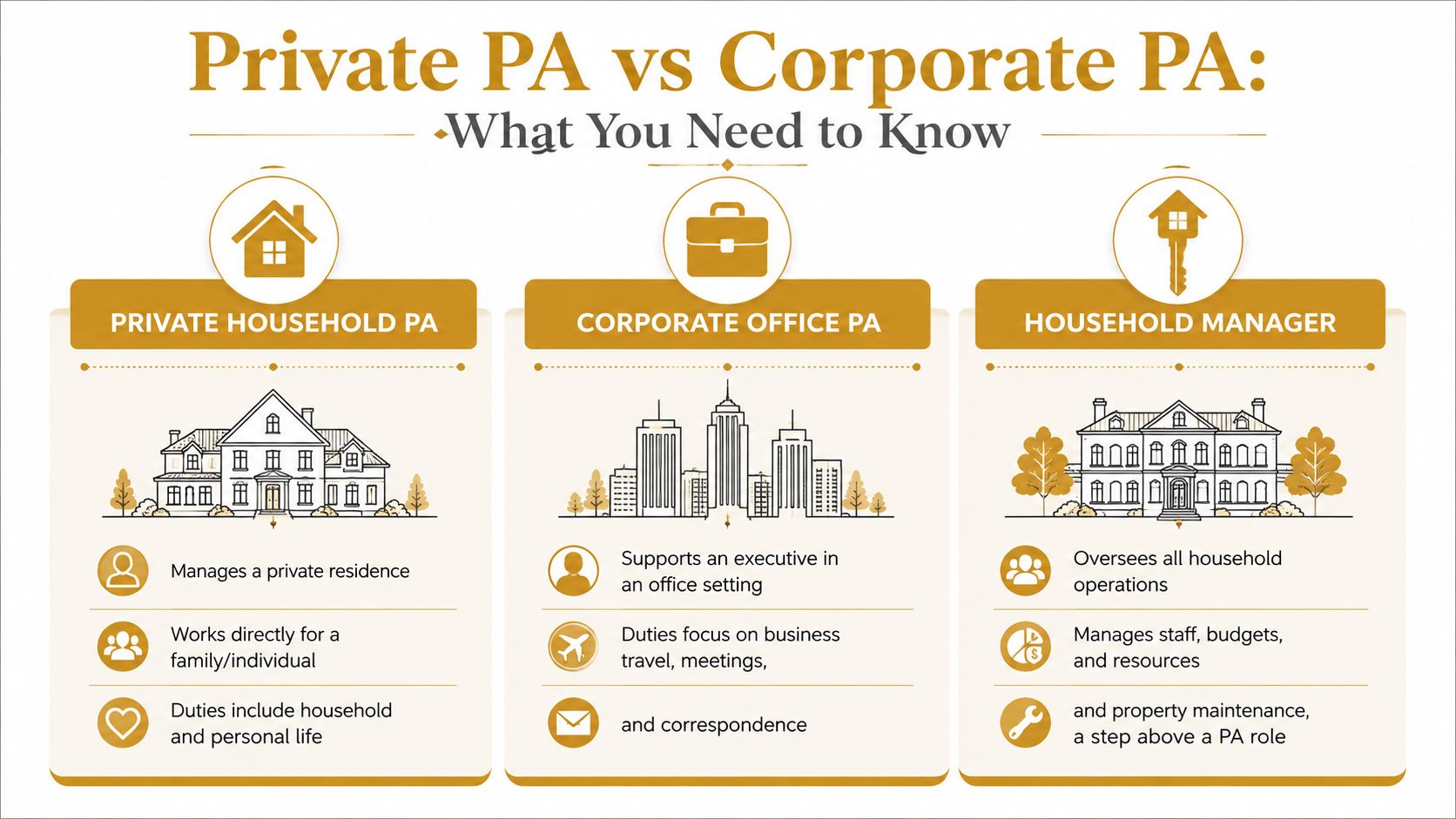
Three environments, three working rhythms
A corporate PA might spend the morning resolving an executive's diary conflicts, preparing meeting papers, and arranging a business trip. A private PA could coordinate a family holiday across several cities, confirm school and medical appointments, organise a delivery to a second residence, and adjust staff cover before the day ends.
Corporate PAs usually work with defined reporting lines, business systems, and clearer professional boundaries. Private PAs handle personal responsibilities, changing family priorities, and decisions that may affect relatives, staff, suppliers, or several properties at once. The work can offer greater trust and variety, but it also requires sound judgement when the brief is incomplete.
Practical rule: Choose private service because you value trust, discretion, and changing priorities, not because the title sounds more prestigious.
Corporate experience transfers well when it includes senior stakeholder support, confidential documents, complex travel, and high-pressure calendars. Private service is a stronger fit for candidates who enjoy personal responsibility and practical problem-solving. Those who prefer predictable structures may find corporate work more comfortable. Families and candidates can compare expectations in this guide to hiring a personal assistant for a private family.
Day to Day Duties of a Private Household Assistant
The job becomes clearer when you look at the operational threads behind an apparently simple request. A private household assistant may be asked to “sort the trip”, but that can mean coordinating calendars, flights, ground transport, accommodation, passports, luggage, dietary requirements, children's arrangements, household cover, and last-minute changes.

Diary diplomacy
Diary management in a private home involves more than entering appointments. The PA must recognise competing priorities and communicate changes without creating unnecessary friction. A medical appointment, school event, business meeting, staff handover, and private dinner may all affect one another.
Time zones add another layer. The assistant needs reliable systems for recording local times, travel buffers, preferences, and who has authority to change an arrangement. Good diary diplomacy also means knowing when to ask a question and when to resolve a minor conflict independently.
Estate coordination
Private households depend on a network of people who may never share the same workplace. The PA can coordinate housekeepers, drivers, chefs, tutors, security providers, tradespeople, travel agents, and property contacts. During a holiday, that may involve confirming staff rotations, checking deliveries, arranging access, and ensuring each residence is ready for arrival.
The strongest candidates don't treat these tasks as isolated errands. They create clear instructions, confirm ownership, record follow-ups, and spot gaps before the family notices them. That operational mindset is central to the day-to-day duties of personal assistants.
Confidentiality management
Private assistants may see personal correspondence, family movements, health information, financial arrangements, or sensitive social details. Confidentiality isn't an optional extra added to an otherwise administrative job. It shapes how the PA speaks, stores information, uses devices, communicates with suppliers, and handles visitors.
A capable assistant keeps information on a need-to-know basis and avoids casual conversation about the household. They also understand that discretion includes what they don't repeat, photograph, post, or discuss after leaving the role.
Salary and Benefits Benchmarks by Region
Pay discussions become misleading when corporate PA salaries are used as a universal guide for private household work. Prospects lists starting salaries of £18,000 to £25,000 and experienced PA salaries of £25,000 to £35,000, with London salaries reaching up to £50,000, while hourly rates average about £18 to £28 depending on sector and location. The figures appear in its UK personal assistant job profile.
A separate UK vacancy benchmark places the median annual salary outside London at £36,000, based on its current market tracking. The same source reported only 4 permanent jobs requiring a Personal Assistant in the six months to 11 November 2025, compared with 16 in the equivalent period in 2023, and described those vacancies as 0.008% of all permanent UK jobs. These figures describe a narrow vacancy market, not the full private staffing ecosystem, so candidates shouldn't mistake limited advertised roles for the absence of household opportunities. See the private staff salary guide for a household-focused budgeting perspective.
Private PA salary benchmarks
| Role Type | UK Excluding London | London | International |
|---|---|---|---|
| General office PA | £25,000 to £35,000 experienced benchmark | Up to £50,000 | Varies by country and employer |
| Private household PA | Scope-led and negotiated | Scope-led and negotiated | Scope-led and negotiated |
| Senior household or family-office support | Depends on autonomy and complexity | Often above standard office bands | Depends on jurisdiction and package |
The table intentionally avoids pretending that every private role fits a fixed band. A live-out PA with a conventional weekday schedule isn't comparable with someone coordinating several homes, travelling internationally, managing vendors, and remaining available outside ordinary hours.
What creates a premium
Compensation should reflect the job's real demands. Discuss these points before accepting or making an offer:
- Scope: Diary support alone is different from diary, travel, household procurement, and staff coordination.
- Availability: Evening, weekend, on-call, or continuous availability needs clear boundaries and appropriate compensation.
- Travel: Frequent international travel affects personal life, rest, and notice periods.
- Accommodation: Live-in arrangements change the overall package and should be documented carefully.
- Authority: A PA who can make decisions, approve routine suppliers, and represent the principal carries more responsibility.
- Confidentiality: Sensitive family or business information raises the trust threshold, although discretion should be expected in every private role.
Families should publish the working pattern and benefits rather than using “flexible” as a substitute for detail. Candidates should ask what availability means in practice, who authorises overtime, and whether travel time, accommodation, meals, insurance, and expenses are covered.
Routes into Private Personal Assistant Careers
There isn't one correct entry route into private personal assistant careers. The right choice depends on what you already know, how much household-specific experience you have, and whether you need access to established employers.
Agency placement
A specialist agency can introduce candidates to private families who don't advertise publicly. Agencies may assess references, role fit, communication style, and employment history before presenting a profile. The trade-off is that you have less control over the initial match, so you should work with a consultant who understands your boundaries and long-term aims.
Candidates can review current private household staff jobs while comparing the duties, schedules, and standards expected across roles.
Apprenticeship and training
Formal learning can strengthen a profile, especially for candidates who need structured development. Relevant UK guidance for adult social care PAs includes the Care Certificate, Level 2 Adult Care Apprenticeship, Level 3 Diploma in Adult Care, and training in medication management, food hygiene, falls prevention, and infection prevention and control. The government personal assistant role category also identifies Level 2 English, maths, and ICT as key skills.
Those qualifications apply particularly to care-focused PA work, not every lifestyle assistant role. For private household candidates, training in hospitality, events, travel coordination, administration, safeguarding, or household operations may be more relevant.
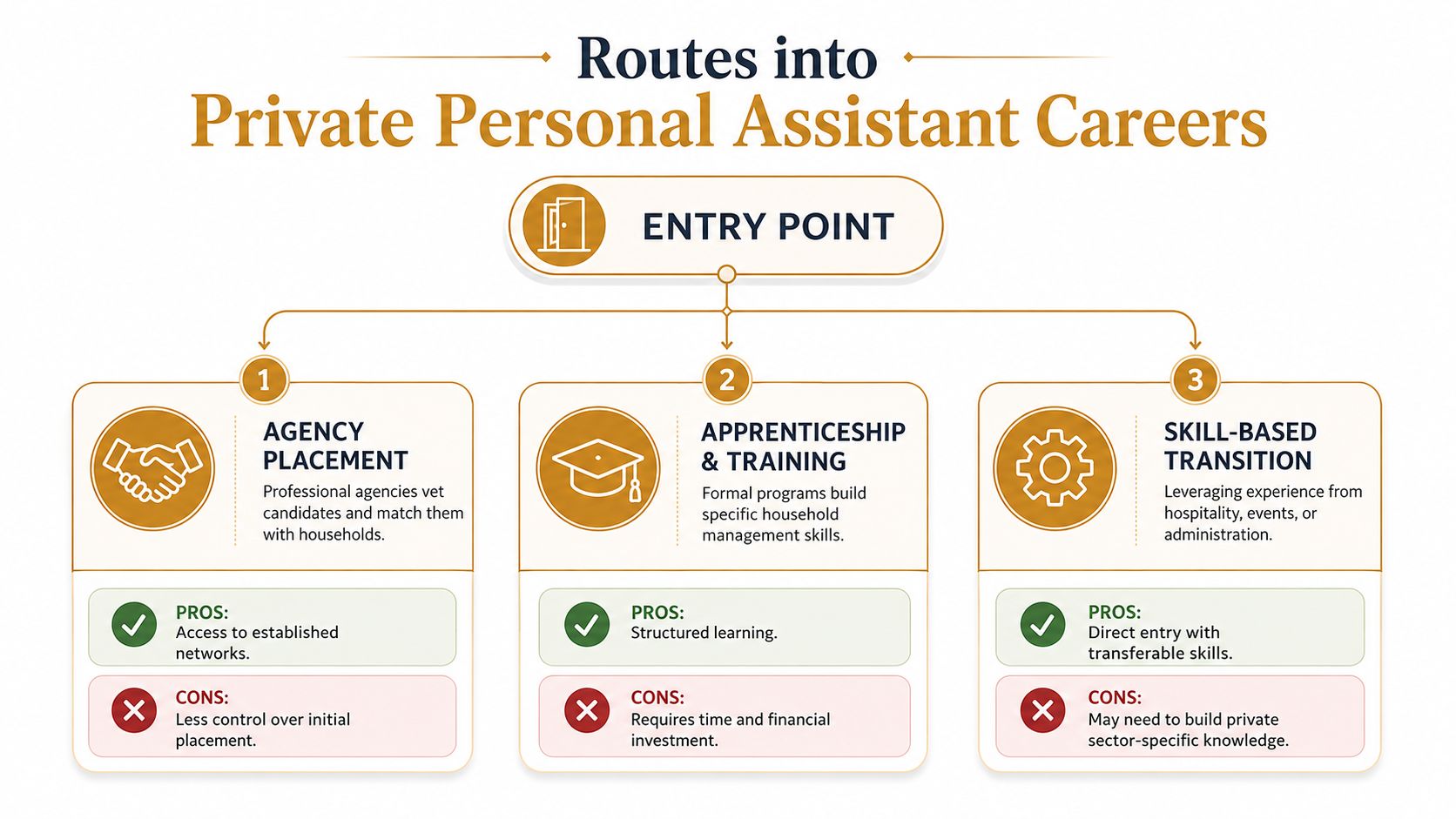
Skill-based transition
Hospitality, luxury concierge, events, executive administration, military support, and property operations can all provide useful foundations. The transferable skill must be specific. “I'm organised” is weak. “I coordinated changing travel, maintained confidentiality, and managed competing requests from senior stakeholders” gives an employer something to assess.
Use this decision guide:
- New to professional support: Choose structured training, supervised administration, or an entry-level household position.
- Experienced in corporate administration: Highlight executive calendars, travel, confidential materials, and independent judgement.
- Experienced in hospitality or events: Translate service recovery, logistics, supplier management, and anticipation into household language.
- Experienced in care: Show trust, boundaries, documentation, safeguarding awareness, and calm support.
CV and Interview Guidance for UHNW Households
A private household CV should make trust visible. Listing software, diary management, and general administration is useful, but it won't distinguish you from dozens of office candidates. Families want evidence that you can handle sensitive information, represent the household appropriately, and remain reliable when plans change.
The National Careers Service profile for personal assistants specifically highlights excellent IT skills and working knowledge of common business software. Include the tools you use, such as Microsoft Outlook, Excel, Word, Google Workspace, travel platforms, or household management systems.
Rewrite duties as evidence
Weak: “Managed diary and arranged travel.”
Stronger: “Managed a complex executive diary, coordinated confidential travel arrangements, and resolved competing commitments with minimal escalation.”
Weak: “Helped with household administration.”
Stronger: “Coordinated suppliers, appointments, deliveries, and staff communications across private household requirements while maintaining clear records.”
Don't disclose names, addresses, family details, or recognisable events from previous roles. An employer doesn't need gossip to understand your competence. If formatting or structure is a barrier, an AI CV builder can help you organise experience, but you must check every statement for accuracy and remove anything that overstates your responsibilities.
Interview for judgement, not performance
Expect questions such as:
- How have you protected confidential information?
- Tell us about a time you noticed a problem before the principal did.
- How would you handle two urgent requests from different family members?
- What would you do if a supplier disclosed household information?
- How do you maintain boundaries when a role becomes personal?
Candidates often damage their prospects by oversharing, criticising former employers, or presenting constant availability as a virtue without discussing sustainable boundaries. Professional warmth matters, but excellence comes from judgement and preparation, not from acting like a friend of the family.
Progression Paths and Specialist Roles
Private PA careers can extend well beyond administration. Advancement usually follows increased ownership: coordinating people, protecting household priorities, and making sound decisions without constant supervision. The strongest candidates build evidence of these abilities through progressively broader responsibilities.
A typical route starts with one principal's diary and travel. The PA then takes responsibility for supplier relationships and arrangements across multiple residences, before coordinating household staff, documenting procedures, and handling routine operational decisions. At that stage, a move into house management becomes realistic. The role shifts from supporting one person to running household operations as a coordinated service.
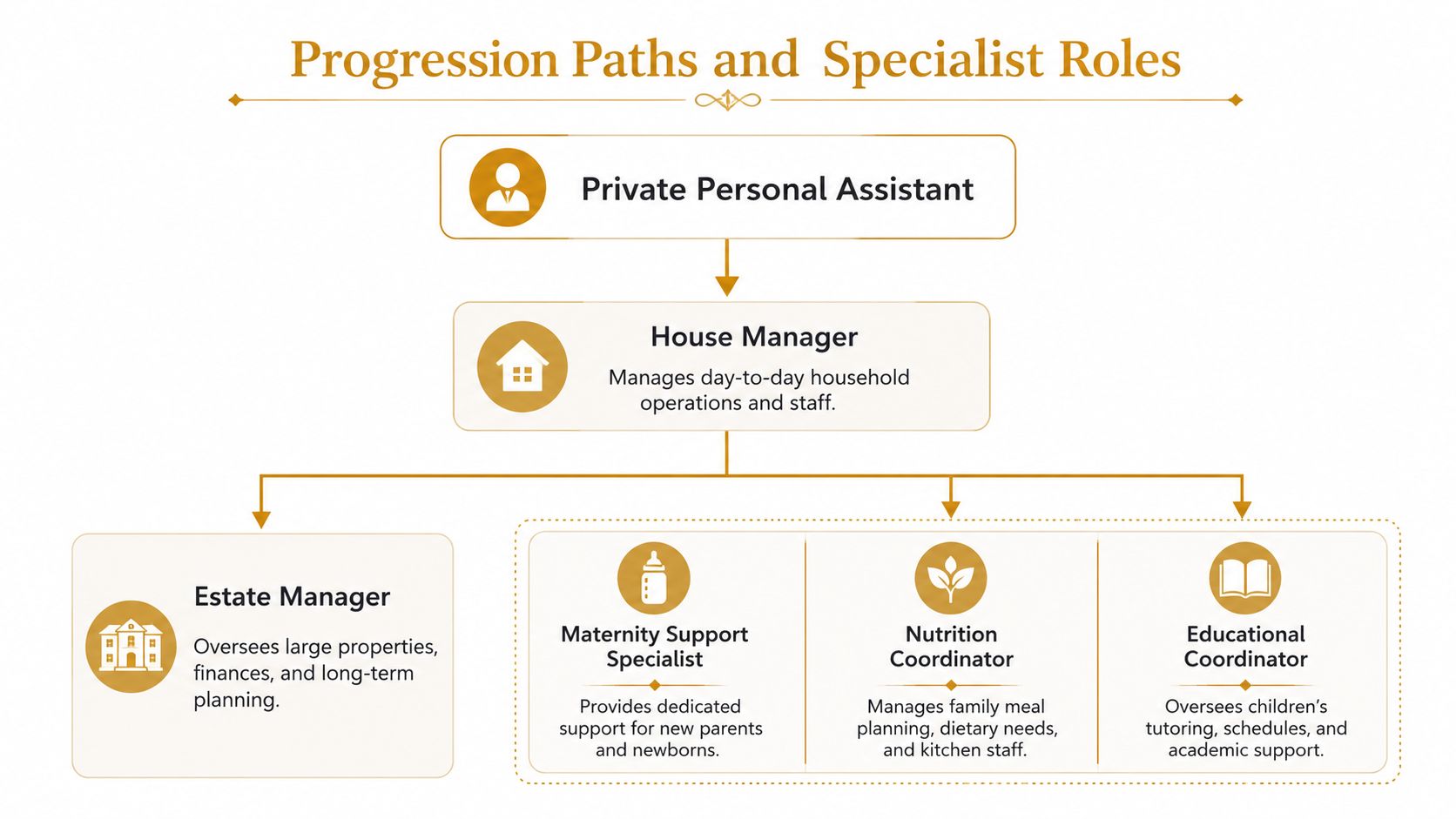
The direction of travel
A house manager oversees daily household operations, staff coordination, suppliers, and service standards. An estate manager may manage larger properties, budgets, maintenance planning, and longer-term operations. Specialist routes include:
- Maternity support specialist: Provides dedicated support for new parents and newborns.
- Nutrition coordinator: Handles meal planning, dietary requirements, kitchens, and relevant suppliers.
- Educational coordinator: Organises tutoring, school communication, schedules, and academic support.
- Family-office support: Applies private-service judgement to structured business administration and confidential coordination.
Choose the next role based on the work already performed well. PAs who enjoy people management should seek staff coordination responsibility. Strong travel and logistics experience can lead towards lifestyle management. Candidates with substantial childcare knowledge may develop into family support roles rather than estate operations.
Professional warmth matters, but the best candidates earn trust through judgement and preparation, not by positioning themselves as friends of the family.
Confidentiality and Professional Standards
Trust is the currency of private service, and a confidentiality breach can end a placement immediately. The consequences may include loss of references, legal disputes, professional blacklisting, or serious harm to the family. Even an apparently harmless social media post can reveal a location, routine, relationship, or travel plan.
Use a simple operating checklist from the first day:
- Clarify access: Ask which information, rooms, devices, systems, and conversations fall within your duties.
- Separate channels: Use employer-approved communication methods and don't move sensitive material into personal messaging or cloud accounts without permission.
- Control documents: Store files securely, use clear naming conventions, and don't leave papers visible in shared spaces.
- Set social boundaries: Never post photographs, locations, gifts, vehicles, interiors, or indirect clues about the household.
- Confirm agreements: Read confidentiality clauses and NDAs before signing, and seek advice if wording is unclear.
- Close access properly: Return keys, devices, passwords, documents, and records when the role ends.
Families should explain expectations rather than assuming every candidate knows their preferred protocol. For a useful explanation of confidentiality agreements and their practical purpose, review this guide from Translators USA, LLC.
Professional standard: If you wouldn't discuss it in front of the family, don't discuss it outside the household.
Next Steps for Aspiring and Hiring Families
Candidates should update their CV around discretion, judgement, travel coordination, diary diplomacy, and household logistics, then prepare examples that show how they prevented problems rather than just completed tasks. Research agencies carefully, define acceptable schedules, and ask direct questions about travel, accommodation, availability, reporting lines, and expenses.
Families need the same precision in reverse. Write a role description that separates personal assistance from household management, states the working pattern, identifies travel expectations, and explains who the PA will support. A UK local authority hiring guide recommends practical steps including creating an advert, interviewing, checking Right to Work, completing DBS checks, verifying references, deciding whether the PA is employed or self-employed, arranging Employers' Liability and Public Liability Insurance, agreeing a start date, writing a contract, and using a payroll provider where appropriate. Read the personal assistant hiring guidance from Reading Borough Council before finalising arrangements.
For both sides, the strongest placement starts with an honest scope of work. A polished title cannot compensate for unclear expectations, and a strong CV cannot compensate for poor boundaries.
Superstar Nannies provides discreet introductions and bespoke private household staffing for families seeking personal assistants, nanny-PAs, house managers, and wider estate support. Visit Superstar Nannies to discuss the household's requirements, candidate profile, working pattern, and confidentiality standards with a placement consultant.