


You're probably looking at a London family office role right now and wondering why the brief sounds half-portfolio, half-household, half-chief operating officer. That's the trap. Family office London jobs are not standard wealth-management roles, and they're not softened-up corporate positions with better coffee. They're private, senior, and ruthlessly specific about who gets through the door.
The market rewards people who understand the unspoken rules. Scope matters more than title, discretion matters more than polish, and seniority matters more than potential. If you're aiming at this sector, you need to present yourself as someone who can protect privacy, handle complexity, and operate across finance, property, people, and principal support without creating noise.
The Reality of the London Family Office Market
London isn't a fringe location for this work, it's the UK's core hiring hub. Jooble's September 2025 snapshot shows a London family office average salary of £74,214 a year, versus a UK average of £53,124, which is about 40% higher. The same dataset shows typical pay at £6,184 per month or £36.67 per hour, with a London range from £37,821 to £115,222. That tells you the market is paying for judgement, not just administration. Jooble's London family office salary snapshot
The vacancy picture backs that up. Revelio Labs reported that Family Office Co. employed 744 people in the United Kingdom in March 2026, equal to 5.5% of its global workforce, and that London remains the dominant UK hiring location for family-office work. Reed listed 1,034 family office jobs within 10 miles of London, while BeBee showed 297 family office job offers across the UK with London as the largest city market. Taken together, that's not a niche market, it's a dense one. Revelio Labs on Family Office Co. employment
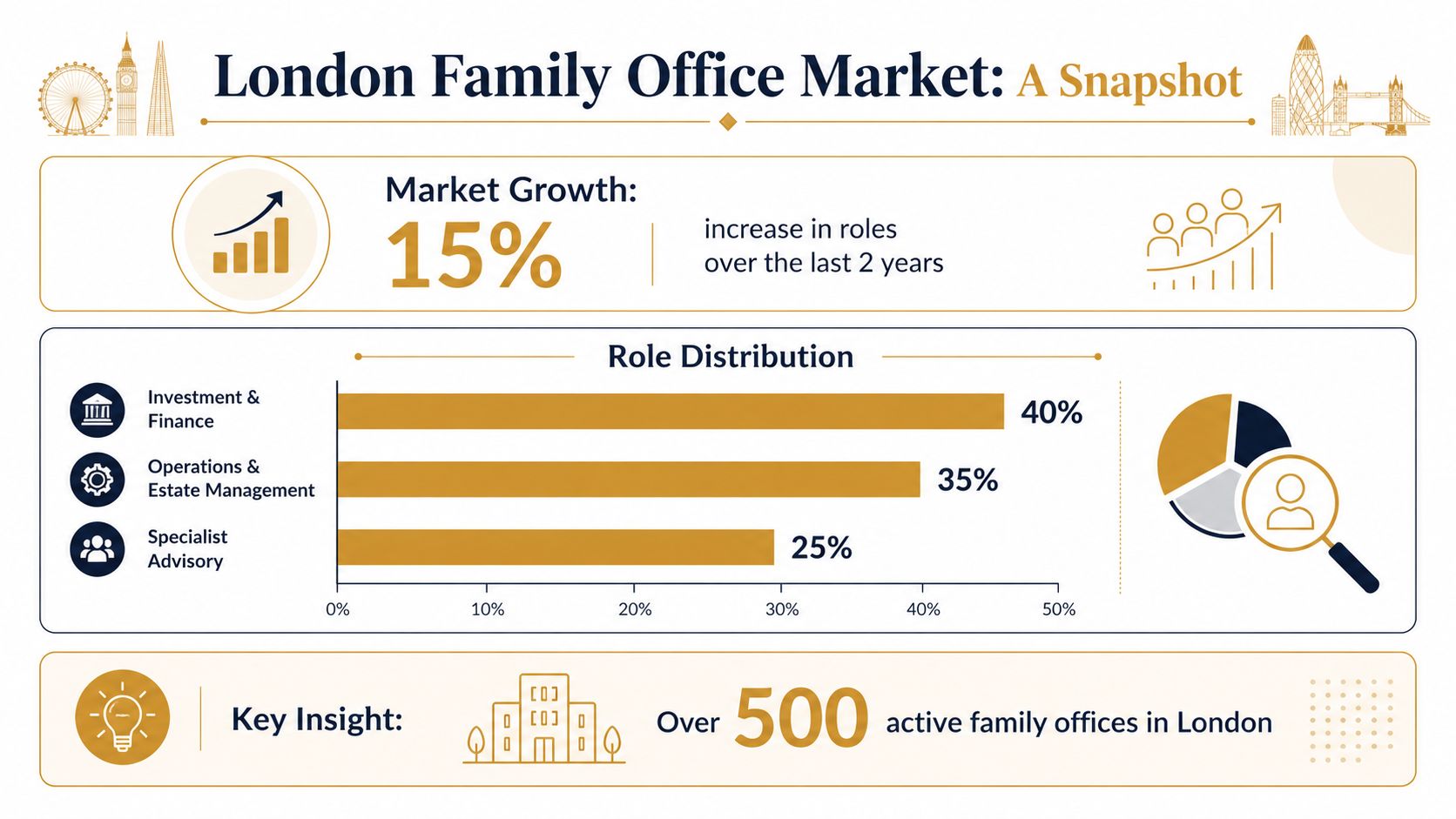
What matters for a candidate is the premium band. London family office hiring sits above ordinary private-office and EA pay because the work supports UHNW households, private capital, and tightly run asset structures. If you're underpricing yourself, you're also probably underselling yourself. If you're overclaiming experience, a recruiter will spot it fast and move on.
Practical rule: if the brief touches property, compliance, investment support, and principal access, treat it as an operating role, not a support role.
For a useful broader context on how elite private recruitment sits around these roles, read the guidance on UHNW family office staffing in London.
Defining the Scope of Modern Family Office Roles
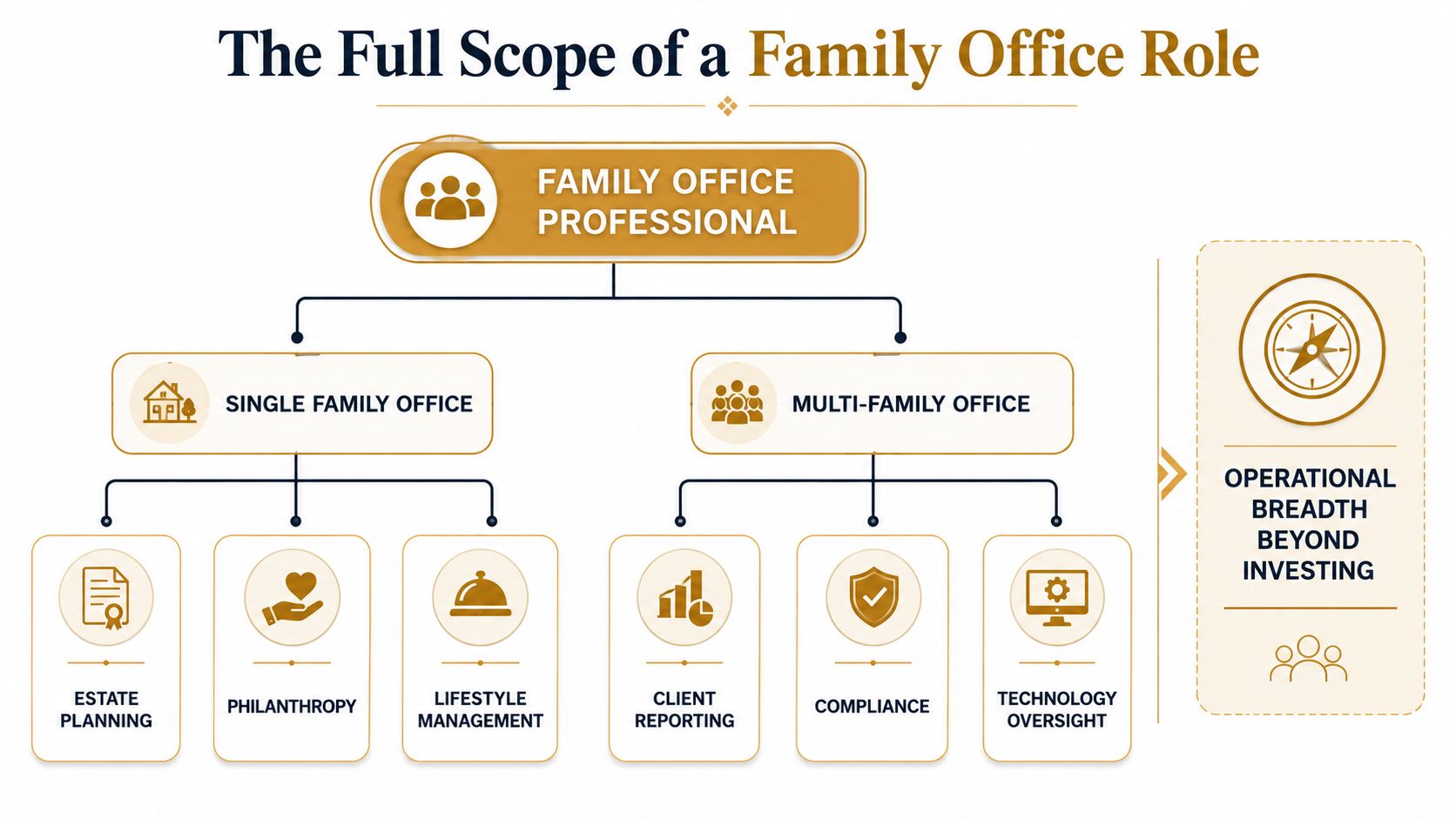
A candidate who assumes every family office role is about investments will miss the brief. AP Executive's UK family office coverage shows roles spanning investment, legal, administrative, operational, lifestyle management, concierge, and philanthropy, which is why generic corporate experience so often fails to translate cleanly. AP Executive family office overview
Single-family offices and multi-family offices do different work
A single-family office can look like a compact private state. A multi-family office can feel more like a service platform with stricter process, reporting, and client-facing controls. That difference changes the day-to-day reality of the job.
A London Chief of Staff role in a UHNW private family office can cover HR, recruitment, security, property and estate management, property acquisitions, sales and lettings, archives, and compliance, alongside team management and external advisers. For a clear picture of how that title is framed in private staffing, see this Chief of Staff job description. The scope is a coordination role for the family's people, assets, and risk profile, far beyond a traditional PA position. A comparable London posting in the market places that level of responsibility at £90,000 to £130,000, which shows how highly the sector values multi-disciplinary control. Knightsbridge Recruitment example
Don't lead with “I'm organised.” Everyone says that. Lead with the exact problems you solved, such as property coordination, internal controls, supplier management, and confidential stakeholder handling.
The unseen work drives the role
Family office professionals are often hired because they can stay calm while handling a family's personal, financial, and logistical pressure points at once. The strongest candidates do more than support, they know how to prioritise, filter, escalate, and disappear into the background when needed.
The sector also rewards people who can move between private life and institutional discipline without acting like they belong only in one world. If your CV suggests you only handled diaries and travel, you'll look narrow. If it shows exposure to governance, privacy, and operational continuity, you look usable on day one.
A good recruiter reads scope before title. So should you. A role called “manager” may require oversight of family logistics, advisers, staff, and sensitive assets. A role called “assistant” may be a gatekeeper position with serious internal authority.
Strategic Routes into the UHNW Sector
Public job boards only tell part of the story. Many of the strongest family office London jobs are filled through specialist recruiters, trusted referrals, and people already inside high-end private environments. If you're applying like you would for a corporate role, you're probably missing the better opportunities.
Use specialist agencies first
Specialist private-staff agencies know the difference between a polished CV and a relevant one. They also know which families want a discreet operator, which families want a polished household professional, and which brief is really about replacing someone who failed on trust. That translation work matters.
Superstar Nannies sits in that bridging space for households that need childcare and wider private staffing support, and that matters because many family office-adjacent hires grow out of private household environments, not out of conventional corporate pipelines. If you've worked in homes where discretion, pace, and shifting priorities were normal, that experience can be more relevant than an unrelated office title.
Don't rely on visible vacancies
The hidden market is real. A family may brief one recruiter, test the market discreetly, and never post the role publicly. That's especially true when the job touches privacy, children, property, or principal access.
The best move is a simple one.
- Target recruiters who already place in private households and family offices. They understand the cultural fit problem, not just the skills list.
- Use discreet networking with people who already work in UHNW settings. Former estate managers, chiefs of staff, and private PAs often know what's coming before it hits a board.
- Watch for internal mobility. A house manager, PA, or operations lead who proves reliable can be pulled into broader family office duties fast.
For a practical listing-style entry point into the market, use private household staff jobs as a way to understand the adjacent roles that often lead into broader private-office responsibilities.
The best family-office candidates don't “apply widely.” They become known to the right recruiters, in the right circles, for the right kind of work.
Tailoring Your CV for Private Capital and Privacy
A corporate CV usually fails here because it sells achievement in the wrong language. Family offices don't care that you “drove cross-functional synergy” if you can't show that you protected confidentiality, managed sensitive relationships, and kept a private operation stable under pressure. Your CV has to speak the language of privacy, control, and trust.
Translate your background into private-office value
If you've worked in finance, law, asset management, luxury, or regulated environments, stop describing your work as if you're selling to a public employer. Reframe it around what a family office needs.
Use phrases like these, if they're true:
- Discretion and confidentiality, because the office is handling personal, financial, and reputational risk.
- Operational control, because the role often spans multiple moving parts, not one function.
- Stakeholder management, because advisers, principals, household staff, and external vendors all need different handling.
- Regulated or high-privacy environments, because those settings prove you can manage sensitive information properly.
The wrong CV sounds like a list of past duties. The right CV shows how you reduce friction for a principal. That distinction is what gets you shortlisted.
Lead with relevance, not prestige
The family office market doesn't reward inflated branding. It rewards proof that you can work cleanly in a private setting. If you've supported a legal team, a partner, a founder, a UHNW household, or an investment desk, say so plainly and show what made the environment sensitive.
Keep one idea in mind as you edit: private-office hirers are buying judgement under discretion, not just competence. If your CV reads like a public-sector or corporate brochure, it's too noisy for this market. If it reads like someone who can protect the principal's time, assets, and privacy, it starts to work.
For confidentiality language and hiring boundaries, the private staff non-disclosure agreement guide is worth reviewing before you send anything out.

Recruiter's test: if I can't tell in ten seconds where your privacy exposure, operational breadth, and seniority came from, your CV needs work.
Navigating Seniority Thresholds and Technical Demands
Family offices in London hire for proof, not promise. One London private-family-office listing asked for 6 to 8 years of relevant experience, another required 7+ years in a senior EA, chief of staff, or family office manager role, and another London role specified 10 years of experience as a Legal Secretary or Executive Assistant. That is the market speaking clearly. OPLU family office manager listings
Technical strength is now expected, but context still wins
A London family office platform posted a Lead Data Engineer role saying the successful candidate would build the firm's technology, data, and AI capability “from the ground up”, and that the ideal background would be in quantitative development, data engineering, machine learning, or research engineering, ideally from a hedge fund, asset manager, investment bank, fintech, or alternative investment platform. That tells you exactly how technical some roles have become, but it also shows the filter is capability-first, not title-first. Lead Data Engineer family office posting
The mistake is to assume strong software skills alone will carry the day. They won't. If you haven't worked in investment data, analytics, or a high-privacy environment, a recruiter will see the gap fast. The job spec is tied to investing and quant analytics, so a strong engineer without finance context is usually weaker than a slightly less technical person who already understands the operating model.
Senior hires are expected to carry judgment
The market also values people who have already handled messy real-world responsibility. That could mean coordinating cross-border logistics, managing competing adviser priorities, or working inside a family or principal-led environment where everything is urgent and not everything is written down.
Confidentiality is not a soft skill here. London job descriptions describe these roles as handling personal, professional, and financial matters, with one requiring the candidate to act as a trusted project manager and liaison for the Board, and another demanding absolute discretion around highly confidential information. Indeed family office operations and investment roles
If you're trying to break in, the question isn't “Am I smart enough?” It's “Have I already shown that I can operate at this level without supervision?” That's what gets you through the first screen.
Mastering the Interview and Vetting Process
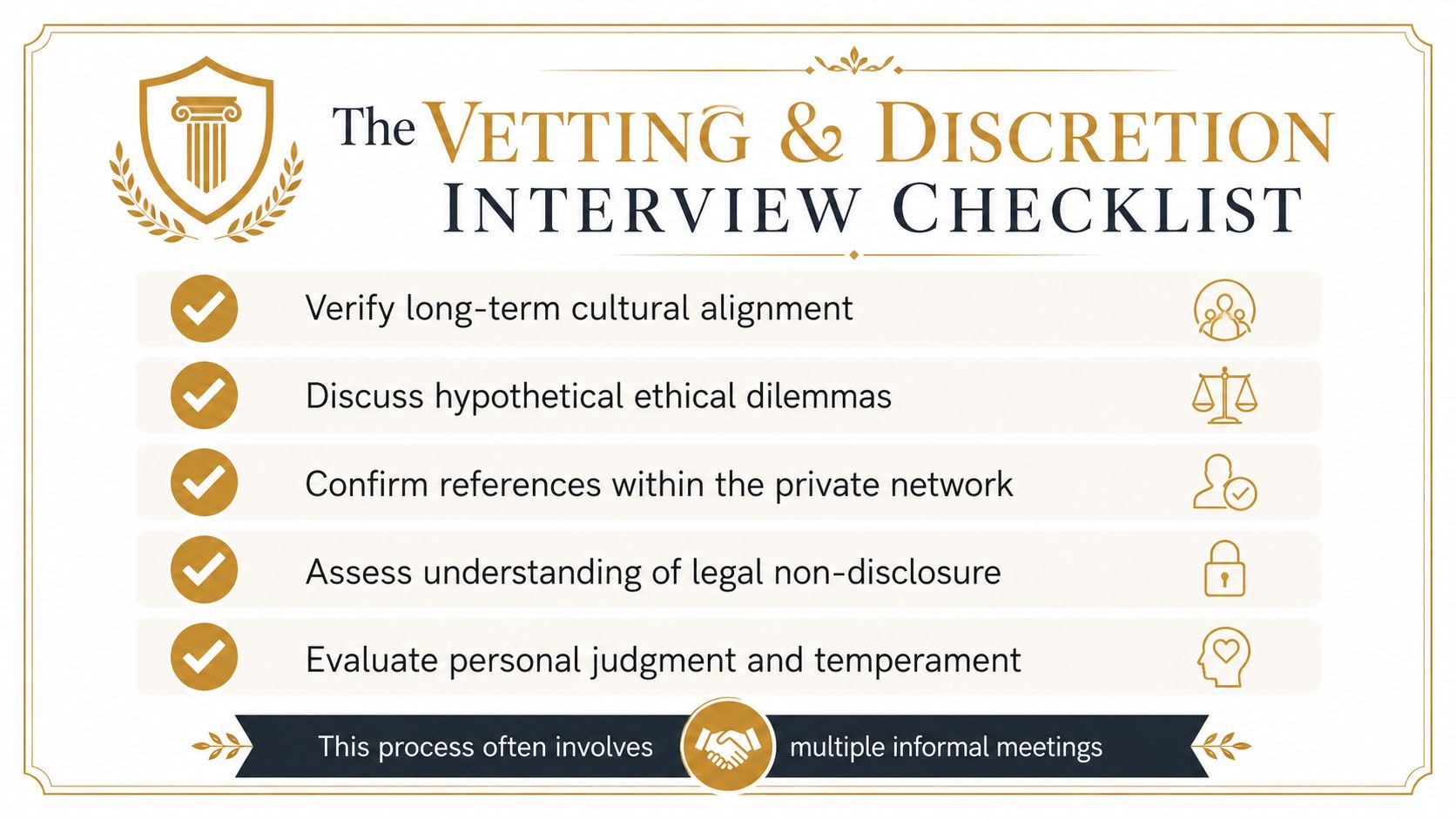
A family office interview is rarely just an interview. It's a discretion test, a temperament test, and a loyalty test wrapped into one. The person across the table is usually asking, without saying it directly, whether you'll be calm, private, and useful when the pressure is personal rather than commercial.
What the final stage is really checking
The strongest candidates talk about confidentiality as a working method, not a personality trait. They know how to explain that they've handled sensitive information, mediated sensitive relationships, and kept their mouth shut when it would have been easier to talk.
A useful prep resource is the Qcard interview prep guide, especially if you need a structured way to rehearse difficult questions and keep your answers tight. Use it to sharpen your delivery, not to sound scripted.
The red flags are often behavioural
Families and recruiters notice small things quickly. Oversharing, a casual attitude to previous principals, sloppy boundaries, and vague answers about past confidentiality issues all create doubt. So does trying to impress with status instead of substance.
What lands better is calm specificity. If you've supported a demanding household or a sensitive private office, say what you handled, how you protected privacy, and how you managed competing priorities without becoming dramatic about it. That's the profile that survives multiple informal meetings and reference scrutiny.
If you want help positioning yourself for family office London jobs, Superstar Nannies can support private-household candidates who need their experience translated into the language UHNW employers use. Visit Superstar Nannies to discuss roles, confidentiality, and the kind of placement that matches your background and seniority.