


A holiday booking is where many otherwise organised families lose control. The school calendar shifts, travel is already fixed, and a child still needs structure, sleep, and someone competent in the room. A holiday nanny solves that problem only if the role is defined properly, the paperwork is tight, and the vetting is far more exacting than a standard babysitting hire.
The Strategic Value of a Holiday Nanny
A family arrives in London for a winter break, the principal's schedule changes twice before lunch, and the children are overtired by dinner. That is the kind of situation a holiday nanny is hired to stabilise. You are paying for continuity, discretion, and a professional who can keep the household steady when the calendar turns chaotic.
The strongest use case is preservation of routine during school holidays, bank holidays, and travel-heavy periods, when care is hardest to source and easiest to get wrong. Industry booking patterns point in the same direction. Short-notice childcare demand is heavily seasonal, with a large share of bookings landing during school holidays, many classed as urgent, and a significant number falling on public holidays. That is not an occasional convenience market, it is a structural need.
The cleaner comparison is with other temporary household support roles that carry real responsibility. If you are budgeting for the broader trip, the cost of house sitting gives a useful frame for how specialist, temporary household cover is priced when reliability matters more than convenience. A holiday nanny sits in that same operational category.

Practical rule: if the family's plans are already set, the nanny must be brought into the plan, not asked to improvise around it.
A holiday nanny also reduces risk in ways families often overlook. Short-notice placements can fail on fit, paperwork, and travel readiness, especially when the assignment crosses borders or runs through a mix of hotels, villas, and family events. A qualified professional should arrive ready to handle routine, boundaries, safeguarding, and the practical realities of a changing schedule without putting pressure back on the parents.
For elite and international households, that distinction matters. A solid placement protects the children, limits avoidable disruption, and reduces the hidden cost of last-minute fixes. It also keeps expectations clear from day one, which is the only reliable way to avoid scope creep and the kind of arrangement that looks simple on paper but becomes expensive in practice.
Defining the Role and Service Models
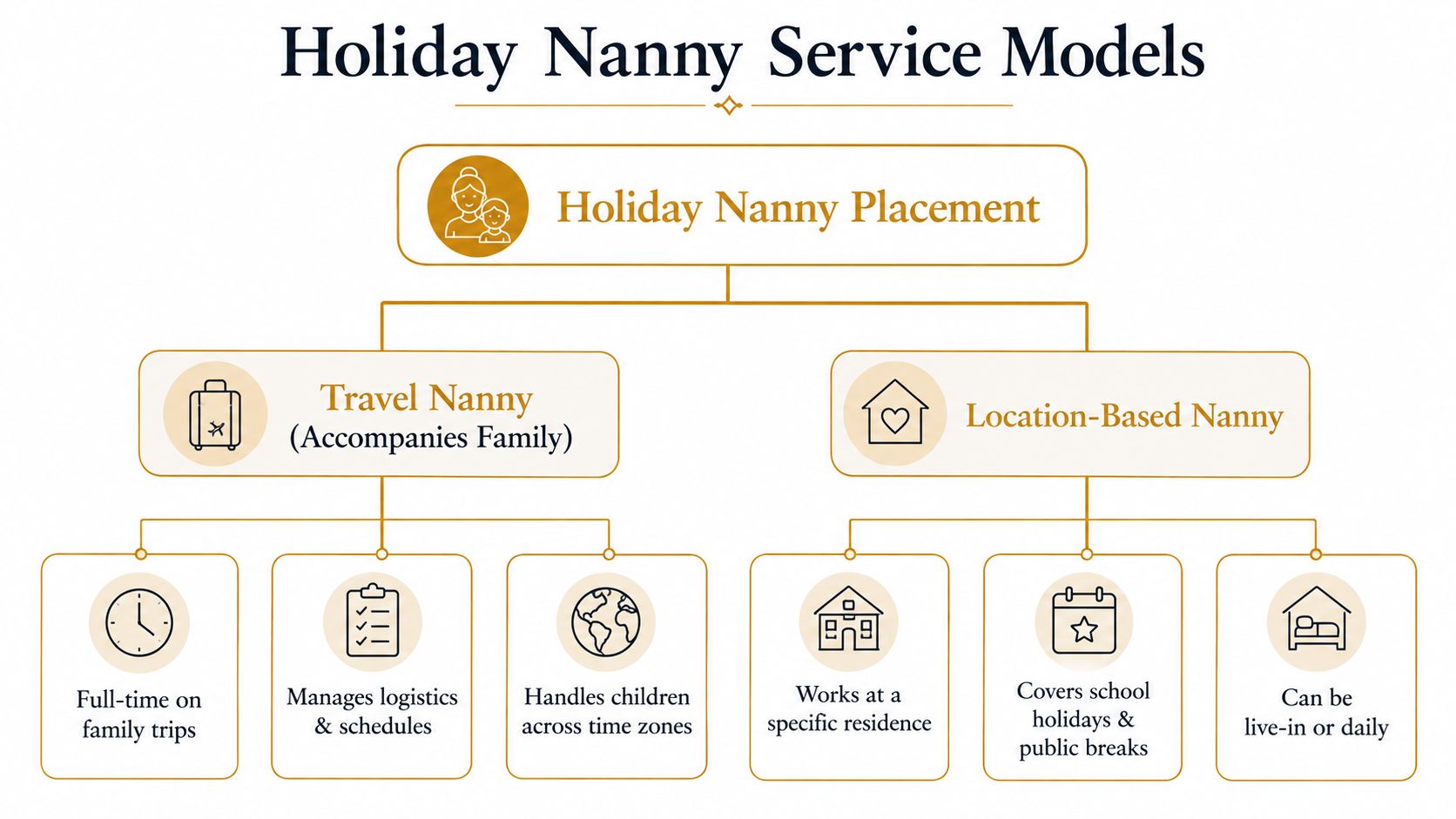
A holiday nanny is not one role. It is three distinct service models, and families make mistakes when they treat them as interchangeable. If you want clean execution, define the format before you speak to any candidate.
Travel nanny
A travel nanny accompanies the family on trips and stays inside the travel rhythm. That means airport days, hotel routines, villa transitions, excursions, and bedtime in unfamiliar places. The right person manages the children across changing environments without making the parents repeat instructions all day.
Location-based holiday cover
This is the version families use for a residence, an estate, or a staycation. The nanny covers a fixed block during school breaks or public holidays and keeps the household running while the parents work, travel, or host. This model is often the cleanest choice for families who want continuity in one location and do not need full travel support.
Ad hoc and part-time support
This is the lightest format, but it still needs proper structure. It suits a family that needs a few defined days, a special event, or backup around existing care. The danger here is scope creep. If you do not define boundaries, the role turns into an open-ended request for everything from laundry to sightseeing supervision.
The best holiday bookings spell out what the nanny does and what they do not do. Managing excursions, preserving educational routines, supervising meals, and handling night care are all normal. Being the family assistant, the housekeeper, or the tour organiser is not. UK holiday packages can be structured very tightly, and one travel-industry example describes 45 hours of care per week, one free day that is not a travel day, and 14 hours of night babysitting spread across a maximum of four nights, with workdays not starting before 7:00 a.m. or ending after 7:00 p.m. except for babysitting (Travelmole). That level of definition is what protects both the child and the professional.
Pricing Structures and Legal Entitlements
Holiday nanny pricing starts with timing, not status. Short-notice cover, school breaks, public holidays, and travel assignments all tighten supply and push the work into a premium bracket. As noted earlier in the booking-pattern data, standard childcare rates sit much lower than holiday cover, so the price you agree should reflect urgency, flexibility, and the level of responsibility the role carries.
For elite families, the cost is rarely just the hourly figure. A nanny who is expected to travel, adapt to changing itineraries, and cover evenings or split shifts is carrying more operational load than a local day nanny. That affects rate, rest planning, and whether the booking should be treated as a simple engagement or a more formal employment arrangement.
The legal side needs the same discipline. In the UK, a full-time employee is entitled to at least 5.6 weeks, or 28 days, of paid annual leave, and that entitlement includes the 8 UK bank holidays (Nanny Tax holiday pay). Acas takes the same statutory line, and employers can include bank holidays within that entitlement instead of treating them as an extra benefit (Morningside Nannies). For a permanent nanny, holiday pay is not optional administration. It is part of the actual employment cost.
Short-term holiday placements still need a proper classification. If the arrangement sits inside employment law, payroll treatment changes. If it is handled through an agency, the terms may shift again. If it is a casual worker setup, the family still needs to know who carries responsibility for pay, rest time, and holiday entitlement. The safest approach is to set this out before the trip, not after the first invoice. For a clear overview of payroll and compliance pressure points, review the agency guidance on nanny tax obligations.
| Variable | Impact on Cost | Typical Scenario |
|---|---|---|
| School holiday timing | Higher demand, less flexibility | Family wants cover during peak break periods |
| Public holiday cover | Premium scheduling pressure | Children need supervision on bank holidays |
| Last-minute booking | Faster placement, less room for choice | Plans change after travel is already fixed |
| Number of children | Higher workload and responsibility | One nanny managing siblings of different ages |
| Live-in or travel requirement | Additional accommodation and logistics | Nanny joins the family away from home |
| Employment structure | Payroll, leave, and compliance costs | Permanent or repeat holiday arrangement |
A clean contract matters more than a low headline rate. Spell out hours, rest time, duties, travel days, expenses, and who pays for what. If the paperwork is vague, the family absorbs the risk later.
Rigorous Vetting and Safeguarding Protocols
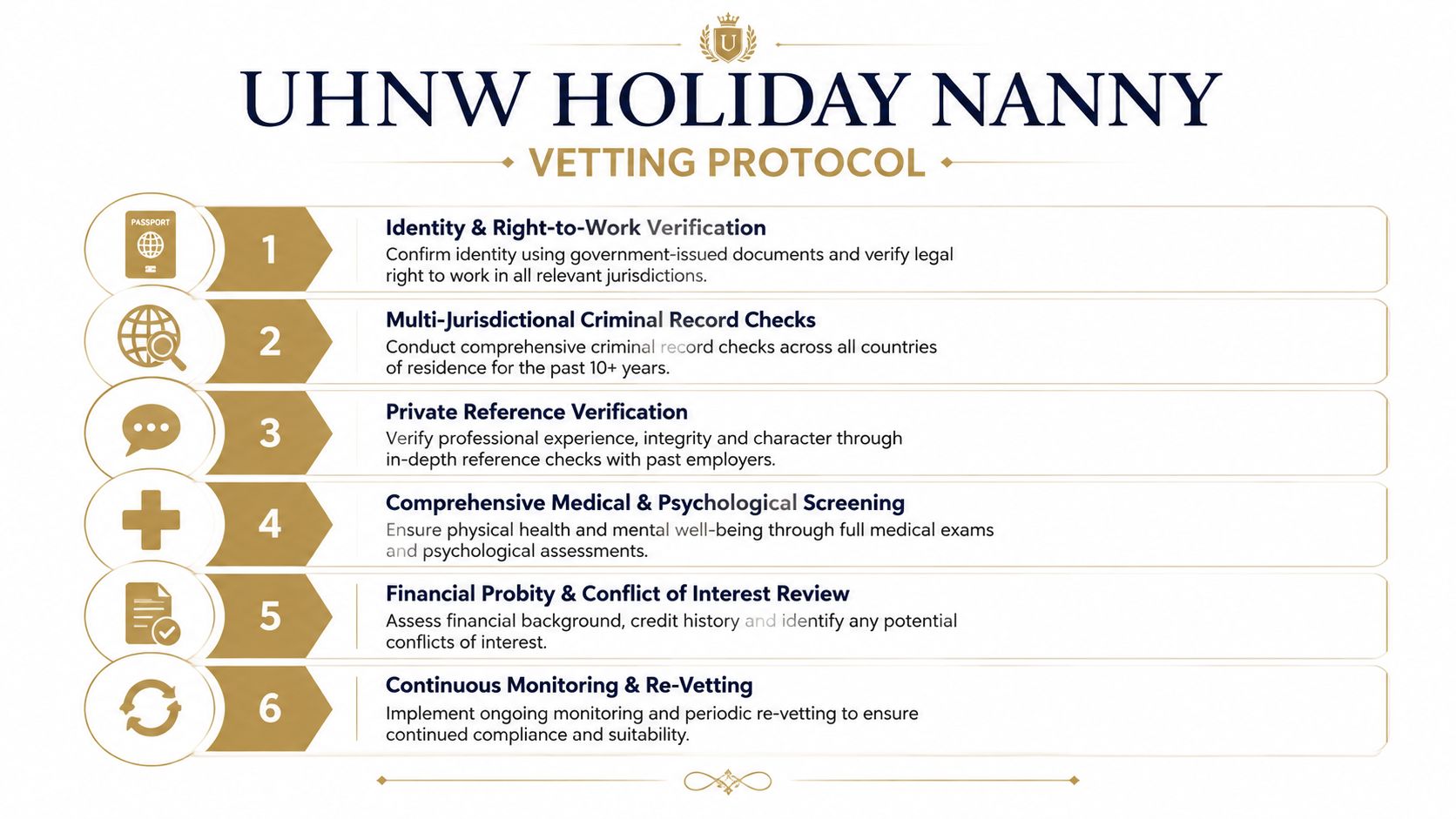
A standard DBS check is not enough for a holiday nanny who may travel, stay overnight, and work in unfamiliar settings. Families who move quickly often skip the parts that matter most. That is a mistake. Urgency is exactly when you need a harder process, not a softer one.
Verify identity and legal status first
Start with identity, right-to-work status, and a clean paper trail. If the person is travelling with the family, make sure the documents match the booking, the name on the passport, and the role description. If anything is inconsistent, stop there. A holiday placement does not justify shortcuts.
Check more than one safety layer
DBS is only one element. Families should ask about private references, current childcare experience, medical readiness, and how the nanny handles emergencies away from home. The weak point in much holiday-nanny content is that it stops at one checkbox. That is nowhere near enough for travel-based work, especially when the child may be in hotels, on yachts, in ski properties, or moving through airports.
A nanny who cannot explain what they do in a medical emergency should not be travelling with your children.
The due-diligence standard should also include insurance, conflict checks, and a direct conversation about boundaries in unfamiliar environments. If a nanny is expected to manage night routines, excursions, or transport, they need to demonstrate calm, judgement, and discretion under pressure. For a structured due-diligence framework, families can review the nanny vetting process guide.
Ask the right travel-specific questions
- Emergency response: Ask what the nanny does if the child becomes unwell in transit or after hours.
- Adaptability: Ask how they handle changed schedules, delayed flights, or unfamiliar sleeping arrangements.
- Routine protection: Ask how they preserve bedtime, meals, and quiet time in a hotel or villa.
- Safeguarding judgement: Ask what they do if an excursion, driver, or local arrangement feels unsafe.
- Communication: Ask how they update parents without creating alarm or noise.
For families who hire quickly, the interview should feel like a risk review, not a friendly chat. The right candidate welcomes that standard. The wrong one resists it.
Agency Placement vs Freelance Hiring
If you need a holiday nanny quickly, the choice usually comes down to agency placement or freelance hiring. I prefer agency placement for UHNW households because the margin for error is smaller and the consequences of failure are bigger. Freelance can work, but only if the family is prepared to manage every operational layer themselves.
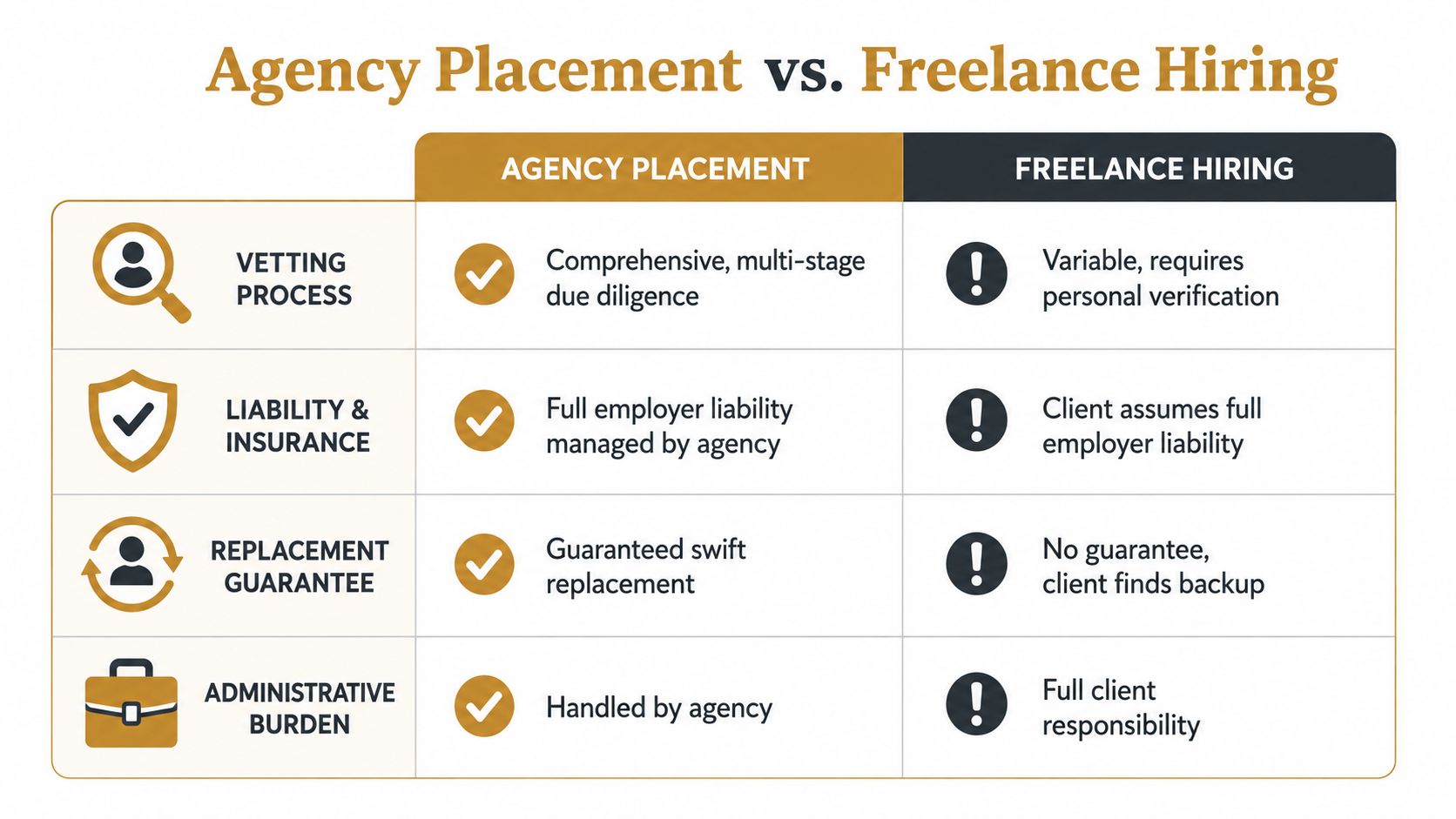
Agency placement gives you a filtered shortlist, process discipline, and someone to stand behind the hire if the placement changes. Freelance hiring puts the burden on you. That includes verification, replacement planning, and handling any dispute that arises mid-trip. If the nanny falls ill or the family extends the journey, the difference between those two models becomes obvious fast. For a fuller comparison, review why families choose a nanny placement agency.
Superstar Nannies is one option in this space. It operates as a private household staffing agency and places travel nannies, live-in and live-out nannies, and other household staff for elite families. That model suits families who want the search, screening, and coordination handled by a specialist team rather than managed ad hoc.
My view is blunt. If you are arranging international travel, multiple children, or a tight holiday timetable, use an agency. If the booking is local, simple, and low risk, freelance may be acceptable. The key question is not price alone. It is who absorbs the failure if the plan breaks.
Travel Logistics and Documentation
An international departure exposes every weak point in a holiday nanny arrangement. If the paperwork is incomplete, the itinerary is vague, or the accommodation has not been planned, the trip turns messy fast. A nanny crossing borders needs proper documents, clear instructions, and a household that has already decided how meals, rest, bedtime, and child routines will work away from home.
Start with the paperwork and do it early. Confirm visa requirements, work permissions, insurance cover, and every document the family expects the nanny to carry. If the itinerary includes several countries, check whether the nanny can legally enter and work in each one. No one should be arguing with border control or a hotel desk over missing paperwork. That belongs in the planning stage.
Pack for the role, not just the trip
A travel nanny's luggage should support childcare, not just personal convenience. Practical clothing, required certifications, emergency contact details, chargers, toiletries, and anything needed to keep the children's routine intact should be packed before departure. The more the family prepares in advance, the less chance there is of friction once travel begins.
Families often leave accommodation decisions too late. If the nanny is staying with you, the room, meals, and rest time must be defined before departure.
A useful benchmark is the holiday-nanny guidance published by Absolutely Education, which says families should agree the hours of work beforehand, use a written contract, and provide three meals a day plus suitable accommodation when the nanny is staying with the family on holiday (NYT on vacation nanny expectations). That same guidance also makes the point that the nanny is not on holiday, and they need proper rest and time off.
Travel arrangements for staff deserve the same discipline as any other mobility planning. For international families, our traveling-nanny guide for international families sets out the documentation and movement issues that can derail a placement if they are handled casually. The practical approach in Passpaw travel companion tips is also useful because it treats movement as a managed process, not an informal handover. Children need that same level of preparation. Build the schedule, confirm the accommodation, arrange meal coverage, and keep naps and bedtime intact even when the setting changes.
Securing Your Family's Peace of Mind
A holiday booking fails when families treat it like a temporary favour instead of a professional placement. Define the role, price it properly, vet it hard, and document everything. That is how you keep the trip calm and the children settled.
The right holiday nanny gives you continuity, but only if the arrangement is built with the same care you would give any other high-value household decision. The family gets a smoother trip, the children get consistent care, and the staff relationship starts on solid ground.
Superstar Nannies places discreet holiday nannies for families who need fast, reliable cover without compromising standards. If you want a properly vetted placement, international travel support, and a process designed for UHNW households, visit Superstar Nannies to discuss your requirements.