


Your household doesn't need another glossy brochure. It needs staff who won't create risk, won't leak information, and won't leave you rebuilding the rota after two weeks. That's why a private staff agency matters, if it's run properly.
Elite families usually discover this the hard way. A warm recommendation from a friend can still fall apart on right-to-work, payroll, or simple cultural fit, and a polished CV means nothing if the candidate can't work inside a discreet, high-pressure home. A serious private staff agency protects the household first, then fills the role.
Why Elite Families Rely on Private Staff Agencies
A family can have the right home, the right school, and the right schedule, then lose control of daily life because one hire wasn't screened properly. That's the reason UHNW households turn to a private staff agency instead of job boards or word of mouth. They need judgement, confidentiality, and a process that can handle more than a simple introduction.
The difference is operational, not cosmetic. A generic recruiter can send names. A specialist agency understands that a nanny, house manager, or estate lead has to fit a family system, not just a job description. Superstar Nannies presents that model directly in its guide to private staffing agencies for elite households.
What a specialist agency really solves
A good household placement firm cuts through three recurring problems.
- Discretion: Elite families need staff who can operate without gossip, over-sharing, or casual social media behaviour.
- Cultural fit: A candidate can be technically strong and still clash with the household rhythm, the children, or the principals.
- Continuity: Live-in and live-out homes both need staff who can settle quickly and stay stable under pressure.
Practical rule: If an agency sells speed before it explains vetting, it's probably optimising for its own calendar, not your home.
Specialist agencies also understand that different households need different kinds of support. A London townhouse with school-age children needs something very different from a multi-property family with travel, shared custody arrangements, and changing calendars. In those homes, a private staff agency acts more like an operating partner than a CV pipeline.
REC says the UK recruitment and staffing industry contributes £43 billion to the economy, handles over 22 million temporary or contract placements and 540,000 permanent placements each year, and employs over 200,000 people in the UK, with a projected contribution of £51 billion by 2025 (REC industry numbers). That scale matters because it shows staffing is infrastructure. In elite homes, the wrong infrastructure fails noisily.
The Full Range of Household Roles an Agency Fills
A narrow agency sells nannies. A serious private staff agency builds households. That is the divide between filling one vacancy and designing a domestic team that can hold under pressure.
Childcare is only the starting point. A family may need a Norland-trained nanny, a bilingual nanny, a maternity nurse, a newborn care specialist, a night nanny, a governess, or a private tutor. Some homes need rota cover, some need a travel nanny, and some need a live-in professional who can keep pace with school terms, travel schedules, and shifting family demands.
A good agency also knows that international hiring changes the brief. If a role involves relocation, passport checks, or cross-border background screening, the process has to be tighter from the start. Families that hire abroad should review the standards used for international background checks before they approve a shortlist.
Household staffing works the same way. A housekeeper keeps standards consistent. A house manager keeps people, suppliers, and timing aligned. A butler handles service and presentation. Domestic couples can cover live-in support with more flexibility, while private chefs, chauffeurs, gardeners, and estate managers keep larger residences functioning without constant escalation.
If your home spans more than one property, the brief has to be broken into layers instead of treated as separate hires.
- Core support: nanny, housekeeper, chef, chauffeur.
- Coordination layer: house manager, personal assistant, butler.
- Estate layer: gardener, maintenance support, estate manager.
- Specialist layer: newborn specialist, governess, travel nanny.
The World Employment Confederation says global agency-work turnover rose 13.7% in 2021 to €417.5 billion, after a 7% decline the year before, and agencies placed 62 million people into work across 40 countries (WEC Economic Report 2023). That rebound matters because elite staffing now runs inside a mature global system. Families hiring across borders should expect that same level of structure at home.
The best agencies do not stop at role titles. They ask how your home runs, who needs coverage at what hour, and what happens when the principal travels, the children change term dates, or the estate team has a conflict.
A private household should be staffed like a controlled system. If the roles overlap badly, even strong people fail.
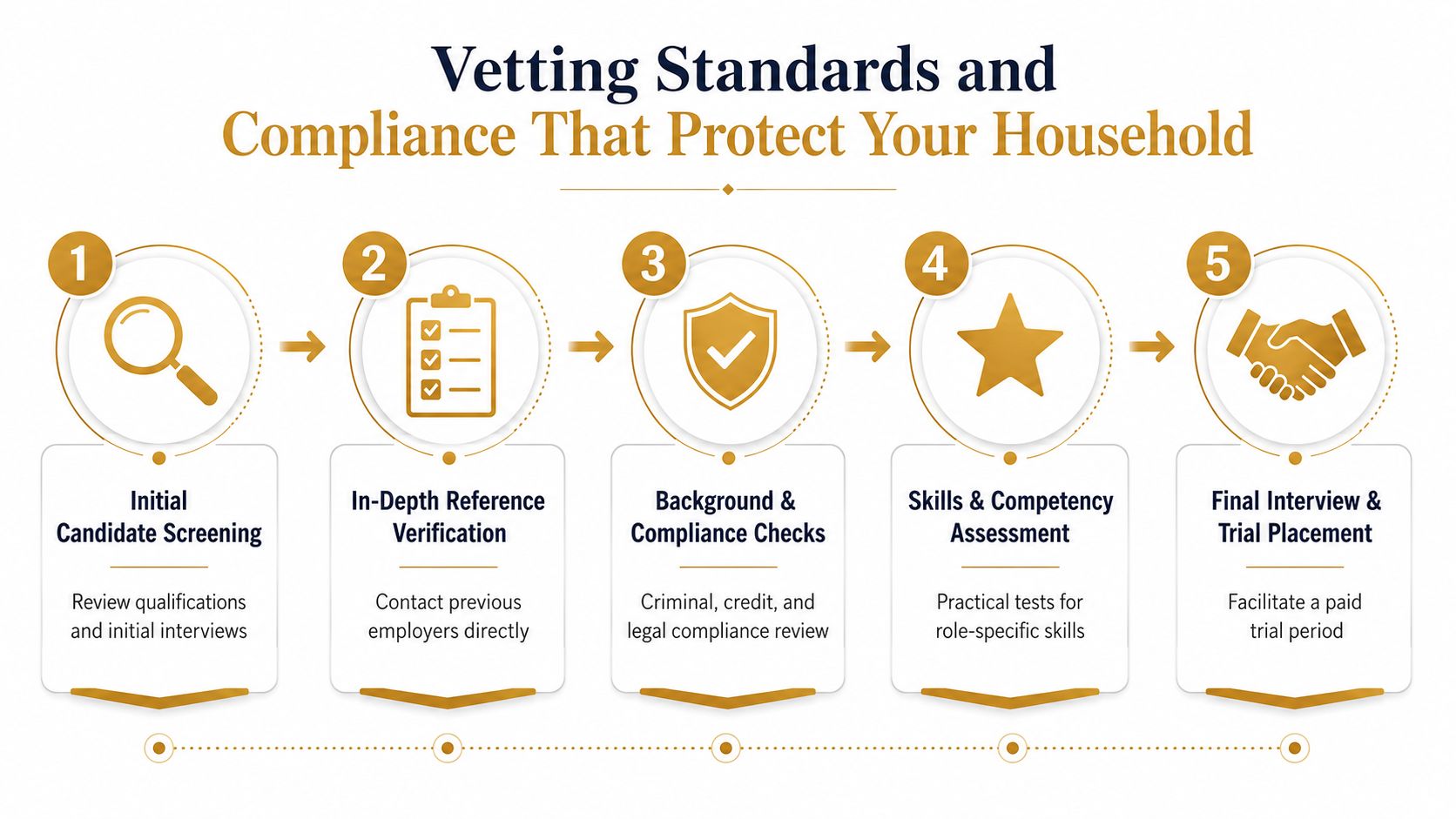
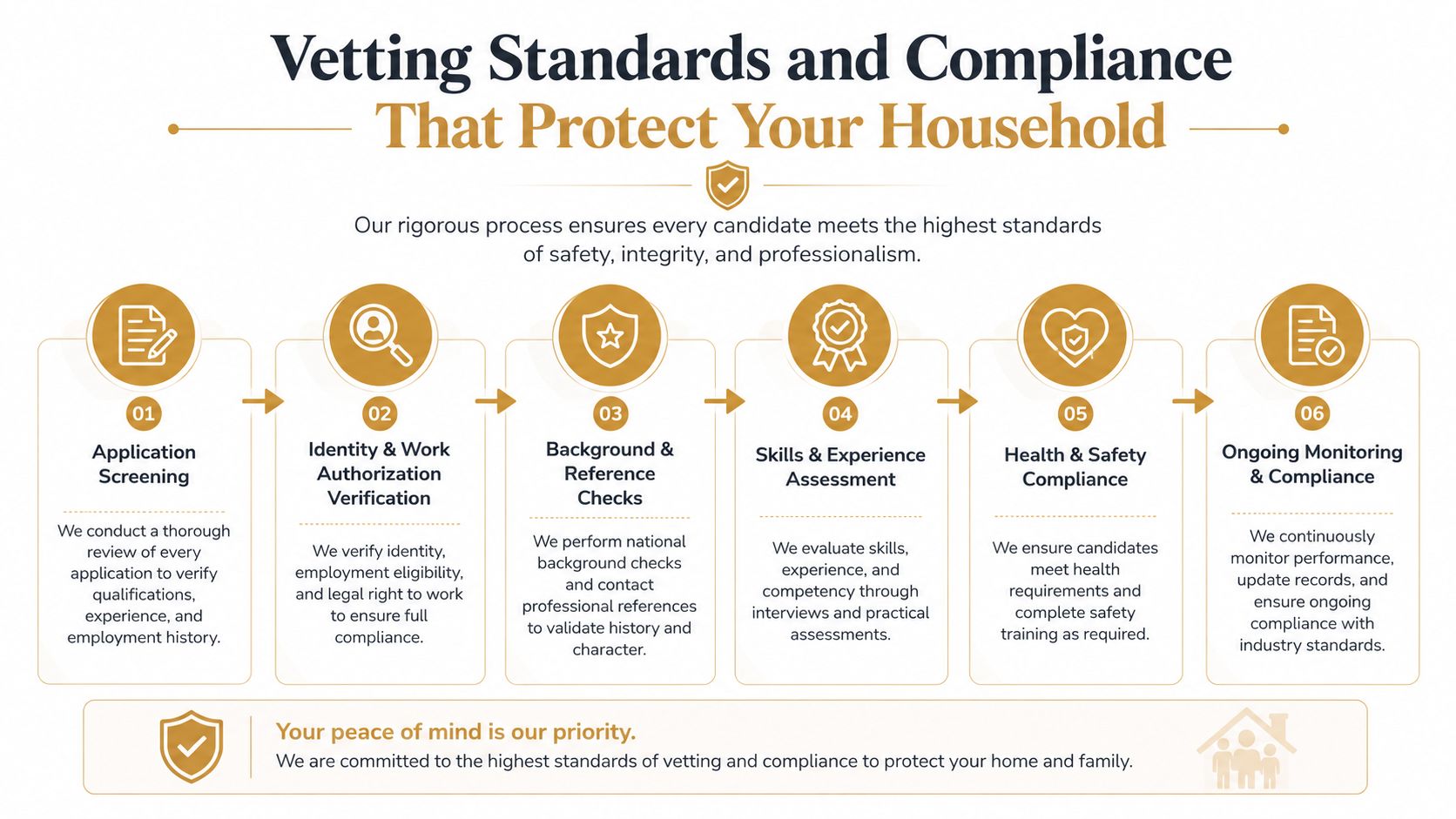
Vetting Standards and Compliance That Protect Your Household
Most bad placements don't fail because of skill. They fail because someone skipped a hard check, or treated compliance like paperwork instead of protection. In a private staff agency, vetting has to be the product.
The baseline is straightforward. You want identity verification, DBS where relevant, direct reference checks, right-to-work documentation, and continuity checks. But the issue is whether the agency treats those steps as a sequence it can defend, or as a box-ticking exercise it rushes through to make the placement look fast.
Compliance is a risk control, not admin
In the UK, employment status decides who is responsible for PAYE, holiday pay, pensions, and workplace rights compliance. That's why contract structure matters so much in private staffing. If the placement is misclassified, the liability doesn't disappear. It can land on the agency, the household, or both, depending on how the arrangement was designed.
The government's guidance for employment agencies and businesses says agencies must not charge work-seekers a fee for finding work, must not withhold wages, and must not prevent a worker from working elsewhere or ending the contract. It also says workers must be paid for all work, receive paid holiday, be paid at least the National Minimum Wage, and be protected by health and safety law (UK government guidance). That's not optional background reading. It's the floor.
Practical rule: If an agency can't explain who is the employer, who runs payroll, and who holds liability, don't sign.
Cross-border staffing raises the stakes further. If you're hiring a bilingual nanny, private chef, or estate staff member from abroad, right-to-work and visa dependency issues can decide whether the placement is viable at all. The estate agency notes that UK immigration rules and sponsor requirements can turn a promising hire into a vacancy if process quality is weak (immigration and compliance context). For families with international homes, that's where documentation discipline matters more than charm.
For a deeper screening layer, many UHNW families use specialist support such as international background checks. Used properly, that's part of a broader compliance stack, not a substitute for judgment.
Understanding the True Cost of Hiring Private Staff
Families usually ask the wrong question first. They ask what the salary is, when they should be asking what the whole employer cost looks like. A private staff agency should be willing to walk through the full stack without hiding the painful parts.
The headline number is only the start. The budget includes base salary, agency placement fees, employer National Insurance contributions, holiday pay, pension auto-enrolment, payroll administration, and, for live-in staff, accommodation and utilities. UK official data show the National Living Wage rose to £12.21 per hour in April 2025, and employer National Insurance contributions increased in April 2025, so the cost of a household hire can change materially even if the agreed salary doesn't move (true cost context).
Budget for the contract model, not just the person
A permanent placement behaves differently from a temporary contract or short-notice cover. Permanent hires usually involve a longer commitment, more onboarding, and more risk if the fit is wrong. Temporary and interim placements can protect continuity, but the price structure often reflects speed, availability, and urgency.
| Cost Component | Description | Typical Consideration |
|---|---|---|
| Base salary | The agreed pay for the role | Depends on seniority, hours, and responsibility |
| Agency fee | The fee charged for the placement | Often linked to the scope of search and support |
| Employer NI | Statutory employer contribution | Changes the true cost above salary |
| Holiday pay | Statutory paid leave accrual | Needs to be planned from the start |
| Pension auto-enrolment | Workplace pension obligations | Applies once eligibility thresholds are met |
| Payroll admin | Processing pay, deductions, and filings | Can be handled in-house or externally |
| Live-in costs | Room, utilities, sometimes meals | Can materially affect total household spend |
If you want a cleaner benchmark for the staffing market, use the private staff salary guide for UHNW families alongside the agency quote. Don't compare a salary line to a full-service package and call it an apples-to-apples decision. It isn't.
Red Flags and Warning Signs When Evaluating Agencies
Bad agencies rarely announce themselves as bad. They sound polished, they promise speed, and they expect you to skip the hard questions. A strong private staff agency earns trust by being exact about process, not by talking smoothly.
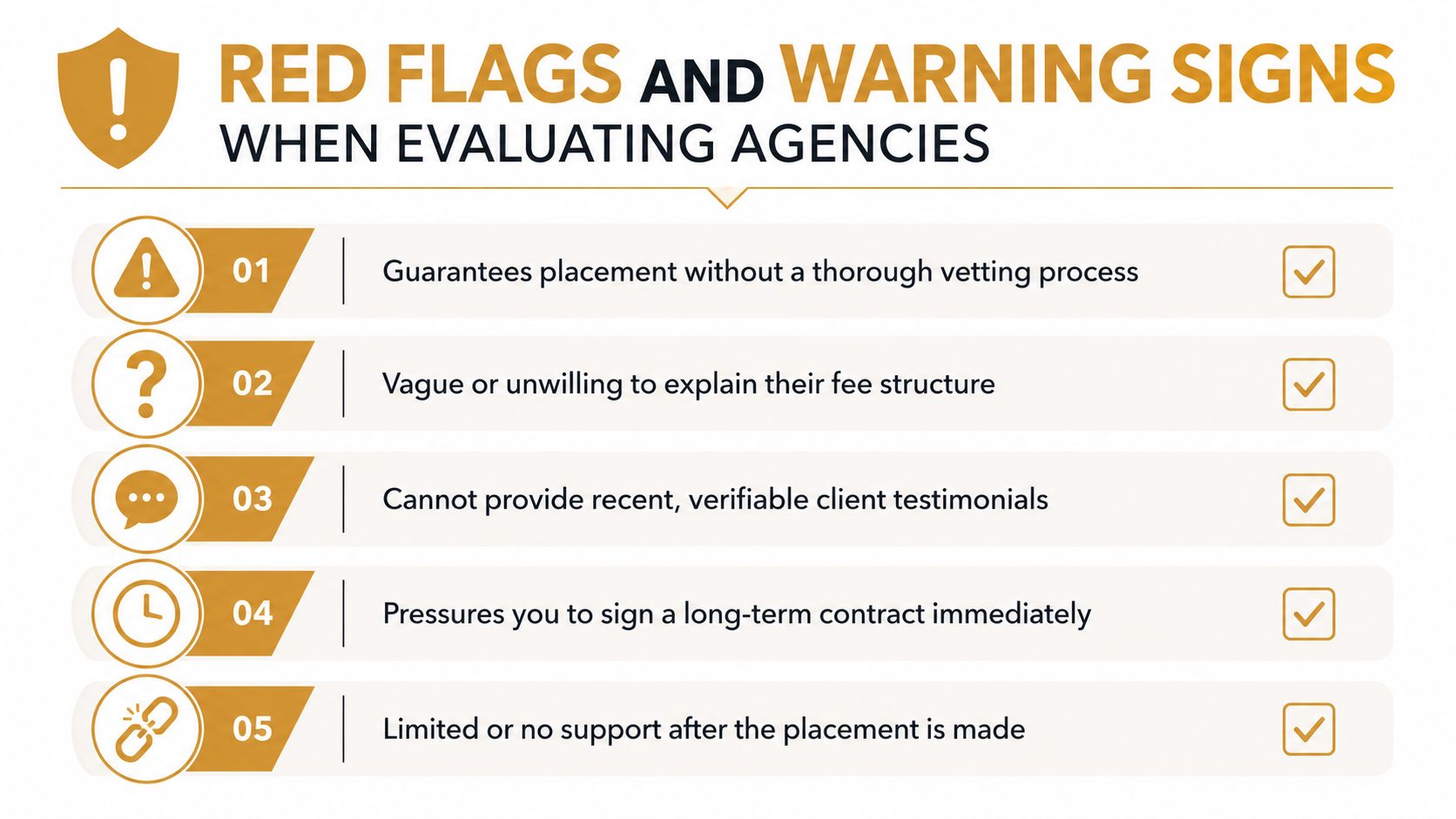
Start with the vetting process. If the agency cannot say what checks it runs, who verifies them, and where the gaps are, stop there. A vague answer usually means a vague operation. Fee opacity is the next warning sign. If the pricing discussion becomes slippery, the contract usually does too, and hidden costs tend to surface later in payroll, compliance handling, or replacement support.
What weak agencies usually hide
A family should treat the following as warning signs, not minor inconveniences:
- Guarantees fit too early: A real search needs screening, interviews, and trial periods, not a sales promise before the work is done.
- Dodges fee detail: If the cost structure is unclear, assume there are extras waiting in the small print.
- Has thin proof: Recent, verifiable testimonials matter more than polished language and generic praise.
- Pushes urgency: Pressure to sign quickly usually helps the agency, not the household.
- Offers little aftercare: A placement is not finished on day one if the household still needs support after the start date.
For a useful check on how buyers describe service when the stakes are high, review buyer testimonials for London property. Read those comments the way you would read agency references. Look for consistency, detail, and signs that the provider followed through after the contract was signed.
International reach is another area where families get misled. A firm can source candidates globally and still be weak on UK status rules, payroll boundaries, or visa timing. That gap creates real exposure in a household where discretion, continuity, and legal compliance all matter at once.
If an agency talks more about access than process, it is selling volume. If it speaks clearly about checks, contracts, payroll, and post-placement support, it is selling control.
Essential Questions to Ask Before Signing a Contract
A contract meeting should feel like an audit. If the agency treats it like a sales chat, walk away. A credible private staff agency will welcome detailed questions because it knows the answers need to stand up under scrutiny.
Start with the vetting process, but go further than the usual checklist. Ask what is checked before a candidate reaches shortlist, how references are confirmed, and how the agency tests for continuity, reliability, and discretion. A serious firm can explain why one profile passes and another fails. It will not hide behind vague talk about “good intuition.”
Then force clarity on who carries the employment burden. Payroll, tax, insurance, and legal compliance cannot be left implied. If the agency is fuzzy on employment status, the household absorbs the risk, and that is a bad arrangement for any home where children, valuables, and private routines are involved.
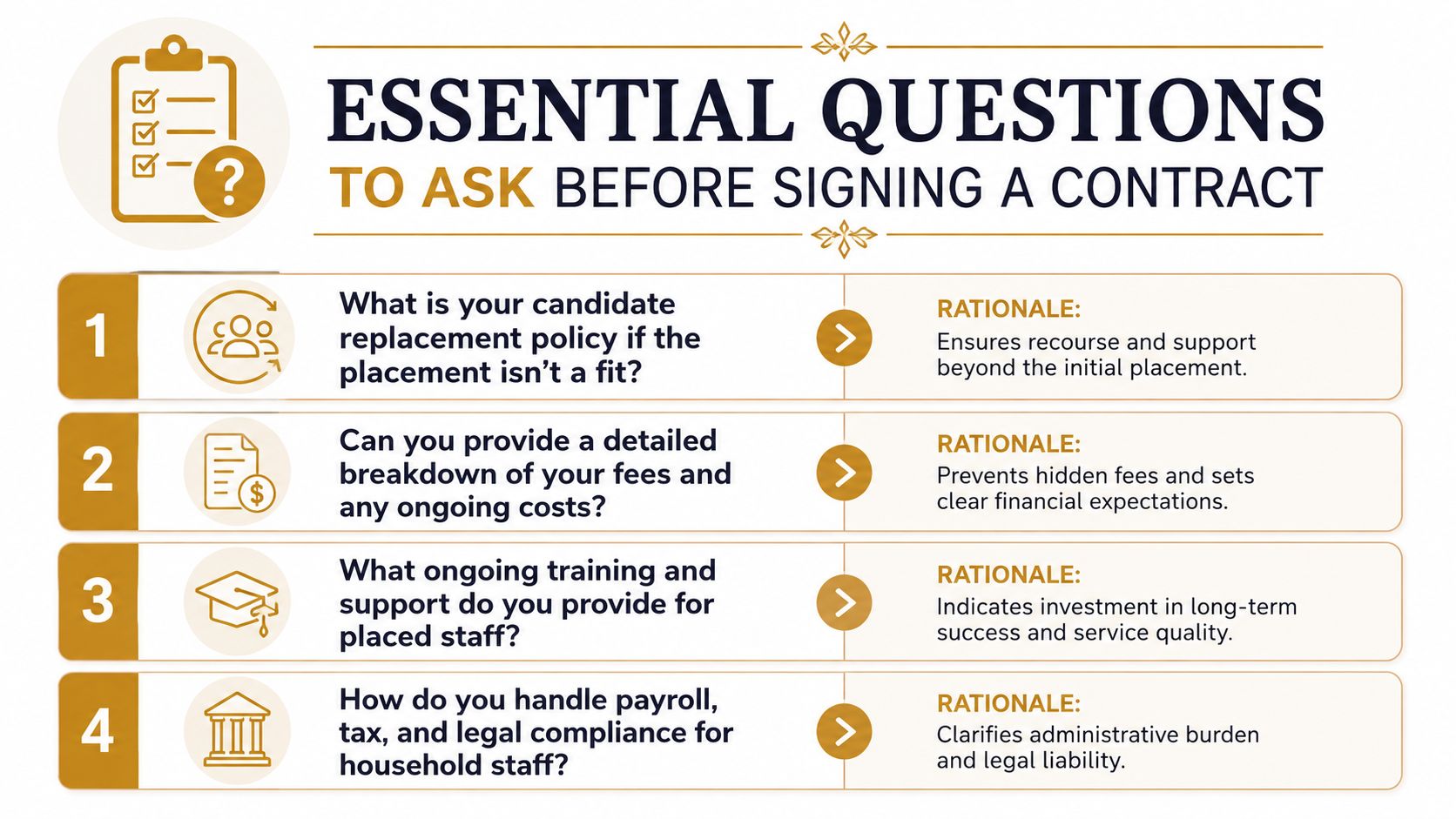
Ask for the contract terms in plain English. What happens if the placement fails, who handles replacement support, and what does the agency do after the start date? If the answer is thin, the service is thin.
Questions that separate experts from generalists
Use these questions and listen for specifics, not polished scripts.
- What happens if the placement isn't a fit? A strong answer includes replacement support, a clear process, and a realistic timeline for next steps.
- How do you handle cross-border hires? Ask about right-to-work checks, documentation, visa timing, and who manages the coordination.
- What does confidentiality look like in practice? The agency should explain data handling, limited information sharing, and how candidate details are protected.
- How do you match lifestyle and culture? The answer should address family routines, travel patterns, household expectations, and the pace of the home.
If your household needs more than one hire, ask whether the firm can coordinate broader staffing through a household staff recruitment agency. That matters if you are building a team, not just filling a single role.
Cross-border competence deserves its own test. An agency can market international reach and still be weak on local employment rules, payroll boundaries, or visa timing. That gap creates real exposure for families moving staff between London, Dubai, and Monaco, where process failures can disrupt continuity fast.
Look at the way the agency talks about the work. If it sells access and avoids process, it is built for volume. If it can explain checks, contracts, compliance, and aftercare without hand-waving, it is built for control. For families setting up a new home or tightening an existing one, practical details like safe furniture add-ons can also matter, because a strong hire still needs a safe environment.
Finding the Right Agency for Your Family's Needs
Choose the agency that fits your risk profile, not the one that sounds the most glamorous. If you only need one live-in nanny, you need a different level of support than a family building a full estate team across several homes. The wrong choice costs time, money, and trust.
The best private staff agency for your household will be the one that can defend its vetting, explain its compliance model, and quote its fees without evasiveness. It should also understand cultural fit, confidentiality, and the realities of live-in versus live-out arrangements. For families setting up new homes or refreshing a staff structure, even practical details like safe furniture add-ons can matter because a good household hire is only one part of a safe environment.
Choose on fit, not noise
If you're hiring for childcare, prioritise specialist screening, continuity, and lifestyle fit. If you're hiring for a larger household, prioritise contract clarity, cross-border competence, and the agency's ability to coordinate multiple roles. If you're managing a mobile or international family, insist on an agency that understands how travel, visas, and household rhythm interact.
Superstar Nannies is one option in this space, offering international private household staffing across childcare and domestic roles. It's the kind of provider you'd compare against other specialist firms if you want discreet, rigorously managed placements rather than generic recruitment.
The right agency should make your household calmer, not busier. It should reduce risk before a candidate steps through the door, not explain problems after they've started. And it should treat your home as a serious operating environment, because that's what it is.
If you're ready to hire with less guesswork and more control, visit Superstar Nannies to discuss a private staff placement built around your household's standards, schedule, and level of discretion. They specialise in bespoke, rigorously vetted placements for UHNW families, and they can help you move from uncertainty to a clear staffing plan.