


The first morning with a new nanny often feels split in two. One part is relief. The routine is finally in place, the nursery is organised, the handover notes are printed, and everyone wants the arrangement to work. The other part is quieter and harder to admit. You're trusting someone with the person you love most, inside the most private space you have.
That's why child protection policies matter so much in private childcare. They aren't paperwork for paperwork's sake. They're the shared rules that tell a nanny what to do, tell parents what good practice looks like, and remove dangerous guesswork when something feels wrong.
Why Child Protection Is Non-Negotiable in Your Home
A parent leaves for the office. The baby has just gone down for a nap. The nanny knows the feeding routine, the buggy route, the allergy notes, and where the spare sleepsuits are kept. Everything looks calm. Yet that calm only holds if the adults have already agreed what safety means in practice.
A proper policy answers the uncomfortable questions before anyone has to ask them under pressure. What counts as a concern? Who documents an unexplained bruise? What happens if a child discloses something unexpected? How is discipline handled? What if the nanny sees behaviour from another adult in the home that worries her?
This isn't theoretical. As of 31 March 2025, nearly 50,000 children were on formal protection plans in the UK, and neglect was the most common reason at 50% of cases, followed by emotional abuse at 37% according to the UK children in need data for 2025. Those figures should change how families think about safety at home. Harm doesn't only happen in obvious places, and it doesn't always begin with dramatic signs.
Practical rule: If a household relies on a nanny, it needs written child protection policies before a problem arises, not after.
The best policies do two things at once. They reassure parents, and they protect professional nannies from being left to improvise. A nanny who has been properly background checked still needs a framework for reporting concerns, managing boundaries, and recording incidents. Vetting is the starting point. It is not the whole system.
In practice, families who skip this work usually tell themselves they have a “good instinct” about people. Families who do it well build trust in a calmer, more mature way. They make expectations explicit, keep standards consistent, and treat safeguarding as part of professional childcare rather than a sign of mistrust.
Understanding Safeguarding and Its Legal Foundations
People often use safeguarding and child protection as if they mean the same thing. They don't.
Safeguarding is the wider system. It covers prevention, safer environments, healthy boundaries, supervision, training, and sensible routines that reduce the chance of harm. Child protection is narrower. It is the response when there is reason to suspect a child is already experiencing harm, or is at risk of it.
A simple way to explain it is this. Safeguarding is the whole home security setup. Locks, lighting, alarms, and clear house rules. Child protection is what happens when the alarm goes off.
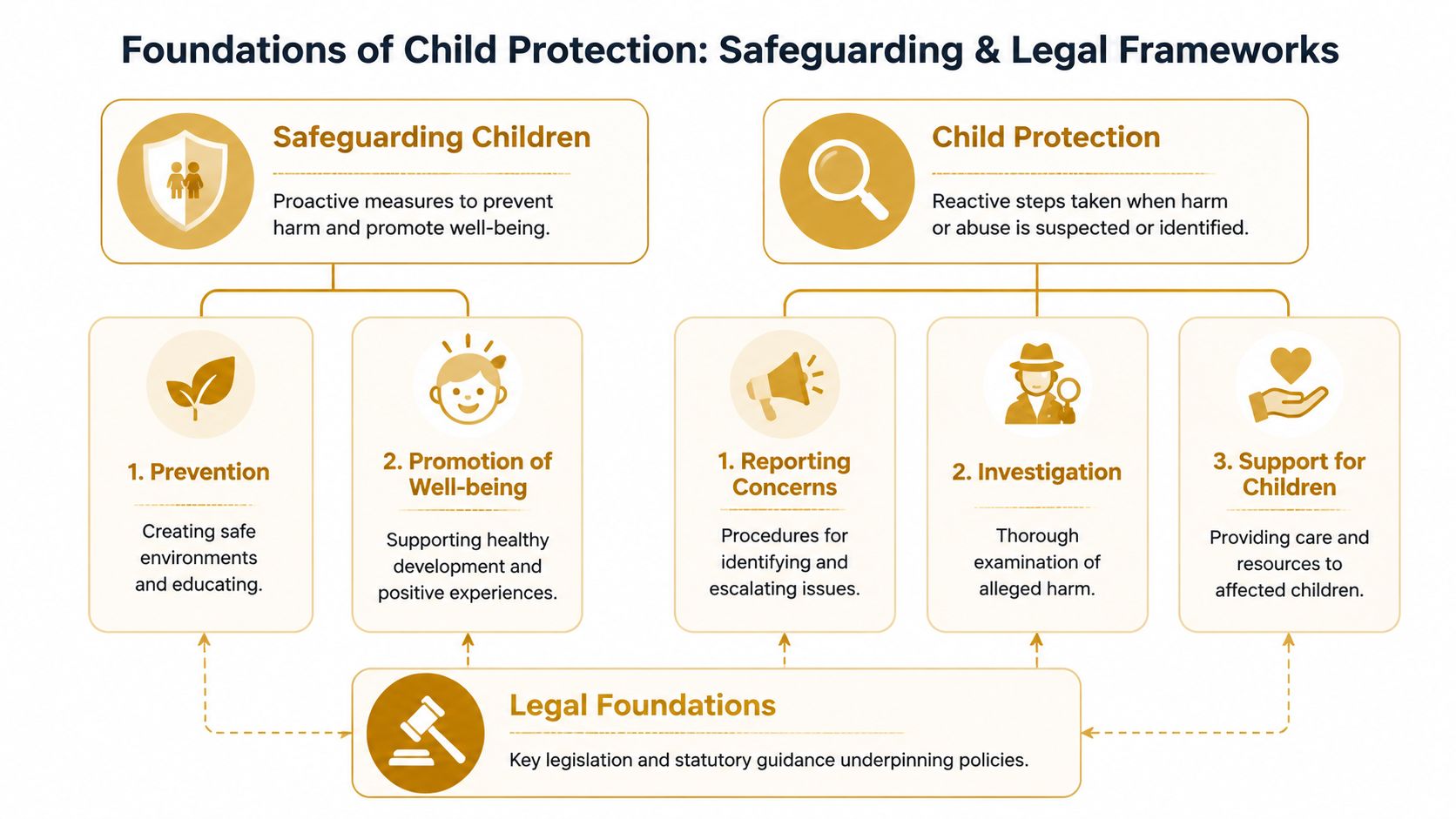
What the law expects
Across the UK, the legal framework differs by nation, but the core duty is consistent. UK child protection law is regionally specific, but all frameworks, including England's Children Act 1989, mandate the protection of children from maltreatment and the prevention of health or development impairment, as outlined in this summary of safeguarding children legislation.
For parents and nannies, the practical meaning is straightforward. Child safety is not optional, private, or left to personal preference just because care takes place in a family home. A household may be discreet. It is still part of a wider safeguarding environment.
What this means in daily practice
A legal duty becomes useful only when it translates into ordinary decisions. In a private home, that usually means:
- Clear reporting lines: The nanny knows exactly who to contact first when a concern arises.
- Defined boundaries: The adults have agreed rules on discipline, physical contact, digital communication, sleep arrangements, travel, and visitors.
- Documented concerns: Worrying incidents are recorded factually, not left to memory.
- Checked credentials: Families verify identity, references, and childcare background checks before employment starts.
- Shared understanding: Everyone knows the difference between a minor welfare issue, a safeguarding concern, and an allegation requiring escalation.
Good safeguarding is ordinary, repeatable, and boring in the best possible way. It should work on a rushed Monday morning, not only in a training session.
Why private homes still need formal structure
Many households resist formal language because it feels too institutional. That hesitation is understandable, but it's misplaced. Structure doesn't make care cold. It makes care reliable.
A written policy reduces confusion, especially when several adults are involved. That could include parents, rota nannies, maternity nurses, tutors, chauffeurs, housekeepers, or security staff. Once a child moves between people, properties, or routines, verbal assumptions stop being enough.
The Essential Components of a Robust Policy
A policy earns its place in a private home only if people can use it under pressure. In nanny placements, that means a document that works at 7am before the school run, during overseas travel, and in homes where several adults share care. The standard school template is rarely enough for that.
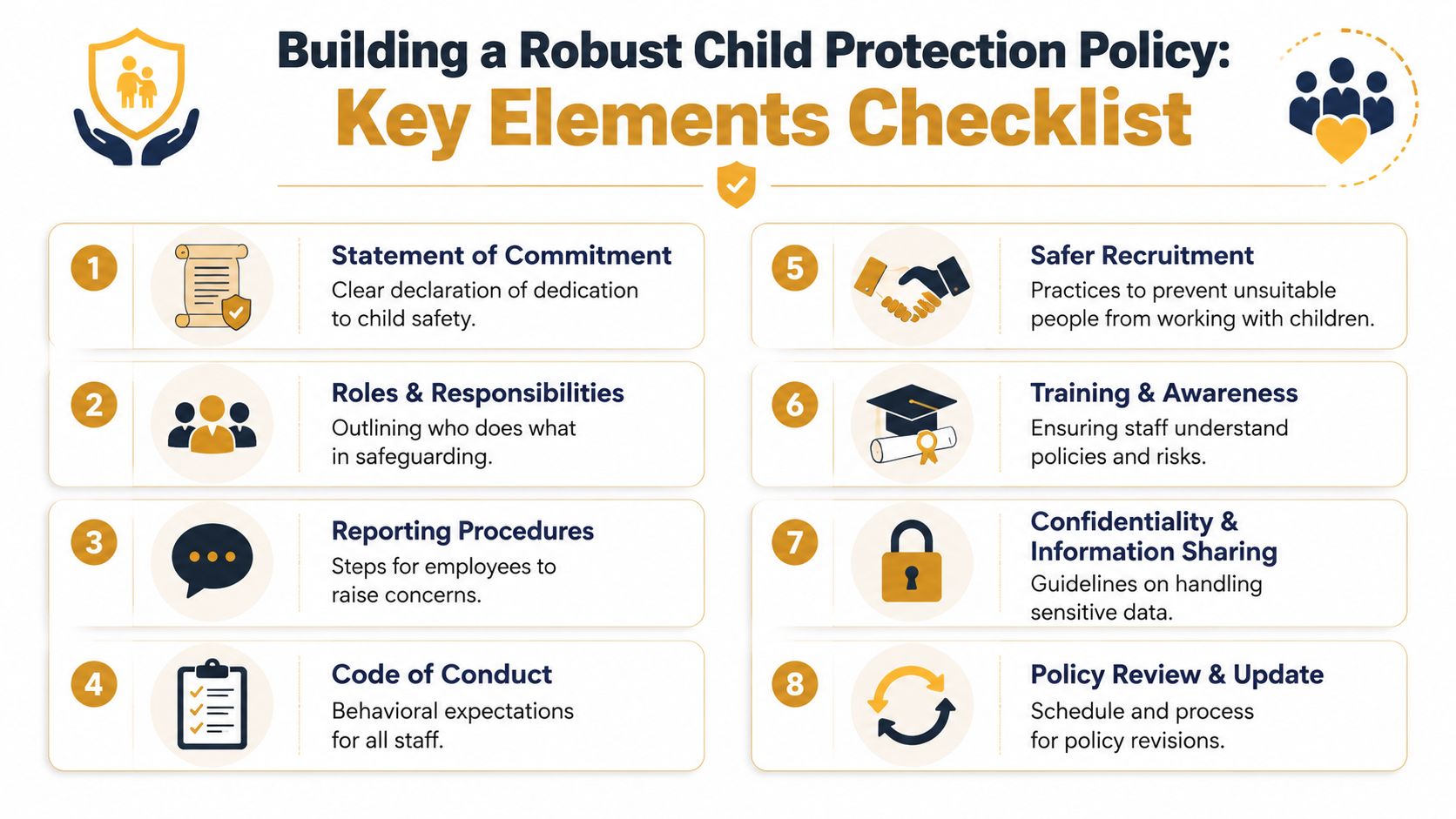
Statement of commitment and named responsibility
Begin with a short, plain statement that the family or agency will protect children from harm, respond properly to concerns, and record decisions. Then assign responsibility by name and role.
In agency placements, that usually means a designated safeguarding lead. In a private household, it may be a parent, family office representative, or house manager. What matters is that everyone knows who holds authority, who receives concerns, and who takes over if that person is unavailable or implicated.
Private households often blur lines because trust is high and hierarchy is informal. That is exactly why named responsibility matters.
Behaviour standards for daily life in a home
A child protection policy needs a code of conduct that reflects what happens in domestic settings, not just formal childcare environments. Nannies work in bedrooms, bathrooms, cars, holiday properties, and family WhatsApp groups. Those details need written rules.
Set expectations on:
- Physical care and contact: what is appropriate by age, routine, and circumstance
- Discipline and language: no shaming, threats, rough handling, or punishment presented as “firmness”
- Digital communication: photos, family devices, monitoring apps, messaging with older children, and social media
- Transport and travel: permissions, passports, room arrangements, supervision ratios, and emergency planning
- Visitors and contractors: who may be around children and under what supervision
- Confidentiality: privacy is required, but it does not override a welfare concern
For households drafting this section from the ground up, Learniverse's advice on company ethics is a useful reference for writing behavioural standards clearly enough to follow.
If a policy cannot answer an awkward real-world question, it is not finished.
Safer recruitment and aligned paperwork
Policy and employment documents need to match. If the contract says one thing, the handbook another, and the induction says something else, the nanny is left to guess. In safeguarding, guessing is a risk.
An effective policy should sit alongside the role description, confidentiality terms, induction notes, travel rules, and disciplinary process. Families hiring directly often miss this step, especially in UHNW households where staffing grows quickly and duties expand informally over time.
Using a professional nanny contract template for the UK helps keep boundaries, reporting duties, travel expectations, and confidentiality clauses consistent with the safeguarding policy.
Risk areas private households often miss
Schools usually have controlled entry points, visible staff teams, and established escalation routes. A private residence does not. The policy should deal with the risks that come with domestic life.
That includes lone working, split residences, overnight care, swimming pools, home security systems, remote tutoring, drivers, household staff moving in and out, and international travel across different legal jurisdictions. For UHNW families, add family office involvement, high public profile, NDAs, and the pressure staff may feel to keep concerns “in house.” Children are less safe when reputation management outranks clear procedure.
Training, records, and review
Good intentions are not enough. Staff need induction that uses scenarios they may face in a home. Records need to be factual, dated, and stored securely. Reviews need to happen after changes in staffing, routine, residence, or family circumstances.
A practical framework looks like this:
| Policy area | What good practice looks like |
|---|---|
| Induction | The nanny reads the policy, works through household-specific scenarios, and signs to confirm understanding |
| Record keeping | Concerns are logged factually, with dates, context, and any action taken |
| Review | The family or agency updates the policy after changes in staffing, travel, living arrangements, or household structure |
| E-safety | Rules cover devices, cameras, online lessons, messaging, and photo storage in the home |
The test is straightforward. A new nanny should be able to read the policy and know how to work safely in that specific household from day one.
Clear Procedures for Reporting Concerns
The most important test of a policy is simple. Can someone use it when their stomach drops and they're not sure what they've just seen?
Take a common example. A nanny notices that a child has become unusually withdrawn over several days. There are repeated comments about being shouted at. The child is tense when one adult enters the room. Nothing is conclusive on its own, but together it creates concern.
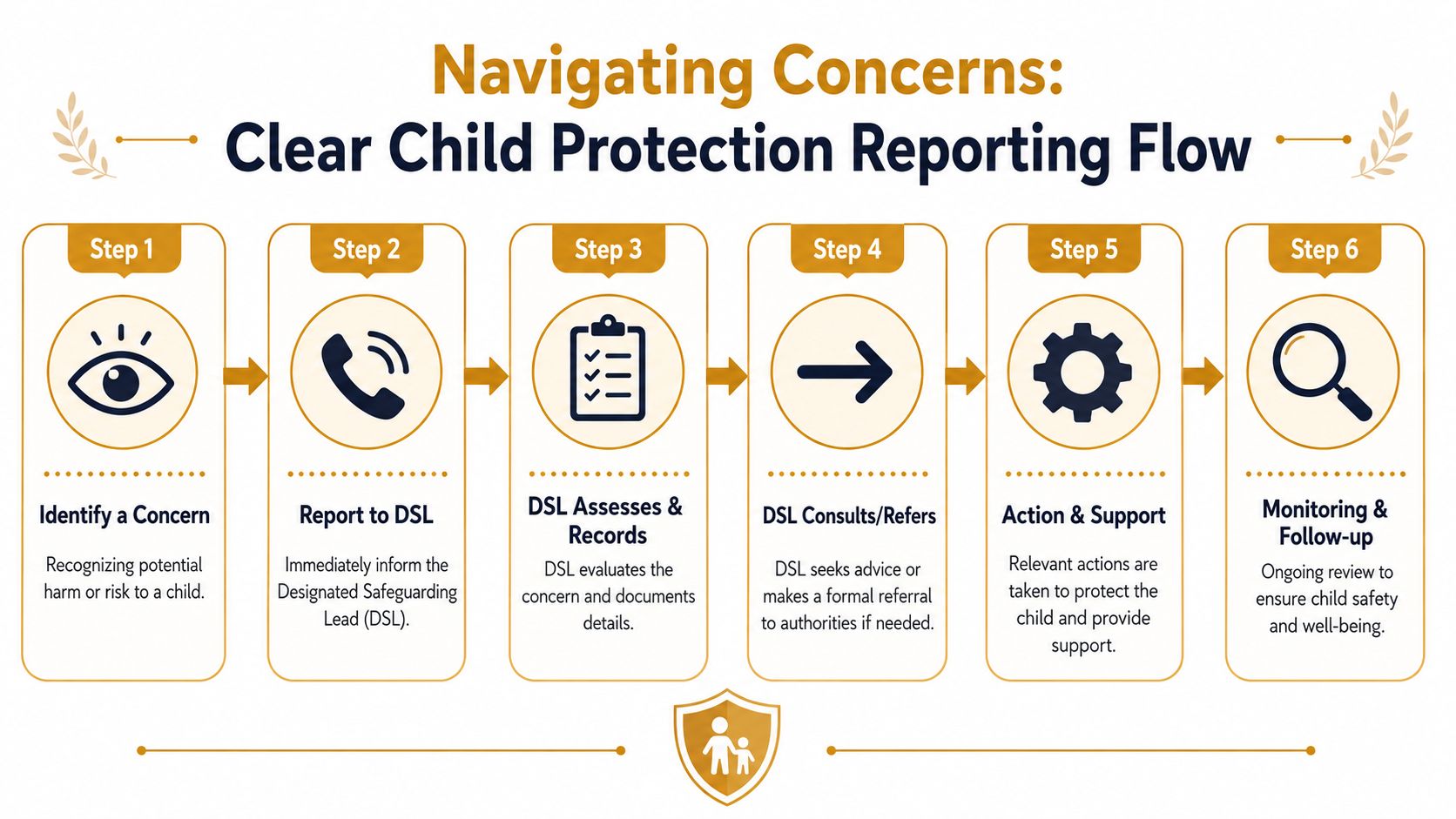
What the nanny should do first
The nanny should not investigate. She should not ask leading questions. She should not confront the adult she is worried about. She should make a factual record. What was seen, heard, or disclosed, with dates and exact words where possible.
Then she reports through the agreed safeguarding route. In an agency-supported placement, that usually means the designated safeguarding lead. In a direct-hire arrangement, the policy must already state who receives concerns and how the matter is escalated if that person is implicated.
What the designated lead should do
The designated lead's role is not to minimise or obscure the issue. It is to assess the information, record it properly, and decide whether to seek advice or make a referral.
Good reporting procedure usually includes:
- Immediate listening: Receive the concern calmly and without judgment.
- Accurate recording: Separate observed facts from interpretation.
- Threshold thinking: Decide whether the concern is low-level, ongoing, urgent, or potentially criminal.
- Protective action: Make sure the child is safe while the next step is taken.
If a concern feels messy, document first and interpret second.
Allegations against a nanny
When the concern is about the nanny rather than reported by the nanny, households and agencies must be especially disciplined. When a safeguarding allegation is made against a nanny, the designated lead must inform the Local Authority Designated Officer within one working day. This requirement comes before any internal investigation, as stated in this safeguarding and child protection policy setting out LADO reporting.
That one working day matters. Families often want to “speak to everyone first” or check whether there has been a misunderstanding. That instinct is understandable, but it can compromise evidence, distort accounts, and expose the child to further risk.
What doesn't work
Certain mistakes appear again and again in private settings:
- Private reassurance instead of action: Telling a nanny “I'm sure it's nothing” without recording the concern.
- Family loyalty over process: Deciding that a respected adult couldn't possibly be involved.
- Informal messaging: Handling serious concerns by text thread instead of proper documentation.
- Role confusion: Asking a house manager or PA to investigate without safeguarding authority or training.
The right process is calmer than panic and firmer than denial. It doesn't accuse prematurely, but it doesn't wait for certainty either.
Tailoring Policies for Private Households and Agencies
School policies are rarely enough for private homes. They assume fixed premises, visible management structures, and a clear distinction between staff space and family space. Household life is different. Children may move between residences, travel internationally, spend time with multiple caregivers, and live within a culture of privacy that can make speaking up harder.
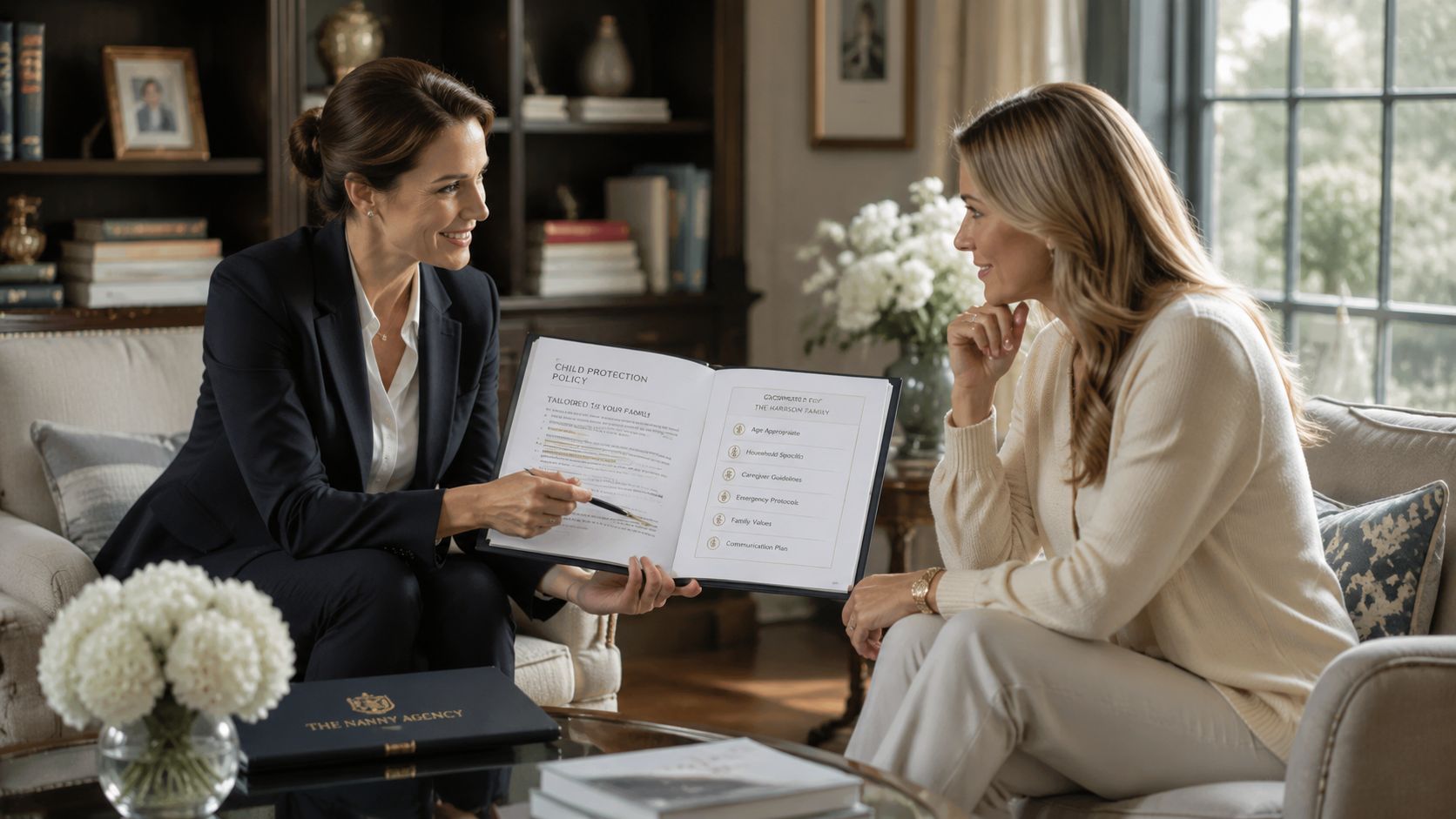
The gap is well recognised. Statutory guidance requires agencies to cooperate in safeguarding, yet private nannies often sit in an “invisible” non-statutory tier, which is why bespoke policies are needed to bridge private employment and the formal child protection system, as explained in the NSPCC overview of the child protection system in England.
Where generic policies break down
In private households, safeguarding often becomes blurred by intimacy and discretion. The nanny may witness family stress, changing relationships, substance concerns, conflict between parents, or behaviour from guests and extended family. None of that fits neatly into an institutional template.
Three pressure points come up repeatedly:
- Confidentiality versus safety: High-profile families often expect strict discretion. That must never prevent reporting a child welfare concern.
- Travel and multiple residences: A policy must state how concerns are reported while abroad, who holds records, and which local authority or safeguarding contact applies when the family returns.
- Rota and team care: If several nannies rotate, the handover process must include welfare concerns, behavioural shifts, injuries, medication changes, and any safeguarding observations.
What bespoke household policies should include
A customized policy for a private family should address the daily realities of the home rather than borrow language from a school handbook.
That usually means including:
| Household risk area | Policy response |
|---|---|
| Multiple staff members | Define who can raise concerns and who receives them |
| High discretion environment | State clearly that confidentiality never blocks safeguarding action |
| International travel | Set out reporting routes, emergency contacts, and record transfer procedures |
| Childcare across properties | Keep one central policy with local adaptations for each residence |
| Rotational staffing | Require written handovers for wellbeing and welfare matters |
In elite households, the biggest safeguarding weakness is often not a lack of care. It is a lack of clarity.
The agency role in bridging the gap
A strong agency can act as a stabilising layer between family life and formal safeguarding process. That doesn't mean replacing parental authority. It means making sure recruitment, induction, reporting expectations, references, and professional supervision are coherent.
This is especially important where there are blurred reporting lines. A nanny employed through one entity, managed day to day by another, and travelling with a family office structure in the background can easily end up unsure who holds safeguarding responsibility. That uncertainty must be removed before the placement begins.
For high-profile homes, there is a second challenge. Security culture can crowd out welfare culture. NDAs, visitor controls, private drivers, and household protocols may be excellent for privacy. They are not a substitute for safeguarding judgment. A child protection policy has to operate alongside security, not beneath it.
Building a Culture of Safety and Trust
The strongest child protection policies don't sit untouched in a drawer. They shape how adults behave every day. They influence recruitment, induction, communication, supervision, handovers, travel planning, and how concerns are handled when emotions are high.
A safe household doesn't rely on personality alone. It relies on standards. Children are better protected when parents are clear, nannies are supported in speaking up, and everyone understands that discretion has limits where welfare is concerned. The most professional homes tend to feel calmer, not harsher, because expectations are settled in advance.
Policies also work best when they sit alongside broader household standards on privacy, reputation, and conduct. Families dealing with public visibility or sensitive domestic arrangements should make sure safeguarding language aligns with their wider private staff confidentiality framework, without ever diluting the child-first principle.
If your current arrangements depend on verbal understanding, instinct, or goodwill, it's time to formalise them. Good intentions help. Clear structure protects.
Frequently Asked Questions About Child Protection
Do nannies in England have to register with Ofsted?
Not always. In England, nannies caring for children in the family home are exempt from mandatory Ofsted registration, but they are restricted to caring for children from no more than two families at any one time, as outlined in the government guidance on what nannies need to know. For families, the practical point is that exemption from registration doesn't remove the need for proper safeguarding standards, written expectations, and appropriate checks.
Does a nanny need paediatric first aid?
Yes, this should be treated as a firm threshold. Under the Ofsted requirements for nannies working in a child's own home, at least one person providing childcare must hold an appropriate first aid qualification, specifically paediatric first aid. In practice, families should verify that the nanny herself holds it, keep the certificate on file, and diarise renewal before it expires.
What should a nanny do if the concern involves a parent?
The nanny should follow the household or agency safeguarding policy, make a factual record, and report the concern through the designated route rather than confronting the parent directly. This is one of the reasons a policy must name an alternative reporting path when the concern involves someone inside the home. In private settings, this protects both the child and the nanny from pressure, confusion, or retaliation.
What should be included in child protection policies for home-based childcare?
The essentials are clear reporting procedures, safer recruitment practice, conduct expectations, e-safety, missing child protocols, secure record keeping, and named responsibility for escalation. In private homes, the policy should also cover travel, multiple residences, household visitors, confidentiality limits, and communication between rotating caregivers. The test is whether the policy can be used in real life by tired adults under pressure.
Is safeguarding only relevant if there is suspected abuse?
No. Safeguarding starts much earlier. It includes the ordinary systems that reduce risk and support a child's welfare before a formal child protection issue arises. That includes boundaries, supervision, digital safety, recruitment checks, first aid readiness, and a clear culture of speaking up. Families often wait until something feels serious. The better approach is to build the structure while everything is still calm.
If you want expert support creating safer, clearer childcare arrangements, Superstar Nannies can help you build professional standards into every stage of hiring, onboarding, and managing private household staff.