


A family often comes to market with a very specific picture in mind. They want a nanny who can move comfortably between London, Geneva, and New York, manage discretion around high-profile guests, support a child with confidence and warmth, and fit effortlessly into a private home where standards are exacting. The risk is obvious. If the search begins and ends with the same familiar networks, the family may get a polished shortlist, but not the strongest one.
That is where inclusive recruitment practices matter. In private staffing, the phrase is often misunderstood. It does not mean lowering the bar, widening the brief without discipline, or turning a household hiring decision into a public corporate exercise. It means building a process that identifies the best candidate by skill, judgement, professionalism, and character, rather than by accent, pedigree, personal similarity, or access to the right circles.
Why Inclusive Hiring Is the New Standard of Excellence
The most insightful families already understand that excellence rarely comes from a narrow funnel. Children benefit from broad perspectives, multilingual environments, and adults around them who bring judgement shaped by real experience. Yet many elite household searches still rely heavily on referrals, legacy networks, and assumptions about what a “proper” background looks like.
That approach feels safe, but it often hides talent. A candidate may have the discretion, stamina, educational awareness, and emotional intelligence a family wants, while lacking one conventional marker that someone else happened to have. When families hire only from a closed loop, they often miss exceptional professionals who were never introduced to that loop in the first place.
Skills should open the door
In the UK, policy and employer guidance have increasingly emphasised skills-based hiring, while the practical challenge remains how to reduce bias without creating fresh barriers for people with neurodivergence, limited digital access, or non-linear career histories, as noted in guidance on inclusive hiring and access. For private households, that point matters more than many families realise. A polished CV is not the same as capability under pressure.
A first-rate nanny, governess, house manager, or private chef should be assessed on what they can reliably deliver:
- Judgement in private settings
- Consistency under scrutiny
- Communication across cultures
- Respect for boundaries and confidentiality
- Evidence of calm, competent decision-making
Inclusive hiring done properly raises standards because it widens the field before narrowing it with discipline.
Families navigating wider conversations around fairness, reputation, and employer standards may also find useful context in this practical piece on addressing workplace DEI concerns, especially where private employment overlaps with broader leadership values.
Network hiring has limits
Trusted introductions still have value. No serious strategist dismisses that. But referrals should be one stream of talent, not the whole river. In high-end domestic recruitment, overreliance on network hiring can produce sameness. It can also confuse familiarity with quality.
A more disciplined private search uses broad market reach, strict vetting, and role-specific evaluation. Families hiring across multiple residences or through a family office often benefit from seeing household recruitment through that wider lens, which is explored in this guide to UHNW family office staffing and elite private recruitment.
Redefining Household Roles for a Wider Talent Pool
The quality of the shortlist is set long before the first application lands. It starts with the brief. Most hiring problems in private households are not screening problems. They are definition problems.
If the role description is vague, status-driven, or built around a previous employee's personal profile, the market narrows immediately. Strong candidates read between the lines. They can tell when a role is open to excellence, and when it is subtly coded for one type of person.
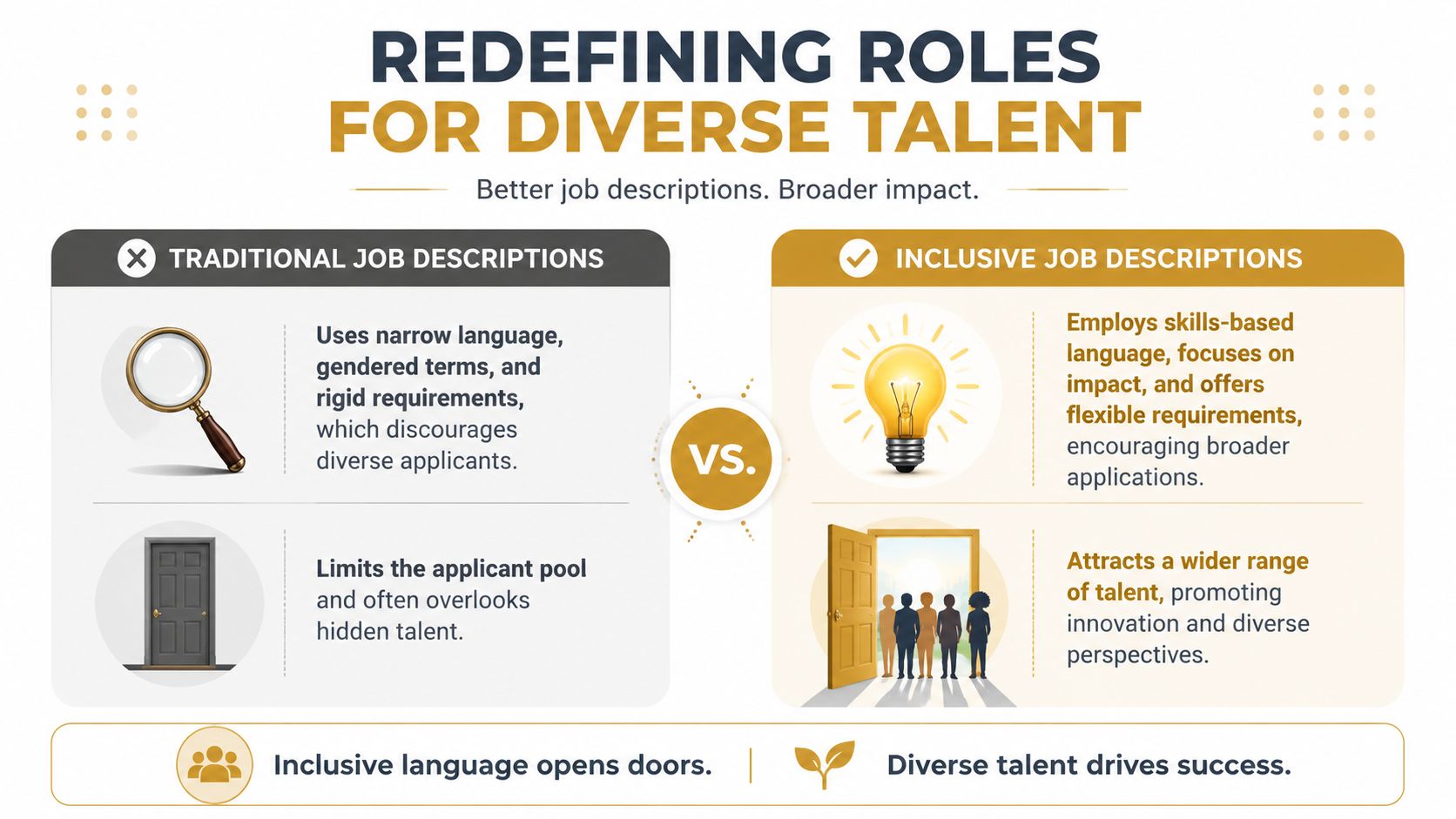
Replace pedigree language with competency language
Many household briefs still use criteria that sound selective but are imprecise. “Must have worked for a VIP family” is a common example. Sometimes it does reflect a legitimate need. Often, it is shorthand for something else.
A better brief identifies the underlying capability.
| Outdated phrasing | Stronger inclusive phrasing |
|---|---|
| Must have VIP experience | Demonstrated ability to maintain discretion and professionalism in a high-profile household |
| Must fit our culture | Must work well within a formal, service-led home with clear standards and respectful communication |
| Native English speaker | Excellent spoken and written English for child development, travel coordination, and parent liaison |
| Young and energetic | Able to maintain a physically active schedule and keep pace with a busy family routine |
| Traditional nanny profile | Proven childcare judgement, secure attachment approach, and confidence managing routines independently |
This shift matters because it tests for output, not image.
Define standards without closing the door
Families are right to have high expectations. The mistake is treating every preference as a requirement. A concise, well-built role description separates the essentials from the desirables.
Use a three-part structure:
Core duties
Be specific about what the person will do each day, each week, and during travel.Critical competencies
Focus on discretion, safeguarding judgement, schedule management, flexibility, communication style, and educational support.Contextual preferences
Note useful additions such as language ability, confidence around formal service, or experience with rota arrangements, but don't present every preference as an absolute requirement.
Practical rule: If a requirement can't be tied to performance in the home, question whether it belongs in the brief.
The same principle applies beyond childcare. Families hiring senior domestic staff often need a more rigorous breakdown of responsibilities before they recruit. This reference on household manager responsibilities for UHNW estates is a useful example of how clarity in role design improves quality at hiring stage.
Rethink cultural fit
“Cultural fit” causes more damage in private staffing than is commonly acknowledged. In many searches, it becomes a polite label for similarity. Similar schools. Similar social style. Similar life story. That is not what a household needs.
A better question is whether the candidate can operate within the household's values and working rhythm.
Look for alignment on:
- Discretion: They understand what stays private.
- Professional boundaries: They know warmth and overfamiliarity are not the same.
- Adaptability: They can move between formal and relaxed settings without friction.
- Respect: They work well with principals, children, security, office staff, and other domestic employees.
That is real fit. It protects household culture without turning it into an echo chamber.
Sourcing and Attracting Diverse World-Class Candidates
A family that wants exceptional staff cannot depend solely on a little black book. The best candidates are not always circulating in the same private WhatsApp groups, alumni channels, or referral chains. Some are performing effectively in excellent roles. Others are visible on specialised platforms, through professional communities, or in adjacent sectors where standards are already high.
Inclusive recruitment practices become real at the sourcing stage. If outreach is narrow, the process stays narrow no matter how polished the interviews look later.

Go beyond inherited networks
Strong sourcing for elite households usually combines several channels at once. The point is not volume for its own sake. The point is controlled breadth.
A good search often includes:
- Specialist international databases that already attract experienced private staff
- Professional associations and communities where childcare and household professionals maintain active profiles
- Direct outreach to candidates whose background aligns with the brief, even if they are not actively applying
- Adjacent talent pools such as education, luxury hospitality, executive support, or formal service environments
That broader lens is particularly useful when the household wants something specific but not conventional. A bilingual nanny with strong educational instincts may come from a governess track. A polished house manager may have built their standards in luxury hospitality before moving into private service.
For readers looking at how high-standard employers present opportunities publicly, even outside the household staffing world, the careers approach behind employment with Arklavo is a useful reminder that serious candidates pay attention to how organisations signal professionalism, clarity, and expectation.
Attraction is part of screening
Top candidates make judgements early. They read the advert, the agency communication, the response times, and the tone of the outreach. If any of it feels careless, elite talent moves on.
That means attraction materials should show three things clearly:
| What candidates want to see | What it signals |
|---|---|
| A clear role scope | The household is organised |
| Respectful, precise language | The employer values professionalism |
| Transparent process expectations | The search is credible and worth engaging with |
Private staffing candidates are especially alert to ambiguity. If the brief is opaque or the requirements seem contradictory, many of the strongest people won't apply. They assume, often correctly, that the role itself may be unstable.
Hidden talent is usually filtered out too early
One pattern appears repeatedly in high-end recruitment. Families ask for excellence, but the early process screens out anyone whose path looks unusual. That can eliminate candidates with exactly the right strengths.
A non-linear career history may reflect international moves, family office work, educational qualifications layered onto practical childcare, or private service performed under confidentiality clauses that leave fewer public markers. Those candidates should not be waived away because they present differently from the expected template.
Households that want a wider, stronger candidate market should treat sourcing as a professional exercise, not a social one. Families comparing routes into private staffing can get useful context from this guide to private household staff agencies in the UK, especially when weighing discretion against search reach.
Fair and Objective Screening and Shortlisting
The shortlist should not be a collection of people who “feel right” on first glance. It should be the result of a clear screening method built before a single CV is reviewed. That is where many private searches go wrong. Someone scans profiles, reacts to schools, surnames, former employers, or presentation style, and begins ranking candidates without a stable standard.
Objective screening protects quality. It also protects the family from expensive misjudgements.
Build the rubric first
Before opening applications, define how each candidate will be assessed. Use the role brief to create a consistent scorecard. Keep it tightly linked to performance in the home.
A practical screening rubric often includes:
- Relevant functional experience such as age-group expertise, rota work, travel support, or multi-residence coordination
- Behavioural indicators such as calm decision-making, reliability, and professional boundaries
- Operational suitability including schedule fit, location flexibility, and legal right-to-work position where relevant
- Presentation of evidence through references, achievements, and clarity about prior responsibilities
If a criterion is important enough to reject someone for lacking it, it should be written into the rubric from the start.
Use blind review where it helps
Some agencies now remove identifying details during the first pass of screening so the reviewer can focus on skill and evidence. That approach is no longer fringe. According to a Recruitment & Employment Confederation survey, 34% of UK employers now use name-blind CV screening, up from 22% the previous year, and 48% are actively working to increase shortlist diversity, showing how structured methods are becoming mainstream in the UK labour market, as reported by People Management on REC hiring data.
That matters in household staffing because first impressions can be unusually loaded. A family name, a school, an address, or a nationality can trigger assumptions before objective evidence is considered.
The best shortlist is not the most familiar one. It is the one that survives the fairest scrutiny.
What objective shortlisting looks like in practice
A disciplined screening process usually follows this order:
- Remove non-essential identifiers for initial review where practical.
- Score against the pre-set rubric rather than reacting informally.
- Separate hard requirements from preferences so “nice to have” traits don't override core ability.
- Document why each candidate progresses or falls away in concise, job-related terms.
This creates an audit trail of judgement. In private recruitment, that matters even if no one outside the process ever sees it. It keeps the search coherent when several decision-makers are involved.
Families who want a better understanding of what rigorous candidate assessment should involve can compare this approach with a detailed nanny vetting process for discerning families. The same principle applies across household roles. Vetting should confirm quality, not compensate for weak screening.
Mitigating Bias in the Household Interview Process
The interview is where many otherwise careful searches become subjective again. A candidate sounds polished. Another feels warmer. Someone reminds a principal of a previous successful hire. Someone else seems “less natural” despite stronger evidence. None of that is a reliable hiring method.
A household interview should be structured enough to compare candidates fairly, while still leaving room to assess judgement, chemistry, and discretion.
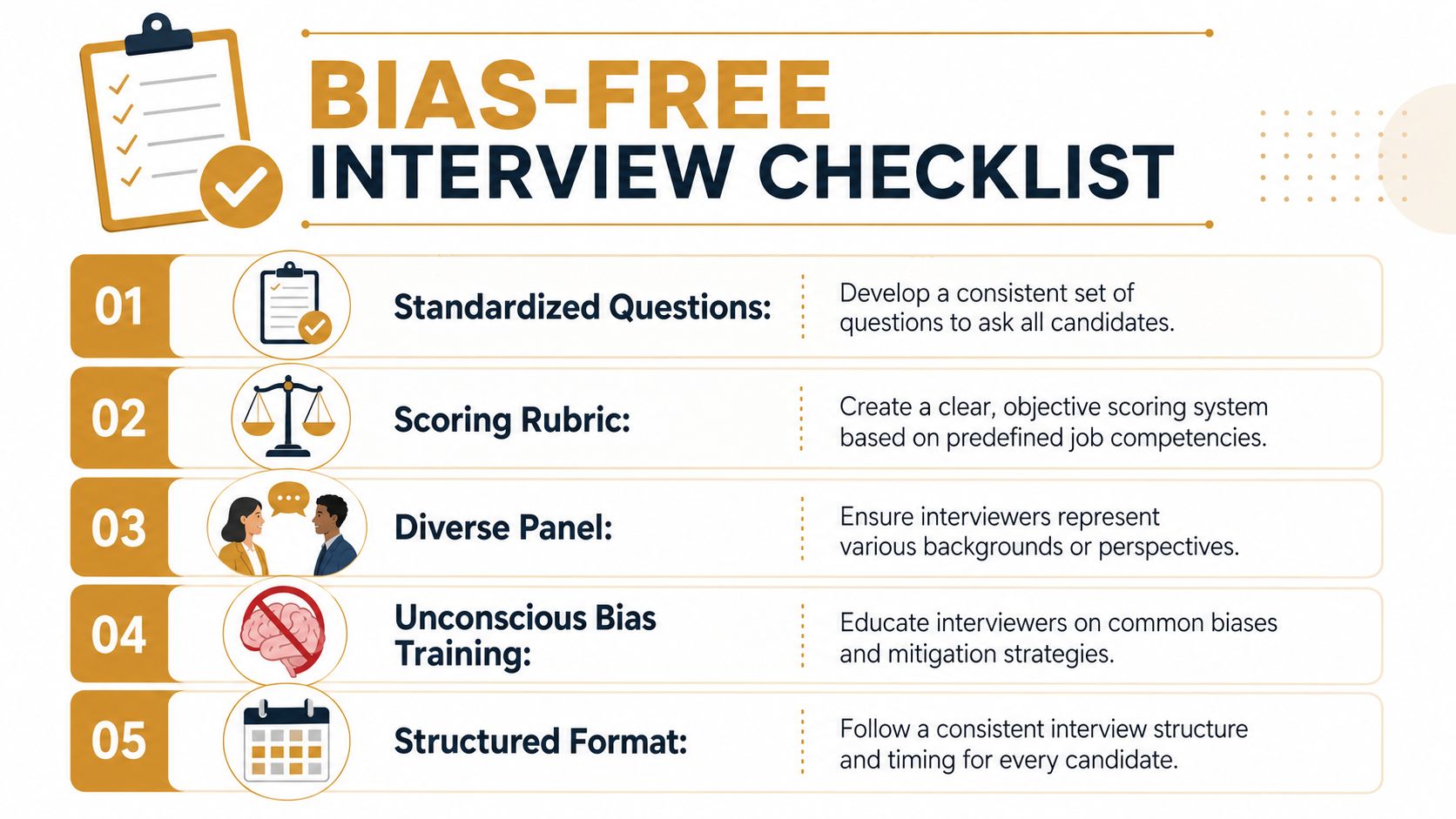
Ask comparable questions
Every serious interview should contain a set of core questions asked in the same way to every candidate. This is not about making the conversation robotic. It is about creating a basis for comparison.
Good household interview questions usually ask for evidence:
| Strong question | Weak question |
|---|---|
| Tell me about a time you handled a sensitive issue with a parent while protecting a child's routine | Are you good with demanding parents? |
| Describe how you manage confidentiality in a high-profile environment | You understand discretion, don't you? |
| Give an example of a difficult travel day and how you kept the children settled | Do you enjoy travelling? |
| Tell me about a situation where you had to hold a professional boundary kindly but firmly | Are you naturally authoritative? |
The strong versions force the candidate to show thinking, not just claim strengths.
Structure matters more than charisma
Interviewers often overvalue confidence because confidence is easy to recognise. Competence is quieter. A highly polished candidate may answer with style and still offer little substance. A more measured candidate may provide excellent examples but need a moment longer to formulate them.
Use a scoring system linked to the role. Rate each answer against clear competencies such as safeguarding judgement, communication, adaptability, and discretion. Write notes before discussing impressions with other interviewers. That prevents the loudest voice in the room from shaping everyone else's view.
Hiring note: If an interview panel cannot explain why one candidate scored higher than another in job-related terms, the process is drifting into preference.
Training is not optional
The CIPD reports that only 28% of UK employers train all interviewers on legal obligations and objective interview practice, which highlights a significant weakness in many recruitment processes, according to the CIPD guide to inclusive employers. In private households, that gap can be even more pronounced because interviews are often led by principals, assistants, or advisers who are highly skilled in many areas but not necessarily trained hiring professionals.
That creates risk. Not just legal risk, but decision-quality risk.
A well-run process should ensure that anyone involved in interviews understands:
- Which questions are job-related
- How to assess answers consistently
- How personal assumptions can distort evaluation
- How to discuss concerns without lapsing into vague language
Keep the human element, lose the randomness
Families sometimes worry that structure will remove intuition. It shouldn't. Intuition has a place, but only after the evidence has been gathered properly.
The strongest interview process usually combines:
- A structured first interview
- A practical or scenario-based assessment where relevant
- A final values and household-style conversation
That sequence lets a family assess both competence and compatibility without allowing either one to overwhelm the other.
Creating an Inclusive Onboarding and Work Environment
A placement can fail even after an excellent search if the home does not receive the new hire properly. Inclusive recruitment practices are not complete when the contract is signed. In private households, retention often turns on the first weeks. A candidate can be exceptional and still struggle if expectations are implied rather than explained.
The households that keep outstanding staff tend to onboard with the same care they used to recruit.

Clarity creates trust
A strong onboarding process gives the new hire practical certainty from day one. That includes written duties, reporting lines, household rhythms, travel expectations, technology protocols, safeguarding procedures, and boundaries around family privacy.
In a private home, “common sense” is often a dangerous phrase. What seems obvious to one household may be entirely different in another. Formal service expectations, clothing standards, guest etiquette, kitchen protocols, and childcare philosophy all need to be stated clearly.
A useful onboarding checklist covers:
- Role boundaries so the staff member knows what falls inside and outside the post
- Household protocols for security, visitors, communications, and confidentiality
- Family preferences around routines, food, travel, educational support, and discipline style
- Practical introductions to other staff, key suppliers, drivers, assistants, or security contacts
Respect is operational, not symbolic
An inclusive work environment is not built with slogans. It is built with day-to-day conduct. Staff stay where they are treated with respect, given clear direction, and allowed to perform at a high level without confusion or unnecessary friction.
That includes being thoughtful about personal boundaries, communication style, religious or cultural considerations where relevant, and reasonable adjustments where needed. It also includes recognising that excellent professionals may work differently while delivering the same high standard.
A household becomes an employer of choice when standards are high, expectations are clear, and respect is consistent.
The first months shape retention
Early check-ins matter. So does discretion in how they are handled. A principal may prefer to communicate through an assistant or chief of staff. That is fine, provided feedback is timely and unambiguous.
The most effective early-stage approach is simple:
- Confirm expectations in writing
- Check understanding after the first few shifts or days
- Address small misalignments immediately
- Review progress before frustrations harden into judgement
Families who invest in this stage usually get better continuity, smoother household harmony, and stronger loyalty. In private staffing, that is not a soft outcome. It is one of the clearest markers of a well-run hire.
Frequently Asked Questions About Inclusive Recruitment
Does inclusive recruitment mean compromising on standards
No. In elite household staffing, it usually does the opposite. It removes distractions that can distort judgement and keeps attention on discretion, childcare skill, service standards, adaptability, and trustworthiness. The standard stays high. The process becomes sharper.
Is this approach slower for busy families
Not when the process is designed properly. Unstructured hiring feels quicker at the beginning because fewer steps are visible, but it often slows down later through weak shortlists, repeated interviews, or failed placements. A clear brief, disciplined screening, and structured interviews create better momentum.
Can inclusive recruitment work for very specialised household roles
Yes, provided the role is defined around outcomes rather than prestige markers. A family can still require travel confidence, language ability, formal service awareness, newborn knowledge, or experience in complex homes. The difference is that each requirement is tied to performance, not social shorthand.
What if discretion is the top priority
Discretion fits naturally within inclusive recruitment practices because confidentiality is a competency. It can be screened, tested in interviews, and verified through references. A broader search does not require a less private process. It requires a more professional one.
Does this only apply to nanny hiring
No. The same principles apply to governesses, maternity nurses, housekeepers, butlers, chauffeurs, private chefs, estate staff, and household managers. Any private role benefits when the brief is precise, the screening is objective, and the working environment is respectful.
For families who want a search process that combines discretion, international reach, and rigorous private household standards, Superstar Nannies offers bespoke support across nanny and household staffing appointments worldwide.