

Private jets jobs are no longer a niche curiosity for a tiny circle of aviation insiders. In the UK, the pressure point is talent. When senior pilots and technical leaders are commanding £300,000 to £500,000 packages and private jet flight attendants are earning £60,000 to £120,000, you're looking at a market where employers are competing hard for proven people, not just filling seats (BlackJet on private plane jobs).
From a recruiter's side, that changes everything. It raises standards, shortens patience for weak applications, and opens real pathways for candidates from adjacent luxury sectors such as yachting, five-star hospitality, executive support, and private childcare. If you understand discretion, service, logistics, and pressure, you may be closer to this world than you think.
Why a Career in Private Aviation is Booming

Private aviation is expanding because wealthy clients want speed, privacy, and control, and they are willing to pay for people who can deliver all three without drama. From a recruiter's seat, the real story is not glamour. It is hiring pressure.
Operators, family offices, and aircraft management firms are competing for a small pool of candidates who can handle high standards, irregular schedules, and direct client exposure. That pressure is especially strong in roles where trust matters as much as technical ability. Pilots are the obvious example, but the same pattern shows up in cabin service, scheduling, maintenance coordination, and client-facing support.
This is why private aviation keeps pulling talent from nearby sectors. A chief stewardess from yachting, a five-star hotel manager, or a travel nanny used to complex itineraries already understands the rhythm of UHNW service. They know how to stay composed, protect privacy, and solve problems before the client feels them. In this market, those habits carry real value.
The working model also appeals to ambitious candidates. Teams are smaller. Visibility is higher. Good performance gets noticed quickly, and poor judgement does too.
Why this market feels different
Private aviation runs on proximity. Staff are closer to principals, closer to decision-makers, and closer to the consequences of small mistakes. A delayed car, a poorly handled dietary request, or a loose comment in the wrong setting can matter as much as a technical error because the client experience is part of the product.
That creates a different hiring brief from commercial aviation or mainstream travel. Operators want certified professionals, of course, but they also want calm people who read a room well, protect confidentiality, and can adjust fast when a family changes plans an hour before departure.
Practical rule: Safety gets you considered. Discretion, judgement, and service standards get you hired and invited back.
For candidates exploring long-term progression, the upside is also broader than one job title. A pilot may start by studying different pilot career paths, while a candidate from hospitality or private childcare may enter through cabin support, trip coordination, or client services and build from there. That route matters for the Superstar Nannies audience in particular. Families who already trust someone with children, routines, and travel often value that background more than applicants expect.
Who tends to break in fastest
Three groups usually move into private aviation with the least friction:
- Experienced aviation professionals with strong licences, clean standards, and client-facing maturity.
- Luxury service candidates from yachting, villas, private households, concierge, and five-star hospitality.
- Childcare and family travel specialists who are already used to discretion, international logistics, and working around demanding principals.
The common thread is reliability under pressure. Private jets jobs reward people who can deliver a polished service while plans shift, time compresses, and expectations stay high. Candidates who understand that early usually make better moves, and get taken more seriously in the process.
Understanding the Roles in Private Aviation
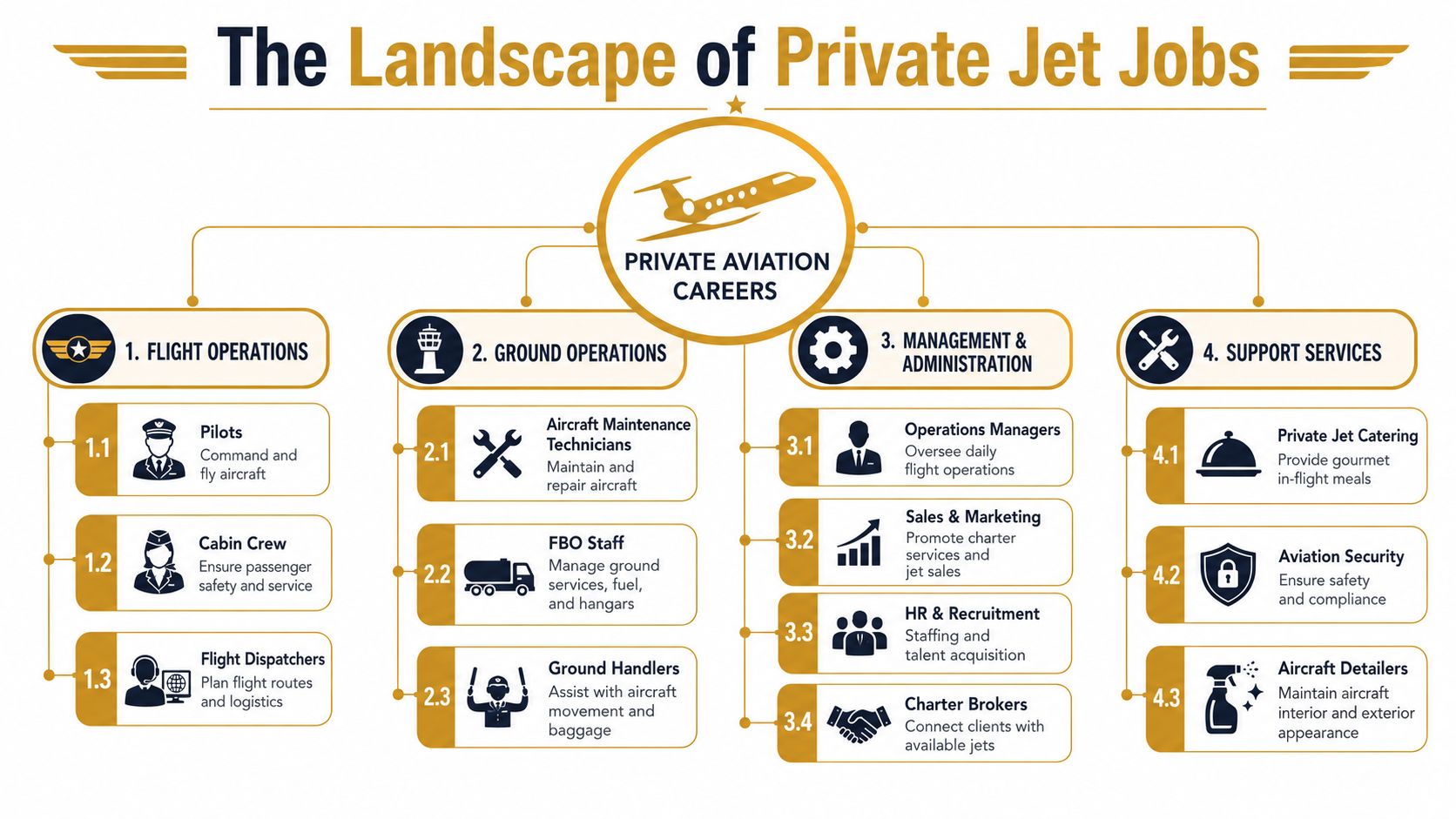
Candidates who approach private jets jobs as a pilot-or-cabin-crew market usually miss half the hiring opportunities.
From a recruiter's side, the market works more like an interconnected service system. Aircraft still need pilots and cabin crew, but significant hiring activity also sits in scheduling, dispatch, client services, maintenance support, charter sales, ground handling, and family office coordination. In London especially, those functions often overlap with the same UHNW households, travel teams, and lifestyle staff who already hire through adjacent luxury channels.
That overlap matters for readers coming from yachting, five-star hospitality, or private childcare. Families do not separate aviation from the rest of their travel operation. They expect the same standards across the whole trip. If you already know how to manage children in transit, protect discretion, handle last-minute itinerary changes, and keep service polished under pressure, you may be closer to a private aviation role than you think.
Four main job groups
Private jets jobs usually fall into four broad categories:
Flight operations
Pilots, first officers, cabin crew, and flight support staff.Technical operations
Licensed engineers, maintenance coordinators, and line support teams.Ground operations
FBO staff, dispatchers, trip coordinators, handlers, and scheduling teams.Commercial and administrative roles
Charter brokers, client services executives, HR, recruiters, and operations managers.
The point is fit. Not title prestige.
I often advise candidates to look at function before they look at glamour. A polished nanny with international travel experience may be a stronger match for cabin support or client services than for a household-based role. A yacht stewardess may transition cleanly into private jet cabin crew because the service rhythm, discretion, and guest expectations are already familiar. An executive assistant who has managed complex family travel can be highly credible for operations and trip coordination.
A useful comparison is to review broader pilot career paths alongside the non-flying roles that support private aircraft operations. The cockpit is only one route into this sector, and for many candidates it is not the most accessible one.
Where household and aviation hiring meet
Private aviation employers rarely hire in a vacuum. They hire around client lifestyle.
That is why candidates from elite domestic staffing often do well here. A travel nanny understands passports, routines, time zones, child safety, meal preferences, handovers, and calm problem-solving in confined spaces. A private PA understands principal management, schedule changes, and discretion. A hospitality professional understands presentation, anticipation, and service recovery. Those are all useful hiring signals in private aviation, especially in roles that sit close to the client.
| Area | Typical focus | Best fit backgrounds |
|---|---|---|
| Flight deck | Aircraft operation, safety, client-facing judgement | Licensed pilots |
| Cabin | Safety, onboard service, discretion | Corporate cabin crew, yachting, luxury hospitality |
| Technical | Airworthiness, maintenance, rapid troubleshooting | Licensed engineers, technical specialists |
| Operations | Scheduling, dispatch, logistics, client coordination | Executive assistants, travel planners, logistics staff |
The strongest applications show a clean match between past work and operational reality. That is usually what gets candidates shortlisted.
Core Flight Roles Pilots and Cabin Crew
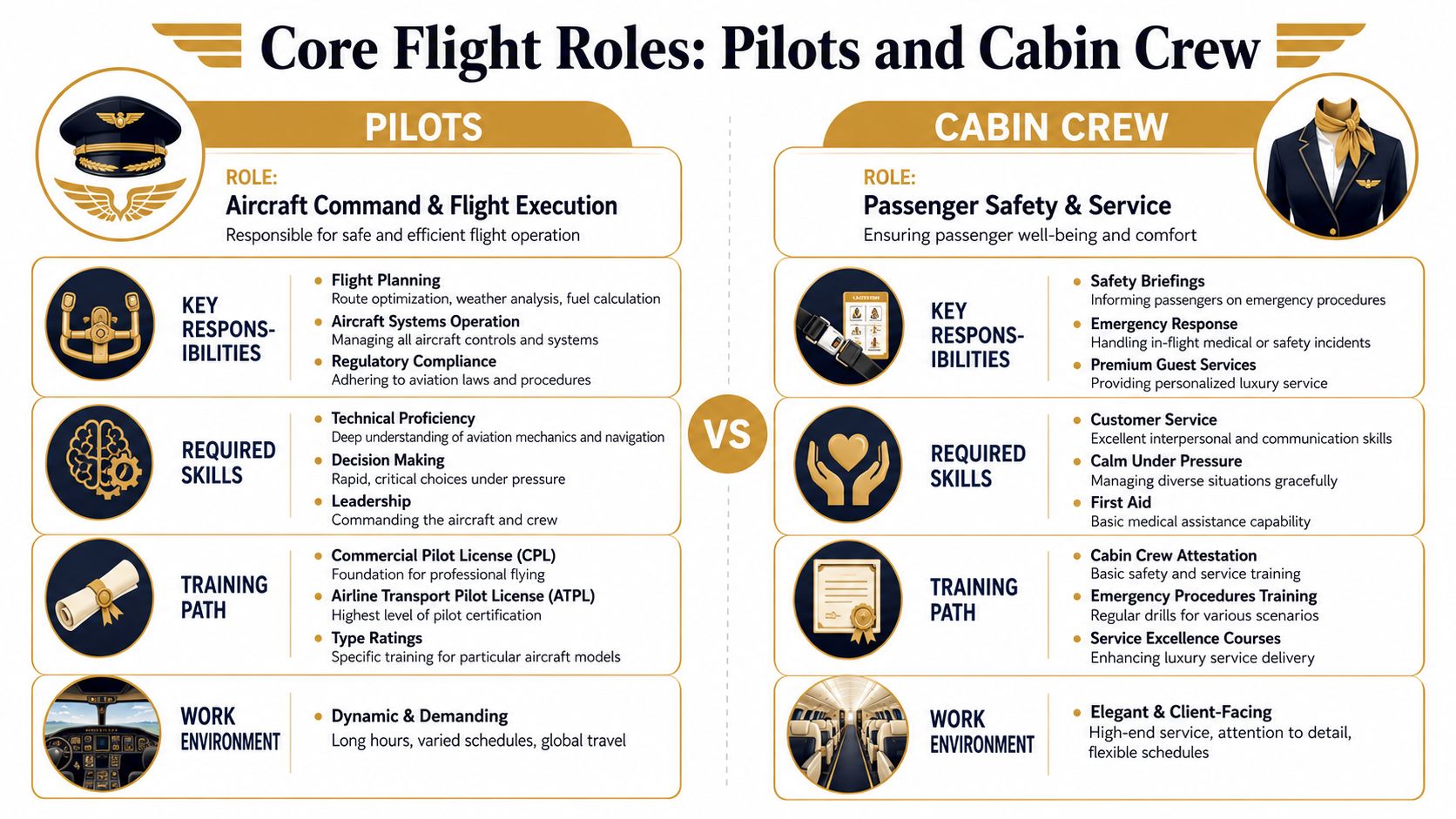
These are the roles most candidates ask about first. They're also the roles most misunderstood.
Pilots need more than flight time
Private jet pilot hiring in the UK is shaped by high experience thresholds and type-rating specialisation. Typical private jet pilot profiles sit around 3,000 to 4,000 total flight hours, while captain roles often benchmark at 1,500 to 3,000+ hours with an ATPL or commercial licence plus multi-engine and instrument ratings. Operators also place strong value on type ratings across aircraft families such as Citation, Challenger, Gulfstream, and Phenom.
That matters because employers aren't just buying time in the logbook. They're reducing risk and shortening conversion time. A candidate with relevant aircraft exposure, recurrent training discipline, and calm operational judgement is easier to place than someone with generic hours but no obvious fit.
For entry-level first officer pathways in the UK sector, the threshold can start lower, with a commercial pilot's licence and a minimum of 250 hours of flight experience in line with the standards cited in the industry data already referenced earlier. But candidates shouldn't confuse minimum eligibility with competitive positioning. They're not the same thing.
Cabin crew is not an entry-level glamour job
Here, I see the most unrealistic applications.
Private jet cabin crew roles are frequently presented online as polished, aspirational, and easy to enter. In practice, major operators often require at least three years of corporate cabin crew experience, and bilingual or multilingual ability is a strong advantage. These roles are usually a lateral move from corporate aviation, premium airline cabins, five-star hospitality, yachting, or similar luxury service environments.
The strongest cabin candidates don't lead with “I love travel”. They lead with evidence that they can manage safety, service, pressure, and confidentiality at the same time.
Candidates also need current documents and personal readiness. Passport, driving licence, medical records, and clean presentation all matter before the interview even starts.
What hiring managers actually look for
For pilots, recruiters usually look for:
- Relevant ratings: Aircraft-specific credentials that reduce training lag.
- Operational maturity: Good judgement under time pressure.
- Client awareness: The ability to interact professionally without overfamiliarity.
For cabin crew, priorities tend to be different:
- Service discipline: Fine detail, timing, and calm execution.
- Discretion: No oversharing, no social media instinct, no drama.
- Transferable service proof: Real examples from premium environments.
If you're rewriting your cabin CV, it helps to turn duties into flight attendant resume stories rather than listing generic tasks. “Provided service” is weak. A sharper approach shows how you handled preferences, timing pressure, safety, and difficult requests without losing composure.
The trade-off candidates need to accept
These roles can be rewarding, but they're not predictable in the way many commercial roles are. Schedules move. Clients change destination, catering, departure time, and onboard requirements. You may have quieter periods, then intense ones.
That suits candidates who like variety and can remain polished when the day doesn't go to plan. It frustrates candidates who want a rigid routine.
Essential Ground and Technical Roles
Private jet passengers judge the experience in the cabin. Operators judge it on whether the aircraft departed legally, on time, properly crewed, fuelled, stocked, and fully documented. Ground and technical teams make that happen.
Engineering is a licensed profession with real accountability
In UK private aviation, engineering sits inside a regulated maintenance system shaped by EASA Part-66 licensing, so this is a specialist route rather than a general mechanical job (AirX careers). Candidates often miss that distinction.
A business jet operator needs engineers who can inspect, rectify, release aircraft correctly, and stand behind that work in a live commercial environment. That responsibility changes the hiring profile. Recruiters look for people who are precise with records, disciplined with procedure, and steady under scrutiny. Good hands matter. So does judgement.
For candidates coming from automotive, marine, or airline maintenance, the trade-off is clear. Private aviation can offer closer involvement with a premium asset and a smaller team, but the margin for paperwork errors is tight and the client impact of delays is immediate.
Irregular hours are part of the job
These teams work around aircraft movements, positioning sectors, crew duty limits, maintenance windows, and last-minute client changes. That can mean late finishes, very early starts, weekend calls, and rapid reprioritisation during AOG situations.
Candidates from rigid roster environments sometimes struggle with that. Candidates from yachting, luxury hospitality, private households, and executive support often adapt faster because they already understand high standards, compressed timelines, and service pressure that does not care what the clock says.
Operators value the person who can solve problems at 02:00 without making the situation noisier.
Where adjacent-sector candidates can break in
Several ground roles are realistic entry points for people without a technical licence, especially if they come from organised, high-trust luxury work:
- Flight operations support, managing schedules, permits, paperwork, and document control
- Client services, handling passenger preferences, special requests, and movement coordination
- Crew logistics, arranging hotels, ground transport, visas, and positioning details
- Operations administration, updating fast-moving records accurately and keeping multiple parties aligned
I observe strong crossover from travel nannies, family assistants, yacht pursers, villa managers, and concierge professionals. The common thread is not aviation knowledge alone. It is controlled execution. If you already manage confidential itineraries, changing plans, premium expectations, and small mistakes with big consequences, you are closer to this market than you may think.
Standards are often higher behind the scenes than candidates expect. If the ground team slips, the cabin crew cannot charm their way out of it, and the pilot cannot depart on goodwill.
Your Route Into The Industry From Other Professions
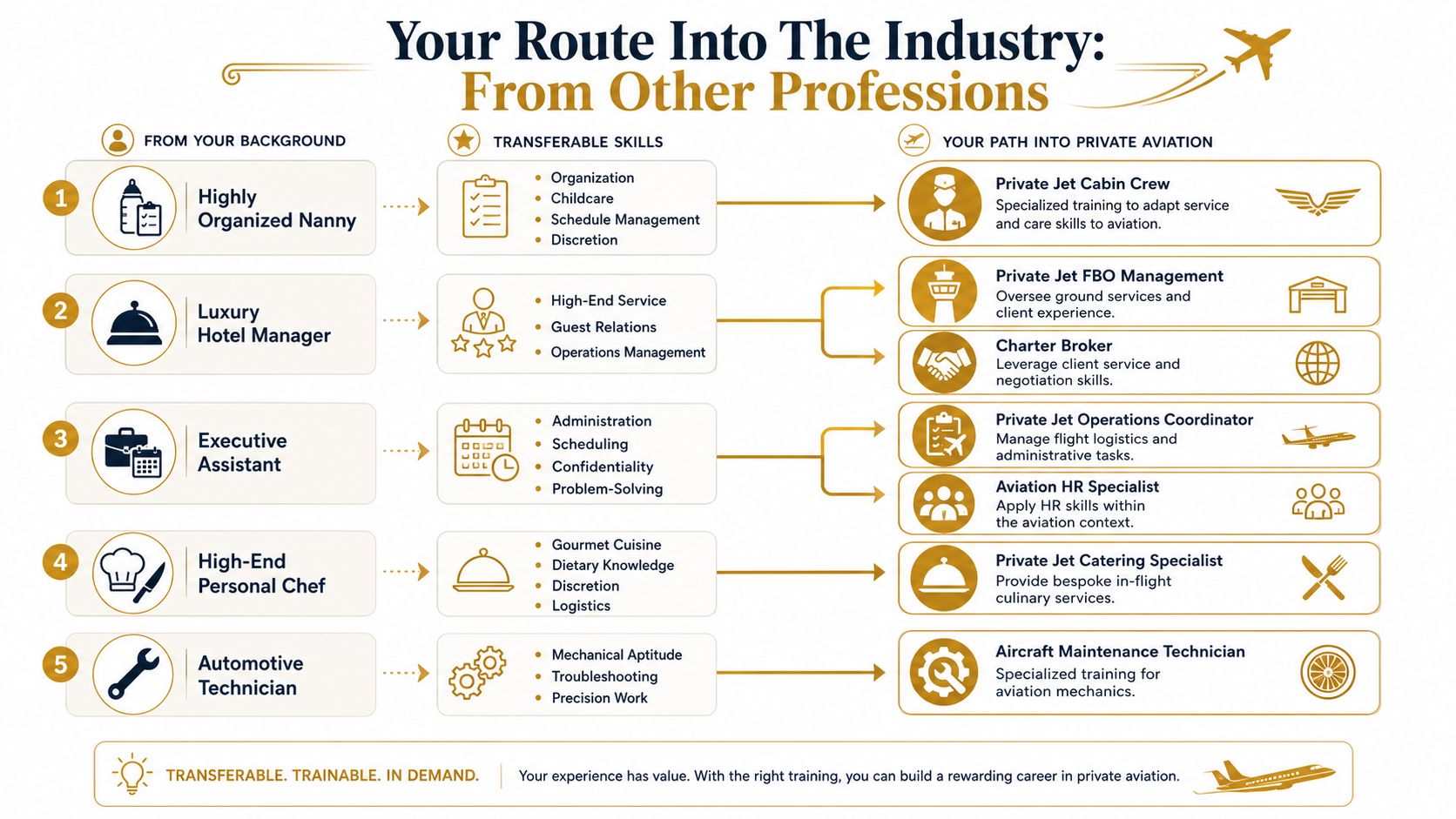
A large share of strong private aviation hires do not start in aviation.
That matters because candidates from adjacent luxury sectors often screen themselves out too early. From a recruiter's side, I see the opposite. Some of the most placeable profiles come from private childcare, yachting, household staffing, and high-end hospitality because they already understand pressure, privacy, and service that has to travel well.
Travel nannies and private childcare professionals
Travel nannies, governesses, and family assistants are closer to this market than they often realise. If you have managed children across borders, kept routines intact during disrupted itineraries, handled passports and packing, and stayed calm in front of stressed parents, you already have experience that maps well to private aviation support roles.
The direct route is usually not technical aviation. It is client-facing cabin support, passenger coordination, or office-based roles linked to trip planning and service delivery. The skills are directly transferable, especially for candidates used to UHNW family travel where timing, discretion, and tone matter as much as logistics.
One useful route is through specialist household staffing channels that already understand UHNW expectations, such as Superstar Nannies. That kind of network helps candidates position their background properly before they make a formal move into aviation hiring processes.
Yachting and five-star hospitality
Yacht crew often adapt quickly because they are already trained in close-quarters service, polished presentation, and guest care where standards stay high even when conditions change. They also understand hierarchy. That matters more in private aviation than many applicants expect.
Luxury hospitality candidates bring a different strength. Good concierges, butlers, guest relations managers, and front-office leaders know how to anticipate needs without becoming intrusive. In jet roles, that translates into better passenger handling and fewer service mistakes.
The strongest crossover skills usually look like this:
- Anticipation: spotting a request before it becomes a complaint
- Cultural fluency: adjusting your communication style to different families, principals, and international guests
- Presentation: looking polished and professional without overperforming
- Composure: keeping service standards steady when plans change late
Executive assistants and household managers
This path is one of the most underestimated.
A sharp EA, chief of staff, or household manager already works in the same operating rhythm as many aviation support teams. They protect a principal's time, coordinate moving parts across multiple vendors, handle confidential information, and fix problems before the client sees them. That background often converts well into scheduling, brokerage support, flight department coordination, and high-trust operations roles.
In practice, these candidates often beat applicants with more obvious glamour on the CV. Employers remember the person who can keep a complicated movement on track, not the person who only sounds polished in interview.
If you already manage confidential travel, shifting schedules, premium service expectations, and competing priorities, you understand far more of private aviation than you may think.
What candidates should do next
Stop framing yourself as an outsider and start translating your experience properly.
State the level of client you supported. Be specific about international travel, confidential calendars, last-minute changes, child-related travel care, premium service, and coordination across residences or countries. Show judgment, not just warmth or availability.
That is what gets attention in this market. Generic enthusiasm rarely does.
Crafting Your Application CVs Interviews and Discretion
A standard CV usually fails in this market. Not because it's badly written, but because it sounds ordinary.
Private aviation employers and the agencies that recruit for them look for evidence of trust. They want to see what level of client you supported, what environment you worked in, how you handled pressure, and whether you understand confidentiality as a baseline professional rule.
What to change on your CV
Most candidates undersell themselves by listing duties instead of outcomes.
A better private aviation CV should show:
- Discretion in practice: NDAs, confidential travel, family office support, VIP service, or sensitive scheduling.
- Operational judgement: Times you adapted when plans changed suddenly.
- Service level: Premium hospitality, executive support, private household, or corporate cabin standards.
- Readiness: Current documents, licences, medicals, language ability, and right to work where relevant.
If you've worked in childcare or household staffing, don't bury high-level travel support under soft wording. “Helped family when travelling” is weak. “Managed children's travel routines, documentation, packing, timing, and in-transit care during multi-stop international itineraries” is credible.
Interviews are testing calm, not charm
Many candidates overprepare polished answers and underprepare judgement.
Expect scenario-based questions. You may be asked how you'd respond if a client changes plans late, if a child becomes distressed mid-journey, if a principal requests something outside procedure, or if two priorities clash at once. The interviewer is not just listening for the answer. They're watching whether you think clearly and speak with control.
A few rules apply almost every time:
- Dress to the client standard. Sharp, understated, immaculate.
- Answer directly. Long explanations often sound evasive.
- Protect confidentiality. Never volunteer recognisable client details.
- Show boundaries. Service-minded does not mean careless or overfamiliar.
The fastest way to lose credibility is to sound impressed by wealth. Employers want professionals who can work around it without being distracted by it.
What works and what doesn't
| Works | Doesn't work |
|---|---|
| Specific examples from high-trust environments | Generic claims about being passionate |
| Calm, concise interview answers | Oversharing to seem interesting |
| Evidence of preparation and document readiness | Turning up polished but vague |
| Understated confidence | Name-dropping clients or luxury brands |
If you're serious about moving into private jets jobs, treat your application like a confidential handover document. Clear. Relevant. Controlled.
The Reality of Working with UHNW Clients
The best candidates are drawn to the standards, not just the setting.
Working with UHNW clients means accepting that flexibility is part of the job. Schedules can move late. Expectations can be exacting. Privacy is paramount. In many roles, formal confidentiality agreements are standard, but the bigger point is behavioural. People notice very quickly whether you can keep information contained.
The unwritten rules are straightforward. Anticipate needs without hovering. Stay warm without becoming familiar. Solve problems without creating extra noise. Keep your personal opinions, curiosity, and social media habits out of the professional space.
Professional boundaries matter just as much as service. Strong candidates don't become overly available, emotionally entangled, or eager to prove loyalty through overstepping. They remain composed, respectful, and useful.
Private jets jobs suit people who can combine precision with restraint. If you need constant recognition, fixed routines, or visible glamour, this market usually disappoints. If you value trust, pace, complexity, and high standards, it can be a very good fit.
If your background sits in private childcare, travel support, household staffing, or other luxury service roles and you're considering a move into adjacent private jets jobs, Superstar Nannies is one route to explore for roles within the same UHNW ecosystem.