


A lot of York households reach the same point. The working day runs long, children need feeding at different times, guests appear with little notice, and the kitchen becomes another operational pressure point rather than part of home life. At that stage, hiring a private chef stops looking indulgent and starts looking practical.
A good private chef in York does more than cook attractive food. The right person protects routines, handles dietary complexity calmly, keeps standards consistent, and gives a family back time that would otherwise disappear into planning, shopping, prep, service, and clean-up.
The Modern Case for a Private Chef in York
A York household can run perfectly well on paper and still feel strained by food. Parents come in late from work, children eat on different schedules, a guest stays for the weekend, and someone is avoiding dairy, gluten, or both. In houses like these, the question is rarely whether good food matters. The question is who is taking responsibility for it every day, and whether they can do that reliably and discreetly.
That is the modern case for a private chef. For many families and estates, this is a household hire with operational value, not a luxury booked for a single evening. A chef can absorb menu planning, shopping, prep, service, kitchen organisation, and stock control in a way that removes pressure from the rest of the house. Anyone comparing options should first understand what a private chef typically does in a household setting, because the role often reaches far beyond cooking supper.
York suits this model particularly well. The city has professional households with demanding schedules, period homes that still entertain properly, and clients who want high standards without staffing an events team every week. In practice, that creates steady demand for chefs who can move between family meals, informal guest dining, and polished weekend service without disturbing the rhythm of the home.

What households are really buying
Food quality matters, but long-term clients are usually paying for structure as much as flavour.
- Time returned to the household: Menus are planned, ingredients are in place, and meals happen without last-minute decision-making.
- Consistency across the week: Standards stay level on busy Tuesdays as well as when guests arrive on Saturday.
- Controlled dietary management: Allergies, intolerances, preferences, and medical requirements are handled carefully and repeated accurately.
- Better hospitality at home: Family suppers, visiting relatives, and informal entertaining feel organised rather than reactive.
- Kitchen order: Fridge rotation, pantry discipline, and sensible provisioning reduce waste and prevent the kitchen from becoming another source of friction.
A private home is a different working environment from a restaurant. Children may need to eat early. Guest numbers can change at short notice. Other staff may be using the same space, and privacy matters. The strongest private chefs handle those conditions calmly. They know when to produce something refined, when to keep service understated, and when a clean handover to the housekeeper or nanny matters more than culinary showmanship.
That distinction matters in York because many available chefs are marketed for dinner parties and short bookings. Some are excellent. But event work and household work are not the same brief. A household appointment, whether part-time, full-time, or rota, needs judgement, routine, and stamina over months, not just one successful evening.
For families and estates considering the hire, the key decision is not whether private chefs exist locally. It is what level of support the household needs, what degree of trust the setting requires, and what the role will cost once service expectations, dietaries, schedule changes, and employment structure are set properly.
First Steps Defining Your Household's Culinary Needs
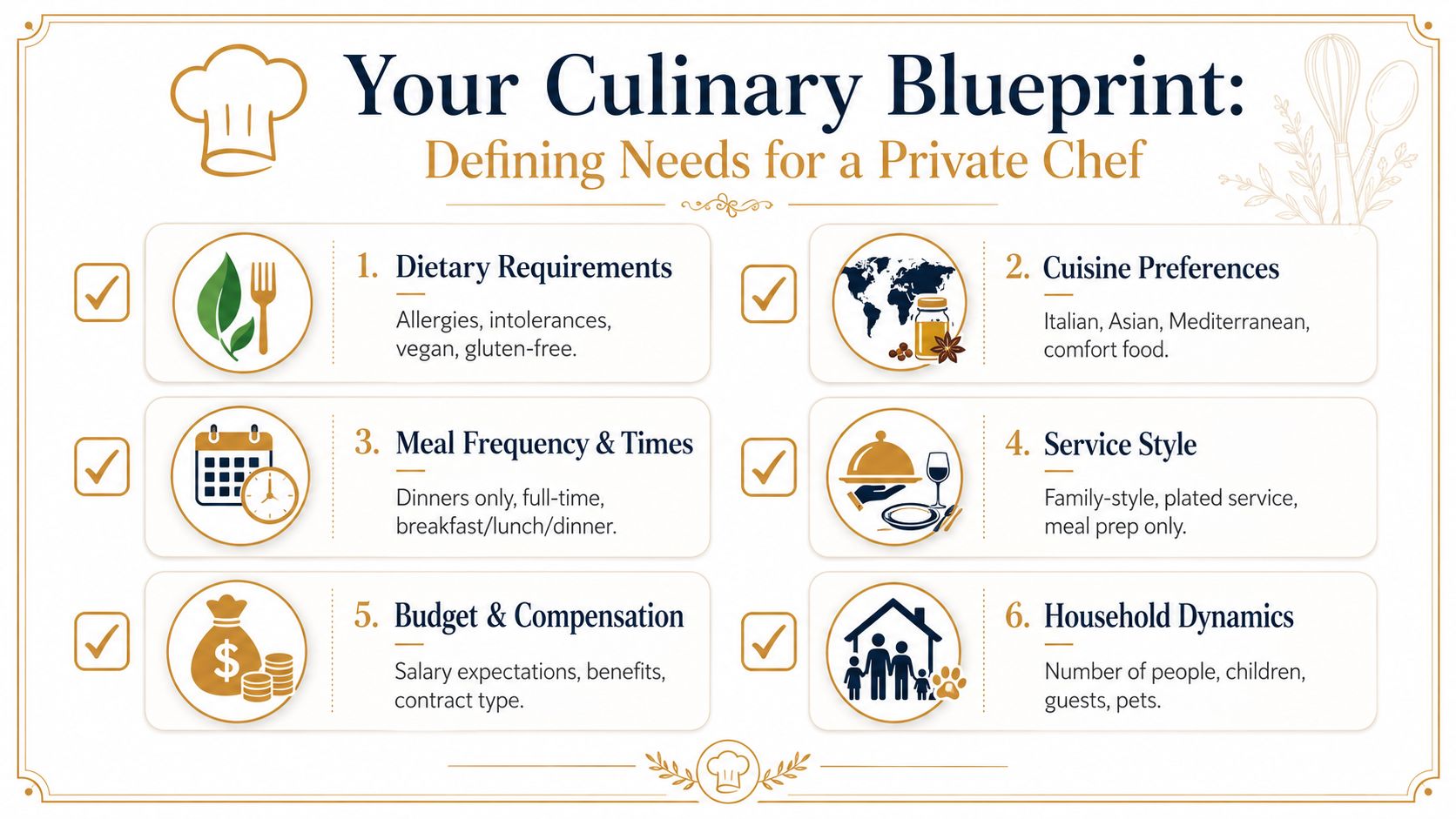
Most poor hires start with a vague brief. “We want healthy meals” isn't enough. “We need four weekday suppers, child-friendly but not childish, nut-free, low spice for one child, and one polished Friday dinner for adults” is much better.
Clarity saves time at every stage. It helps you assess candidates properly, compare like with like, and avoid hiring a brilliant event chef for what is really a family logistics role.
Build a household culinary brief
Start with the operational basics.
- Who is being fed: Adults, children, teenagers, regular guests, or visiting relatives all change the brief.
- When food is needed: Daily supper only, full-day coverage, weekend support, or travel accompaniment.
- What style of service suits the house: Drop-off meal prep, family-style service, plated dinners, or mixed service depending on the day.
Then move beyond logistics into standards.
- Preferred cuisines: Not just “healthy” or “varied”, but the actual food the household enjoys repeatedly.
- Shopping expectations: Farmers' market sourcing, premium supermarkets, organic preference, or strict ingredient lists.
- Kitchen ownership: Some households want complete chef autonomy. Others want menu approval every week.
For a family household, it also helps to define what “good” looks like. Is success elegant dinner-party food, or is it children eating well at the right time with no friction before bedtime? Often it's both, but one usually matters more day to day.
Dietary discipline matters more than flair
Many online guides stay too superficial, as existing private chef content often overlooks cross-contamination risk, allergen protocols, and child-specific nutrition, even though those are often the deciding factors in real family homes. As discussed in this guide on hiring a private chef, households increasingly expect documented ingredient controls, and the strongest family chefs are often the most operationally disciplined.
Practical rule: If a candidate answers allergy questions with reassurance instead of process, keep looking.
Ask directly how the chef handles:
- Separate prep systems: Distinct boards, utensils, storage, and plating for allergen-sensitive meals.
- Labelling: Clear ingredient labels on batch-cooked items, sauces, and packed meals.
- Coordination with other staff: Nannies, housekeepers, and house managers need to know what is safe to serve.
- Children's nutrition: Age-appropriate meals, school lunch routines, and household rules around snacks or sugar.
A chef who can produce lovely food but can't run a safe, traceable family kitchen will create avoidable risk.
For a fuller overview of the role itself, this explanation of what a private chef does is a useful starting point when shaping the brief.
Questions worth answering before you search
Use these prompts to tighten your requirements:
- Do you need presence or production? Some homes need service and visible hospitality. Others mainly need organised meal preparation.
- Is discretion critical? For high-profile or security-conscious households, personality and confidentiality matter as much as food.
- How often does the brief change? A static household can work well with a structured planner. A fluid household needs someone adaptable.
The better your brief, the better your shortlist.
Sourcing Options Freelancer vs Staffing Agency
A York family hires a chef for three evenings a week. The food is excellent for the first month. Then school schedules change, a parent starts travelling more often, grandparents stay for ten days, and the chef who looked perfect for a simple brief struggles with the pace and inconsistency. That is usually the point at which households realise they were not hiring for cooking alone. They were hiring for reliability, judgement, and fit inside a private home.
Hiring a freelance chef directly
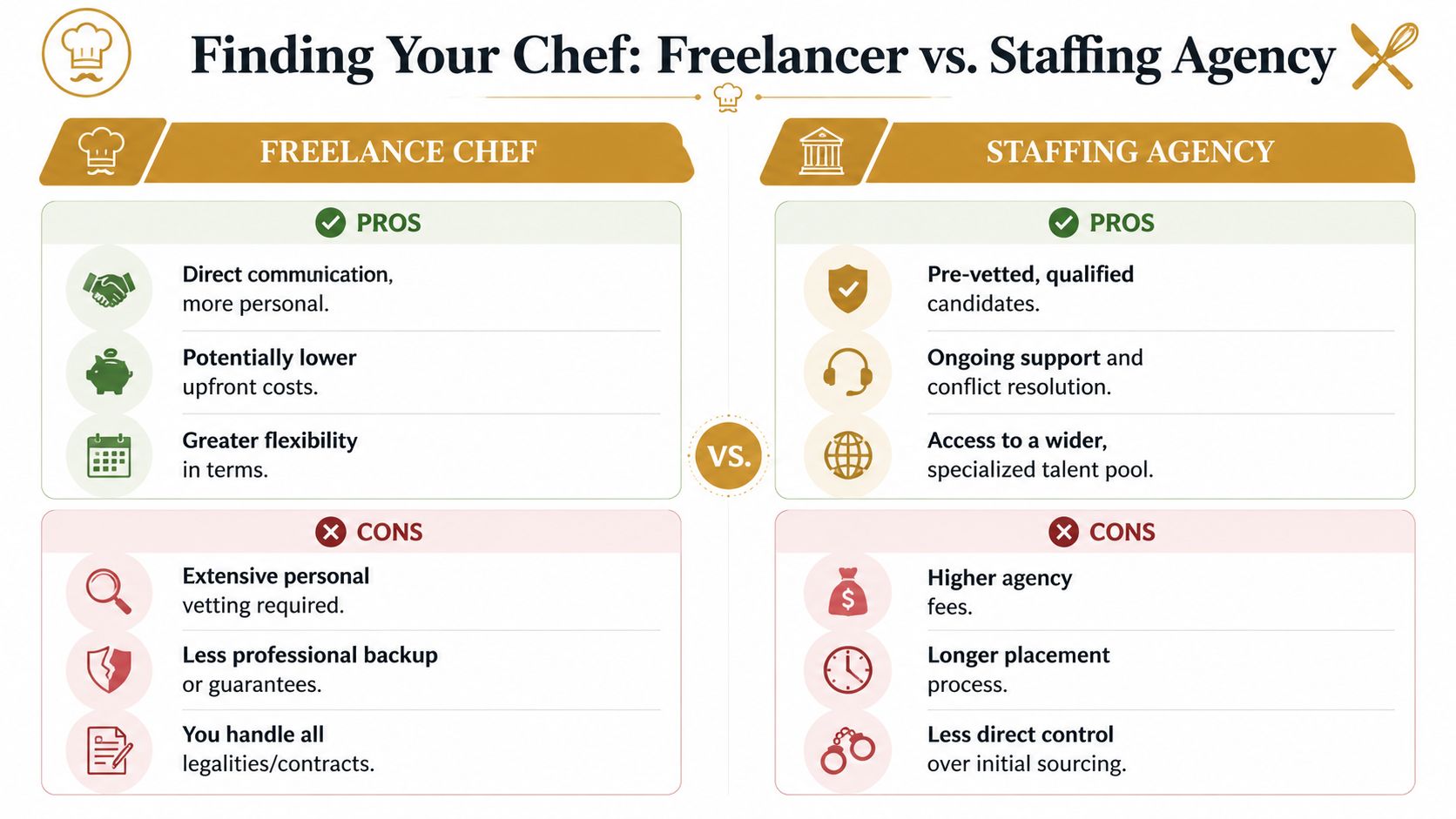
Direct hiring can work well in the right circumstances. It gives the household immediate contact with the chef, more freedom on scheduling, and a less formal process. For lighter briefs, that can be entirely sensible.
The trade-off is clear. The household takes responsibility for search, screening, references, trial planning, paperwork, and contingency cover if the arrangement ends abruptly. That workload is manageable for occasional entertaining or a known recommendation. It becomes heavier when the chef is expected to support daily family life.
A direct freelance route usually suits households where:
- The role is narrow: occasional dinners, weekend support, or short seasonal cover.
- The candidate comes through a trusted introduction: personal referrals reduce uncertainty, though they do not remove it.
- The household is comfortable running the hiring process itself: someone still needs to assess work history, boundaries, availability, and replacement options.
Cost can look lower at first. The hidden expense appears later if the fit is wrong and the search has to start again.
Using a staffing agency
An agency earns its place when the brief is part-time, full-time, rota, or otherwise embedded in the running of the home. That is often the case for York households who need more than polished dinner-party food. They need breakfast and supper routines, packed lunches, guest flexibility, travel support, and calm coordination with nannies, housekeepers, or a house manager.
Good agencies screen for private-household judgement, not only restaurant pedigree. That difference matters. A chef may have excellent technical skills and still be unsuitable for a family setting if they dislike changing schedules, communicate poorly with other staff, or treat a home kitchen like a restaurant pass.
For families weighing that route, this guide to private staffing agencies for elite households explains what agency-led recruitment adds when the appointment needs to hold up over time.
Poor fit is expensive. In private homes, it rarely shows up as one dramatic failure. It shows up as friction, repeat instruction, uneven standards, and a household that never quite relaxes around the person in its kitchen.
Which route works best
The right choice depends on how exposed the household will be if the hire underperforms.
| Route | Best for | Main strength | Main risk |
|---|---|---|---|
| Freelance chef | Occasional entertaining, short cover, lighter weekly support | Flexibility and direct communication | The household carries vetting, administration, and fallback planning |
| Staffing agency | Part-time, full-time, rota, and family-based roles with complexity | Better fit assessment, structured search, and replacement support | More process at the outset |
For a chef who will work around children, recurring guests, changing diaries, or multiple dietary requirements, a structured search is usually the safer decision.
The Vetting Process From Interview to Trial Dinner
A polished CV and attractive sample menu don't tell you how someone behaves in your kitchen on a busy Tuesday. Vetting has to go further than culinary style. You are assessing judgement, routine, discretion, and operational steadiness.
The strongest candidates usually describe their work clearly. They know how they plan, shop, prep, serve, store, and reset. They don't rely on charm to fill the gaps.
What to test in interview
A useful interview mixes practical and situational questions. Don't only ask what they can cook. Ask how they think.
Good questions include:
- How do you plan a week of meals for a family with different tastes?
- What is your system for stock rotation and avoiding waste?
- How do you handle a last-minute increase in guest numbers?
- What do you do if a nanny or housekeeper serves the wrong item to a child with a restriction?
- How do you leave the kitchen at the end of service?
Listen for specifics. Strong candidates talk about process, not vague confidence. They explain prep lists, ordering habits, backup plans, and communication with the household.
Professional standards to expect
A serious private chef should be able to articulate a method. Practitioner guidance points to a three-stage operating method: define the service model, build priced menus from documented recipes with accurate yields, and run a feedback loop. The same guidance also stresses that recipe scaling is what prevents surprises whether cooking for 5 or 95 guests, and notes that only 25% of clients typically leave reviews on their own, which is why active feedback collection matters, according to this practitioner article on becoming a personal chef.
In household terms, that means the chef should already think in systems:
- Documented recipes: So results stay consistent.
- Accurate yields: So portions aren't guessed.
- Feedback habits: So preferences are refined instead of forgotten.
Ask a chef how they repeat success. Their answer often tells you more than the tasting.
For households with strict privacy requirements, this overview of high-profile staffing vetting standards is worth reading before interviews begin.
Why a paid trial is non-negotiable
A trial shows what no interview can. It should be paid, structured, and observed properly. One dinner can work for an event chef. For a family role, a few days is often more revealing.
During the trial, watch for five things:
Food quality
Is the food of good quality, and does it suit the brief rather than the chef's ego?Timing
Meals that are ten minutes late every day will eventually disrupt the household.Kitchen conduct
Is the workspace clean, organised, and calm?Communication
Do they ask sensible questions and confirm details without becoming dependent?Temperament
Are they composed when something changes at short notice?
The best trial chefs don't just cook well. They make the household feel easier to run.
Contracts Pay and the True Cost of Employment
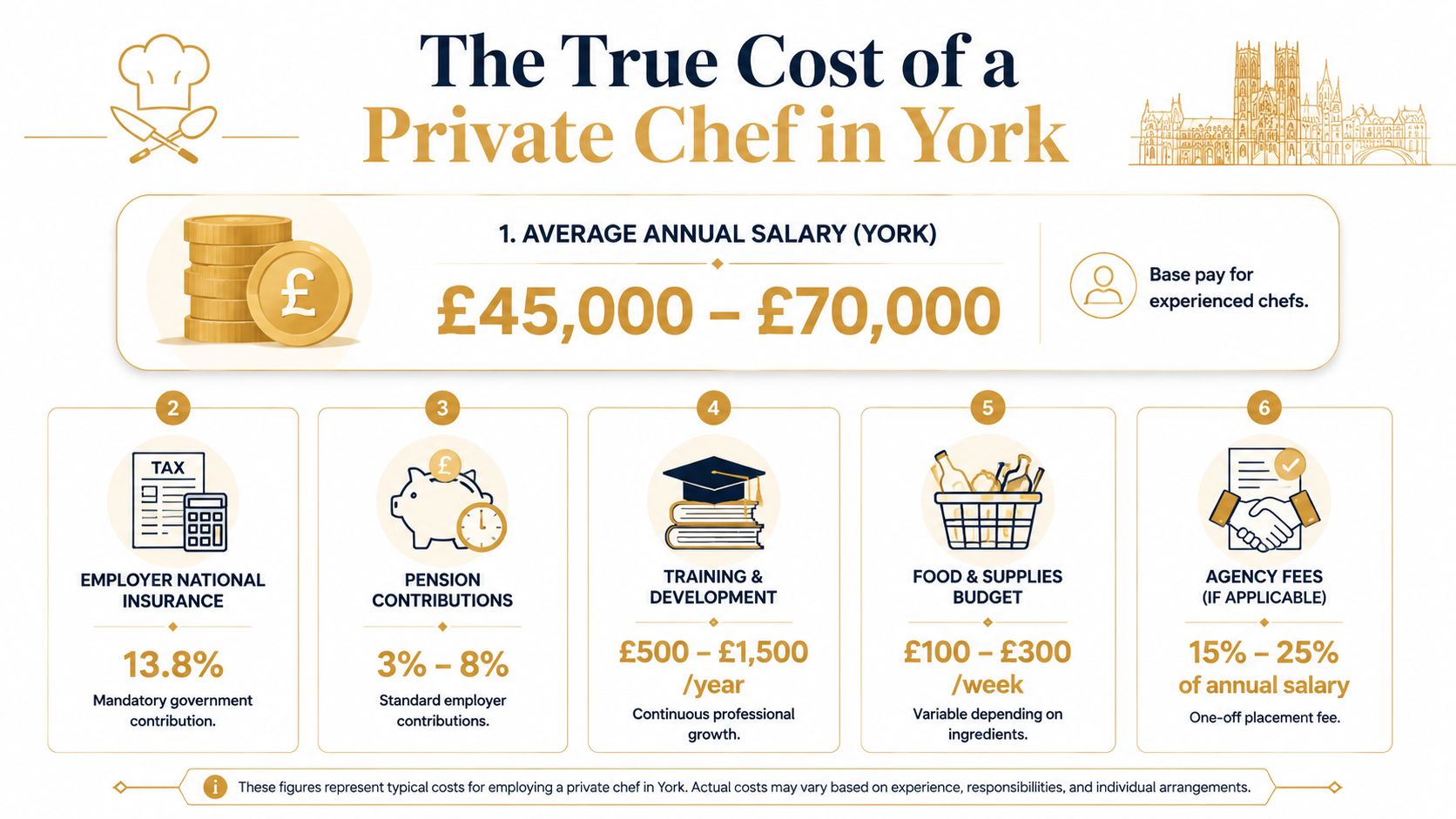
Many households miscalculate. They focus on salary or day rate, then discover later that the true cost sits much higher once employment obligations and household realities are added in.
A proper budget starts with labour benchmarks, then builds outward to compliance, coverage, and the practical cost of maintaining service standards over time.
The baseline is not the whole picture
For general UK chef pay, the Office for National Statistics benchmark cited in this guide to hiring a private chef places mean hourly pay at about £13.73, median pay around £12.25, with the 10th to 90th percentile running from roughly £10.50 to £17.24. Those figures are helpful as a floor for labour cost. They are not a ready-made quote for a private household chef.
Household chefs often need to absorb scheduling volatility, bespoke sourcing, autonomous kitchen control, and household-specific standards. A chef who can manage allergies, shopping, menu planning, and smooth service without supervision won't price like a line cook.
What employers need to budget for
For long-term hires, salary is only one part of the equation. In the UK, employers must budget beyond salary for PAYE income tax, National Insurance, pension auto-enrolment, holiday pay, and sick pay, as explained in this discussion of private chef hiring costs. That's why event pricing is a poor guide when you're considering a part-time, full-time, or rota arrangement.
A realistic household budget should account for:
- Core pay: Salary, hourly rate, or rota package.
- Employment overheads: Payroll obligations and statutory contributions.
- Food procurement: Regular shopping, specialist ingredients, and supplier coordination.
- Travel and flexibility: Particularly if the chef works across residences or accompanies the family.
- Operational buffer: Cover for schedule changes, guest increases, and seasonal pressure.
If you're costing a long-term hire, this guide on the cost of a private chef is a helpful companion to your planning.
Buying criterion: Judge affordability over a year of household use, not by comparing one event invoice with one monthly salary figure.
Contract terms that protect both sides
A private chef contract should be plain, detailed, and realistic. It needs to cover more than pay.
Include clear wording on:
- Duties: Family meals, guest dinners, menu planning, shopping, pantry management, travel, and kitchen resets.
- Hours and rest periods: Especially important in homes with irregular entertaining.
- Confidentiality: Standard in any private household, and essential in high-profile homes.
- Expenses and procurement authority: Who approves premium purchases and supplier accounts.
- Termination and notice: So both sides know the process if fit isn't right.
The contract should reflect the actual role. Problems start when a household hires “a chef” but expects chef, nutrition lead, event planner, and kitchen manager all in one without documenting any of it.
Bringing Culinary Excellence to Your York Home
The best private chef hires improve more than meals. They calm the household. Children eat on time. Adults stop negotiating dinner logistics every day. Guests can be welcomed properly without turning the kitchen into a stress point.
That outcome usually comes from disciplined hiring, not luck. A clear brief, sensible sourcing route, serious vetting, and a realistic employment budget do most of the heavy lifting. Culinary talent matters, but in a private home, reliability and judgement matter just as much.
For family households, one final detail is worth attention. Equipment affects consistency. If you're reviewing kitchen readiness before a chef starts, a practical resource like this 2026 non-toxic cookware guide can help you assess whether your current setup supports safe, efficient daily cooking.
A strong private chef York appointment should integrate smoothly after the initial onboarding. Meals fit the home, the kitchen runs properly, and the service becomes part of the household rhythm rather than a special occasion add-on. That's the standard worth hiring for.
Frequently Asked Questions About Hiring a Private Chef
Some questions come up in almost every search. The answers below are the ones clients usually need before they move from interest to action.
| Question | Answer |
|---|---|
| What is the difference between a private chef and casual domestic cooking help? | A private chef is part of a recognised occupational category rather than an informal arrangement. The role of a private household cook or personal chef is defined as preparing meals in private homes, and that structured definition aligns with the premium household-service model used in staffed homes, according to the occupational category for private household cooks. |
| Is a private chef in York only suitable for dinner parties? | No. Event chefs are common, but many households need recurring family meals, seasonal residence coverage, travel support, or a rota arrangement. The key is matching the service model to the household rather than defaulting to a one-off event format. |
| Should a family prioritise restaurant pedigree or household experience? | For many homes, household experience is more valuable. Restaurant training can be excellent, but family kitchens require flexibility, discretion, routine management, and comfort around children, guests, and changing plans. A chef who understands domestic flow often settles faster than one focused mainly on presentation. |
| How long should a trial be? | It depends on the brief. A single paid dinner can be enough for occasional entertaining. For family meal coverage or a long-term hire, a longer paid trial is more revealing because it shows consistency, communication, timing, and how the chef handles repeated routines. |
| Can a private chef work well with nannies and house managers? | Yes, and they should. In a well-run household, the chef needs to coordinate with childcare and household staff on meal timings, school lunches, allergies, guest changes, and kitchen access. Compatibility across the team is often just as important as the food itself. |
If you'd like expert help finding a discreet, thoroughly vetted private chef for your home, Superstar Nannies supports discerning families with bespoke household staffing across the UK and internationally.