

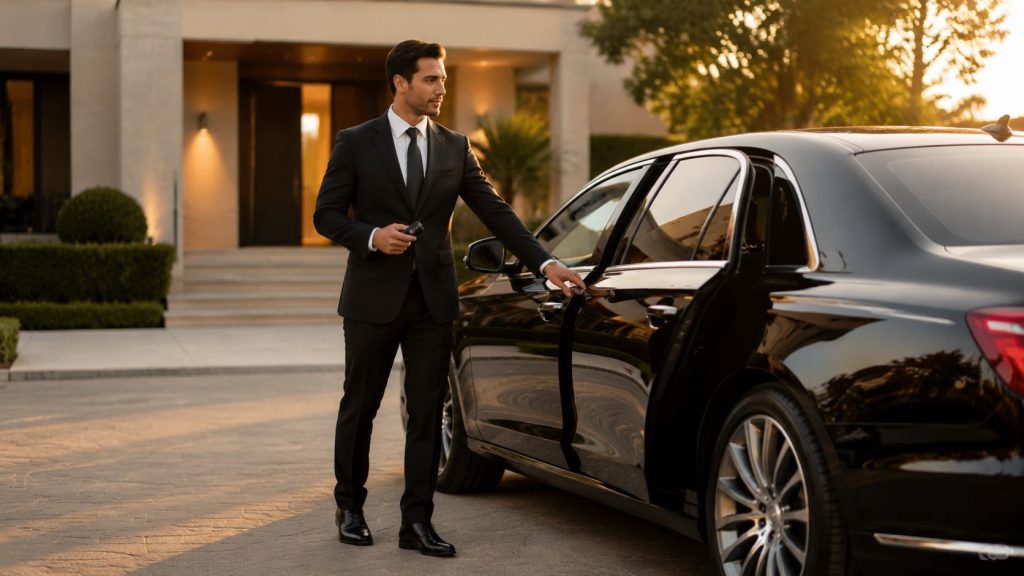
A family lands from a long-haul flight at dawn. One child needs to be at school on time. A parent has a breakfast meeting across town. The house manager is juggling contractors, luggage, and a diary that has already changed twice before 8 am. In that setting, a personal driver job isn't a luxury label. It's a role that keeps the household functioning without friction.
Such is the situation in the private staffing world. The best drivers don't just take someone from A to B. They protect time, preserve privacy, and remove small points of stress before they become visible problems. In elite households, that matters as much as smooth driving.
In the UK, the role is best understood through adjacent official occupation groupings because the Office for National Statistics doesn't publish a standalone personal driver headcount. The ONS does note that 1.9 million people were employed in transport and storage in 2024, and private driver hiring sits inside that wider labour picture while remaining a very different kind of placement focused on trust, reliability, and premium service expectations, particularly in major urban centres (UK driver workforce context).
Introduction The Drive for Seamless Living
A well-run household often looks effortless from the outside. Behind that calm exterior, someone is keeping movements precise, protecting timing, and making sure the day doesn't slide off course because of traffic, vehicle issues, or poor planning. That's where a personal driver becomes indispensable.
For families, the pressure points are familiar. School runs overlap with airport collections. Evening events run later than expected. A principal asks for a route change while already en route. None of that is unusual in a busy private home. What matters is whether the driver absorbs the disruption or passes it straight back to the family.
For candidates, the role holds more interest than many job adverts suggest. A strong personal driver job combines logistics, etiquette, confidentiality, and judgement. The driver who succeeds in a premium household is usually the one who can think ahead, stay composed, and make the right call without creating unnecessary noise.
Practical rule: If a family notices the transport logistics, something has usually gone wrong.
What a Personal Driver Job Really Entails
A modern personal driver job is closer to live transport management than simple driving. The vehicle is only one part of the assignment. The rest is preparation, timing, and adjustment.
UK employers expect drivers to use GPS and navigation tools, track traffic and weather in real time, and reroute when needed to preserve punctuality and safety. The role also includes vehicle readiness, regular inspections, and basic maintenance checks that reduce the risk of breakdowns and service disruption (personal driver duties and route planning).
The working day starts before the key turns
In an elite household, a driver's day usually begins well before departure. That means reviewing the schedule, checking likely congestion points, confirming addresses, and making sure the car is clean, fuelled, and properly prepared for the passengers using it.
On some days, the job is straightforward. On others, it involves coordinating with a PA, estate manager, nanny, or security contact. A driver may need to collect forgotten items, stage luggage for a station transfer, or hold position discreetly while plans shift.
The unseen duties matter most
Families often value what never becomes a problem. That includes:
- Vehicle readiness: Tyres, lights, warning indicators, fluid levels, charging status, and cabin presentation should be checked before the first journey.
- Route discipline: A skilled driver doesn't trust one route. They keep primary and fallback options in mind.
- Passenger handling: Opening doors, assisting with luggage, and adjusting driving style for children, elderly passengers, or tired travellers all matter.
- Schedule protection: The role often includes building realistic buffers so a delayed earlier journey doesn't ruin the rest of the day.
A mediocre driver reacts. A strong one pre-empts.
If a principal has to ask whether the car is ready, the standard is already too low.
It's a service role, not just a transport role
The most successful candidates understand that households hire for confidence as much as competence. They want someone who won't overshare, won't become flustered under pressure, and won't treat every request as an inconvenience.
That's why the best personal driver job descriptions tend to include more than driving tasks. They hint at the true brief. Be calm. Be prepared. Be discreet. Make the day run better.
Personal Driver vs Chauffeur Understanding the Distinction
Families often use these terms interchangeably, but they don't always mean the same thing in practice. The distinction matters because it shapes recruitment, presentation, and expectations from day one.
A chauffeur role is often more formal. It may involve a dedicated luxury vehicle, stricter standards of dress, and a service style that is outwardly polished and ceremonial. A personal driver role is usually more embedded in the principal's real daily life. It can include family logistics, ad hoc errands, and a working relationship that is closer to the rhythm of the household.
For travel-specific examples of a classic chauffeur-style service outside the household setting, resources such as Faro Airport chauffeur transfers are useful because they show the polished, journey-focused side of the profession. For families hiring within a private home, the brief is often broader, and a guide on how to hire a chauffeur can help clarify where the role overlaps and where it diverges.
Personal Driver vs. Chauffeur at a Glance
| Aspect | Personal Driver | Chauffeur |
|---|---|---|
| Primary focus | Daily household and principal transport | Formal passenger transport and presentation |
| Relationship to household | Often integrated into family routines | Often more service-defined and transport-led |
| Typical duties | School runs, errands, airport transfers, schedule support | Executive journeys, events, premium transfers |
| Dress code | Smart, sometimes less formal depending on family | Usually more formal and consistent |
| Vehicle context | Family or principal's vehicle, sometimes multiple cars | Often a dedicated premium vehicle |
| Working style | Flexible, adaptive, highly embedded | Polished, structured, ceremony-aware |
The wrong title causes the wrong hire
A family who really needs flexible household support may attract the wrong candidates if they advertise only for a chauffeur. Equally, a candidate seeking a formal driving role may be frustrated if the actual job includes children's kit, shopping collections, and late changes to school or activity schedules.
The title matters less than the brief behind it. The clearer the expectations, the stronger the placement.
The Anatomy of a Five-Star Driver Skills and Qualifications
The best candidates are measured in layers. First come the essential requirements. Then come the qualities that make a private household trust someone with their time, routines, and privacy.
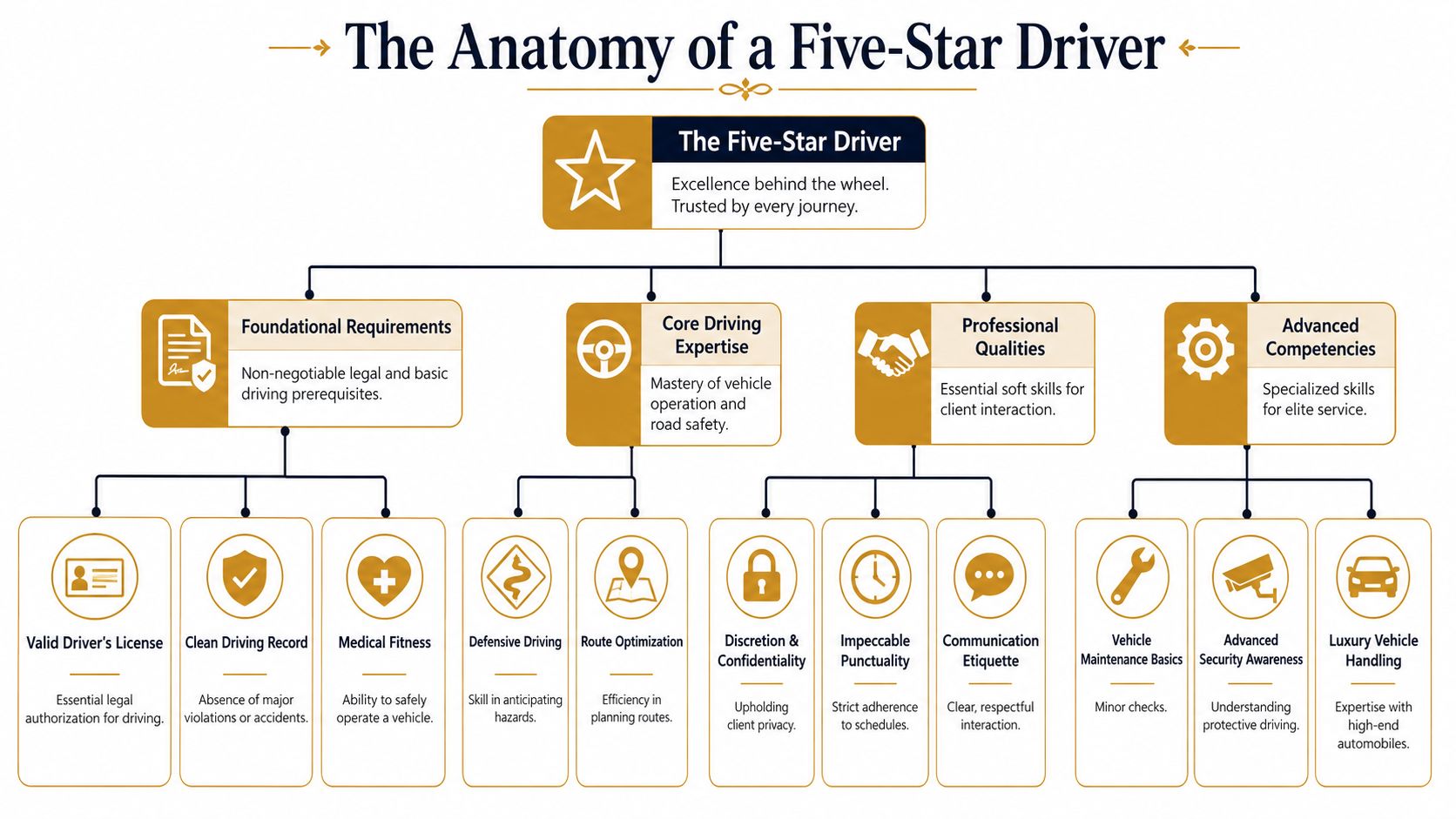
UK personal driver hiring places clear weight on compliance and passenger-risk management. Standard requirements include a valid licence, a clean driving record, and strong knowledge of road regulations. In higher-end roles, the brief often extends to luggage handling, confidentiality, and flexibility for evenings and weekends (personal driver qualifications and compliance).
Foundational requirements
Start with what has to be in place before a candidate reaches interview stage:
- Licence and record: The basics must be current, clean, and easy to verify.
- Medical fitness: Families want confidence that the driver is safe and dependable over long days.
- References: In private service, references often carry as much weight as technical ability.
- Background screening: Households commonly want vetting that supports trust, safeguarding, and access to private environments.
What separates a good driver from a five-star one
Beyond paperwork, elite placements are usually decided by professional behaviour.
- Discretion: A driver hears calls, sees patterns, and learns routines. Saying less is part of the craft.
- Calm under pressure: Traffic jams, delayed flights, and last-minute location changes are routine. The household doesn't need commentary. It needs solutions.
- Presentation: Clean car, polished shoes, neat grooming, and professional body language still matter.
- Spatial awareness: Good road sense is expected. Great drivers also read kerbside risks, pickup positioning, and passenger comfort instantly.
For candidates who want to sharpen the fundamentals of roadcraft and hazard awareness, even material written for a broader audience can be useful. Practical refreshers such as these driving tips for Florida drivers are a reminder that polished private service still rests on disciplined driving habits.
The private market rarely rewards the loudest candidate. It rewards the one who feels safe, steady, and easy to trust.
Qualifications are only half the story
A CV can show licences and employment dates. It can't always show judgement. That usually appears in the interview, the trial day, and the references. When a candidate speaks respectfully about former principals, keeps details general, and understands boundaries instinctively, that tells you far more than a long list of claims.
Expected Salary and Working Conditions in 2026
Candidates for a personal driver job often focus first on salary. That's understandable, but in private service, working conditions often determine whether a role is sustainable.
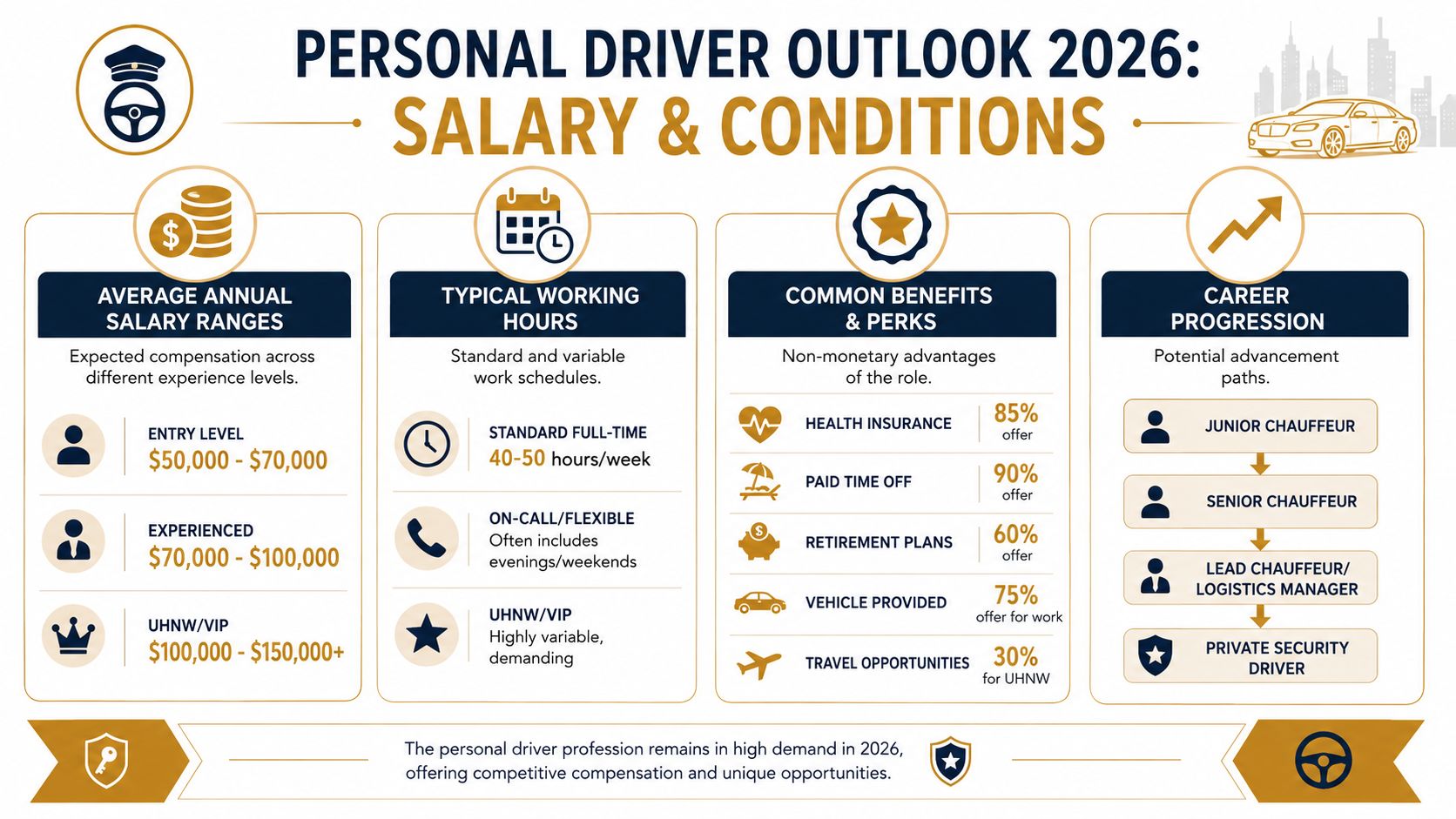
The most useful hard data in this area isn't a salary benchmark. It's the schedule reality. Available job data shows that driver roles can require 24/7 availability, with peak demand from 6 AM to 6 PM, Monday to Sunday, which has obvious implications for rota design, overtime expectations, and work-life balance (driver scheduling patterns and availability demands).
That matters because two roles with similar headline pay can be completely different jobs in practice. One may be structured, with clear off-duty periods and predictable handovers. Another may look generous on paper but involve constant messaging, split days, weekend drift, and little genuine downtime.
What families should define clearly
Before discussing compensation, households should settle the operational model:
- Live-in or live-out: Convenience for the employer isn't always convenience for the driver.
- Fixed schedule or fluid diary: A role tied to a known pattern is easier to retain staff for.
- Single principal or family coverage: The broader the passenger pool, the more coordination is needed.
- Vehicle expectation: Daily urban driving, school logistics, long-distance motorway work, and airport support all create different demands.
What candidates should ask before accepting
Strong candidates don't only ask about pay. They ask how the role functions.
A useful interview line is simple: what does a typical week look like when nothing unusual is happening, and what changes when the household is travelling or entertaining? That answer usually reveals whether the role is organised or reactive.
For those who enjoy longer road assignments and varied regional routes, even leisure-focused resources can offer useful context on route character and driving conditions. A piece on planning your South Wales driving adventure won't replace route planning tools, but it does reflect the kind of terrain awareness and preparation mindset strong drivers bring to unfamiliar journeys.
Households comparing broader compensation structures across domestic roles may also find this private staff salary guide for 2026 helpful when aligning driver pay with the rest of a staffed home.
How to Hire or Become an Elite Personal Driver
A family may only need one driver, but the hiring standard is closer to appointing a senior household employee than filling a transport vacancy. In this market, small errors have expensive consequences. The wrong person can disrupt school runs, expose private information, unsettle security routines, or fail to read the tone of the household.
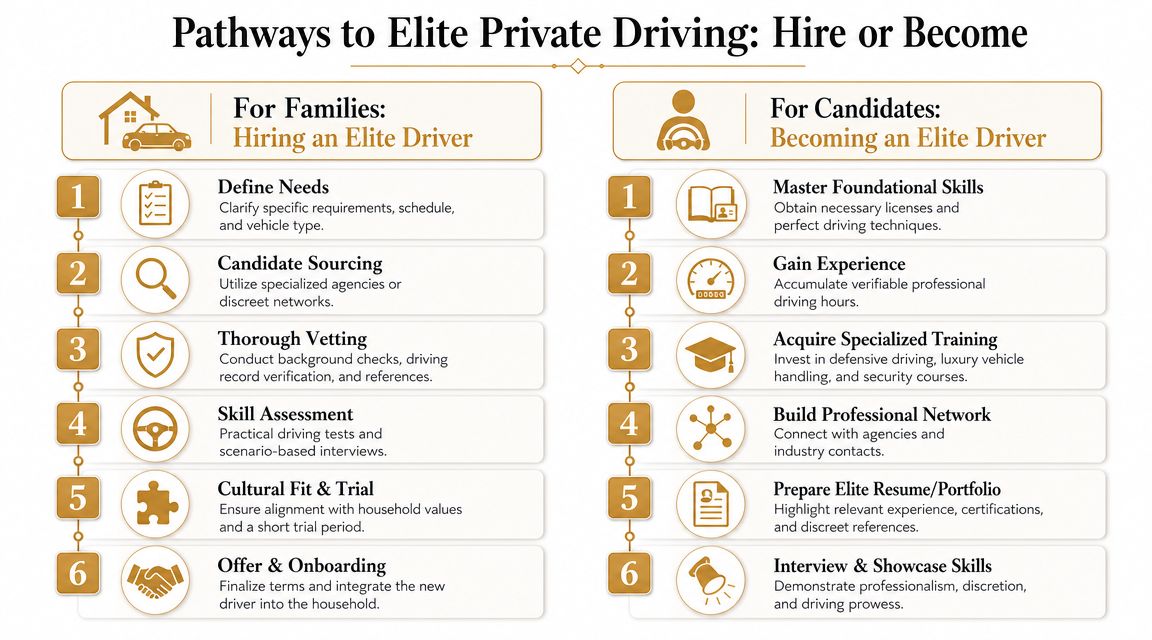
That is why elite placements are selective on both sides. Families need a clear brief and a disciplined vetting process. Candidates need relevant experience, sound judgement, and the kind of discretion that comes across before anyone asks for it.
For families hiring a driver
The brief sets the quality of the search. A vague instruction to find “a good driver” usually produces weak shortlists because the role itself has not been defined properly. A strong brief covers who the driver supports, the usual working pattern, whether children are transported, whether travel extends beyond local driving, what vehicle standards apply, and how often plans change at short notice.
Then test for household suitability, not just road competence.
- Interview for judgement under pressure. Ask how the candidate would handle a cancelled route, a last-minute airport change, a child handover issue, or sensitive items left in the vehicle.
- Assess service standards in real time. A proper driving assessment should include punctual arrival, vehicle presentation, parking decisions, route planning, passenger awareness, and calm communication.
- Take references beyond job title and dates. Ask former employers whether the candidate was trusted with private routines, adapted to changing diaries, and maintained confidentiality without prompting.
- Use a paid trial where possible. A trial often shows more than a polished interview. You see timing, attitude, discretion around staff, and whether the driver understands that this role is about support, not visibility.
Families who want a structured search process usually get better results through a specialist agency model for hiring personal drivers. The screening criteria for a UHNW household are materially different from those used for standard driving jobs.
For candidates seeking elite roles
Candidates often lose strong opportunities by presenting themselves too broadly. Private employers are not looking for a generic driver. They are hiring someone who can represent the household well, protect privacy, and operate reliably when the day changes three times before lunch.
A strong CV is restrained and specific. List the environments you have worked in, the vehicle types you have handled, the level of diary flexibility you have managed, and any duties that show trust, such as child transport, airport coordination, vehicle maintenance oversight, or close support to a principal. Leave out inflated language. In this market, overstatement reads as risk.
Preparation matters just as much.
- Use service-focused language. Speak clearly about timing, passenger comfort, discretion, route planning, and calm support.
- Prepare real examples. Be ready to explain how you handled delays, competing priorities, confidential information, or a difficult day on the road.
- Show discretion in the interview itself. Strong candidates do not trade on stories about previous principals. They prove trustworthiness by what they choose not to say.
- Expect proper vetting. Top roles often involve licence checks, reference verification, right-to-work review, background screening, and practical assessment before an offer is made.
The best candidates understand the trade-off. Elite roles can offer stability, excellent compensation, and long-term trust, but the standard is higher every day, not just at interview.
Excelling in a UHNW Household The Unwritten Rules
Technical ability gets a driver hired. Household judgement is what keeps them in post.
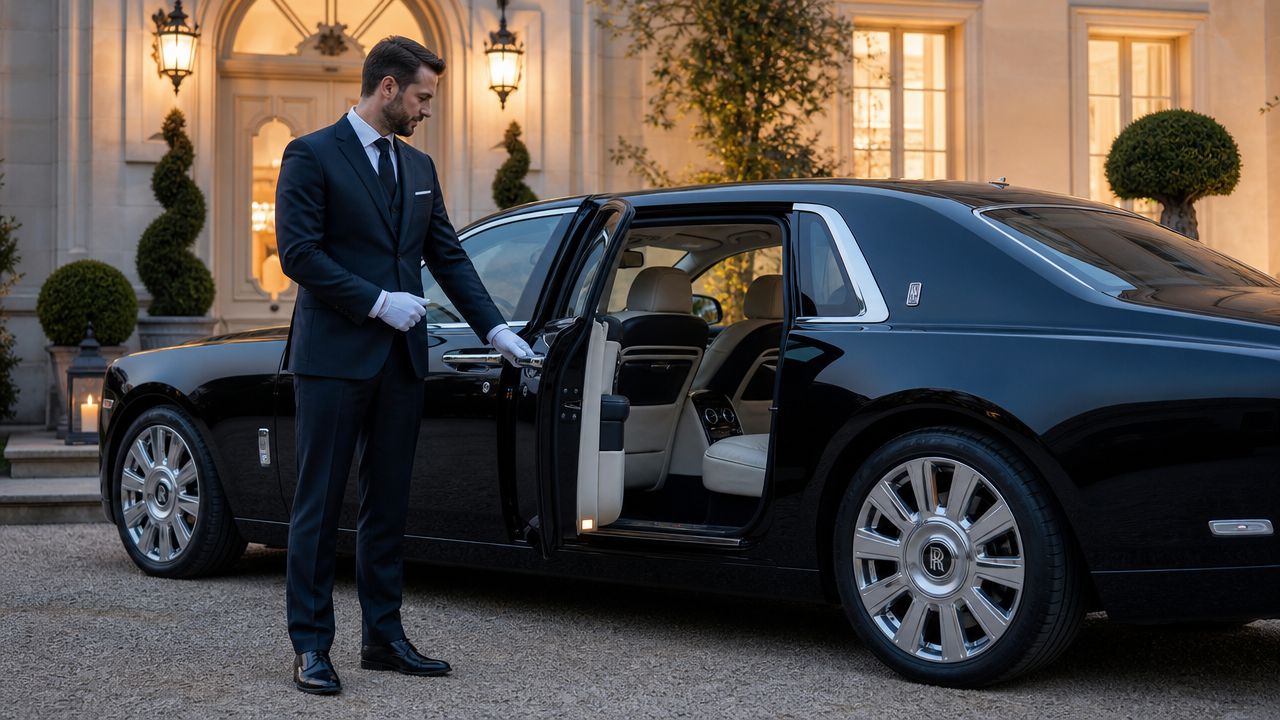
In a UHNW or VIP setting, the driver often operates close to the principal's private life without being part of it. That line has to stay clear. The strongest drivers are warm but never familiar. Helpful but never intrusive. Available but not over-present.
Boundaries have to be visible
A driver may know the family's school timetable, travel habits, preferred routes, regular guests, and periods when the household is empty. Mishandling any of that information can end a placement immediately.
That's why confidentiality needs to be active, not theoretical. Phones shouldn't be left where conversations can be recorded accidentally. Details shouldn't be discussed with other staff unless there is a genuine operational need. Notes, access codes, and addresses should be handled with care. Guidance on private staff confidentiality for high-profile families is especially relevant here because transport staff often sit at the edge of many sensitive moments.
Read the room, then read it again
A few common scenarios reveal the difference between a competent driver and a refined one:
- After a difficult meeting: Don't fill the silence. Offer the smoothest route home and keep the atmosphere calm.
- During family transport: Children may be chatty, tired, or upset. The driver stays steady and neutral.
- At events: Know where to wait, when to step forward, and when to remain invisible.
In private households, professionalism often looks like quiet judgement.
Respect the chain of communication
Some principals like direct communication. Others want all changes routed through a PA, chief of staff, or house manager. A driver who ignores that structure creates friction very quickly.
Small details also matter. Confirm changes clearly. Acknowledge instructions without over-talking. If there's a problem, bring a solution with it. The household should feel that the transport side is under control.
This is one of the least teachable parts of the role. It comes from maturity, observation, and respect for the environment.
Conclusion Your Next Move in Private Transport
A personal driver job is far more than professional driving. At the top end of the market, it combines logistics, presentation, discretion, and operational reliability. Families need someone who protects the flow of the day. Candidates need to understand that elite roles are won through trust as much as technical skill.
If you're hiring or exploring your next move in private service, the best results usually come from specialist guidance. The standards are high, and the fit has to be right.
Frequently Asked Questions About Personal Drivers
A family can be impressed by a candidate's road test and still decide against a hire after the final references come in. That happens often in private service. In elite households, the hiring question is rarely limited to driving skill. It is whether this person can be trusted with access, routines, children, travel plans, and private conversations.
That is why late-stage questions matter. The right answers protect both sides from a poor fit.
FAQs
| Do personal drivers need DBS checks? | In many household roles, yes. If the position includes children, elderly principals, or regular access to the home, families often require safeguarding and background screening before an offer is confirmed. |
| Is a personal driver expected to provide security? | Usually, no formal close-protection duties are attached unless the brief states that clearly. Families still look for strong awareness, good judgement, route discipline, and the ability to stay calm under pressure. |
| Can a personal driver travel internationally with a family? | Sometimes. The brief should spell out passport readiness, visa history, schedule flexibility, overnight expectations, and whether the driver remains on duty during the trip or only handles transfers. |
| Do drivers only transport adults? | No. Many private driver roles include school runs, activity drop-offs, airport collections, and support for guests or household staff. |
| What usually disqualifies an otherwise capable candidate? | Weak references, casual handling of confidential information, poor communication, inconsistent timekeeping, and any sign that the candidate does not understand household etiquette. In this market, small lapses can end a process quickly. |
One point candidates often underestimate is access. A personal driver may know where the family banks, where the children attend school, which terminal the principal prefers, and when the house is empty. Families hire accordingly. Candidates who present themselves as polished, discreet, and easy to brief tend to progress further than candidates who focus only on mileage, vehicle knowledge, or licensing.
If you're looking to hire a discreet, highly vetted private driver, or you're a candidate seeking an elite household role, Superstar Nannies can help with a confidential consultation specific to your requirements.