


You're probably here because standard job advice feels miles away from the roles you want. You're not trying to land just any placement. You want access to polished, well-run homes, serious principals, and work that values judgement, loyalty, and calm execution.
That's exactly where private household staff jobs differ from mainstream recruitment. In the UHNW and VIP world, being good at the task isn't enough. You need to understand household structure, presentation, contracts, trials, and the long game of building a reputation people trust with their homes, children, travel, and private lives.
Embarking on Your Career in Private Service
Ambitious candidates often enter private service with the wrong target. They look for a title first, when they should be building a profile that solves a household's problem. A family rarely thinks in simple job-board language. They think in terms of trust, continuity, discretion, standards, and whether this person will make life easier without creating friction.
That's why the strongest route into private household staff jobs starts with clarity. Know what level you're suited to, what environment you perform best in, and what kind of household rhythm you can sustain. A formal London residence, a fully staffed country estate, and a fast-moving international VIP household may all need excellent staff, but they don't reward the same style.
Treat this field as a profession from day one.
Private service rewards candidates who prepare like operators, not applicants.
The people who progress fastest are rarely the loudest. They're the ones who arrive briefed, ask precise questions, understand boundaries, and make employers feel safe handing over responsibility.
Understanding the Landscape of Elite Household Roles
A well-run private residence functions like a small business with a very personal client. Titles matter, but structure matters more. If you don't understand who owns which area of responsibility, it's easy to apply for the wrong role or overstate your fit.
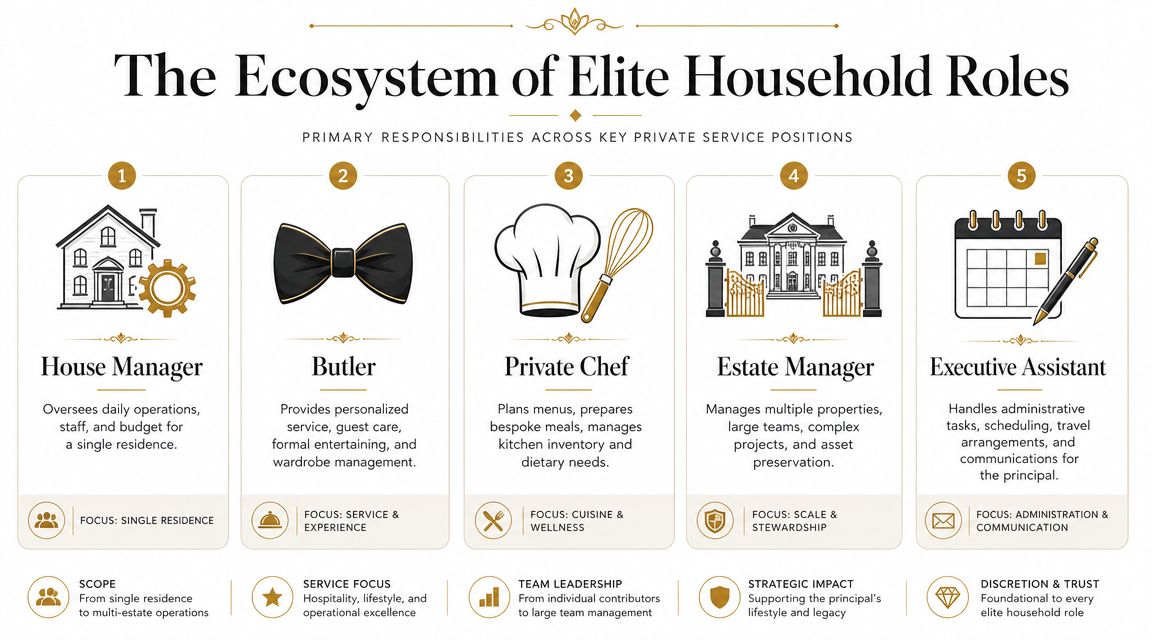
The core roles inside a staffed home
Some homes need one versatile professional. Others need an entire service team. In broad terms:
| Role | Primary Focus | Key Skills |
|---|---|---|
| House Manager | Daily household operations | Staff coordination, scheduling, discretion |
| Butler | Personal service and guest care | Formal service, presentation, anticipation |
| Private Chef | Food planning and execution | Menu design, dietary awareness, consistency |
| Estate Manager | Oversight across properties and projects | Leadership, maintenance coordination, budgeting |
| Executive Assistant | Principal support and logistics | Diary management, travel, communication |
A House Manager keeps the household running. That includes staff rotas, suppliers, standards, and often the invisible fixing of small problems before they become expensive ones.
A Butler is usually more front-facing. Service, wardrobe support, guest readiness, polished hosting, and situational awareness all sit close to this role.
A Private Chef serves the family's real life, not restaurant ego. That means dietary requirements, changing schedules, travel, children's preferences, and consistency under pressure.
For larger properties, an Estate Manager sits at a higher operational level. If that's the path you're targeting, studying current estate manager jobs in the UK will tell you more than generic descriptions ever will.
Formal household versus modern VIP setup
Not every elite home operates the same way. Traditional households often have a clearer chain of command, stricter etiquette, and narrower role boundaries. Modern VIP families can be less formal in tone but more demanding in pace. They may expect staff to switch context quickly, travel often, and handle blurred personal and professional logistics without fuss.
That's where many candidates slip. They assume “informal” means easier. It often means less ceremony and more complexity.
If the principal travels with security, drivers, assistants, and domestic staff, your work sits inside a wider ecosystem. Reading about the reality of elite protection can help candidates understand how household service often overlaps with security, movement planning, and controlled access.
Why the market feels selective
This labour market is also shaped by who works in it and how households hire. Domestic work in private homes has long relied on workers from overseas in the UK, and the Overseas Domestic Worker visa route was introduced in 2012. In comparable U.S. data, more than 600,000 domestic workers are employed directly by private households, with 90% concentrated in three occupations, and women make up 82% to 97% of core roles according to the U.S. Department of Labor domestic workers fact sheet.
That helps explain why experienced candidates with strong references, settled work status, and cultural agility stand out so sharply in private service.
Crafting Your Application for the Top Tier
A standard CV is usually too thin for top-end private service. It lists employment. It doesn't prove judgement. In this sector, your application has to answer a private employer's unspoken question: can I trust this person inside my life?

Build a portfolio, not just a CV
Your CV still matters, but it should be one part of a more complete professional pack. Strong candidates prepare:
- A customized CV that reflects private home experience, staffing level, travel exposure, and the standard of homes served
- A reference file with referee names, titles, relationship context, and clean chronology
- A short professional profile that states your role, style, strengths, and preferred setup
- A suitable photograph if requested by an agency or employer, kept professional and understated
- Proof of eligibility such as right-to-work documents ready for formal screening
If you're entering childcare-led roles, practical preparation matters just as much as presentation. This guide on how to become a nanny is useful because it reflects the difference between general childcare experience and employable private-household readiness.
Language that signals seniority
Top applications use the language of responsibility. Weak CVs say “helped with cleaning” or “looked after children”. Stronger ones describe outcomes, scope, and standards without overselling.
Use terms that employers and recruiters recognise immediately:
- Discretion
- Confidentiality
- Proactive support
- Smooth service
- Calendar-led organisation
- Travelling with principals
- Wardrobe care
- Vendor coordination
- Child-led routine management
- Household standards
Don't stuff in buzzwords. Match the vocabulary to the role you've done.
Your application is the first trial. If it's vague, rushed, or inconsistent, employers assume your work will be too.
Clean up your digital footprint
Private employers do look beyond the CV. They may not care whether you have a large online presence, but they do care whether it's sensible. Public arguments, careless comments about former employers, overly revealing posts, and chaotic profile history all create doubt.
The safest approach is simple:
- Audit your public profiles and remove anything that undermines professionalism.
- Align your dates and job titles across CV, LinkedIn, and agency forms.
- Avoid discussing past households in any detail online, even when unnamed.
Discretion isn't a line on the page. It has to be visible in how you carry yourself before anyone meets you.
Where and How to Find Exclusive Opportunities
Exclusive roles rarely behave like ordinary vacancies. The best ones are often circulated discreetly, filled through trusted recruiters, or offered to people already known in the network. If you rely only on public job boards, you'll see some opportunities, but not the full market.
Why specialist agencies matter
Households at this level don't just want candidates. They want filtered options. A specialist agency pre-screens eligibility, reviews references, pressure-tests fit, and helps both sides define the role properly before time is wasted.
For candidates, that means better briefings and fewer surprises. It also means someone can tell you when a role sounds glamorous but is structurally wrong.
If you're considering international or multi-jurisdiction placements, reviewing a specialist overview like this global recruitment agency guide for elite households can help you understand what serious cross-border recruitment should involve.
How to judge whether an agency is worth your time
Not every agency understands private service at the same level. Before you register, look for signs of real sector knowledge.
Role clarity
Good recruiters can explain reporting lines, household style, schedule pattern, and why the previous hire left.Vetting standards
They should ask for references, documentation, and precise career history, not just a quick CV upload.Communication quality
If the consultant is vague, inconsistent, or pushes unsuitable roles, expect problems later.Understanding of privacy
They should protect client identity properly while still briefing you enough to prepare.
Networking still carries weight
Word-of-mouth remains powerful in private service. Former principals, family offices, assistants, drivers, head housekeepers, and tutors all influence future hiring. Your reputation travels long before your CV does.
That doesn't mean casual networking. It means staying known for reliability, calm conduct, and clean exits. Candidates who leave households professionally, even after difficult placements, usually keep doors open. Candidates who dramatise, gossip, or disappear don't.
Keep your portfolio current. A discreet opportunity can appear with very little notice.
Excelling in the High-Stakes Interview and Trial
Interviews in this sector can feel deceptively calm. The room may be elegant, the tone relaxed, and the questions polite. Don't mistake that for low stakes. Every answer is being weighed for judgement, emotional control, and fit.
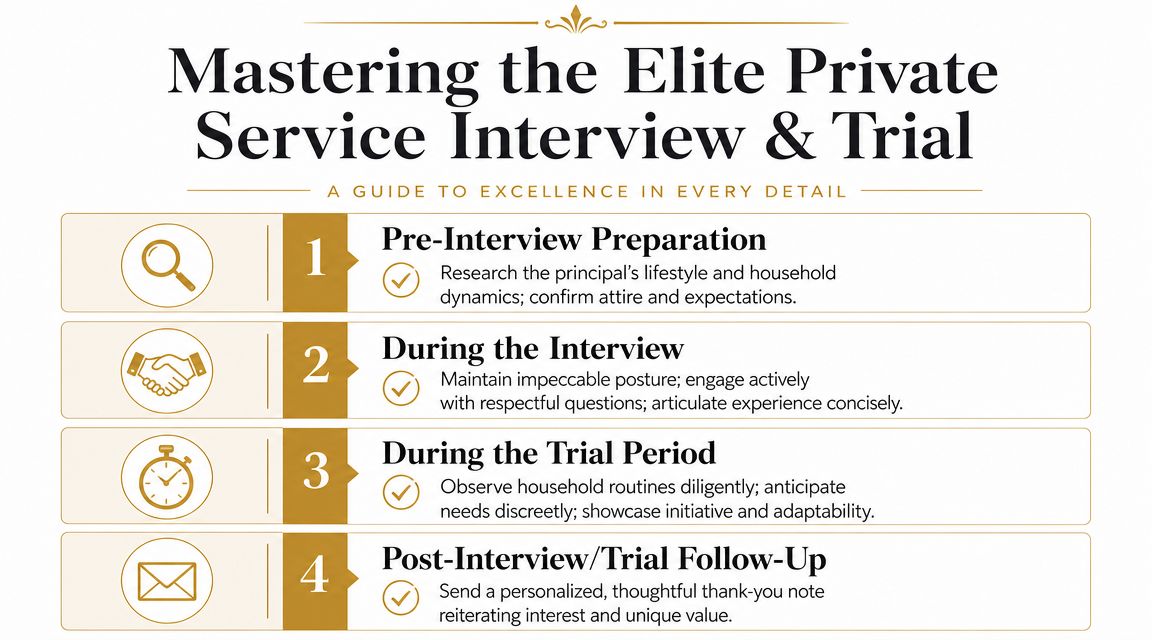
What the interview is really testing
A principal might ask about service standards, difficult schedules, or travelling at short notice. A chief of staff might focus on reporting, boundaries, and how you handle instructions that change midstream. A family office representative may care more about consistency and risk than charm.
The weak candidate answers in generalities. The strong one gives calm, specific examples without oversharing confidential details.
If you're asked how you handle pressure, don't say you “work well under stress”. Explain how you prioritise, who you update, and how you maintain standards when plans move fast.
The structured trial is where decisions are made
In UK hiring practice, the most reliable method is a written role specification followed by a structured trial day. Domestic staff are treated as employees where the household controls the work, and ambiguity in duties can create problems. That's why vague terms like “light housekeeping” are a warning sign. The household hiring mistakes guidance reflects the value of clear duties, independent checks, a written contract, and a trial assessed against actual household procedures.
Here's what that looks like in real life. A nanny on trial may be assessed not only on warmth with children, but on whether she follows the family's handover style, food instructions, privacy habits, and travel readiness. A housekeeper may be tested on product knowledge, laundry handling, pace, and whether they ask sensible questions before touching specialist finishes.
Ask for clarity before the trial starts. Hours, tasks, reporting line, and non-negotiables should be clear enough that you can succeed on purpose.
Trial behaviour that works
During a trial, candidates often fail in one of two ways. They either become too passive and wait to be directed, or they overperform and become intrusive. Neither reads well.
A better approach:
- Observe first and notice how the home runs before trying to improve it
- Confirm standards for wardrobe, nursery, pantry, guest spaces, or service sequence
- Show initiative carefully by solving the obvious, not redesigning the household
- Keep notes mentally or discreetly, not in a way that unsettles the principal
- Stay composed if plans change suddenly, because they often will
The household is watching whether you can slot in smoothly. Competence matters. So does timing.
Navigating Contracts Salary and Global Mobility
A polished offer letter doesn't mean you've got a good deal. In private service, the quality of the contract often tells you more than the headline pay. Candidates who focus only on salary can miss expensive problems hidden in accommodation terms, travel obligations, rest arrangements, or rota wording.
What UK employment status means in practice
In the UK, domestic workers employed in private households sit inside a regulated employment framework. They're treated as employees with rights connected to the National Minimum Wage, paid holiday, and rest breaks, and the National Minimum Wage regime has existed since 1999 with annual updates, as described in this overview of private household employment and labour classification.
That matters because many elite roles don't look like standard office work. Live-in staff, rota nannies, travelling assistants, and short-term placements can all involve unusual patterns. The contract needs to match the reality of the job.
Clauses worth reading twice
Candidates should read these parts slowly:
Hours and schedule
“Flexibility” needs definition. Ask what is routine, what is exceptional, and how extra time is handled.Live-in accommodation
Clarify privacy, guest rules, separate entrance arrangements, meals, and what happens on days off.Travel expectations
Confirm notice periods, destinations, rooming arrangements, downtime, and whether the role is expected to remain active throughout trips.Confidentiality and NDAs
These are common and often reasonable, but they should be clear and proportionate.Termination terms
Notice, probation, payment timing, and return of property all need to be explicit.
UK-specific guidance often misses the practical side of flexible patterns, but it matters. Candidates should understand how live-in, rota, and similar arrangements affect tax treatment and employment rights in this niche, as noted in this discussion of employment compliance in high-net-worth household staffing.
Salary discussions need context
Pay should be benchmarked against role scope, not just title. A “nanny” role that includes frequent international travel, proxy parenting, school liaison, packing, and schedule management isn't the same as a straightforward live-out childcare post. The same goes for a “housekeeper” role that includes service, wardrobe, pet care, and guest turnover.
For role-by-role context, candidates often compare against a specialist private staff salary guide for UHNW families before negotiating.
A small but useful habit is to review adjacent service etiquette too. For example, if travel and chauffeur coordination are part of your remit, understanding client-facing expectations such as this limousine driver gratuity guide can sharpen your judgement around hospitality norms during events and airport movements.
Building Your Long-Term Career in Private Service
The candidates who last in private service think in chapters, not placements. They don't ask only, “Can I get this job?” They ask, “Does this role move me towards greater trust, stronger references, and more valuable scope?”
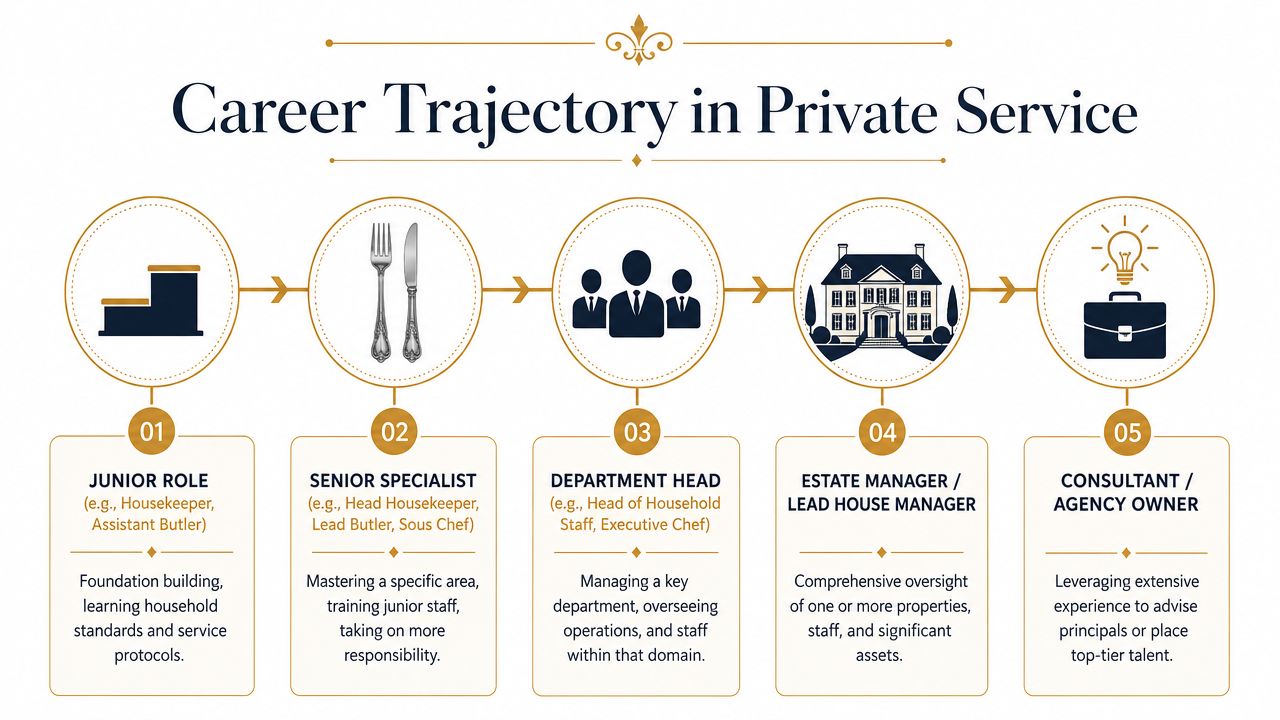
Careers grow through depth, not job hopping alone
A junior housekeeper can become head housekeeper. A nanny can develop into a rota specialist, governess, or household-facing childcare lead. A butler can move into house management. An experienced house manager can step into estate leadership or principal support with broader operational oversight.
Progress usually comes from a mix of three things:
- Technical mastery in your area
- Trustworthiness under pressure and around private information
- Operational maturity so people know you can handle more without drama
The leap to senior roles often happens when a candidate stops acting like task-based labour and starts thinking like a custodian of standards.
Skills that compound over time
Training helps, but not all development is formal. Courses in childcare, hospitality, food safety, household systems, or management can strengthen your profile. So can learning how to brief vendors properly, support travel days, manage handovers, and document routines cleanly.
The most valuable staff member in a private home is rarely the flashiest. It's the one the household doesn't have to worry about.
That's why soft skills carry real weight in this field. Discretion. Restraint. Consistency. Cultural sensitivity. Emotional steadiness. Clear communication. These are the traits that keep people employed when a family's life changes shape.
Protect your reputation like an asset
Leave roles well. Keep references warm. Don't inflate titles. Don't speak carelessly about former principals. Private service is a smaller world than it looks.
A good first placement can open the next door. A poor exit can close several.
Your Partner in a Premier Career
The difference between average and outstanding outcomes in private household staff jobs isn't luck. It's preparation, positioning, and knowing how elite households hire. Candidates who understand role structure, present themselves professionally, handle trials with precision, and read contracts carefully put themselves in a stronger category straight away.
This field can offer remarkable careers, but it rewards people who take the work seriously from the start. If you want access to discreet, high-calibre opportunities, your standards have to be visible long before the offer stage.
Qualified candidates who are ready to approach private service with that level of professionalism should speak to an agency that works in this market every day.
Frequently Asked Questions
What's the difference between a House Manager and an Estate Manager
A House Manager usually oversees the day-to-day running of one residence. An Estate Manager typically operates at a broader level, often across multiple properties, larger teams, projects, maintenance issues, and asset care. The right title depends on scale, reporting line, and how much operational complexity sits behind the home.
How should I respond if a job description seems vague
Ask direct questions early. Clarify duties, hours, travel, reporting line, accommodation, and what success looks like in the first months. Vague phrases often create problems later, especially in roles that mix childcare, housekeeping, service, and personal support.
Are trial days in private household staff jobs normal
Yes. A trial is often one of the clearest ways for both sides to test fit. You should know what tasks will be assessed, who you report to, how long the trial runs, and whether the household has specific procedures you're expected to follow.
How important is discretion compared with technical skill
Both matter, but discretion often decides who gets retained. A highly skilled candidate who talks too much, posts too freely online, or shows poor judgement around private information will struggle in elite homes.
Is on-call availability the same as flexibility
No. Flexibility can mean reasonable changes around agreed duties. On-call availability suggests a deeper expectation of responsiveness. If a role hints at this, get it defined in writing before accepting.
If you're ready to pursue private service with a professional strategy, explore opportunities and guidance through Superstar Nannies.