


Your home may already look polished from the outside, yet still feel operationally messy behind the scenes. School runs clash with travel, suppliers arrive without warning, standards slip when no one owns them, and what should be a private sanctuary starts to feel like an unmanaged business.
That's when families start looking at private household staff agencies UK. Sensibly so. A good agency doesn't just send CVs. It helps you define what support your household needs, what it will really cost, and how to hire without exposing your family to avoidable risk.
If you're also weighing location, lifestyle, and staffing practicality at the same time, it helps to find luxury homes in London with a clear view of how the property itself will shape staffing needs. A lateral flat, a listed townhouse, and a country estate do not require the same household structure. Get that wrong at the property stage and staffing becomes reactive from day one.
Introduction Finding Harmony for Your Home
Most families wait too long to hire properly. They patch together childcare, housekeeping, drivers, ad hoc assistants, and outside contractors, then wonder why the household still feels strained. It feels strained because no one has designed the structure.
That's the true value of private household staff agencies UK. They should bring order, not just people. The right adviser will look at your routines, travel, privacy requirements, family dynamic, guest flow, and property footprint, then work backwards to build a staffing model that fits.
A serious household hire isn't only about capability on paper. It's about whether a candidate can operate discreetly in your environment, respect boundaries, and slot into the rhythms of your home without constant correction. That's why families who care about longevity stop treating household recruitment like ordinary recruitment.
A smooth household is rarely accidental. Someone has specified roles clearly, set standards early, and hired for fit as carefully as for skill.
You don't need more options. You need clarity. Which role comes first. Which tasks should be combined. Which expectations belong in a contract. Which costs sit on top of salary. And which agency understands the difference between a polished candidate and a suitable one.
What a Premier Staffing Agency Really Does
A premier agency acts as part consultant, part gatekeeper, part risk manager. If all you receive is a stack of profiles, you are not getting a premium service. You are outsourcing admin.
The UK market covers a broad range of placements. Industry agency descriptions show roles commonly include house managers, butlers, housekeepers, chauffeurs, estate managers, nannies, and domestic couples across different assignment types, which is why detailed scoping and reference verification matter before any match is made, as outlined by Bespoke Britannia's household staffing overview. The more complex the role, the more dangerous a vague brief becomes.
The work happens before you meet a candidate
A proper agency should pressure-test your assumptions. If you ask for a nanny-housekeeper, it should ask whether that split is realistic in your home. If you want live-in support, it should ask about accommodation quality, privacy, boundaries, and schedule design. If you need rota cover, it should ask whether handovers, travel expectations, and authority lines are clear.
Those questions protect you. They also protect the candidate, which is exactly how stronger placements are made.
For a more detailed view of that consultative process, this guide on what a luxury staffing agency does for discerning families is worth reviewing before you speak with any recruiter.
What separates a specialist from a generic recruiter
Generic recruiters tend to focus on availability. Specialist household agencies focus on compatibility.
They should be assessing things such as:
- Role architecture: Is this one job, or three jobs awkwardly bundled together?
- Household culture: Formal or relaxed. Child-led or structured. Busy and social or highly private.
- Operational reality: Live-in versus live-out, weekend expectations, travel frequency, and backup cover.
- Trust threshold: Exposure to children, valuables, confidential information, guest lists, and private routines.
Practical rule: If an agency can't explain why a candidate fits your household beyond “great experience”, keep looking.
The fee should buy judgement. It should also buy discretion, tighter screening, sharper shortlists, and someone willing to say no when your brief is unrealistic.
Understanding the Spectrum of Private Household Roles
The UK market is far broader than many first-time clients realise. It is concentrated around London and the South of England but also extends into affluent commuter belts and country estates, with agencies regularly recruiting housekeepers, nannies, private chefs, butlers, and estate managers, which points to a mature sector built around integrated staffing solutions rather than one-off hires, as described by Abode Staff.
The strategic roles
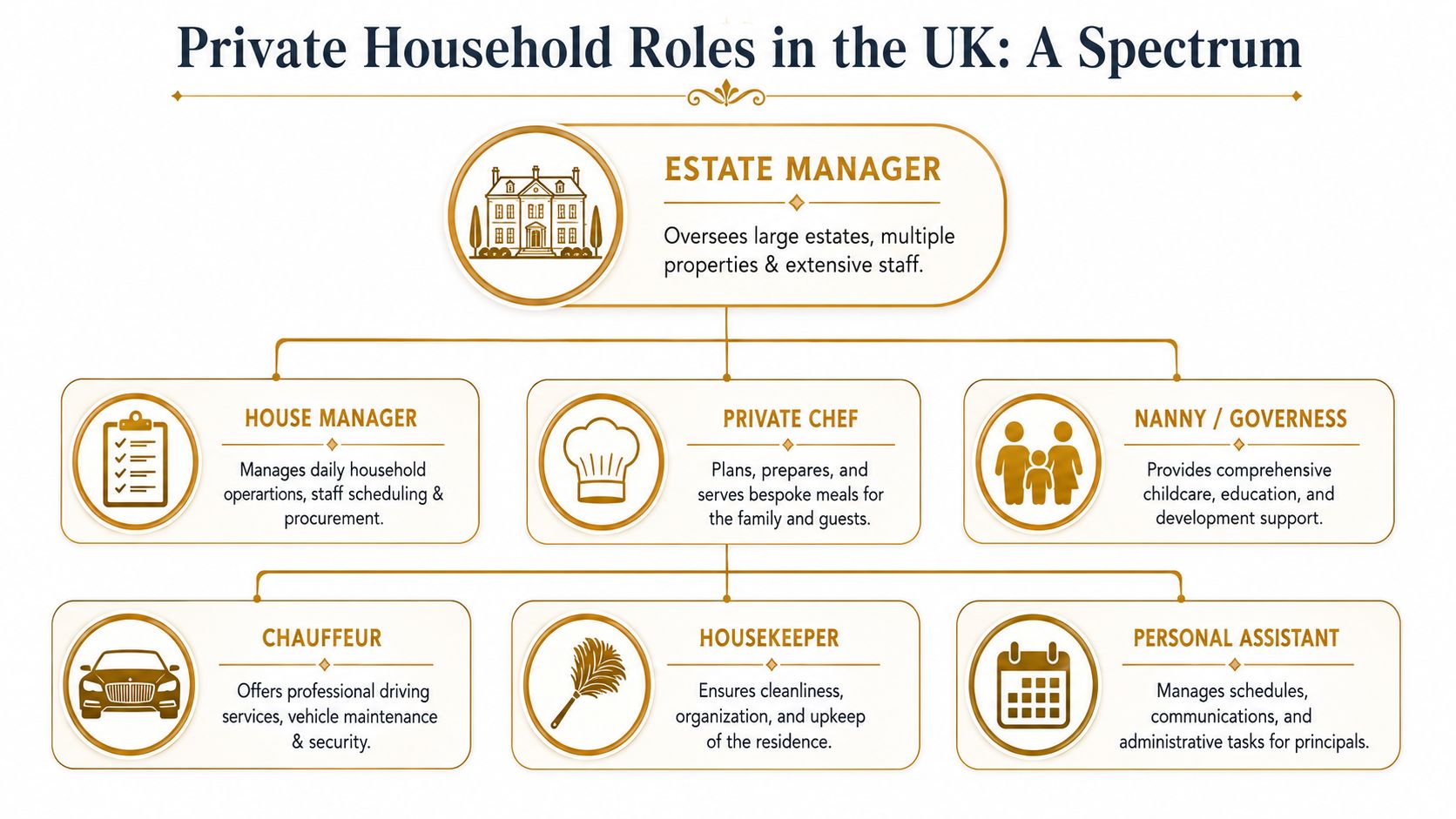
An Estate Manager is for scale. Think multiple properties, external contractors, grounds, security coordination, budgets, and senior staff oversight. If you own or use more than one residence, or run a substantial country property, this role often becomes essential.
A House Manager is more hands-on and day-to-day. This person keeps the residence running, manages diaries linked to household operations, oversees staff rotas, handles provisioning, and ensures standards don't drift.
A Private Chef belongs in homes where nutrition, entertaining, allergies, cultural requirements, or schedule complexity make ordinary meal planning inefficient. This is not just cooking. It's menu design, sourcing, timing, service, and consistency.
The support roles that hold the house together
A polished home relies on disciplined support functions:
- Housekeeper: Maintains cleanliness, laundry, wardrobe care, and household presentation.
- Chauffeur: Handles driving, vehicle care, route planning, discretion, and often an element of personal security awareness.
- Nanny or Governess: Covers childcare, routine, development, educational support, and often travel.
- Personal Assistant: Manages appointments, logistics, correspondence, and personal administration.
Some households also need a Butler, particularly where formal service, entertaining, silver service, guest management, and front-of-house polish matter. Others benefit from a Domestic Couple, especially in secondary residences or country homes where a combined housekeeping and maintenance model is more efficient.
When not to combine roles
Families often try to compress too much into one hire. That's where placements fail.
Use this simple distinction:
| Household need | More suitable role |
|---|---|
| Large property, several suppliers, household team to coordinate | Estate Manager or House Manager |
| Young children with demanding routines and travel | Nanny or rota nanny |
| Formal entertaining and guest service | Butler |
| Ongoing food planning with dietary precision | Private Chef |
| Full property care in a country setting | Domestic Couple |
If your household needs constant childcare, high-standard housekeeping, frequent entertaining, and travel support, one “all-rounder” won't solve it. A layered structure will.
Decoding the True Cost of Hiring Private Staff in the UK
Most families fixate on salary because it's the visible number. That's a mistake. Salary is only the front door.
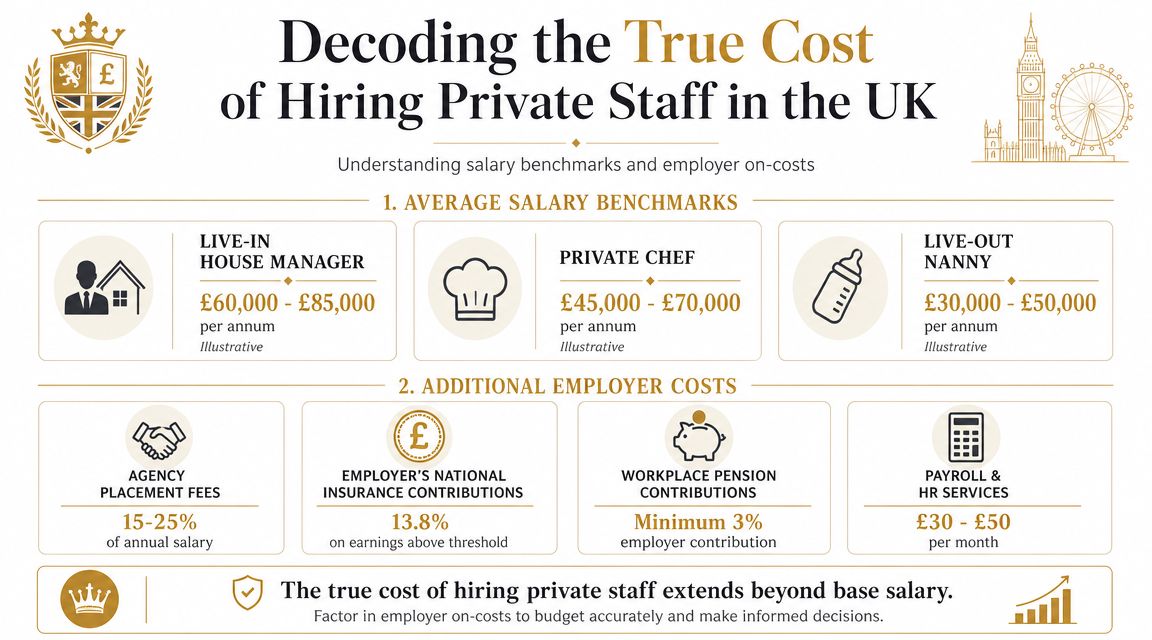
The UK market supports premium compensation for experienced private staff. A domestic staffing guide reports typical London pay bands of about £40,000 to £70,000 for nannies, £30,000 to £50,000 for housekeepers, £50,000 to £100,000+ for private chefs, and £70,000 to £120,000+ for estate managers, according to this UK domestic staffing guide. Those figures tell you something important. You are not hiring casual help. You are hiring trusted operators into highly private environments.
Salary is only one line in the budget
Once you employ staff directly, other obligations follow. The practical conversation should include:
- Payroll administration: Someone must run pay correctly and keep records in order.
- Holiday pay: Time off has to be budgeted and covered operationally.
- Pension auto-enrolment: This sits with the employer, not the agency.
- Sick pay and absence planning: A household still has to function when a key person is off.
- Right-to-work compliance: You need proper checks before employment begins.
If you haven't budgeted for the employment framework around the hire, you haven't budgeted properly.
What smart families do before they hire
They build a cost model around the role, not just the wage. That means deciding whether the role should be live-in or live-out, whether backup support is required, whether travel time changes the shape of the contract, and whether the duties justify one senior person or two narrower hires.
A useful starting point is this private staff salary guide for UHNW families, particularly if you're trying to sense-check title inflation against genuine scope.
The cheapest hire on paper often becomes the most expensive hire in practice. Poor scoping creates turnover, replacement searches, service gaps, and avoidable legal exposure.
My recommendation
Don't ask an agency only, “What is the salary?” Ask these instead:
- What is the realistic total annual employer cost?
- What legal obligations sit on top of employment?
- Will this role need trial days, cover, or overlap with existing staff?
- Is this brief stable enough to support retention?
If the adviser sidesteps those questions, they are selling placement. They are not advising on household employment.
Navigating UK Vetting, Legal, and Tax Requirements
Many households become exposed when they assume the agency handles everything forever. It doesn't. An agency should support the process, but if you employ staff privately, you carry employer responsibilities.
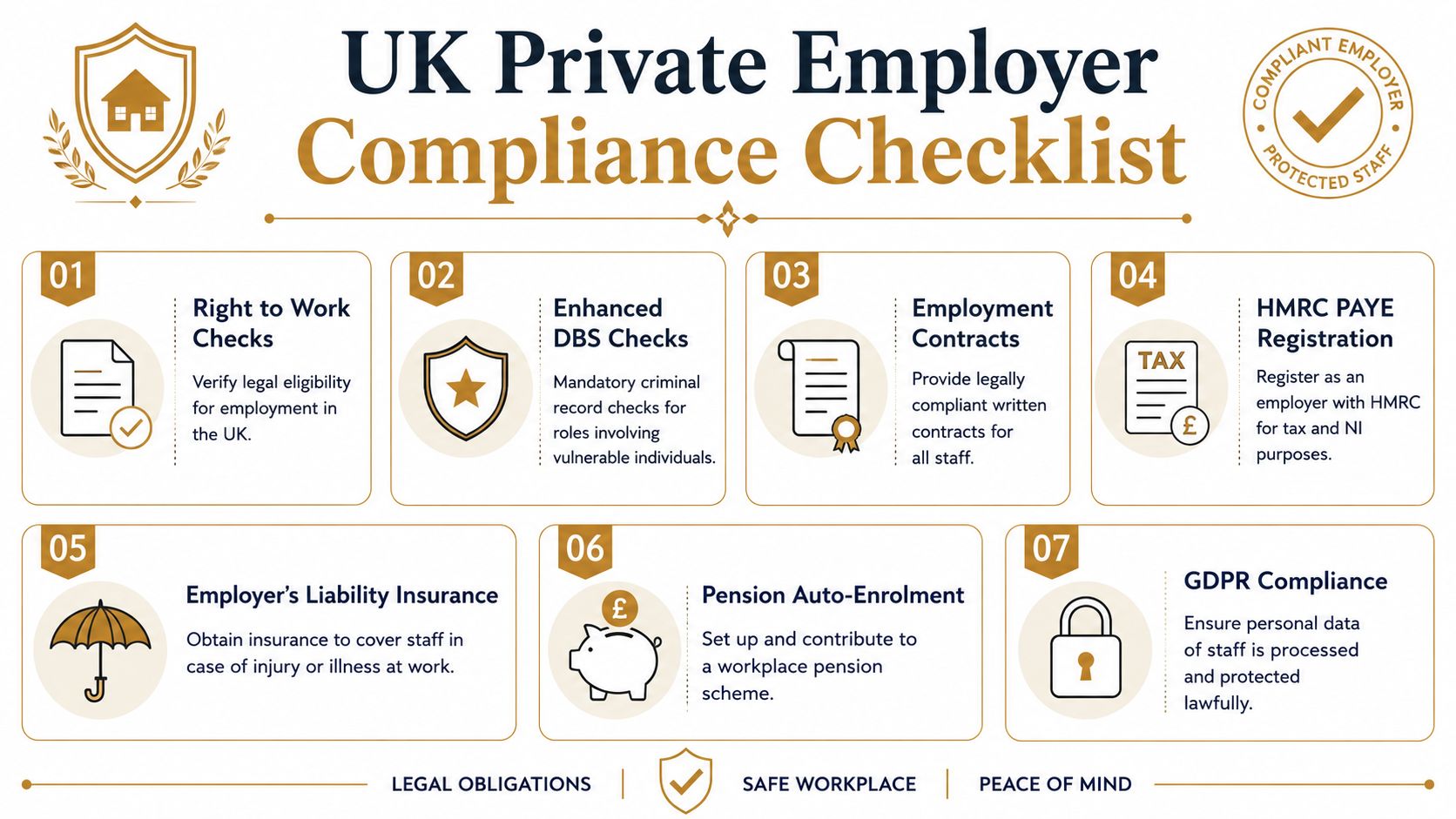
A common gap in UK coverage is the full employer burden around PAYE, National Insurance, holiday pay, pension auto-enrolment, and right-to-work checks. Private household hiring is regulated like other UK employment, and agencies often underplay those responsibilities while focusing on the roles they place, as noted by Achieve Hospitality's private household recruitment guidance.
The checks you should insist on
Before anyone starts in your home, the basics need to be done properly.
- Right to work: Verify legal eligibility to work in the UK.
- Reference verification: Not surface-level references. Real conversations with former employers who can speak to standards, reliability, and conduct.
- Background screening: Especially important where children, vulnerable family members, valuables, or sensitive information are involved.
- Identity confirmation: Names, dates, work history, and documentation should line up cleanly.
For childcare positions, this becomes even more important. If the role includes sole charge of children, school collection, travel, or overnight care, your tolerance for ambiguity should be zero.
Your legal duties as a private employer
Once hired, staff need a proper framework. At minimum, think in terms of contract, payroll, insurance, pension duties, working arrangements, and data handling. Casual arrangements create problems later, especially when expectations change or the role expands.
A written agreement should set out duties, hours, accommodation terms where relevant, confidentiality expectations, holiday arrangements, notice, and any travel obligations. If you need a starting point, this UK nanny contract template for elite households helps frame the right questions even if the final contract is customized for another type of household employee.
Compliance is not a bureaucratic extra. It is what protects your family when a relationship goes wrong, a dispute arises, or circumstances change.
The quiet risks families overlook
Most problems don't begin with dramatic misconduct. They begin with loose administration.
A few examples:
| Risk area | What goes wrong |
|---|---|
| Working hours | Expectations drift beyond what was originally agreed |
| Live-in arrangements | Boundaries become blurred and privacy suffers |
| Pay and leave | Informal handling creates tension and later disputes |
| Role creep | A nanny becomes PA, housekeeper, and travel fixer without revised terms |
| Documentation | Missing checks weaken your position if issues arise |
If you want a discreet household, run it properly. Quiet households usually have strong paperwork.
How to Choose the Right Agency for Your Family
Choosing among private household staff agencies UK isn't about who replies first or who has the glossiest website. It's about who asks the sharpest questions and is willing to challenge a weak brief.

What to ask in the first conversation
If you want a meaningful answer, ask practical questions, not performative ones. “How long have you been established?” matters less than “How do you prevent a mismatch in my type of household?”
This overview of household staff recruitment agencies is a useful comparison point, but you still need to test the adviser in live conversation.
Here is the checklist I'd use.
| Area of Inquiry | Essential Questions to Ask |
|---|---|
| Role definition | How would you structure this role based on my property, family routine, and existing support? |
| Vetting | What checks do you complete yourself, and what remains my responsibility as employer? |
| Candidate quality | Are these candidates career private staff, or people crossing over from unrelated sectors? |
| Confidentiality | How do you protect our identity, address, routines, and personal information during the search? |
| Assignment type | Have you handled live-in, rota, travel-heavy, or multi-property roles like this before? |
| Fees and terms | What exactly is covered in your fee, and what happens if the placement doesn't work? |
| Search process | How many candidates do you typically present, and how do you shortlist them? |
| Post-placement support | Do you help with offer structure, onboarding, and settling-in issues after the start date? |
The signals that matter
A serious agency will speak clearly about mismatch risk, role clarity, and employer responsibility. It won't promise perfection. It will explain process.
Watch for these signs:
- They push back intelligently: Good. You want judgement.
- They understand household dynamics: Better than merely understanding recruitment.
- They talk about retention: Short-term placement thinking is expensive.
- They respect discretion: Loose talk during the search phase is a bad sign.
If an agency rushes to send profiles before it understands your home, it is working for speed, not fit.
One option in this space is Superstar Nannies, which handles nanny and wider private household staffing for UK and international families. What matters most, however, is not the brand name. It's whether the consultant in front of you can translate your lifestyle into a workable staffing plan.
Conclusion Your Partner in Building a Harmonious Home
The process usually starts with one uncomfortable truth. The household isn't running as smoothly as it should. Then comes the brief, the role design, the search, interviews, checks, contract, and onboarding. By the first day, the strongest placements already feel structured because the groundwork was done properly.
That's why private household staff agencies UK matter. The right one helps you define the role, budget realistically, hire compliantly, and bring someone into your home who can add calm rather than friction. If you want a discreet conversation about what your household specifically needs, contact Superstar Nannies for a confidential consultation.
Frequently Asked Questions
Do private household staff agencies in the UK only place nannies?
No. The UK private staffing market covers a much wider range of roles. Depending on the household, agencies may recruit housekeepers, chauffeurs, private chefs, butlers, house managers, estate managers, maternity nurses, and domestic couples. If your home has operational complexity, you may need a staffing structure, not a single hire.
Is live-in always better than live-out?
No. Live-in works well when hours are irregular, travel is frequent, or location makes commuting impractical. It works badly when the accommodation is poor, boundaries are unclear, or the family expects constant availability. Live-out often suits urban households with defined schedules and strong daily routines.
What's the difference between a House Manager and an Estate Manager?
A House Manager focuses on the day-to-day running of a residence. An Estate Manager sits at a more senior operational level and is usually better suited to larger properties, multiple residences, external contractors, broader staffing oversight, and estate-wide logistics. If you own several homes or run a country estate, the distinction matters.
Can one person cover childcare and household management?
Sometimes, but usually only in smaller homes with a limited scope. Families often underestimate how quickly a combined role becomes overloaded. If childcare is high-touch and the property also requires strong operational management, splitting the brief produces better standards and stronger retention.
Do agencies help after the candidate starts?
The better ones do. Early support may include help with offer terms, start-date planning, trial feedback, onboarding expectations, and resolving small issues before they become larger ones. Post-placement support is especially useful when the role is senior, live-in, rota-based, or tied to children and travel.
If you're weighing private household staffing decisions and want clear advice on role design, hiring risk, and household fit, speak with Superstar Nannies. A confidential consultation can help you define the right structure before you commit to the wrong hire.