

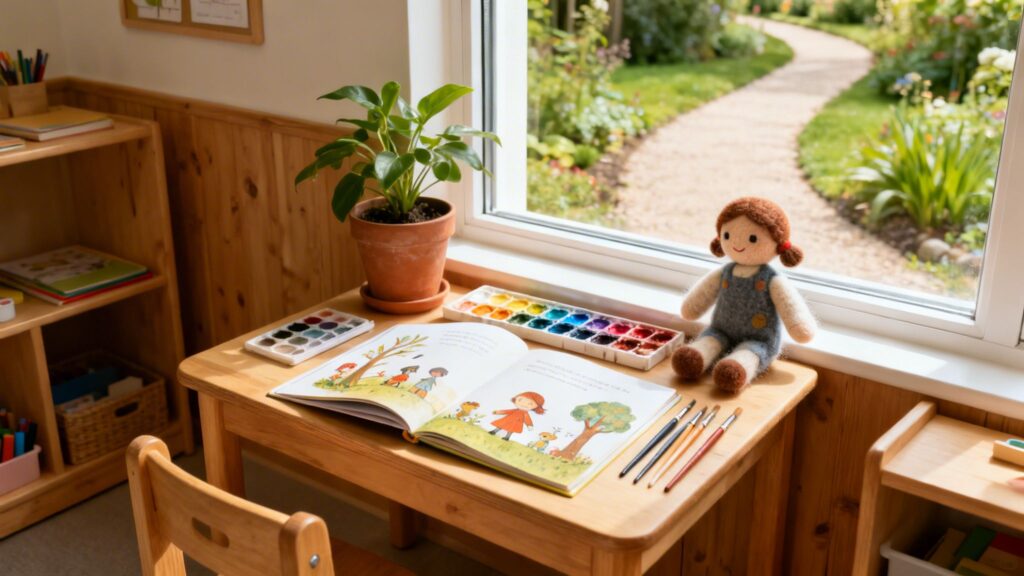
To understand what is Waldorf education, it helps to picture a garden rather than a factory. This unique philosophy sees a child not as a vessel to be filled with facts, but as a seed to be nurtured—mind, body, and spirit. It’s an approach that values the whole child, often described as educating the ‘head, heart, and hands.’ As parents and nannies seek educational paths that honor a child's natural development, understanding the Waldorf method is more important than ever.
Understanding the Heart of Waldorf Education
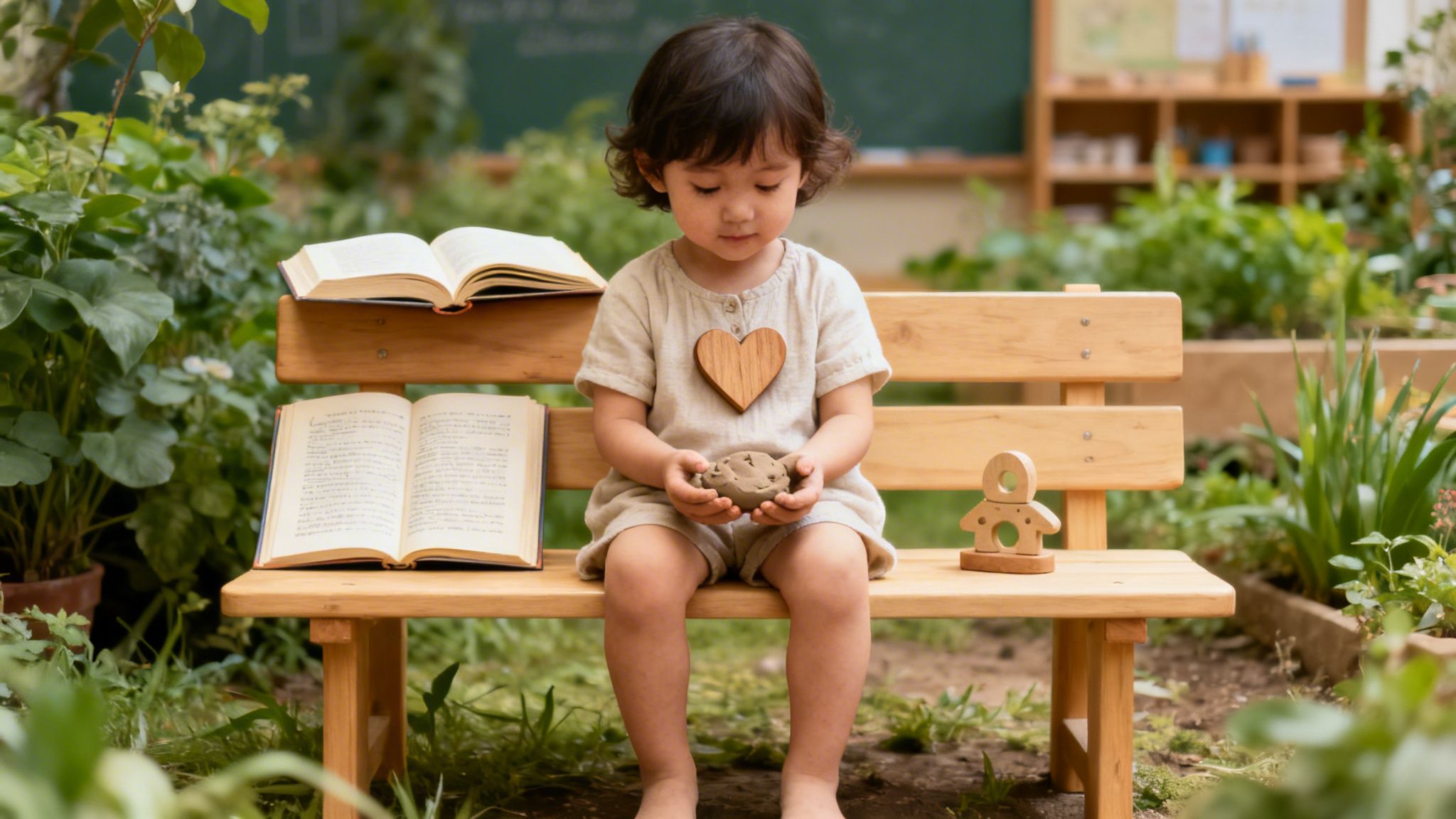
At its core, Waldorf education is a deeply considered response to how children actually grow and learn. Founded by the Austrian philosopher Rudolf Steiner in the early 20th century, its central idea is that education should harmonize with the natural stages of child development, not rush them. This stands in stark contrast to many conventional models that prioritize early, measurable academics.
Instead of rote learning and standardised testing, a Waldorf classroom is an unhurried, art-infused space where learning is an imaginative journey. Subjects come alive through storytelling, music, art, and purposeful movement, making every lesson meaningful. To really see what makes it unique, it’s worth comparing it to other leading philosophies of early childhood education to understand its distinct rhythm and priorities.
The approach is designed to achieve a few key things for the child:
- Cultivate Imagination: Creativity isn’t just an art class; it’s the primary tool for learning. It’s about fostering flexible, inventive thinking through rich, imaginative play.
- Nurture Emotional Intelligence: Children develop empathy and resilience within a close-knit, supportive group, learning to navigate their social world with grace.
- Build Practical Skills: It grounds children in the real world. Activities like baking, gardening, knitting, and woodworking connect learning to tangible, useful outcomes.
Everything is centred on a predictable daily, weekly, and seasonal rhythm. This rhythm acts as a comforting anchor, giving children a deep sense of security and stability. The environment itself is part of the curriculum, with an emphasis on natural materials and a strong connection to nature that stimulates the senses without overwhelming them. We explore this further in our article on the importance of early childhood education.
The goal isn’t simply to produce great students, but to raise great human beings. Waldorf education seeks to cultivate curious, compassionate, and self-reliant individuals who carry a genuine love of learning into adulthood, ready to meet the world with confidence and a clear sense of purpose.
In this guide, we’ll explore how these beautiful ideals translate into practice, from the core principles to how you can weave its gentle, effective methods into your own home.
The Three Pillars of the Waldorf Philosophy
If you want to understand Waldorf education, you really only need to remember three words: head, heart, and hands. This isn't just a catchy phrase; it’s the very foundation of the philosophy, a beautifully integrated model for nurturing the whole child.
This approach ensures that learning is never a purely abstract or intellectual exercise. Instead, it’s always deeply connected to a child’s emotional life (the heart) and their ability to engage with the world in a practical way (the hands). Let’s look at how each pillar works to build a balanced and capable young person.
The Head: Engaging the Thinking Mind
This is all about nurturing a child’s thinking mind and their capacity for clear, independent thought. But in a Waldorf environment, this doesn't start with worksheets or rote memorisation. The real aim is to spark a child's innate curiosity and lay the groundwork for a genuine, lifelong love of learning.
This intellectual journey is lit by rich, imaginative content. History and science aren’t taught from dry textbooks; they come alive through vivid storytelling, myths, and legends that resonate with a child's imagination. Even mathematics is introduced artistically, often through rhythmic movement or drawing beautiful geometric forms, making abstract concepts feel tangible and engaging.
Formal reading and writing are intentionally introduced later, typically around age seven. The thinking behind this is to wait until children are developmentally ready to grasp these abstract symbols with genuine enthusiasm, not out of a sense of pressure. This patient approach cultivates a rich inner life first, preparing the mind to tackle complex ideas with real depth and interest later on.
The Heart: Cultivating Emotional Intelligence
The ‘heart’ pillar is dedicated to fostering a child's emotional and social world. It’s about developing empathy, a sense of community, and a rich inner life of feeling. This is where a child learns how to connect meaningfully with others and discover their place in the world.
In a Waldorf classroom, cultivating a child’s capacity for feeling is considered just as important as developing their intellect. The arts are not extracurricular; they are central to the entire curriculum.
Activities that nourish the heart are woven into the daily rhythm:
- Music and Singing: Group singing is a daily practice, creating a shared experience that builds unity and encourages emotional expression.
- Painting and Drawing: Using watercolours and other natural materials, children explore colour and form, learning to express their inner world in a non-verbal, intuitive way.
- Drama and Eurythmy: Through class plays and the art of eurythmy (a form of artistic movement unique to Waldorf), children learn to work collaboratively, listen to one another, and develop profound social awareness.
These artistic and group-oriented experiences are fundamental for building strong social bonds and a deep sense of empathy. This focus on emotional intelligence is a cornerstone of what is Waldorf education.
The Hands: Building Will and Practical Skill
The ‘hands’ represent the vital importance of practical, purposeful work. This is the realm of ‘doing,’ where children learn to engage with the physical world, solve real problems, and see the tangible results of their efforts. It’s through this hands-on work that they develop willpower, perseverance, and a grounded sense of their own competence.
Engaging the hands is about making learning real and meaningful.
- Handwork: Activities like knitting, crocheting, and sewing are much more than crafts. They develop fine motor skills, focus, and the ability to see a complex process through from beginning to end.
- Gardening and Cooking: Planting a seed and watching it grow or baking a loaf of bread connects children directly to nature's cycles and teaches them about transformation and nourishment.
- Woodworking: Shaping wood with real tools builds physical strength, spatial awareness, and a deep respect for natural materials.
By actively creating things that are both useful and beautiful, children learn that their actions can have a meaningful impact on the world. This practical work grounds their intellectual and emotional development, building a powerful sense of purpose that stays with them for life.
The Three Pillars of Waldorf Education at a Glance
To bring it all together, this table shows how the "Head, Heart, and Hands" philosophy translates into concrete practices and developmental aims within a Waldorf setting.
| Pillar | Focus Area | Classroom Activities | Core Developmental Goal |
|---|---|---|---|
| Head | Intellectual Development (Thinking) | Storytelling, mythology, nature observation, artistic presentation of academic concepts (e.g., geometry through drawing). | To cultivate curiosity, clear thinking, and a lifelong love of learning. |
| Heart | Emotional Intelligence (Feeling) | Watercolour painting, group singing, music, plays, Eurythmy (artistic movement), celebrating seasonal festivals. | To nurture empathy, social harmony, and a rich inner emotional life. |
| Hands | Practical Skill (Willing) | Knitting, sewing, woodworking, gardening, cooking, building, and other forms of handwork. | To develop willpower, perseverance, and a sense of purpose and competence. |
As you can see, each pillar supports the others. The thinking mind is enlivened by the arts, and the practical work of the hands provides a real-world context for what is learned, creating a truly holistic educational experience.
How the Waldorf Journey Unfolds Through Childhood
Waldorf education isn’t a fixed, rigid system. It’s better thought of as a living curriculum that adapts beautifully to the different stages of growing up. The entire approach is built around three distinct seven-year cycles, a framework designed to introduce concepts and skills only when a child is developmentally ready to truly grasp them.
This patient, deliberate pacing respects the natural way a child's abilities unfold. The journey moves from a world of imitation and play, through a phase of artistic feeling and imagination, and finally arrives at intellectual clarity and sound judgement. By meeting children exactly where they are at each stage, the Waldorf approach nurtures their potential at just the right time.
The Early Years: Ages 0 to 7
From birth to around age seven, the Waldorf environment is deliberately gentle, warm, and protective—almost dreamlike. The kindergarten classroom is designed to feel less like a school and more like a secure, loving home. Here, learning happens almost entirely through imitation and imaginative free play.
In these early years, a child’s natural impulse is to explore and engage with the world through doing. For a deeper look at how this works in practice, this guide to what is play-based learning is an excellent resource for parents.
You won't find plastic or electronic toys. Instead, children are surrounded by simple, natural materials like wood, silk, and wool that engage their senses without overwhelming them. The cornerstone of the day is a strong, predictable rhythm—a comforting pattern for daily, weekly, and seasonal activities that gives children the security they need for their imaginations to truly flourish. A typical day might include:
- Free, imaginative play with open-ended toys.
- Artistic activities like watercolour painting or drawing with soft beeswax crayons.
- Practical, real-world tasks such as baking bread, tending a garden, or tidying up.
- Rich oral storytelling, puppet shows, and circle time filled with songs and verses.
You’ll notice a distinct lack of formal academic instruction. This is by design. The focus is on building a strong physical body, a vibrant imagination, and the social and motor skills that are the bedrock for all future learning. This period is dedicated to helping a child feel, deep in their being, that the world is good. This rich environment of stories and songs also provides the perfect foundation for the key child language development stages.
The diagram below shows how the core Waldorf pillars—Head, Heart, and Hands—are woven into this journey from the very beginning.
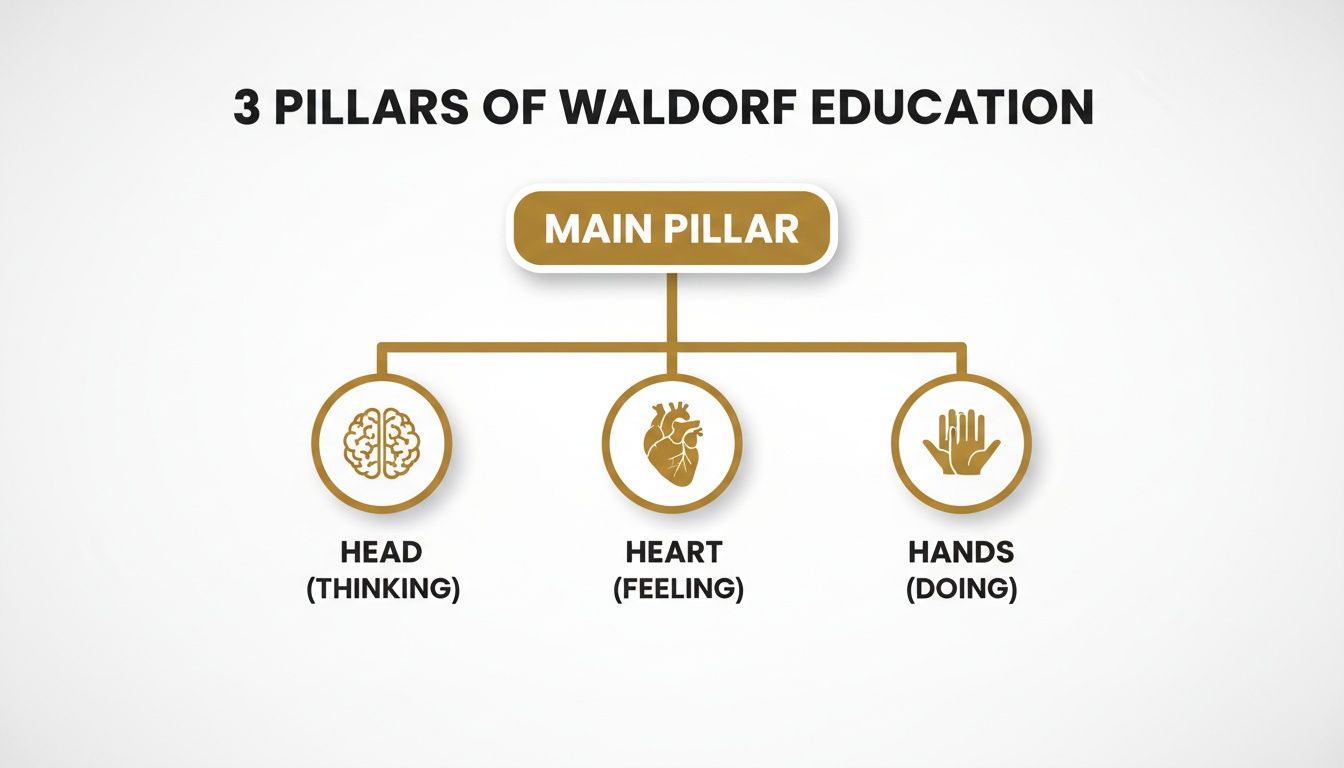
It’s never about separating thinking, feeling, and doing. Instead, they are integrated at every stage to create a truly holistic experience for the child.
The Middle Years: Ages 7 to 14
Something shifts around age seven. Children begin to see themselves as more distinct from their surroundings, and it’s at this moment that formal learning begins. The focus now moves to the ‘heart’ as the primary gateway for learning, with the curriculum delivered through artistry and imagination.
In these middle years, subjects are brought to life through epic stories, mythology, painting, music, and drama. The goal is to engage the child’s feeling life, helping them experience the world as a place of profound beauty and wonder.
A hallmark of this phase is the Class Teacher, who, in an ideal setting, stays with the same group of children from Class 1 right through to Class 8. This fosters an incredible bond of trust and gives the teacher a deep, nuanced understanding of each child. Academics are always taught artistically; rather than just using textbooks, students create their own beautifully illustrated ‘main lesson books’ for each subject.
The Upper Years: Ages 14 to 21
As children move into adolescence, their capacity for abstract thought and critical judgement blossoms. The curriculum evolves with them, challenging them to think for themselves, analyse complex ideas, and form their own well-reasoned opinions.
The educational focus shifts towards specialisation, with expert teachers for different subjects. Students dive into history, advanced sciences, world literature, and higher mathematics with a new level of intellectual rigour. Ultimately, the goal is to help each young adult discover their unique purpose and develop a strong sense of social responsibility. They are empowered to see that the world is true and that they have a meaningful part to play in it.
The Story of Waldorf Education in the UK
To really get a feel for Waldorf education today, it helps to look back at its journey in the United Kingdom. It’s a story with humble beginnings, some serious growing pains, and a remarkable period of renewal. For families considering this unique path, understanding this history is not just interesting—it builds confidence by showing how the movement has adapted and strengthened over time.
The Waldorf story in the UK isn’t a simple, straight line. It's one of quiet, steady growth followed by a challenging chapter that ultimately forced a deep and positive transformation. This evolution is key to understanding the high standards that define the movement today.
From Small Beginnings to National Growth
The first seeds of the Waldorf movement were sown in Britain nearly a century ago. It all started when the very first school, originally called the New School (and later renamed Michael Hall), opened its doors in London in 1925. A group of pioneering teachers, inspired by Rudolf Steiner’s own lectures in the country, decided to bring his vision to life. This one school was the start of a quiet but determined expansion, usually driven by parents and educators who were looking for something more holistic.
Over the following decades, that single school sparked a nationwide movement. By 2015, there were 33 independent Steiner Waldorf schools of all shapes and sizes across the UK. To create a sense of shared purpose and offer support, the Steiner Waldorf Schools Fellowship (which we now know as Waldorf UK) was officially formed back in 1953.
A significant moment came in 2008 when the first state-funded Steiner Academy opened in Herefordshire, as part of the government’s academies programme. Three more followed between 2014 and 2016 in Exeter, Frome, and Bristol. This was a clear sign that the Waldorf approach—with its emphasis on art, imagination, and hands-on skills—was gaining mainstream attention.
A Period of Challenge and Transformation
But this period of growth hit a wall. Around 2018 and 2019, a series of Ofsted inspections uncovered serious problems in a number of schools. The reports were stark, revealing that some institutions were failing to meet the government's minimum standards for safety, education, and care.
This was a genuine crisis for the UK Waldorf community. It was a wake-up call that prompted a period of intense soul-searching and a commitment to root-and-branch change. A revitalised Waldorf UK led the charge, realising this wasn't about small tweaks but about fundamentally rebuilding trust and accountability.
This difficult chapter, though painful, ultimately strengthened the movement. It cleared the way for a new era of transparency, accountability, and educational quality that defines Waldorf education in the UK today.
Since then, Waldorf UK has rolled out a complete overhaul to ensure every school operates to the highest standards. The changes were far-reaching, touching on nearly every aspect of how the schools were run.
Some of the key reforms included:
- New Leadership and Governance: New, transparent leadership structures were put in place to guarantee proper oversight.
- Updated Curriculum Frameworks: The curriculum was modernised, and new ways of assessing pupil progress were brought in.
- Enhanced Teacher Training: A huge investment was made in teacher development, including a nationwide phonics programme and a partnership with the US-based Math for Love to improve maths teaching.
- Modern Tools and Practices: Teachers were given new digital planning tools, and extensive training was provided in areas like trauma-informed practice.
A Resurgence Built on High Standards
The results of all this hard work speak for themselves. Ofsted reports from June 2021 onwards have shown a dramatic turnaround. Inspectors now consistently highlight the warm, respectful relationships in schools, the high aspirations for pupils, and the quality of the teaching. You can find more detail about this important history on the Waldorf UK website.
For discerning families and the childcare professionals at agencies like Superstar Nannies, this story of transformation is crucial. It demonstrates that Waldorf education in the UK didn't just survive its challenges—it emerged stronger, more accountable, and better prepared than ever. It now stands as a reliable, high-quality choice for families seeking a nurturing and creative environment for their children.
Waldorf vs. Montessori: A Practical Comparison for Parents
As parents explore alternatives to mainstream education, two names almost always come up: Waldorf and Montessori. Both are highly respected, child-centred philosophies, but they take remarkably different routes to get there. Knowing the core distinctions is the first step in deciding which environment might be a better fit for your child and your family.
While both champion hands-on learning, the real difference comes down to their views on imagination and structure. One path is built on the power of make-believe and artistic expression, while the other is firmly grounded in the tangible, practical world. Neither is better, they simply speak to different kinds of learners.
Imagination vs. Reality
Perhaps the biggest philosophical split between the two is the role of imagination. In a Waldorf school, fantasy is the very heart of early learning. You’ll find classrooms filled with fairy tales, beautiful handmade puppets, and simple, open-ended toys made from natural materials. The goal is to nurture a child's rich inner world and creative spirit.
Montessori, on the other hand, is rooted in reality. Dr Maria Montessori observed that young children are intensely focused on making sense of the world they can see and touch. So, learning materials are practical and based in reality. A child won’t just play with a toy kitchen; they’ll learn to prepare a real snack. They won't pretend to sweep; they’ll use a child-sized broom to actually clean up.
The Waldorf approach believes that a strong foundation in fantasy prepares a child for abstract thought later on. The Montessori philosophy holds that mastering reality first gives a child confidence and independence.
Teacher-Guided vs. Child-Led Learning
The daily flow of the classroom also looks quite different. A Waldorf classroom is very much teacher-guided. The day follows a predictable, gentle rhythm of artistic work, storytelling, music, and practical tasks, with everyone participating as a group. The teacher leads the children as a cohesive whole, building a strong sense of community.
Conversely, a Montessori classroom is famously child-led. Children have the freedom to choose their own activities, or 'work', from a meticulously prepared environment. They can then focus on that task, uninterrupted, for as long as they wish. The teacher is more of a guide on the side, observing and introducing new concepts when a child shows readiness. This fosters incredible independence and self-direction. For families interested in other child-led philosophies, our guide on the Reggio Emilia approach offers further insight.
To make these contrasts even clearer, here is a side-by-side look at their core philosophies.
Waldorf vs. Montessori Key Philosophical Differences
| Aspect | Waldorf Education | Montessori Education |
|---|---|---|
| Core Philosophy | Nurturing the ‘head, heart, and hands’ through imagination, art, and rhythm. | Fostering independence and self-discipline through self-directed, reality-based work. |
| Learning Style | Teacher-guided, group-oriented, and artistic. Learning happens through storytelling, music, and collaborative projects. | Child-led, individualised, and self-correcting. Children choose their own work and learn at their own pace. |
| Role of Imagination | Central and celebrated. Fantasy and fairy tales are seen as essential for cognitive and emotional development. | Grounded in reality. The focus is on practical life skills and tangible, real-world tasks. |
| Approach to Academics | Deliberately delayed. Formal reading and writing begin around age seven to align with developmental readiness. | Introduced early. Children often learn to read, write, and understand maths concepts from age three. |
| Social Structure | Emphasis on community and the whole class working together. This fosters strong social bonds and collaboration. | Emphasis on individual work and concentration. This fosters independence, focus, and self-reliance. |
Ultimately, the choice between Waldorf and Montessori comes down to knowing your own child and what makes them tick. A child who lives in their imagination and loves collaborative projects might feel right at home in a Waldorf setting. Another child who is fiercely independent and loves to figure things out for themselves might just flourish in a Montessori environment. By understanding their fundamental differences, you're much better equipped to make a decision that truly honours your child’s unique spirit.
Bringing Waldorf Principles into Your Home
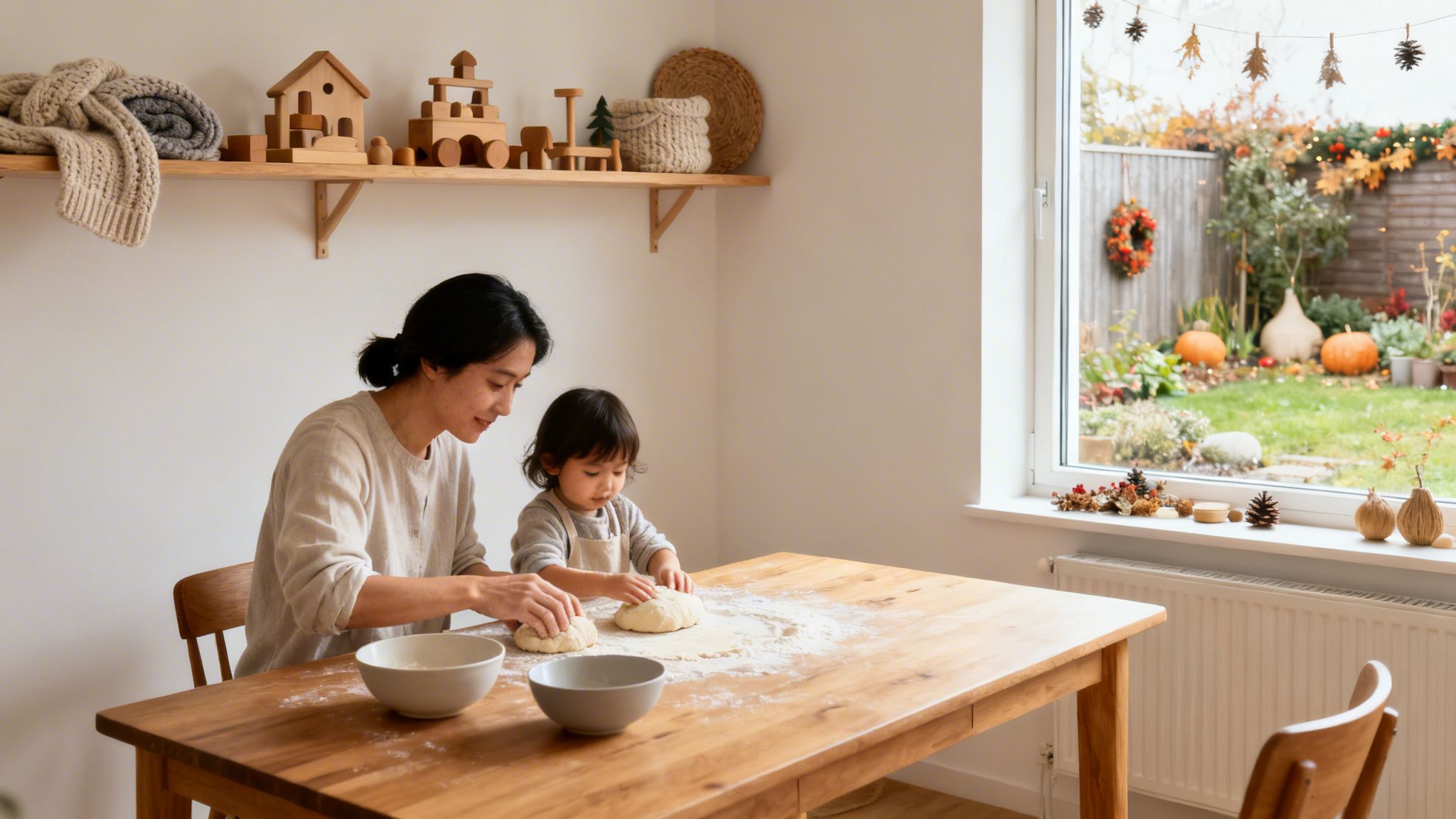
You don’t have to enrol your child in a Waldorf school to embrace its gentle, nurturing philosophy. In fact, weaving its core ideas into your home life can create a wonderfully consistent and supportive environment, whether you’re going all-in or simply complementing another form of education. For parents and nannies, the secret lies in focusing on three key areas: rhythm, imagination, and connection.
At its heart, bringing the Waldorf spirit home is about creating a predictable and soothing atmosphere. This isn't about enforcing a rigid timetable; it's about cultivating a gentle, flowing structure that anchors your child’s day, letting them feel secure enough to truly explore and grow.
Establish Soothing Rhythms and Routines
Rhythm is the very heartbeat of a Waldorf-inspired home. When children can anticipate the patterns of their day—for meals, play, and rest—they feel safe. This sense of security reduces anxiety and frees up their energy for what really matters: creativity and learning.
A weekly rhythm can be especially powerful. By assigning a gentle theme to each day, you create comforting reference points that help a child make sense of their week.
For example, your week could flow with activities like:
- A baking day: Kneading dough is a fantastic sensory experience and a brilliant way to develop fine motor skills.
- A painting day: Simple watercolours allow for a beautiful exploration of colour and emotion without pressure.
- A gardening day: Even a small window box connects children to nature’s cycles and teaches gentle responsibility.
- A mending day: Involving children in simple, purposeful tasks like polishing shoes or sorting laundry gives them a real sense of contribution.
The goal isn't perfection. It's about the shared, meaningful experience that builds a deep sense of security and belonging.
Foster Deep and Imaginative Play
One of the most beautiful aspects of the Waldorf philosophy is its profound trust in a child's imagination. To really let it flourish, consider swapping out the loud, branded plastic toys for simple, open-ended playthings made from natural materials.
Look for things like:
- Wooden blocks and simple animal figures.
- Silk cloths in a rainbow of colours (playsilks).
- Treasures from nature like pinecones, shells, and smooth stones.
- Simple, handmade dolls with neutral expressions.
These kinds of toys don't come with a pre-written story; they are an invitation for the child to create their own. A blue silk can become a rushing river, a superhero's cape, or a queen's veil, all in the space of an afternoon. This is the kind of play that builds true creativity and problem-solving skills. For more ideas on how to engage children in this way, you might find our guide to activities in nurseries helpful.
Connect with Nature Daily
A deep, abiding connection to the natural world is fundamental to the Waldorf approach. Try to make outdoor time a non-negotiable part of your daily rhythm, whatever the weather. It doesn’t need to be an epic adventure; a simple walk to collect leaves, watch the clouds, or feel the rain provides a powerful sensory experience that simply can't be replicated indoors.
In a Waldorf-inspired home, nature isn't a special occasion; it's a daily companion. This connection grounds children and teaches them to observe and appreciate the world around them.
Celebrate the turning of the seasons. Go on walks to spot the first buds of spring, collect conkers in autumn, or create a simple nature table in a corner of your home. These small rituals help children feel connected to the larger, life-affirming rhythms of the world.
Mindfully Limit Media Exposure
A cornerstone of Waldorf education, particularly in the early years, is the conscious limitation of screen time. The philosophy holds that digital media can get in the way of imaginative play and genuine social connection. Modern research increasingly shows that a "phone-based childhood" can contribute to attention fragmentation and social anxiety.
Instead, fill your home with opportunities for real-world engagement: storytelling, singing, drawing, and simply being together. This isn't about banning technology forever, but about introducing it thoughtfully when children are older and can use it as a tool rather than a distraction. By creating a low-tech, high-connection environment, you are giving your child the gift of focus, creativity, and strong family bonds.
Conclusion: Is Waldorf Right for Your Family?
Understanding what is Waldorf education is the first step toward deciding if its gentle, holistic, and creative approach is the right fit for your child. By focusing on the whole person—head, heart, and hands—this philosophy nurtures not just academic skills, but also emotional intelligence, practical abilities, and a deep love of learning. From its emphasis on imaginative play to its grounding in nature and rhythm, Waldorf offers a powerful alternative to conventional schooling.
At Superstar Nannies, we believe every child deserves care and education that aligns with their family’s values. Our nannies and governesses are well-versed in a range of philosophies, including Waldorf, and are ready to support your child’s whole development. Discover how we can find the perfect match for your household.
FAQs About Waldorf Education
1. Is Waldorf education right for every child?
No single method is perfect for every child. Waldorf education is often a wonderful fit for children who thrive in a predictable, gentle, and artistically rich environment. Its predictable rhythm can be especially grounding for children with more sensitive or anxious natures. However, a child who thrives on fast-paced academic competition might find the unhurried pace frustrating. The best way to know is to visit a classroom and observe.
2. Why does Waldorf delay formal reading and writing?
Waldorf education delays formal literacy until around age seven, not to hold children back, but to build a stronger foundation for lifelong learning. The early years focus on developing imagination, motor skills, and rich oral language through stories and song. By waiting until a child is developmentally ready for abstract symbols, the goal is to cultivate a genuine, lasting love for reading rather than treating it as a chore.
3. How do Waldorf graduates perform in university and beyond?
Studies and anecdotal evidence show that Waldorf graduates perform exceptionally well in higher education and their careers. The curriculum is designed to foster creativity, self-motivation, and powerful critical-thinking skills. By the time they reach university, graduates are often noted for their intellectual curiosity, resilience, and ability to tackle problems from unique angles, leading to success in a wide variety of fields.
4. Is Waldorf education a religious-based schooling?
Waldorf education is not tied to any specific religion, but it is spiritually-based. It was founded on Rudolf Steiner’s philosophy of Anthroposophy, which views human beings as having a body, soul, and spirit. In practice, this translates to a curriculum that nurtures reverence for the beauty of nature and the human experience through seasonal festivals, stories, and art, but it does not teach religious doctrine.
5. What is the role of technology in a Waldorf school?
Waldorf schools consciously limit or exclude screen-based technology, especially in the early grades. The philosophy prioritizes hands-on, real-world experiences and direct human interaction for healthy development. The belief is that technology is a tool that should be introduced when children are older and can use it consciously and purposefully, rather than letting it interfere with imaginative play and social development during formative years.