


If you are inviting a private tutor into your home to work one-to-one with your child, basic reassurance is not enough. A recommendation from another parent, a polished profile, or an impressive CV does not confirm that the individual has been properly identified, that qualifications are genuine, or that support will be available if the arrangement breaks down.
That is the value of a home tutor agency. A reputable agency does far more than present available tutors. It adds an essential layer of safeguarding, verification, and continuity between the family and a child-facing appointment in the home. In the UK, private tutors are not legally required to hold a teaching qualification or a DBS check, so the strength of the agency's process matters significantly. Prospects explains the position on tutor qualifications and DBS checks, while official safeguarding guidance makes clear that practical checking responsibilities sit squarely with families and tuition providers.
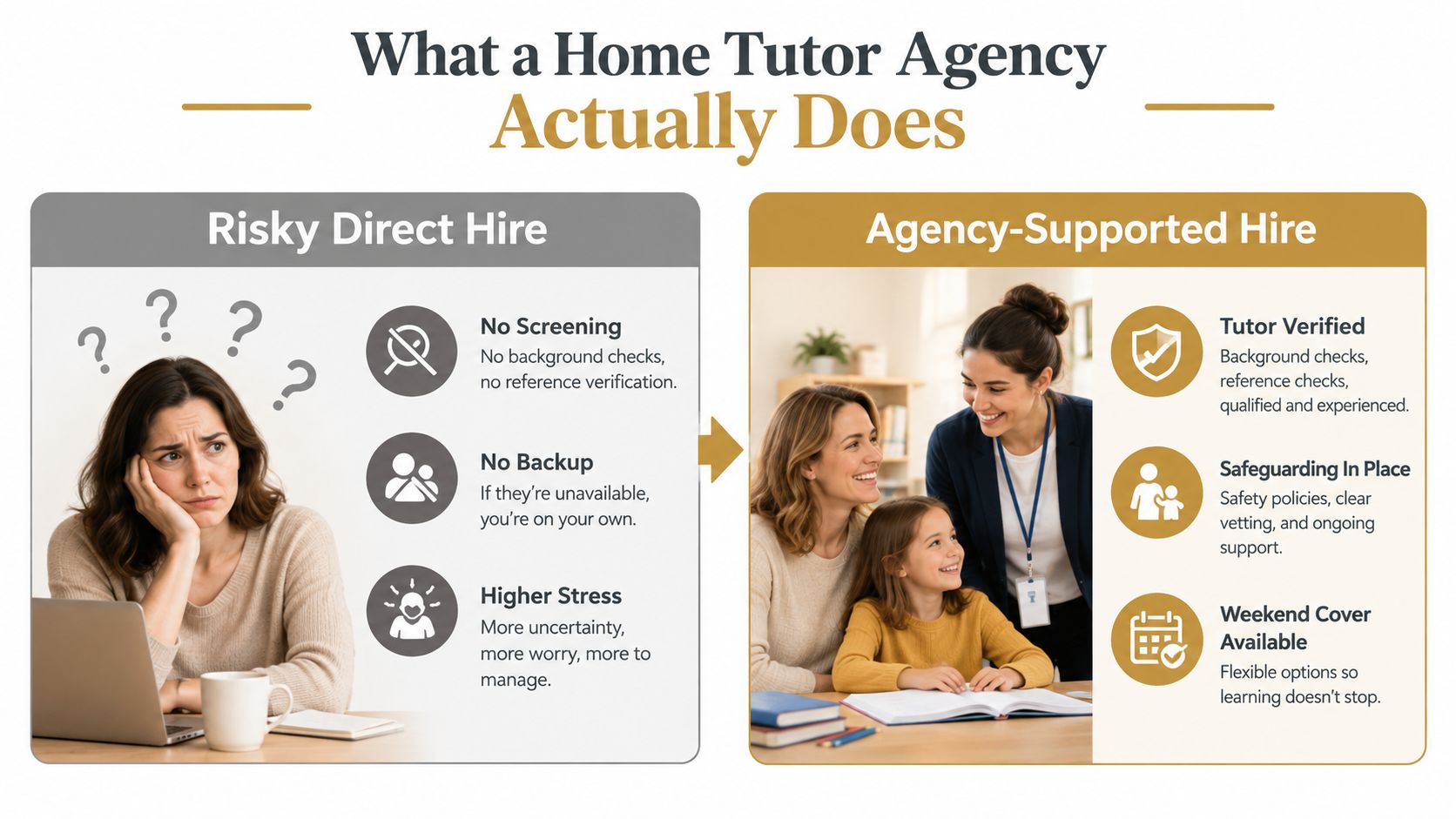
What a Home Tutor Agency Actually Does
When a tutor arrives at a private residence, parents should not be left relying on assumptions. They should know who has checked the tutor, what has been verified, and whether anyone at the agency has assessed that person beyond the contents of an online profile.
A home tutor agency should resolve those questions before the first lesson. It recruits and assesses private tutors, gathers evidence of identity, qualifications, and experience, discusses the family's requirements, and introduces a suitable professional for one-to-one work in the home. Some agencies employ tutors directly, while others introduce or contract with self-employed professionals. The arrangement, responsibilities, and liabilities should be stated clearly in writing.
The model differs from several services that families often group together:
- A tuition centre operates from a commercial classroom. The child travels to the tutor, usually follows a fixed timetable, and may learn alongside other pupils.
- An online tutoring platform provides profiles or digital access. The family often remains responsible for screening, contracts, and ongoing management.
- An independent tutor may be highly capable, but the family sources and verifies that person directly.
- A governess or nanny-tutor combines education with wider childcare or pastoral responsibilities, often within a live-in or fully staffed household role.
A credible agency also manages the practical relationship. It should clarify the fee structure, lesson arrangements, reporting expectations, confidentiality requirements, cancellation terms, and what happens if the match proves unsuitable. Depending on the arrangement, the agency may take a placement fee, manage the contract, or coordinate an introduction. Responsibility should never be assumed. It should be defined.
Why the agency's role matters
The difference is not simply administrative. It is one of risk management. A directory provides options. A professional agency should provide a documented rationale for why a particular tutor is appropriate for the child, the curriculum, the household, and the family's safeguarding expectations.
For families also recruiting nannies, governesses, or wider household staff, a broader private staff agency service can help maintain consistent recruitment standards across the residence. The central question is straightforward: is the family receiving a vetted recommendation, or merely a list of contacts and the burden of due diligence?
The Four Core Services a Home Tutor Agency Offers
The right tutor depends on the child's immediate needs, the family's longer-term objectives, and the education system involved. A capable consultant begins with those factors, not with the first available candidate.
Academic private tutoring
A child moving from one education system to another may need focused support in GCSE English and Maths before the new term begins. Lessons may also need to fit around travel, household staff, and complex family schedules.
This is standard subject tutoring, but it still requires a careful match. The tutor should understand the relevant syllabus, identify gaps accurately without damaging confidence, and work comfortably within a private household. Families should ask whether the agency reviews school reports, recent work, and examination dates before recommending candidates. Generic homework supervision is not an adequate substitute for a structured academic plan.
For subject-led in-home support, review how a provider presents its private tutor at home service. The important point is not the service label, but whether the tutor's teaching experience genuinely aligns with the child's year group and curriculum.
Specialist subject and learning support
Some requirements are too specific for a general search. A household may need a Mandarin A-Level tutor, an Oxbridge admissions mentor, or support for a child with dyslexia or another specific learning difficulty.
The agency should be able to define what it means by “specialist” in each case. That may refer to subject depth, familiarity with a particular examination system, or experience supporting a specific learning profile. Broad statements such as “experienced with SEND” are not enough without precise explanation of the tutor's background and practice.
Exam preparation
Exam tutoring requires a tighter fit than general revision support. Families may be seeking preparation for the 11+, 13+, Common Entrance, GCSE retakes, IB, A-Level, SAT, ACT, ISEE, or SSAT. The tutor needs to understand the format, assessment criteria, and preparation timeline.
Families should ask how the agency evaluates examination expertise. A tutor who has recently worked through the papers may bring relevant familiarity, while a tutor who marks for an awarding body may offer a different form of insight. Neither claim should be accepted without verification. The agency should explain the evidence behind its recommendation, and the limits of the tutor's experience where relevant.
Language and bilingual tutoring
International households often need more than conversational language support. A French, Spanish, Mandarin, Arabic, or Russian tutor may be needed to help a child transition into an international school, maintain a home language, or operate confidently across multiple linguistic environments.
Language fluency and teaching ability are not interchangeable. A native speaker may not know how to teach effectively, while a qualified teacher may not offer the cultural fluency a family wants. Discuss the child's current level, the target language, the household's communication preferences, and whether the tutor is expected to teach academic subjects through that language.
Not every agency offers all four services. That is not necessarily a weakness. A specialist provider may be stronger than a broad listing service, provided it is transparent about its network, vetting process, and limits.
How a Home Tutor Agency Vets and Safeguards Tutors
A CV is not a safeguarding process. For a home placement, an agency should be able to explain what it checked, who carried out the checks, and when.
Identity and eligibility
The first stage is identity verification. The agency should inspect suitable identity documents and confirm the tutor's information before making an introduction. Where the tutor's work status requires additional evidence, the agency should explain what has been checked rather than relying on a vague statement that the candidate is “approved”.
DBS evidence
Private tutors are not legally required to hold a teaching qualification or DBS check, but reputable agencies commonly seek enhanced DBS evidence for child-facing placements. Devon County Council's private tutoring safeguarding guidance recommends criminal record screening, references, and transparency with parents.
From 21 January 2026, eligible self-employed workers and personal employees can apply for an Enhanced DBS check, and parents or carers may ask to see the certificate before deciding whether to hire them for child-related work, as set out in the UK Government's announcement. Families should ask what level of check the agency has obtained, whether children's workforce eligibility applies, and how pending certificates are handled.
References and qualifications
References should be checked by a real person, not simply uploaded by the tutor. Families should ask whether referees are contacted directly and whether the references relate to recent teaching, childcare, or household work.
Qualifications also require scrutiny. A credible process may include checking degree or training evidence with the issuing institution. An impressive university name should not be mistaken for proof that the claimed qualification has been verified.
Interview and ongoing oversight
A senior consultant should interview the tutor in depth and assess communication, judgement, professional boundaries, and teaching approach. For a child-facing role, the agency should also understand how the tutor teaches, responds to frustration, and escalates concerns.
Once the placement begins, families should know who remains responsible for contact. Lesson reports, trial-period reviews, and a named consultant provide a clear route for raising concerns. The UK Government's guidance for parents using tuition services also advises families to check DBS evidence and ask whether other adults are present in a tutor's home and, if so, whether those adults have been checked.
Before confirming a placement, ask the agency to produce or explain these six items:
- Identity evidence: What document checks have been completed?
- DBS information: What level of check exists, and can the family see appropriate evidence?
- Reference record: Who supplied the references, and how were they verified?
- Qualification evidence: Which certificates or professional claims have been checked?
- Written terms: Who contracts with whom, and what are the fees, notice, and cancellation arrangements?
- Safeguarding route: Who should the family contact if a concern arises?
Reluctance to provide reasonable evidence, vague references, and pressure to skip a paid trial are warning signs. Families can also compare an agency's procedures with the international background checks service it describes, particularly when a tutor has lived or worked in more than one country.
The wider principle is supported by UK Government safeguarding guidance for out-of-school settings, which includes private tuition and expects providers to address safeguarding, health and safety, suitable people, and governance. An agency that cannot explain its controls is not offering a professional household service.
Home Tutor Agency vs Independent Tutor vs Tuition Centre
There is no single correct model. The right choice depends on the child's needs and on how much recruitment responsibility the family is willing to retain.
| Criterion | Home Tutor Agency | Independent Tutor | Tuition Centre |
|---|---|---|---|
| Vetting | The agency should organise and evidence identity, DBS, references, and qualifications | The family arranges checks directly | The centre controls its own staff process, which the family should still ask about |
| Flexibility | Usually designed around the household's timetable and location | Can be highly flexible if the tutor has availability | Fixed sessions and travel to the centre are more common |
| Confidentiality | Can be addressed through agency and placement terms | Must be negotiated directly | Depends on the centre's policies and environment |
| Cost | Includes the tutor's work plus agency services and administration | Often simpler to price, but the family carries more recruitment work | May use group or structured pricing |
| Continuity | The agency may help coordinate cover or a replacement, subject to written terms | The family must find a substitute if the tutor is unavailable | The centre provides continuity through its programme rather than one individual |
| Curriculum control | Can be tailored to the child and household | Depends entirely on the tutor | The centre usually controls the teaching framework |
An independent tutor may be excellent. Many families build long and productive relationships with tutors they source themselves. The weakness is not necessarily in the tutor. It is that the family must manage identity checks, references, contracts, confidentiality, safeguarding expectations, and any dispute directly.
A tuition centre can be effective for children who benefit from a group environment or a fixed academic programme. It is less suitable when a child needs quiet one-to-one support at home, a tutor who can coordinate with a nanny or governess, or preparation tailored to the expectations of a particular school.
For international families, curriculum fit deserves particular attention. A useful external resource on Goethe and IB exam preparation can help parents frame questions about German language learning and the IB, but it does not replace checking the individual tutor's experience.
Choose an agency when the household values screening, discretion, flexibility, and a managed relationship. Choose an independent tutor when the family is prepared to carry out the checks itself. Choose a centre when the child benefits from its specific teaching environment and programme. For families seeking a managed private placement, a private tutor service should explain where it adds value rather than assuming every family needs the same model.
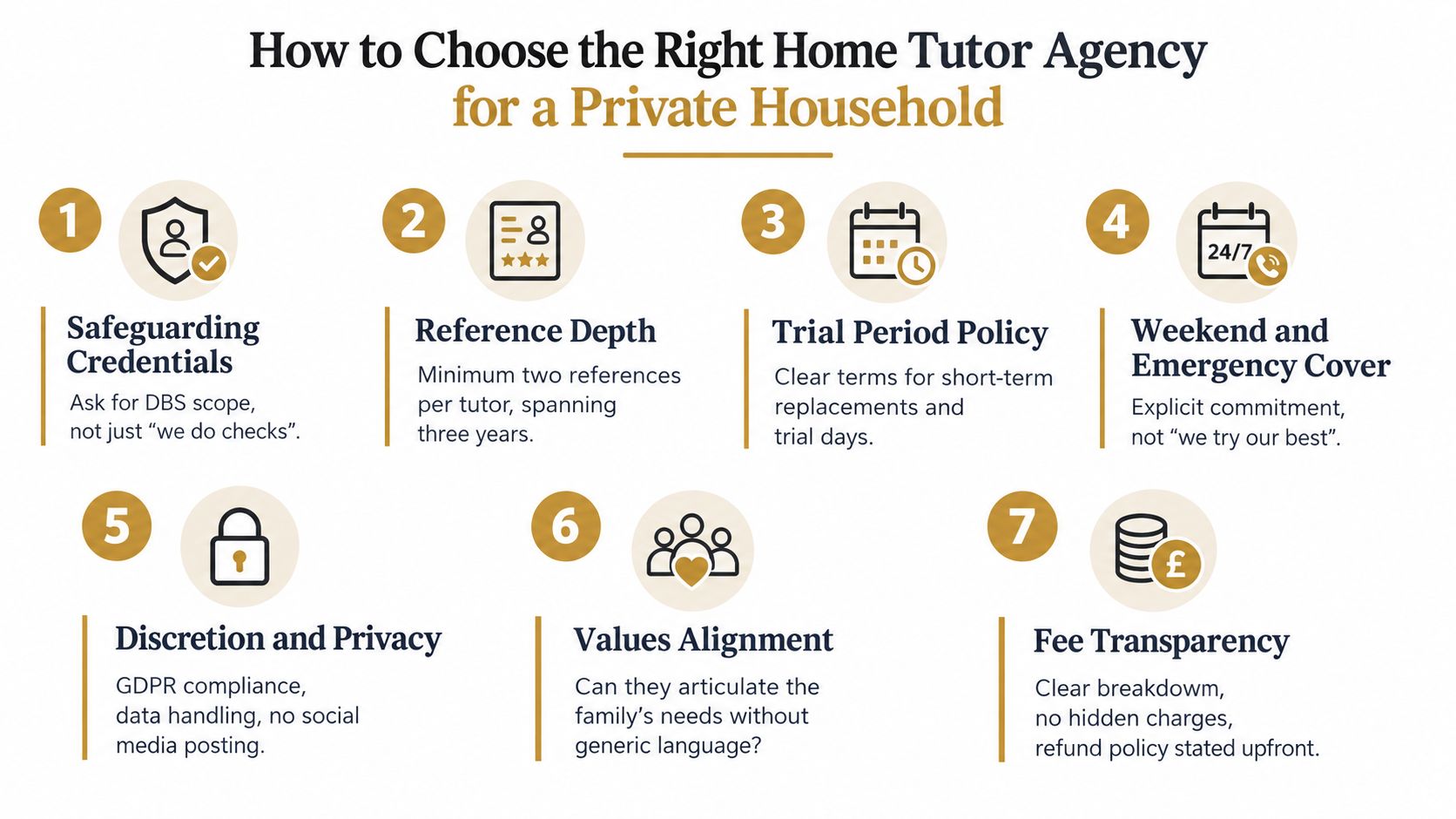
How to Choose the Right Home Tutor Agency for a Private Household
Treat the first consultation as an assessment of the agency, not as a commitment to hire. The consultant should ask about the child's personality, school, curriculum, schedule, household routines, existing staff, and privacy requirements. If the conversation consists only of a request for subject, postcode, and budget, the family is likely dealing with a listing service rather than a true placement agency.
Use this checklist during initial calls:
- Safeguarding lead: Can the agency identify the person responsible for safeguarding questions?
- DBS evidence: Will it explain the scope and status of the check rather than saying only that checks are done?
- Reference method: Does it contact referees directly and retain a clear record?
- Qualification verification: Can it distinguish verified qualifications from unverified claims?
- Household fit: Does it understand how the tutor will work alongside parents, nannies, governesses, or household managers?
- Continuity plan: What happens if the tutor is ill, unavailable, or unsuitable?
- Fee transparency: Are placement fees, ongoing charges, cancellation terms, and any taxes explained in writing?
- Confidentiality: Is the agency willing to discuss an NDA, data handling, and restrictions on social media?
- Trial process: Can the family arrange a properly structured, paid trial lesson?
- Communication: Will the family have a named consultant after the introduction?

The tone of the conversation matters. A discreet recruiter will not ask a family to disclose unnecessary personal information, but will need enough context to make a safe and workable recommendation. The consultant should also understand that a tutor entering a fully staffed home must respect household protocols, access arrangements, technology rules, and the child's privacy.
Ask for a written outline before sharing sensitive family details. Establish who can see the child's reports, where documents are stored, and whether the tutor may discuss the placement publicly. A family comparing childcare environments may also find this UK nursery guide for parents useful when thinking through questions about policies, communication, and safeguarding.
The strongest signal is not a polished website. It is a consultant who can say clearly, “This tutor is not right for your child,” and explain why.
Pricing, Contracts and What to Expect on Paper
A credible home tutor agency makes the cost and responsibilities visible before a tutor enters the household. Private tutoring rates vary by subject, experience, location, curriculum and specialist demand. Prospects gives a common hourly range of around £30 to £42 for private tutors, with experienced tutors sometimes charging above £50, and notes that London and other high-cost regions can be more expensive. Those figures cover the tutor's time, not the full cost of an agency-supported placement.
Ask for a written breakdown of the agency's charges. The family may pay the tutor's fee separately from recruitment or placement fees. Confirm what the quoted amount covers, including consultation, sourcing, checks, introduction, administration, replacement support and follow-up. If the tutor works through a company, ask who issues the invoice, how the total is calculated and whether VAT applies. Verbal assurances about tax treatment are not enough.
What the agreement should clarify
The contract should be reviewed before the first lesson. It should state:
- The parties: who contracts with the family and who contracts with the tutor.
- The fees: hourly or session charges, agency fees, payment dates, and additional costs.
- Notice: how either party can end the arrangement.
- Cancellations: what happens if the family travels, the tutor is ill, or the child is unavailable.
- Cover: whether the agency provides a replacement or sick-cover service, and the conditions that apply.
- Confidentiality: how family information, photographs, lesson reports, and household routines are protected.
- Safeguarding: how the family reports a concern, who receives it, and how it will be handled.
- Trial arrangements: the trial's length, payment terms, and decision process.
The Enhanced DBS changes introduced from 21 January 2026 make the agency's evidence especially important where a tutor may be eligible for an enhanced check. The contract or accompanying records should make clear whether the certificate is available, pending, or outside the relevant eligibility route. A DBS check does not replace wider vetting, but the agency should explain what has been verified.
For a wider explanation of terms that professional service contracts often address, consult this professional service agreement guide. It is not legal advice, but it can help a household manager identify unclear provisions before signing.
Before committing, ask one direct question: what happens in writing if this placement does not work? The answer should cover notice, fees, replacement support, and outstanding payments. If those terms are vague, the contract is not ready to sign.
Questions Families Ask Before Signing
How current should a tutor's DBS check be?
Ask for the certificate status and scope, not only the date. A DBS check is one component of safeguarding, not proof that a tutor is suitable in every respect. The agency should explain what check was obtained, whether the tutor is eligible for an enhanced check, and how identity and references are verified alongside it.
What qualifications should a private tutor hold?
The qualification should fit the assignment. UK tutors are not legally required to hold a teaching qualification, so families should ask what evidence supports the tutor's subject knowledge and teaching experience. A GCSE tutor, bilingual tutor, and specialist learning-support tutor may require very different backgrounds.
What happens if the tutor is locked out or unavailable?
Read the cover terms before the first lesson. The agency should explain who handles access problems, illness, cancellations, and replacement requests. A placement fee should not be assumed to include emergency cover or a guaranteed substitute unless stated in writing.
Will the family receive lesson reports?
Agree the reporting format in advance. Some families need concise updates for a household manager, while others want detailed academic notes shared with parents and school staff. Confirm who receives reports and how confidential information is handled.
Can the family request a trial period?
A paid trial is sensible when both child and tutor need to assess the fit. It allows the family to evaluate communication, boundaries, and teaching style without assuming that a CV can predict the relationship. The agency should set out the trial fee and decision terms in advance.
A home tutor agency should help a family make a considered appointment, not encourage endless browsing through profiles. Arrange an initial consultation, ask for evidence, and assess the process before assessing the tutor.
Superstar Nannies sources private tutors and mentors for in-home tuition and structured home education support, with the placement shaped around the child and the household's existing routines. Visit Superstar Nannies to discuss a discreet tutor search and the safeguarding, confidentiality, and continuity requirements your family needs.