
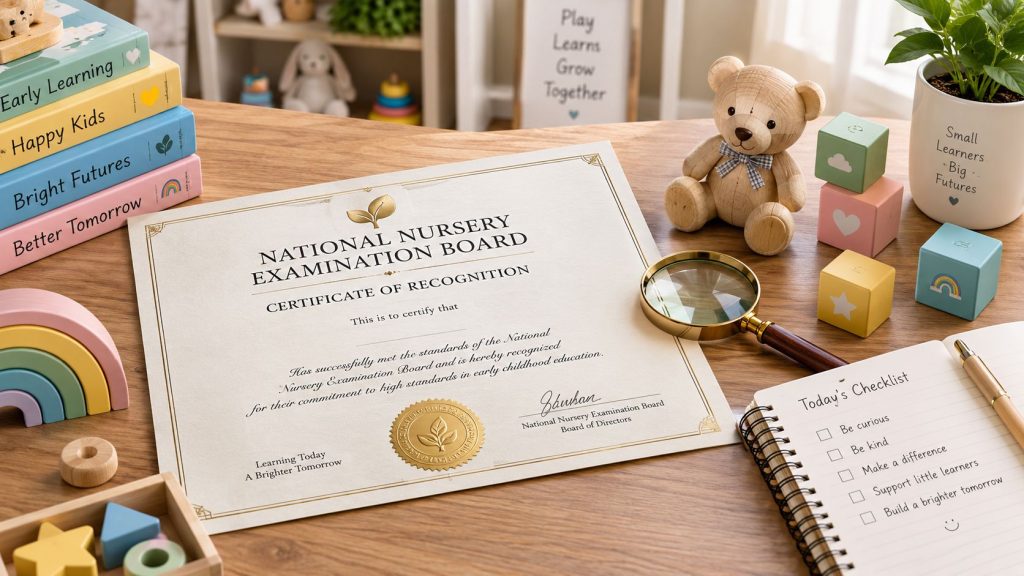
A CV lands on a family's desk, and three strong candidates all carry the same brief line, NNEB. One parent recognises it vaguely, another assumes it must be a modern diploma, and the household manager wants to know whether it still matters for a private placement. That's the problem with legacy childcare credentials, they can signal excellent training, but only if you know how to read them properly.
Why the NNEB Still Surfaces on a Nanny CV
A family hiring for a serious London role often sees NNEB long before they see a polished explanation. The initials can sit beside years of experience, excellent references, and fluent baby care, yet the qualification itself remains a mystery to parents who have only hired in today's framework. That's where confusion starts, because the credential looks small on paper but carries a long professional history.
The reason it still appears is simple. The National Nursery Examination Board was widely treated as the sector's former “gold standard” in the UK, and that reputation still travels through the private-staffing world. For families, it acts less like a trendy badge and more like a shorthand for structured early-years training, especially when candidates move between Britain and international placements. Superstar Nannies' guide to Norland College and elite nanny training is useful background if you're comparing legacy elite training pathways.
Practical rule: don't treat NNEB as a magic yes or no. Treat it as a clue that the candidate may have completed formal, standardised childcare training, then check the details behind it.
That distinction matters in UHNW households, because the name alone doesn't tell you whether the nanny has current safeguarding knowledge, SEND awareness, or fresh first-aid certification. It does, however, tell you where to begin your screening. A strong recruiter or parent doesn't dismiss the line, and doesn't stop there either.
Origins and Structure of the National Nursery Examination Board
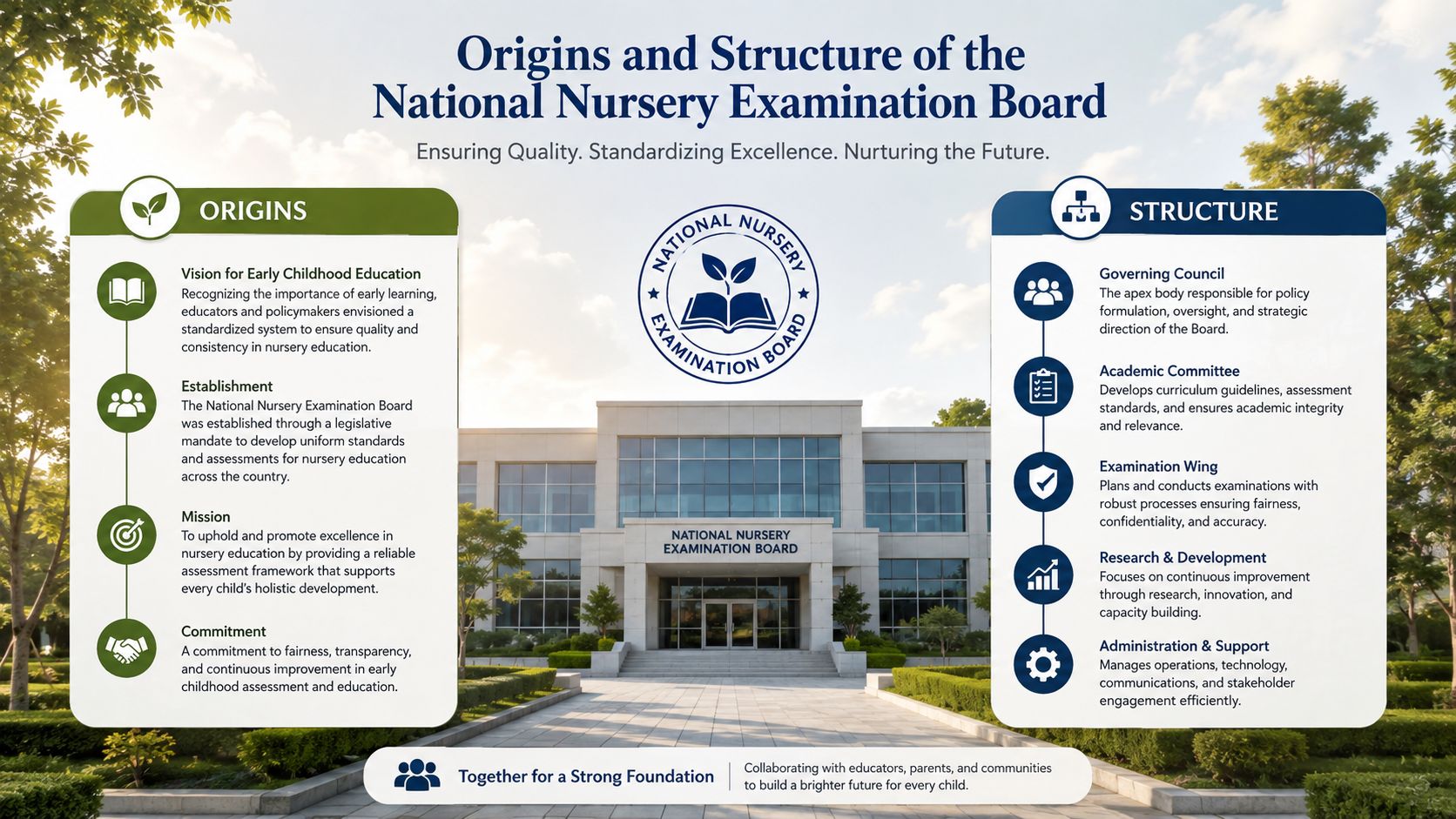
The National Nursery Examination Board traces its roots to the 1940s in the United Kingdom, and some histories credit Bessie Wright with helping form it. That places it inside a much longer British tradition of formal childcare preparation, one that reaches back to the Norland Institute in September 1892, when the first formal training for women to work as children's nurses began. The continuity matters because it shows that NNEB was not a one-off scheme, it grew out of an established professional culture around early-years care. Norland's archive on childcare training history gives that longer arc in one place.
NNEB was delivered at state and private colleges around the UK, which is one reason it became a national benchmark rather than a niche private credential. It wasn't an abstract classroom label either. The programme was a two-year pathway covering care from birth to age 7, with teaching in first aid, child development, communication, and play, plus placements in schools, nurseries, hospitals, and private families. That breadth is what made the qualification so practical for employers.
For a parent reading a CV, the key point is straightforward. An NNEB-trained nanny wasn't just taught theory, they were trained across multiple care settings and expected to understand child development in real situations. That's why older recruiters still talk about the qualification with such respect. It signalled a standardised route into the profession, not a loose collection of unrelated classes.
Where NNEB Sits in the Modern UK Qualification Landscape
NNEB didn't disappear from the childcare conversation, it was overtaken by a more fragmented system. By 2012, the early years sector had 445 qualifications at different levels (the international qualification summary notes this), which helps explain why families now need to do more than match initials on a CV. In that crowded field, NNEB is remembered as a single, standardised benchmark.
Modern references generally place NNEB alongside the CACHE Level 3 Diploma in Childcare, and the newer NVQ Level III is described as equivalent to NNEB. Specialist professional networks still treat it as a benchmark Level 3 childcare qualification. For hiring managers, that means the credential can still sit in the right tier for nanny, nursery, and early-years roles, even if the awarding body has changed.
The practical hiring question is not only “what was it called?”, but “what does it map to now?”. A good way to read that is to compare the legacy route with current expectations around child development, welfare, and learning frameworks. For parents who want a plain-English guide to the current context, understanding the EYFS framework is a helpful companion read.
Superstar Nannies' overview of Ofsted registration for nannies is also worth a look if you're matching credentials to regulated family settings. The important takeaway is this. NNEB still has recognisable value, but you now need to place it inside a wider map of equivalent qualifications and current childcare duties. The old name is useful, the modern framework does the hiring work.
How to Verify an NNEB Qualification in Practice
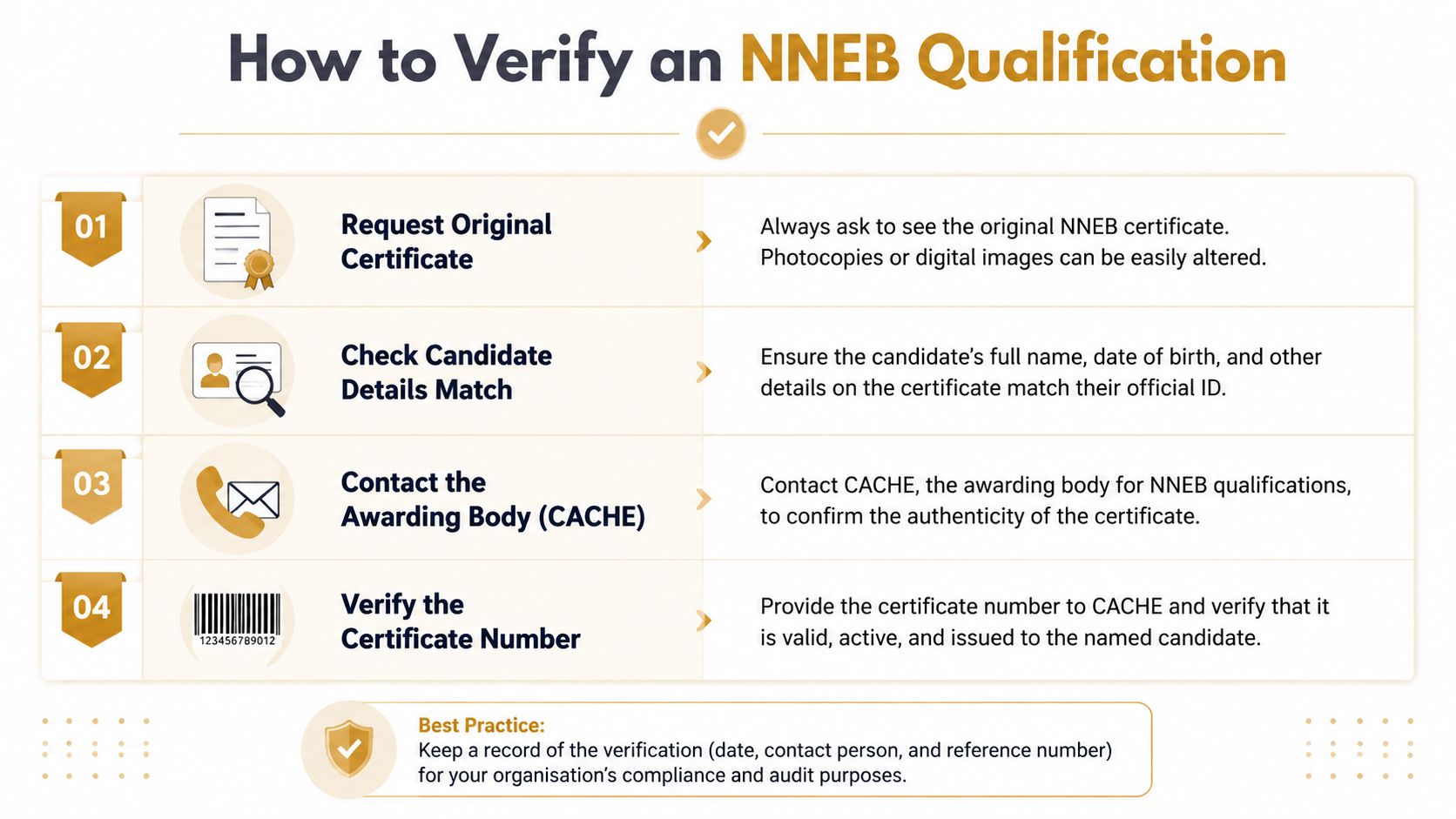
Start with the certificate itself. Check the candidate's full name, the college or training provider, and the year of award. If any of those details look inconsistent with the CV, ask for clarification before you move to interviews or trial dates. A genuine legacy qualification usually comes with a clear paper trail, even if the document is older.
Next, look for corroboration. The NNEB Old Collegians network positions itself as a standards-led professional community for childcare and maternity professionals, and that makes it useful for alumni tracing and credential credibility. That doesn't replace your own vetting, but it can help you understand whether the candidate can produce legacy documentation or credible references from older employers.
You should also cross-check the setting history. References from schools, nurseries, hospitals, or private families matter because NNEB training was built around placement-based practice, not just theory. If the candidate trained in multiple environments and can explain what they did there, that's a stronger sign than a CV line on its own. For a broader screening framework, Bornbir's nanny background check guide is a sensible companion read.
The certificate tells you the qualification exists. The references tell you whether the candidate can still apply it well.
Finally, match the legacy credential to today's working reality. NNEB's syllabus emphasis on health, first aid, hygiene, play, and physical, intellectual, emotional, and social development aligns well with what families still care about, but it doesn't automatically prove current compliance. In modern hiring, that means checking whether the nanny also meets current EYFS expectations and has up-to-date first-aid cover. Superstar Nannies' background check overview is a useful internal starting point if you're building a proper shortlist.
Modern Equivalent Qualifications and Stackable Upskilling
A strong recruiter won't stop at the equivalence chart. NNEB maps most naturally to a Level 3 childcare benchmark, but modern households increasingly want evidence of stackable upskilling on top of the original diploma. That means the legacy qualification is the foundation, not the full answer.
| Qualification | UK Level | Typical Duration | Age Coverage | Best-Fit Role |
|---|---|---|---|---|
| National Nursery Examination Board | Level 3 benchmark | Two years, full-time | Birth to age 7 | Nanny, nursery practitioner, private childcare |
| CACHE Level 3 Diploma in Childcare | Level 3 | Varies by provider | Early years | Nursery and nanny roles |
| NVQ Level III | Level 3 equivalent | Varies by route | Early years | Childcare and nursery settings |
| T Level in Education and Childcare | Level 3 route | Two years | Broader education and childcare pathway | Entry into support and early-years roles |
| Level 3 Early Years Educator | Level 3 | Varies by provider | Early years | Nursery and early-years practitioner |
Norland or Montessori training can overlap with parts of NNEB coverage, but they don't replace the same historical route or the same placement pattern. That's why families shouldn't use brand names as shortcuts. They should look at actual content, practice settings, and recent refresher training.
The gap that matters today is practical. UK workforce research increasingly points to the value of communication, safeguarding, clinical skills, and collaborative working, especially for children with complex needs. In plain terms, a wonderful legacy credential still needs support from safeguarding refreshers, SEND awareness, paediatric first aid, and strong parent-facing communication. If you're hiring in a busy family home, those are the extras that make a good CV usable in real life.
Common Employer Questions About NNEB-Trained Candidates
Is NNEB still recognised in 2026?
Yes, in practice it is still recognised as a legacy childcare qualification, and NNEB-OC continues to frame it as a gold standard credential. The key for families is to verify the document and see how the candidate's current practice matches modern expectations. Recognition and readiness are not the same thing.
Does NNEB count as Level 3 for Ofsted-relevant roles?
Specialist professional networks treat it as a benchmark Level 3 childcare qualification, so it sits in the right general tier. That said, employers should still check whether the role needs any current registration, documentation, or refresher training beyond the legacy diploma. The qualification helps, but the compliance file still needs to be current.
Can an NNEB-trained nanny work with newborns as well as older children?
The syllabus covered care from birth to age 7, so the training itself was broad enough to include both ends of early childhood. In hiring terms, though, newborn care is its own specialist area. A family should still ask about recent baby experience, sleep routines, feeding support, and current first-aid knowledge.
How does NNEB compare with a Norland diploma for UHNW placements?
They're not the same credential, and they shouldn't be treated as interchangeable. NNEB signals a historically standardised UK childcare pathway, while Norland sits in a different elite training tradition. For VIP and UHNW homes, the decision usually comes down to the full profile, not the badge alone.
Hiring with Confidence and Where Superstar Nannies Fits
The cleanest way to read NNEB is as a reliable signal, not a complete verdict. It tells you the candidate completed a standardised two-year UK programme, trained across multiple childcare settings, and holds a credential that still maps onto a Level 3 benchmark. It does not, on its own, prove recent safeguarding practice, SEND confidence, or current first-aid certification.
That's why strong families use the qualification as one part of a wider checklist. They verify the certificate, check references, and ask how the nanny has updated their practice for today's EYFS and family-home expectations. Superstar Nannies' values-led approach fits that style of hiring, because discretion and evidence matter as much as experience.
If you're shortlisting NNEB-trained nannies, maternity nurses, or governesses for a household in London, New York, Miami, Palm Beach, Washington DC, Paris, Monaco, Zurich, Milan, Rome, Lisbon, Berlin, Madrid, Hong Kong, Singapore, Dubai, or Qatar, speak to a specialist who understands legacy credentials and modern standards. Contact Superstar Nannies for a confidential consultation, and we'll help you place the right professional with the right mix of training, references, and current childcare practice.