


A family can live with the wrong chef for a season. It can't live with the wrong butler for hire for long. When the house runs on formal dinners, travel turns chaotic, and the principals want standards kept without being chased for every detail, the hire stops being a luxury decision and becomes an operational one.
When Hiring a Butler Actually Makes Sense
A couple renovating a large family home usually starts with the wrong question. They ask whether a butler for hire sounds too grand for their household, when the better question is whether the home now runs on enough moving parts to justify one accountable person at the top of the service flow.
That's the point where a butler starts making sense. If your calendar includes regular dinners, guest weekends, seasonal entertaining, wardrobe care, wine service, or multiple properties that need the same standard kept in each one, the role stops being decorative. It becomes a control point.
The UK market itself tells you this isn't a casual hire. BBC reporting noted that about 350 to 400 butlers were trained each year in Britain, with roughly half staying in the UK and the rest going overseas, especially to the Gulf and other international markets, and the average newly employed butler was 41 years old. That's not a junior service hire, it's a specialist appointment with enough maturity to carry real household authority, which is also why what a house manager does is often the right comparison before you default to a butler title.
Practical rule: if you need someone to manage standards, not just serve meals, the role is probably justified.
A butler makes sense when the household needs one person to hold together the front-of-house finish, the entertaining schedule, and the principal's personal rhythm. If the home is smaller, more informal, or mostly run by housekeeping staff, a house manager or estate manager may be the cleaner fit. Don't hire a title, hire a function.
What a Modern Butler Does Day to Day
A modern butler is not just a server who appears at dinner. In a private household, the job is operational and visible at the same time, because the butler is responsible for the standards guests notice first and the systems staff depend on behind the scenes.
Front-of-house service and household polish
The core remit starts with front-of-house standards. That means guest arrivals and departures, formal dining service, wine service, crystal and silver care, and the presentation that makes a household feel composed rather than managed in pieces. It also includes staff coordination during entertaining, because a dinner party falls apart fast when nobody owns the sequence.
The role often stretches further in homes that run like small private operations. Wardrobe management, personal service for the principal and family, event coordination, and support across changing routines now sit alongside the classic service duties. A butler who cannot move between formal dining and a spontaneous guest arrival is too narrow for most modern UHNW homes, and in many households the role starts to overlap with duties you would usually see in a house manager job description.
What to write into the brief
Use a narrow brief if you want a narrow hire, and a broader brief if you need a working household lead. A strong scope usually covers:
- Guest handling: arrivals, departures, luggage, room preparation, and guest-facing etiquette.
- Service execution: formal dining, beverage service, and table standards.
- Object care: wine, crystal, silver, and any other high-value serving pieces.
- Staff coordination: directing house staff during entertaining and sharing instructions clearly.
- Personal support: wardrobe care, packing, unpacking, and principal-facing assistance.
That list is the practical version of the role, and it is the part families miss when they treat “butler” as a luxury label. One specialist guide describes the butler as the person responsible for these moving parts, not a vague “household support” role. That matters because the brief shapes the hire, and the hire shapes how much authority the person needs once they are in the house. My Household Managed's butler overview is useful here because it breaks the role into the actual mechanics families tend to miss.
Choosing Between Live-In and Live-Out Arrangements
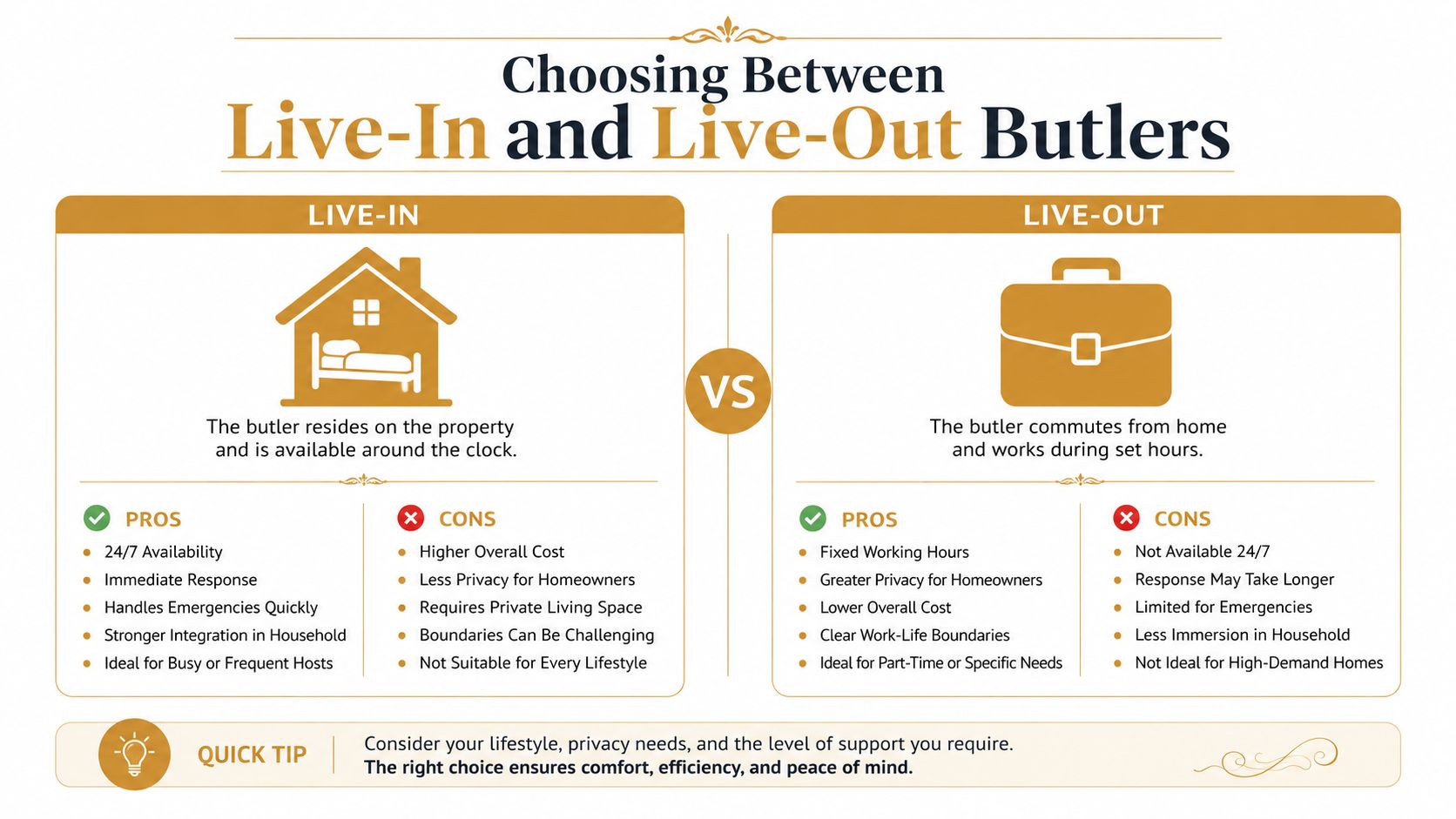
The live-in versus live-out decision isn't about prestige. It's about how your household runs, how private you want it to feel, and how quickly you need service to respond when the day changes.
Live-in works when the house never really stops
Live-in makes sense in large estates, homes with frequent entertaining, and households where principals travel often. The upside is immediate response, early starts, late finishes, and a stronger chance of continuity across changing routines. The trade-off is privacy, access, and the need for proper accommodation that doesn't turn into an awkward half-solution.
UK guidance is blunt on the point that employers should clearly define whether the butler is full-time, whether they have access to all areas of the house, and what facilities they may use after working hours, before employment starts. For live-in roles, those rules need to be settled in writing so nobody improvises later. Polo & Tweed's first-time hiring guidance is one of the few public sources that spells that out plainly.
Live-out suits homes that value separation
Live-out is usually better for city properties, more private households, and principals who don't want staff presence after hours. It gives cleaner boundaries and can work well when the butler's main task is structured daytime service rather than constant availability. It also forces better planning, which many households need.
If your household wants discretion first and 24/7 presence second, live-out is usually the stronger fit.
My recommendation is simple. Choose live-in when the property, pace, and entertaining pattern demand a resident service lead. Choose live-out when the household wants excellent service without the feeling that staff life and family life are blended together.
UK Salary Benchmarks and Total Cost of Employment
A butler hire goes wrong fast when a household fixes only the salary and ignores the rest of the employment package. The wage is the visible line item. The budget includes the contract structure, payroll handling, benefits, and the practical cost of employing someone who may be running the house on a daily basis.
What the UK numbers say
BBC reporting said UK butler salaries typically averaged £40,000 to £50,000. The Telegraph reported that live-in butler wages in London increased by 8.2% in two years, reaching an average of £43,000, while live-out butlers in the city averaged £45,000, which was 14.2% higher than in 2016. A separate UK job-profile source listed a broader salary band of £15,000 to £50,000 and cited an average UK salary of £37,430 for 2024.
| Role or Region | Salary Range | Notes |
|---|---|---|
| UK average market | £40,000 to £50,000 | BBC-reported typical UK pay |
| London live-in | £43,000 average | Telegraph-reported city benchmark |
| London live-out | £45,000 average | Higher than the live-in figure in the same city market |
| Wider UK salary band | £15,000 to £50,000 | Broad range across households and duties |
| UK average for 2024 | £37,430 | Job-profile average cited in the brief |
Agency fees sit on top of salary. Domestic staffing agencies may charge up to 25% of annual salary, with 20% described as the industry average in Superstar Nannies' private staff salary guide. That is why a serious budget needs the placement fee in the same spreadsheet as pay, rather than treating it as an afterthought.
The hidden costs families forget
The rest of the budget usually includes PAYE payroll, holiday pay, pension administration, accommodation costs for live-in staff, and any uniform or wardrobe allowance you choose to provide. UK households must also respect National Minimum Wage rules, and for 2025/26 the government set it at £12.21 an hour for workers aged 21 and over. A household that ignores that side of the hire is taking on an avoidable risk.
My advice is to price the role as an employment package, not a salary alone. That means checking whether the butler is live-in or live-out, whether accommodation is part of the offer, how overtime or extra duties are handled, and what the contract says about time off, notice, and expense reimbursement. The right figure is the one you can sustain cleanly after payroll, agency fee, and ongoing staff costs are all included.
Sourcing Candidates Through Agencies Versus Direct Hire
Once the budget is real, the next question is where the shortlist comes from. In this market, you will not be flooded with generic applicants, so the sourcing route matters more than it does for many other household roles.
Agencies give you reach and filtering
Specialist household-staffing agencies are the better choice when the brief is precise, the property is sensitive, or the household needs discretion from the first conversation. A good agency screens for experience depth, presentation, and the ability to work inside a home with established rhythms. That matters because butler searches attract about 48 applications per role on average, which is materially below personal assistants at 112 and private chauffeurs at 106, so the candidate pool is tighter and more specialist.
A strong agency also saves time on filtering weak candidates before they ever reach you. If you want a specialist route, use a private household staffing agency in the UK that understands live-in and live-out structures, confidentiality, and the level of polish expected in UHNW homes.
Direct hire works when trust already exists
Direct sourcing through private networks, estate referrals, and trusted introductions can work well if you already know the standard you want and you have time to vet properly. It can save placement fees, but it also puts more of the burden on you to screen references, test judgment, and reject candidates who look polished but cannot run a service sequence.
That trade-off is real. Direct hire suits households with experienced principals, a strong internal process, and enough patience to interview more than once. If those pieces are missing, cheap sourcing becomes expensive fast.
The export angle matters too. BBC reporting noted that about 30% of people hiring British butlers are located in the UAE, Qatar, and Saudi Arabia, which tells you British-trained staff are a recognised export skill. If you are hiring internationally, that changes how you think about relocation, acclimatisation, and cultural fit.
Use an agency when speed, discretion, and screening depth matter more than saving on placement fees. Use direct hire only when your network is strong and your internal vetting is disciplined.
A specialist option such as Superstar Nannies fits households that want butler placements alongside broader private staff recruitment, but the method still needs to match the home. The wrong sourcing route wastes time even when the candidate is good.
Vetting, References, and the Hiring Timeline
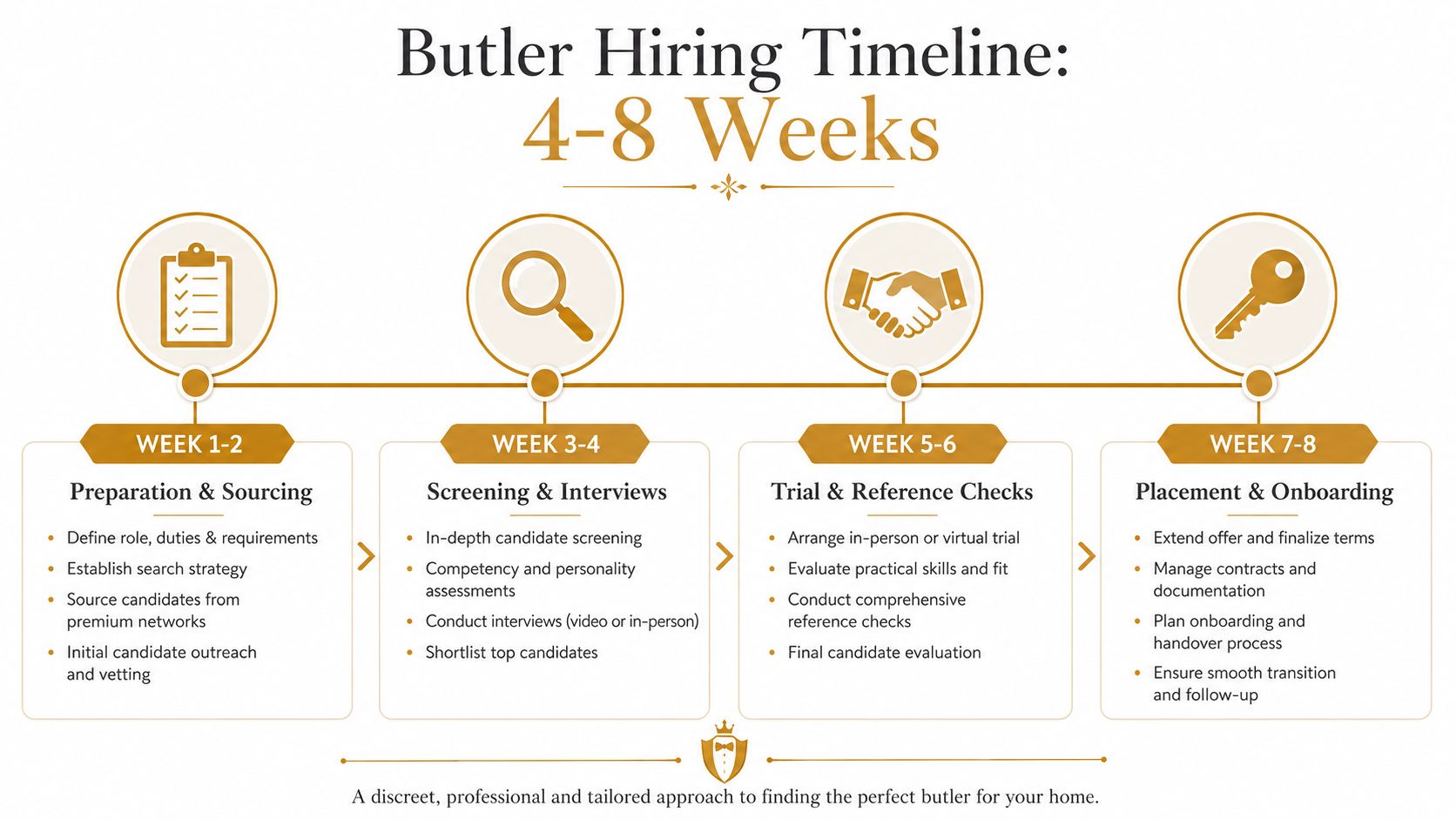
A proper butler hire takes time. One structured guide says the process typically runs 4 to 8 weeks, with weeks 1 to 2 for preparation and sourcing, 3 to 4 for candidate evaluation, 5 to 6 for final selection, and 7 to 8 for onboarding preparation. That timeline is realistic if you want to hire carefully rather than reactively.
The vetting sequence you should never skip
Start with identity and right-to-work confirmation. Then move to criminal background checks, employment verification, and financial screening. If the candidate has lived internationally, get police clearance from the relevant countries rather than assuming one UK check is enough.
References need more than a polite call to an HR contact. Speak to previous principals where possible, ask about discretion, and listen for what they don't volunteer. Long-term trust usually shows up in the way a former employer talks about handling pressure, not in a glossy CV.
What the timeline should actually feel like
Weeks 1 and 2 should be about source quality and household fit. Weeks 3 and 4 are where you compare live-in and live-out viability, entertaining experience, and how the candidate handles service standards. By weeks 5 and 6, you should be narrowing to a final finalist or two, not still collecting basic paperwork.
A butler who is excellent in conversation but vague about references is not a safe hire. Treat discretion as evidence, not a claim.
By weeks 7 and 8, onboarding should already be planned so the hire starts with structure rather than confusion. The timeline in the earlier section becomes useless if the house isn't ready for the person on day one.
Interview Questions and Trial Days That Reveal Real Aptitude
Most strong candidates sound polished. The interview is where you find out whether they can run your house when the door opens, the guests arrive, and the principal changes plans mid-evening.
Questions that separate polish from competence
Start with scenarios, not opinions. Ask how they would handle a formal dinner where one guest arrives late, a principal who changes the menu after service has started, or a last-minute request to prepare a guest suite while the household is already entertaining. A real butler won't just answer with manners, they'll describe sequence, priorities, and communication.
Other useful questions are more specific:
- Formal dining: “Walk me through how you'd set and service a formal table for a guest dinner.”
- Staff coordination: “How do you brief housekeeping or junior staff during an event without creating confusion?”
- Discretion: “Tell me about a time when you had to manage a sensitive situation and stay invisible.”
- Changing routines: “How do you adapt when the principal's schedule changes after you've already planned the day?”
- Household standards: “What do you check before you say a room or service area is ready?”
Listen for the order of their thinking. A strong answer sounds practical and calm. A weak one hides behind general service language.
What a trial day should prove
A trial day or weekend should test real service conditions, not just charm. Put the candidate into a live sequence with actual timing pressure, a table setup, and one or two changes to the plan. Watch how they react when someone junior makes a mistake, because that tells you more about leadership than any CV line.
Trial-day rule: if they stay composed, protect the principal's time, and keep the room organised when the plan shifts, you've learned something useful.
You should also watch how they handle the handoff with other staff. A butler who can't work neatly beside a house manager or estate manager will create friction even if their service is technically strong. If two finalists look equally good, choose the one whose judgement is steadier and whose references speak most clearly about long-term trust.
Contract and onboarding terms that protect the household
The contract should spell out the job description, hours, live-in accommodation rules, holiday entitlement, notice periods, and confidentiality clauses. If the butler will be present during sensitive family or business moments, the NDA language needs to be specific, not decorative. Keep reporting lines clear if there's a house manager or estate manager already in place.
Onboarding should introduce the butler to the wider household team, set communication norms with the principal, and define review points at 30, 60, and 90 days. That matters because the UK labour market for private household roles remains tight, with about 1.6 million people working in domestic or related service occupations, so retention matters as much as recruitment. A good hire still needs a good start.
If you want the hire to last, treat the first month as a calibration period, not a probation box to tick. Clear boundaries, direct feedback, and a tidy reporting structure will do more for retention than any elegant job title.
The right butler for hire is the one whose remit, pay, and working model match the household you run, not the one you imagine on paper. If you need a specialist placement, a clean brief, and support hiring household staff with proper vetting and onboarding discipline, contact Superstar Nannies and start with a consultation that reflects the true standards of your home.