


You've found a nanny who looks ideal on paper. She's warm, experienced, polished with children, and comes recommended from a household abroad. Then the obvious question lands: how do you verify someone's history when that history spans more than one country?
That's where international background checks stop being a nice extra and become part of responsible hiring. For families, especially those bringing someone into a private home and into close contact with children, the core challenge isn't deciding whether to vet. It's knowing what proper vetting involves when the candidate has lived, studied, or worked overseas.
Your Guide to International Background Checks
A lot of parents assume the hard part is finding the right person. In practice, the harder part is confirming that the right person is exactly who they say they are, with a history that stands up across borders.
In private staffing, this issue comes up constantly. A nanny may have trained in one country, worked in another, and now be applying for a role in London. Her CV may read beautifully. Her references may sound polished. None of that replaces a lawful, jurisdiction-specific screening process.
That's why international background checks need a different standard from domestic screening. The process is slower in some countries, restricted in others, and shaped by local privacy rules that many families never see until a placement becomes urgent. If you're comparing providers, it helps to understand how screening platforms differ on workflow, reporting, and international coverage before you commit. A useful starting point is this guide to compare pre-employment screening platforms.
Parents also need to understand the hiring context. Bringing British childcare professionals across borders raises its own paperwork, compliance, and cultural considerations, which is why many families also review guidance on hiring a British nanny abroad.
Practical rule: If a candidate has an international footprint, your checks must follow that footprint.
The goal isn't to make hiring feel suspicious or adversarial. It's to remove blind spots. Done properly, international screening protects your child, protects your household, and protects good candidates from being judged on assumption rather than verified fact.
Why a UK DBS Check Is Not Enough
A family sees a clear DBS certificate and feels reassured. I understand why. In practice, that reassurance can be badly misplaced if the candidate has lived, studied, or worked abroad.
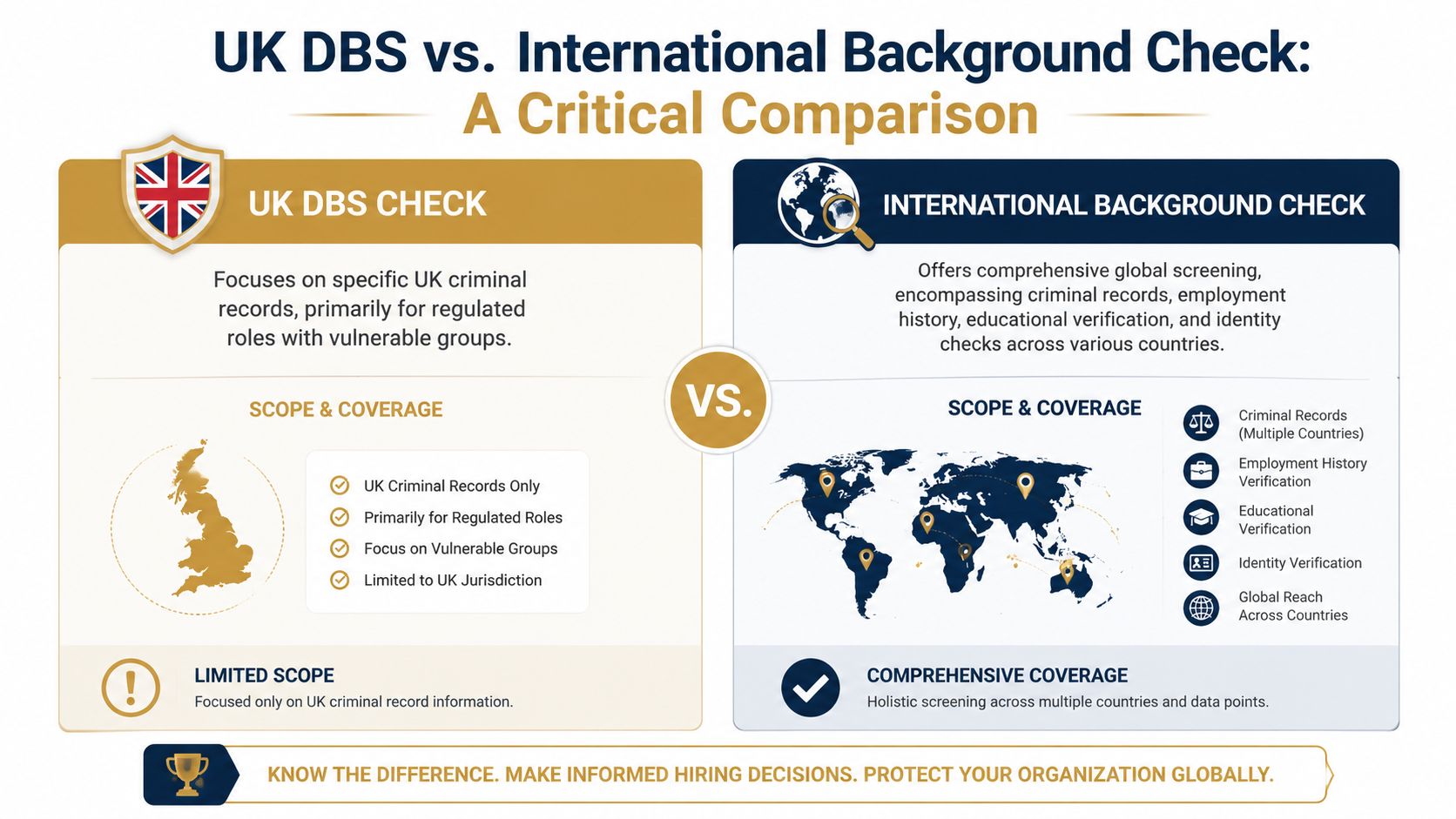
A DBS is a UK safeguarding check. It searches relevant information held within UK systems. For a candidate whose recent life has been entirely British, that is an appropriate starting point. For a candidate with an international footprint, it is only one part of the file.
Families should still understand the separate safeguarding standards involved in checks for working with children, particularly for sole-charge roles, travel roles, and private household positions where trust is unusually high.
The gap is straightforward. A DBS does not tell you what happened outside the UK. There is no single worldwide database that fills that gap. As AMS Inform explains in its guidance on cross-border hiring and global background checks, screening has to follow the candidate's actual country history, not only the country where the new role is based.
That distinction matters more than many parents realise. If a nanny spent six years in Dubai, trained in Paris, and worked for a family in New York before applying in London, a clean DBS only speaks to any relevant UK-held information. It does not clear the years spent elsewhere. It does not confirm whether records are unavailable, restricted, or never checked.
I see one mistake repeatedly. Parents treat the DBS as the main event and the overseas work as an optional extra. For internationally mobile candidates, the reverse is often true. The overseas checks are where the primary blind spots sit, and they are also where the legal and practical complications begin.
Three problems follow from relying on a UK check alone:
- No meaningful UK history: Some candidates have only recently arrived, so a DBS offers very little insight into their past.
- False completion: “DBS done” can sound like the file is finished when the relevant jurisdictions have not even been requested.
- Poor decisions based on partial evidence: A family may reject a good candidate out of uncertainty, or hire one without seeing risks that existed outside the UK.
A clean UK result is not proof of a clean international history.
For household staff who will care for children, travel with the family, or move freely through a private residence, partial screening is not enough. The check has to match the person's real timeline, country by country, with valid consent and realistic expectations about what each jurisdiction will and will not release. That is the standard careful families should expect.
The Essential Pillars of a Robust International Check
A proper international screening process isn't one search. It's a bundle of checks built around the person's real history.
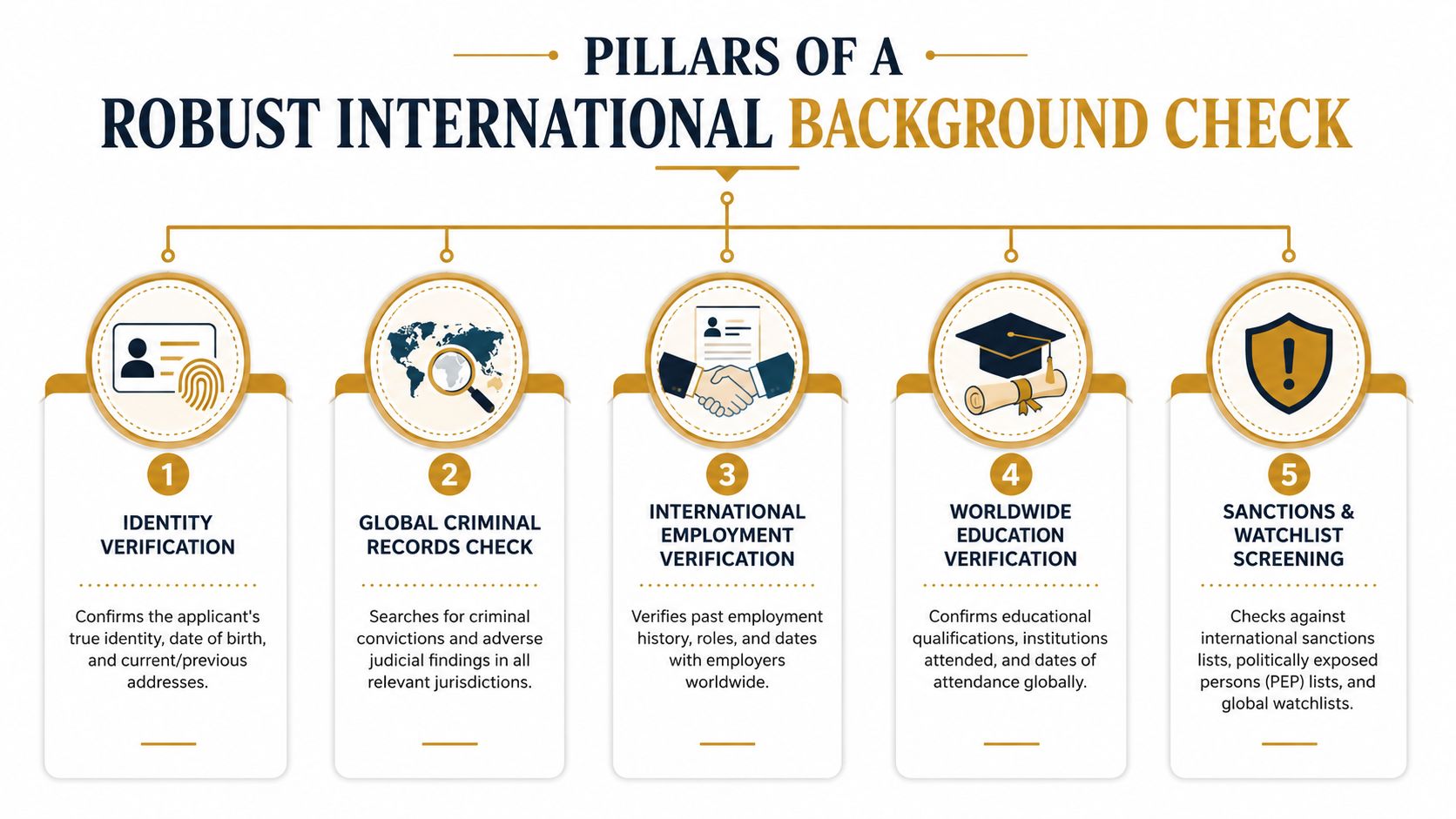
For UK employers, the practical methodology is clear: identify all countries of prior residence, obtain explicit written consent under UK GDPR, submit requests to national authorities in each relevant country, and verify employment and education credentials alongside criminal records. The standard search usually covers the last 7–10 years and completes in 3–10 business days, depending on the jurisdictions involved (Sterling's UK guidance on global screening).
Identity verification
This comes first because every other check depends on it. Names vary across documents. Dates of birth are entered differently in different systems. Previous addresses may be incomplete or translated inconsistently.
Identity verification should reconcile:
- Core identity details such as full legal name, date of birth, and nationality
- Document history including passport and any relevant visa paperwork
- Address history across the countries that matter for screening
If identity isn't pinned down properly at the start, the rest of the report can become unreliable.
Country-specific criminal record checks
Families often expect a single global search. That doesn't exist in any meaningful universal form. Criminal checking has to be built country by country.
For childcare roles, I want to know where the candidate has lived, worked, or studied. That determines which authorities need to be approached and what records are legally available. The right check for a candidate from the United States won't look the same as the right check for someone from France or the UAE.
Employment and qualification verification
It becomes clear whether polished CVs hold up or don't. In private homes, title inflation is common. So are vague dates and references that confirm personality but avoid specifics.
A thorough check verifies:
| Area | What should be confirmed |
|---|---|
| Employment | Role title, dates, employer identity, and reason for leaving where available |
| Education | Institution attended, qualification earned, and attendance dates |
| Professional standing | Relevant childcare training or licences where applicable |
Sanctions and watchlist screening
For many families, this is less about corporate compliance and more about household risk. Private homes involve travel, discretion, access, and trust. Watchlist and sanctions screening won't replace the core checks above, but it can surface concerns that deserve closer review.
Good vetting doesn't chase volume. It builds a coherent file from the right jurisdictions and the right records.
Navigating the Global Screening Process
Once you know what needs to be checked, the next issue is how to run the process legally and efficiently. At this point, many placements start well and then stall.
Start with lawful consent
The first priority is consent that works in the relevant jurisdictions, not just in the UK. That sounds simple. It often isn't.
A critical nuance highlighted by Complygate is that some jurisdictions require country-specific consent forms, and a standard UK template may be invalid. A delayed or failed check can happen because the paperwork is wrong, and a candidate's refusal to sign a non-compliant form may be a legal requirement in their home country rather than a warning sign (Complygate's guide to global background checks).
That's why a rushed “please sign this form today” approach causes trouble. Families need a process that respects both UK GDPR and local law.
Build the candidate's jurisdictional map
Before any provider can screen properly, someone needs to map the candidate's real footprint. Not just where they're from, but where they've lived and worked.
A sound intake asks for:
- Residence history: Every country where the candidate has lived for a meaningful period
- Work history: Employers, job titles, and dates across jurisdictions
- Study history: Schools, colleges, training institutions, and professional courses
- Name variations: Maiden names, alternate spellings, and local-language versions where relevant
The biggest errors happen when families check nationality but miss residency. A Spanish nanny who worked in Qatar and studied in Switzerland shouldn't be screened only in Spain.
Decide who should manage the process
Parents can try to coordinate checks themselves, but international screening is one of those tasks that looks straightforward until the first complication appears. Records are issued by different bodies, response times vary, and some countries require local handling or specific forms.
For families who want a managed route, providers can coordinate the workflow, gather documents, and handle jurisdiction-specific requests. One option in the childcare sector is the nanny vetting process for discerning families, which outlines how vetting is structured for private household hiring. In practice, some agencies also offer dedicated international background check services for candidates with overseas histories.
Plan for delays without lowering standards
Urgent placements create pressure, especially with maternity nurses, rota roles, or relocation timelines. That pressure shouldn't tempt you into skipping a country because it's slow.
A more disciplined approach is to:
- Start early: Request documents as soon as the candidate reaches serious consideration.
- Sequence the checks: Run faster jurisdictions immediately while slower jurisdictions are in motion.
- Set expectations clearly: Tell the candidate what's needed and why.
- Avoid guesswork: If a country has restrictions, use compliant alternatives rather than improvising.
Speed matters. Accuracy matters more when the hire will live and work inside your home.
Interpreting Results and Making Safe Decisions
A background report doesn't make the hiring decision for you. It gives you verified information so you can make that decision properly.

Read for relevance, not drama
Some findings are immediately disqualifying for childcare. Others need context. The essential question is whether the issue is relevant to the actual role.
Expert guidance from INTOO notes that 85% of UK employers encounter candidates who fail checks, and that all screening must satisfy five conditions: consent, legitimate purpose, role relevance, necessity, and proportionality. It also identifies a common error: failing to tell candidates about negative findings before making a hiring decision, which can breach UK GDPR (INTOO on background check compliance pitfalls).
That framework matters in a private household. You are not looking for reasons to reject people casually. You are assessing risk fairly.
What tends to count as a serious red flag
In domestic staffing, the most concerning issues are the ones that speak directly to safety, honesty, or access.
| Type of finding | Why it matters in a private home |
|---|---|
| Violence-related history | Raises obvious safeguarding concerns |
| Child-related offences | Incompatible with childcare roles |
| Fraud or financial dishonesty | Relevant where staff handle expenses, cards, or valuables |
| Identity discrepancies | Undermines the reliability of the entire application |
| Fabricated employment or qualifications | Calls competence and honesty into question |
These findings don't all carry the same weight, but they should never be brushed aside because the candidate interviewed well.
What may require context and discussion
Not every adverse entry means the candidate should be rejected. Sometimes a report shows an inconsistency, a historic issue, or an administrative problem that needs clarification.
That's where disciplined interpretation helps. Ask:
- Is the finding clearly verified?
- Is it relevant to sole-charge childcare or household trust?
- How old is the issue within the reporting scope?
- Has the candidate disclosed it already, or tried to conceal it?
A report should prompt judgement, not panic.
Candidate fairness is part of good vetting
Families often focus on protection, which is right. They should also value procedural fairness. If there's an adverse finding, the candidate needs an opportunity to respond before a final decision is made.
That matters legally and practically. Reports can contain errors, mistranslations, or incomplete context. Giving the candidate a chance to address the issue helps you distinguish between a real red flag and a record that needs correction.
For households where discretion is as important as safeguarding, that same principle carries into information handling. Sensitive reports and hiring discussions should be managed with the same care described in this guide to private staff confidentiality for high-profile families.
Integrating Checks for Total Peace of Mind
The safest hires come from a joined-up process. A strong interview, meaningful references, identity verification, right-to-work review, DBS where relevant, and properly scoped international background checks should all support each other.
When families miss one layer, they usually don't realise it until later. The candidate may still be excellent. But hope is not a safeguarding method. Verification is.
For children's roles, international checks are not an administrative flourish. They're part of how careful households reduce preventable risk while still hiring with fairness and respect. The process can be detailed, and some jurisdictions are slower or stricter than others, but that doesn't make the work optional. It only means it should be handled properly from the start.
If you want a rigorous and discreet vetting process managed with the level of care a private household requires, contact Superstar Nannies for a confidential consultation.
Frequently Asked Questions
When does a nanny need international background checks
Start asking the question as soon as a candidate has spent a meaningful period outside the UK. In practice, if a nanny has lived, worked, or studied abroad for several months, I treat overseas checks as part of the file rather than an optional extra.
The exact threshold depends on the role, the country, and what records are legally available. The point for families is simpler. If a candidate's recent history crosses borders, the vetting should cross borders too. There is no single global certificate that covers everything.
How long do international background checks take
Expect anything from a few business days to several weeks. The timeline depends on the country, whether the record is court-based or police-issued, whether fingerprints are required, and how quickly the candidate returns valid consent and identity documents.
The avoidable delays are usually administrative. A missing middle name, an old address in the wrong format, or consent that does not meet local rules can stop a search before it starts. Families often focus on speed. I focus on getting the scope and paperwork right first, because a fast but incomplete result does not protect anyone.
Can the Home Office or visa process replace private screening
No. Visa approval answers an immigration question. It does not give a private household a full safeguarding file.
A candidate can have the right to work in the UK and still require separate criminal record checks, identity verification, reference testing, and overseas screening relevant to the role. Reporting on gaps in Home Office criminal record certificate checks shows why private employers should not treat visa status as proof of full vetting (Migration Central on Home Office background check gaps).
Are UK organisations consistently checking overseas candidates properly
Standards vary widely. Some employers screen international histories carefully. Others stop at a UK DBS and a passport check, which leaves obvious blind spots for anyone who has spent time abroad.
That gap matters most in childcare. A UK result only covers what UK systems can lawfully and practically show. If part of a candidate's adult history sits in another jurisdiction, families need to ask what was checked, what could not be checked, and whether the consent obtained would stand up in that country.
What documents might be needed from a candidate
Expect to collect proof of identity, previous names, date of birth, nationality, address history, and signed consent forms. Some countries also require passport copies, local ID numbers, proof of current address, fingerprints, or an application signed in a specific format.
Families often encounter challenges. Consent that works in one country may not be enough in another, and a candidate cannot lawfully be screened everywhere on the same basis. If the paperwork is incomplete or the consent is not valid for the jurisdiction, the check may be delayed, rejected, or produce a result that should not be relied on.
If you're hiring for a private household and need a discreet, properly structured vetting process, Superstar Nannies can help you assess candidates with the level of care international placements require.