


When it comes to your child's health, having complete trust in your caregiver is everything. Proper medication administration training is no longer just a bonus skill for nannies—it's a fundamental pillar of professional, safe, and reliable childcare. For parents, it provides invaluable peace of mind. For nannies, it’s a non-negotiable part of your professional toolkit.
Why Medication Administration Training is a Non-Negotiable Skill
Managing a child’s medication is a high-stakes responsibility that requires precision, focus, and a strict adherence to safety protocols. A small mistake can have serious consequences, which is why formal training is an essential qualification. For parents, knowing your nanny has been professionally trained to handle this critical task allows you to breathe easier, confident that your child is in the safest hands.

A Foundation of Trust and Professionalism
For nannies, completing a medication administration course speaks volumes about your commitment to your career. It demonstrates that you understand the immense responsibility you hold and are dedicated to upholding the highest safety standards. This goes far beyond simply reading instructions on a medicine bottle—it’s about adopting a systematic approach that protects the child, the family, and you.
Understanding the Legal Duty of Care
In the UK, the legal landscape surrounding childcare is clear. For professionals in health and social care, medication administration training is a core requirement that sets the benchmark for competence. This crucial training covers the 'golden rules' of giving medication, accurate dosage calculations, risk assessments, and meticulous record-keeping, all of which are vital for minimizing health risks.
This training elevates a caregiver's role. You're no longer just following instructions; you're actively and safely managing a critical part of a child's health within a proven safety framework that informal guidance simply can't offer.
Ultimately, this skill is a cornerstone of a modern nanny's capabilities. It stands alongside other vital qualifications and is a key component of robust child protection policies. By investing in this training, you prove you are prepared, responsible, and worthy of a family's complete trust.
Mastering the Core Principles of Medication Safety
So, what should you really expect from proper medication administration training? It’s not just a quick run-through of medical terms. It’s about building a deep-seated, almost instinctive understanding of safety protocols that protect the children in your care.
Think of it this way: a pilot wouldn't dream of taking off without completing a pre-flight checklist. The same rigorous, methodical approach applies here. At the very centre of this training is a framework known as the ‘Five Rights’ of medication administration. Getting this right, every single time, is non-negotiable.
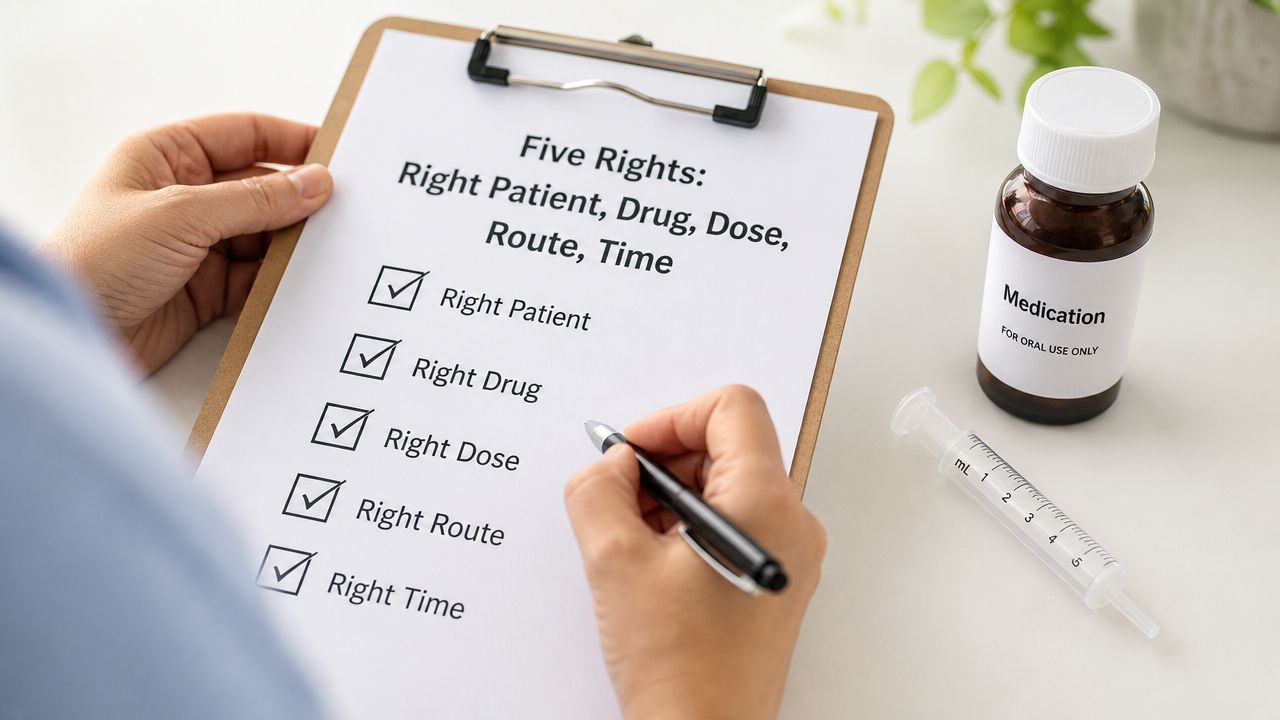
This simple but powerful system is designed to catch potential errors before they happen, ensuring the child’s absolute safety. It's a foundational skill that every professional caregiver must master.
Unpacking the ‘Five Rights’
To truly get to grips with medication safety, you need to understand what these 'Five Rights' look like in a real home environment. This framework is the bedrock of any credible training programme, teaching you to systematically check every detail before you administer anything. For another perspective, you can see this guide from FindMyScript on medication administration.
The table below breaks down these five critical checks. Think of it as your go-to reference for safe practice.
The ‘Five Rights’ of Safe Medication Administration
| The ‘Right’ Check | What It Means in Practice |
|---|---|
| Right Child | Always confirm you have the correct child, especially if you care for siblings. A simple, "Okay, Alex, it's time for your medicine," can prevent a serious mix-up. |
| Right Medication | Read the label carefully. Many medicines have similar-sounding names or packaging. Double-check that the bottle in your hand is exactly what was prescribed. |
| Right Dose | Measure the dosage with precision using the correct tool (like an oral syringe, not a kitchen spoon). Even a tiny miscalculation can have a big impact on a small child. |
| Right Route | Check how the medicine should be given. Is it to be swallowed, applied to the skin, or inhaled? The route is just as important as the dose for the medicine to work correctly. |
| Right Time | Stick to the schedule provided by the doctor or parents. Consistent timing is often crucial for the medicine's effectiveness and to maintain the right level in the body. |
This systematic check, performed every single time, is the key to preventing errors and building trust with the families you support.
Beyond the Basics: Key Curriculum Elements
A truly comprehensive medication administration training course pushes far beyond just memorising the 'Five Rights'. It gives nannies the confidence and competence to handle a child's health needs in a more holistic way.
Quality training empowers a nanny to be a proactive partner in a child's health. It's about developing the critical thinking to not only follow instructions but to spot potential issues before they become problems.
A good course will teach you how to make sense of doctors' prescriptions, understand the practical differences between liquids, tablets, and inhalers, and spot common side effects. Crucially, it must provide hands-on practice in paediatric dosage calculation—a vital skill where there is absolutely no room for error.
This expertise complements other essential skills, like knowing how to respond in an emergency. To learn more about that, have a look at our guide on essential paediatric first aid skills. For parents, knowing what's in a good training curriculum will help you ask the right questions and hire a nanny with skills that truly matter.
Navigating Your Legal and Regulatory Responsibilities
When you give a child medicine, you're taking on a huge responsibility—one that comes with real legal and professional expectations. This is much more than just another task on your daily list. For nannies and private household staff, understanding these duties is non-negotiable. It's about protecting the child, the family, and your own professional integrity.
At the heart of it all is the need for informed consent and written authorisation from the parents for every single medication. A quick ‘yes’ over the phone simply won’t do. You must have a clear, documented instruction that spells out what to give, how much, and when. This is your legal green light.
Think of your medication log as the ship's logbook for the child's health. It’s an undeniable legal record of every action you take—the date, time, dose given, and any notes about how the child responded. Meticulous records are your best professional safeguard.
Establishing Clear Household Protocols
To create a safe and legally sound environment, you need clear, written protocols agreed upon with the family. These aren't just helpful suggestions; they are the essential ground rules for medication safety in the home.
A strong set of protocols should always cover:
- Authorisation: A specific, signed form from the parents for each medication.
- Storage: A clear plan for where medicines will be kept securely, well out of reach of any children.
- Administration: A firm commitment to checking the ‘Five Rights’ before giving any dose.
- Record-Keeping: A detailed medication administration record (MAR) chart that is filled out immediately every time.
- Disposal: A safe and agreed-upon procedure for disposing of out-of-date or leftover medicines.
Putting these formal systems in place helps eliminate confusion and significantly cuts down the risk of mistakes. And make no mistake, errors can happen even in the most well-run households. Research has shown that even in formal healthcare settings, medication errors are a persistent risk, which highlights why proper, skills-based training is so crucial for anyone in a caring role.
Upholding Professional and Regulatory Standards
Taking these responsibilities seriously is what separates a good nanny from a truly great one. It shows a deep commitment to the highest standards of safety and professionalism—the very qualities that build a long-lasting, trusted relationship with a family.
This level of competence is also what regulatory bodies look for. For example, if you are an Ofsted-registered nanny, demonstrating this rigour is a core part of meeting your professional obligations.
Beyond the household, it’s also wise to understand the wider regulatory landscape that keeps medical services safe. Knowing how and why providers are held to high standards reinforces the importance of your own role in the chain of care. For an interesting look at this process in action, you can read about XO Medical's GPHC approval status.
Ultimately, your diligence with these legal and regulatory details is what builds the foundation of trust that every successful nanny-family relationship is built on.
Building an Ironclad Medication System at Home
All the training in the world means very little without a practical, reliable system in place at home. This is where theory meets reality. A well-designed medication protocol is what transforms good intentions into safe, consistent actions, ensuring every dose is given correctly and logged without fail. This isn't about creating needless bureaucracy; it's about establishing a simple but robust framework that removes guesswork and minimises risk.
At its heart, an effective home medication system is built on three key habits: secure storage, meticulous record-keeping, and a culture of double-checking. For some great tips on managing loved one's medications, that resource offers excellent advice. By embedding these principles into the daily routine, families and nannies create a process that inspires confidence and, most importantly, protects the child.
Secure and Organised Storage Solutions
The first and most non-negotiable rule in a home with children is secure storage. Period. All medicines must be kept in a designated, locked container or cabinet, completely out of sight and reach. This is about more than just preventing a child from accidentally getting their hands on them; it's also about basic organisation.
A tidy, well-organised medicine cabinet means you can find the right medication quickly, drastically reducing the chance of grabbing the wrong bottle in a rush. Make sure everything is clearly labelled and, whenever possible, keep medicines in their original packaging. This keeps crucial information, like expiry dates and dosage instructions, right where you need it. For anything that needs to be kept in the fridge, use a separate, clearly marked container to avoid any mix-ups.
The Power of the Medication Administration Record (MAR)
The Medication Administration Record, or MAR, is the bedrock of your entire system. It’s the single source of truth. This is not just a quick note scribbled in a daily diary; it’s a formal, detailed log of every single dose administered. A properly maintained MAR chart is your strongest defence against common but dangerous errors like double-dosing or missing a dose entirely.
Think of the MAR as the central nervous system of your medication protocol. It connects the doctor's instructions, the nanny's actions, and the child's response, creating a complete and transparent record of care.
At a minimum, your MAR should have columns for:
- The child’s full name and the specific medication.
- The prescribed dose, the route (e.g., oral, topical), and the exact time it's due.
- A space for the caregiver to initial immediately after giving the dose—not before, not later.
- A section for notes to record any observations (e.g., "child seemed sleepy afterwards," "refused first attempt").
This document is far more than a simple checklist; it's a critical communication tool between parents, nannies, and any other caregivers. Furthermore, should any medical issue or discrepancy arise, this log becomes an indispensable legal record. You can learn more about how this ties into your professional duties in our guide to employment liability coverage.
This infographic gives a clear visual of the workflow every professional caregiver should follow.
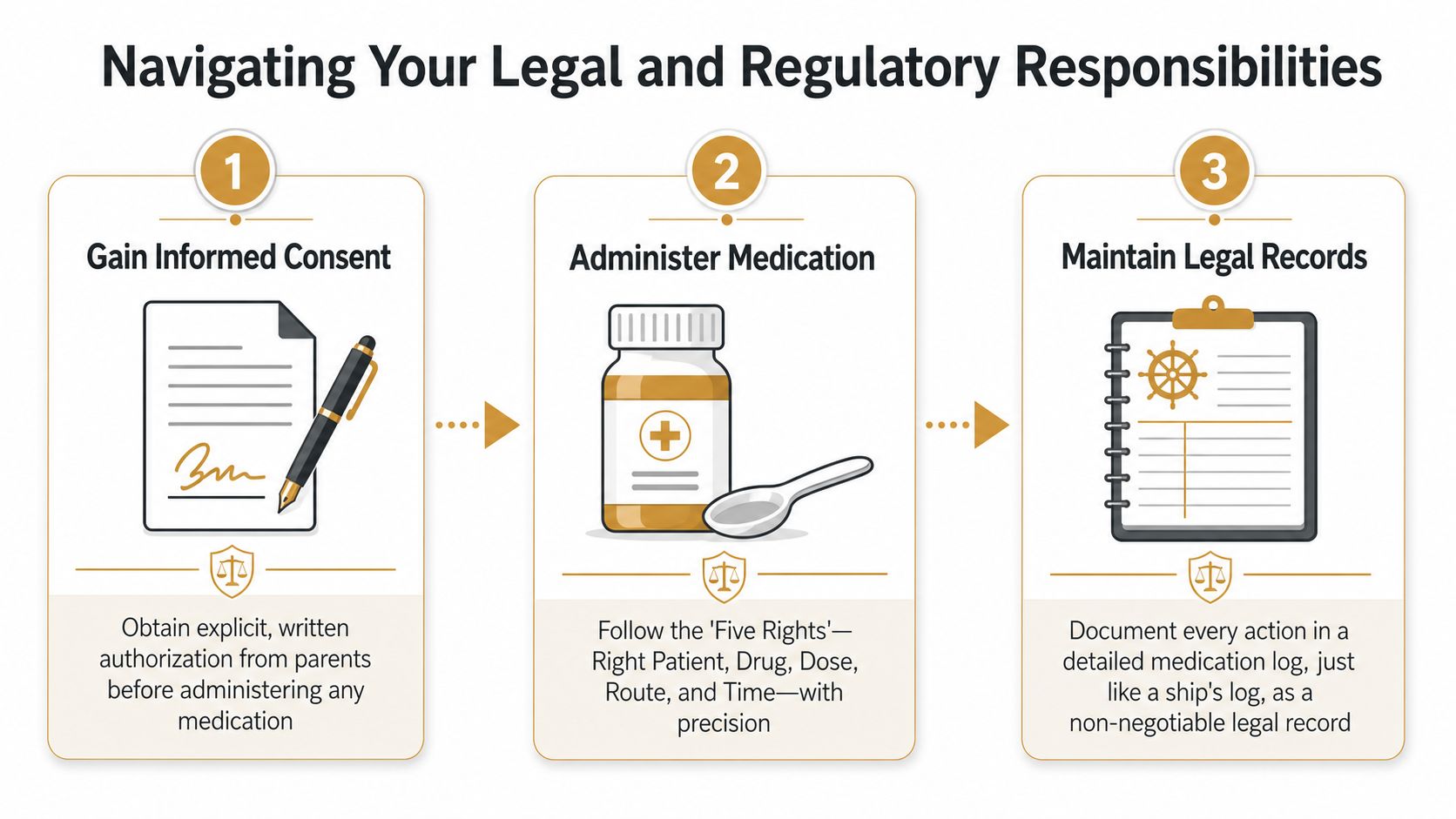
As you can see, the process shows that safe administration is a chain of precise actions, from getting the right permissions to documenting every single step.
Failsafe Procedures for Dosage and Checks
Finally, you need to embed failsafe procedures into the daily routine until they become second nature. The single most effective habit you can build is the "double-check" rule.
Before you even think about administering a medicine, simply pause. Re-read the MAR, then re-read the medication label one last time. This simple, two-second habit is incredibly powerful for catching potential errors before they happen. Always use the specific measuring tool that came with the medicine, like an oral syringe or a calibrated spoon—never a regular kitchen spoon.
By combining secure storage, diligent records, and routine checks, you create an ironclad system that puts the child's safety above all else.
How to Choose an Accredited Training Course
Navigating the world of medication administration training can feel a bit overwhelming. With so many courses out there, it’s tough to tell a genuinely valuable programme from a simple “certificate mill.” Choosing the right one isn't just about ticking a box; it's a serious investment in your career and, more importantly, in a child's safety.
You'll find everything from fully online modules to intensive, in-person workshops. The best fit for you will hinge on your learning style, budget, and how much hands-on practice you feel you need. That said, there are a few universal hallmarks of quality that should be non-negotiable.
Spotting Quality and Avoiding Red Flags
So, what should you look for? First and foremost, check for proper accreditation. In the UK, reputable courses are often accredited by bodies like the CPD (Continuing Professional Development) Certification Service. This is your assurance that the training has been independently vetted and meets high educational standards.
Be wary of any programme that promises certification in just an hour or that lacks a practical assessment. Administering medication is a hands-on skill, full stop. A quality course will always include a practical element where you have to prove you can measure a dose, use the equipment, and follow protocols correctly while an expert observes.
A certificate proves you sat through a course; a practical assessment proves you mastered the skill. Discerning parents and premier agencies know the difference.
Comparing Different Course Formats
To help you decide, it’s useful to weigh the pros and cons of the main training formats. Each one has its place, depending on your individual circumstances. Online courses offer fantastic flexibility, while in-person sessions provide that crucial hands-on practice. Blended models, meanwhile, try to give you the best of both worlds.
This table breaks down the key differences to help you find the format that aligns with your professional goals.
Comparing Medication Training Course Formats
| Format Type | Best For | Pros | Cons |
|---|---|---|---|
| Online | Nannies needing a flexible refresher or those with a solid foundation of practical experience. | Self-paced learning fits around busy work schedules. Often more affordable. | Lacks hands-on assessment. Can be isolating and requires self-discipline. |
| In-person | Nannies who are new to the skill or want to build confidence with expert feedback. | Direct, hands-on practice and assessment. Opportunity to ask questions and learn from peers. | Requires a set time commitment and is usually more expensive. Less flexible. |
| Blended | Professionals seeking a comprehensive experience that combines convenience with practical skill-building. | Combines the flexibility of online theory with the rigour of an in-person assessment. | Can be harder to find and may require coordinating separate online and practical sessions. |
Ultimately, choosing an accredited medication administration training course is an investment in your professionalism and in the wellbeing of the children you care for. Whether you go for an online, in-person, or blended format, make sure the programme you choose has CPD accreditation and a robust practical assessment. This is what ensures you are not just certified, but truly competent and confident in your skills.
Conclusion: Becoming the Gold Standard in Childcare
When it comes down to it, completing formal medication administration training is about much more than simply adding another line to your CV. It’s a powerful signal to families—a clear statement that you are deeply committed to a child’s health and safety above all else.
This qualification sets a serious childcare professional apart, showing you’re ready to handle one of the most critical responsibilities with genuine competence. Throughout this guide, we've explored the core skills you need: mastering the ‘Five Rights’ of safety, understanding your legal duties, and setting up foolproof protocols for storage and record-keeping. Together, these elements form the bedrock of truly professional, trustworthy care.
For families who prioritise this level of professionalism, the peace of mind it brings is immeasurable. If you value these impeccable standards and are looking for a nanny who embodies this commitment, contact Superstar Nannies today. We specialise in connecting families with rigorously vetted professionals who represent the very best in childcare.
FAQs on Medication Administration Training
It's completely normal for families and nannies to have questions about the finer points of medication administration. Here are answers to some of the most common queries we hear.
Is a nanny legally allowed to give medication in the UK?
Yes, a nanny can legally give medicine to a child, but only with explicit, written consent from a parent or legal guardian. This isn't just a suggestion; it's a fundamental legal requirement. However, to truly fulfil their duty of care, a professional nanny needs formal medication administration training. This teaches them how to handle medicines safely, calculate doses with precision, and keep meticulous records that protect the child, the family, and the nanny.
How often does medication administration training need to be renewed?
The gold standard, and the strong recommendation from most UK accrediting bodies, is an annual refresher course. While a certificate might not have a formal expiry date, medical guidelines evolve and practical skills can get rusty. An annual update ensures a nanny stays current on best practices and sharpens their skills, which is vital when caring for children with complex health needs where there is zero room for error.
What is the difference between this training and paediatric first aid?
That's a great question, as the two are often confused but cover very different, equally important ground.
- Paediatric First Aid is for the unexpected. It's about emergency response, giving a nanny the skills to act decisively during a crisis like choking, a severe injury, or performing CPR.
- Medication Administration Training is for the planned. It’s about the safe, routine, and precise delivery of prescribed medicines, covering legal protocols, dosage, and record-keeping in a non-emergency context.
A true professional should be certified in both.
Can I just show my nanny how to give my child's medicine?
While showing your nanny your child’s specific routine is essential, it's no substitute for formal training. A quick demonstration covers the 'how' for one medicine but misses the 'why' behind universal safety protocols. Accredited medication administration training provides the professional framework that underpins everything, teaching the core principles—from legal duties to error prevention—that apply to all medicines. This formal knowledge ensures a consistent, high standard of care and provides a critical layer of safety for your child.
What should be included in a medication consent form?
A comprehensive consent form is a legal and practical necessity. It should include the child's full name, the name of the medication, the specific dose, the route of administration (e.g., oral, topical), the time it should be given, and the start and end dates for the course of medicine. It must be signed and dated by a parent or legal guardian. This written authorisation is crucial for ensuring clarity and protecting everyone involved.