


If you're looking for a special needs nanny, you're probably not looking for “help with childcare” in the generic sense. You're looking for somebody who can step into a busy, emotionally loaded, highly specific family system and make daily life feel steadier, safer, and more manageable for your child and for you.
That distinction matters. The right hire doesn't just supervise. They support routines, reduce friction, communicate clearly with parents, and fit around school, therapy, sensory needs, medical considerations, and family dynamics without turning your home into a clinical setting.
Beyond Babysitting Understanding the Special Needs Nanny Role
A special needs nanny is a childcare professional whose work goes beyond feeding, play, naps, and school pick-ups. They provide individualised, structured support for a child whose needs may involve neurodiversity, physical disability, sensory processing differences, behavioural regulation, communication challenges, or complex daily routines.
For many families, the search begins after standard childcare stops working. A child may become overwhelmed by unpredictable transitions. Nursery pick-ups may end in distress. School handovers may require far more communication than a typical nanny role covers. Parents often realise they don't need more childcare hours. They need a different level of skill.
That need is far from rare. In England and Wales, the 2021 Census reported 16.0 million disabled people, representing 18.4% of the population, and 28.8% of households included at least one disabled person, according to this UK special needs nanny overview. That's why specialist care should be viewed as part of a large, established family need, not an edge case.
What makes the role different
A standard nanny may be excellent with children generally. A special needs nanny must also know how to:
- Follow structured routines that reduce overwhelm
- Support communication differences without pressure or frustration
- Handle transitions carefully between home, school, therapies, and public settings
- Work consistently with parents' strategies rather than improvising every day
- Notice small changes in regulation, energy, behaviour, mobility, or tolerance
Practical rule: If a child needs predictability, tailored communication, or close coordination with adults around them, standard childcare experience alone usually isn't enough.
What doesn't work
Families often struggle when they hire someone who is warm and willing, but too generalist for the role. Good intentions don't replace judgement. A special needs nanny must know when to prompt, when to pause, when to simplify, and when to escalate to a parent or clinician.
The role sits in the space between home life and a wider care plan. Done well, it gives a child continuity and gives parents room to breathe.
The Spectrum of Care From Neurodiversity to Physical Support
“Special needs” is a broad phrase, and that's one reason families can feel unseen by generic advice. The practical question isn't the label. It's what support your child needs at home, in transit, after school, during meals, at bedtime, and out in the world.
Here's a simple way to think about it.
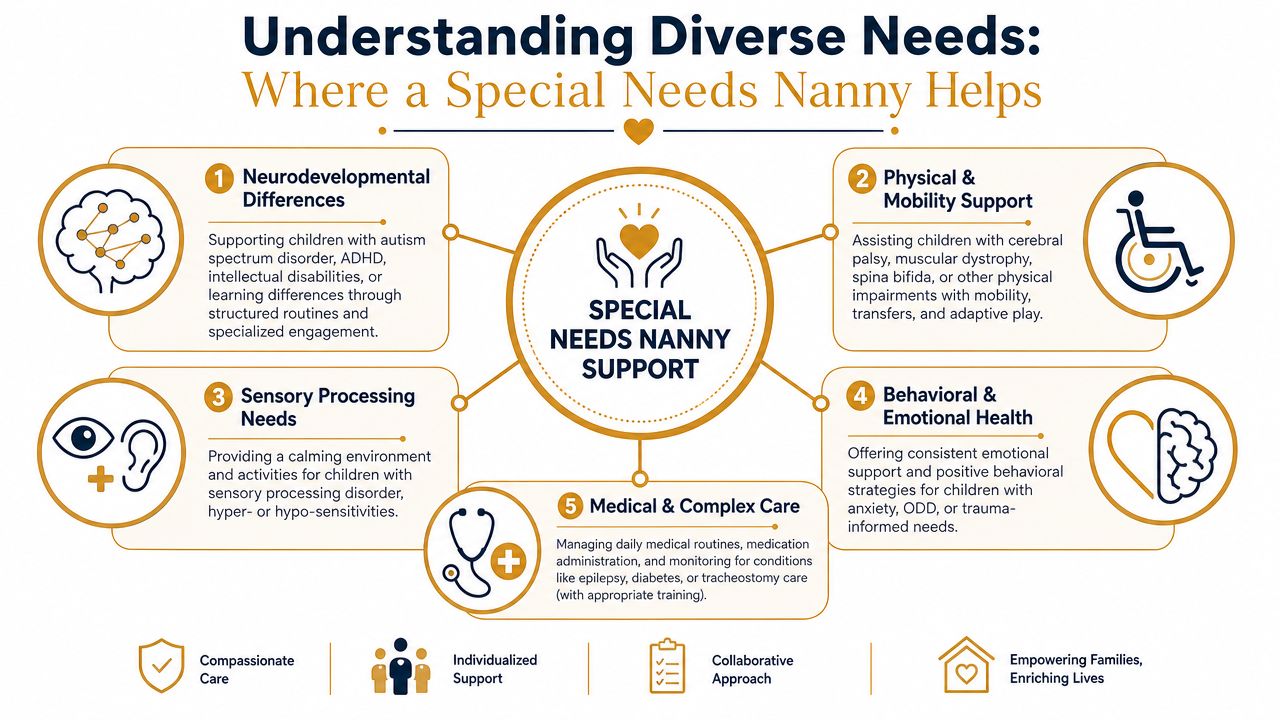
In England, the Department for Education reported that 1.7 million pupils were identified as having special educational needs in January 2025, equal to 18.4% of all pupils. Of these, 480,000 had an EHC plan and 1.2 million received SEN support, as noted in this summary of SEN childcare demand. In real family life, that often means care has to fit around school support, not just around parents' work schedules.
Neurodevelopmental differences
For children with autism, ADHD, developmental delay, or related differences, the nanny's value often lies in structure. The day needs rhythm. Instructions need to be clear. Activities need to be matched to regulation, not to an ideal timetable.
A strong nanny in this area might:
- Use visual prompts for dressing, toileting, snack time, and transitions
- Break tasks down so the child isn't hit with too many demands at once
- Prepare for changes rather than announcing them abruptly
- Build in recovery time after school or social settings
Families managing learning differences often need support that is calm, practical, and non-shaming. If that's relevant in your home, Children Psych's guide for parents is a useful primer on how learning disabilities can affect everyday functioning, not just academics.
Physical and mobility support
Some children need help with movement, transfers, positioning, adaptive equipment, fatigue management, or safe participation in play. In these cases, a nanny isn't there to “watch” the child. They help the child move through the day with dignity and consistency.
That can include:
- Safe school handovers where access and timing matter
- Adaptive play planning so the child can participate rather than sit out
- Close attention to pace because rushing can create stress or physical strain
Where a child's needs cross into clinical routines, families may also need a more specialised role alongside nanny support. Some households decide to pair childcare with a medically trained professional, such as the options discussed in this guide to a private medical nurse for little ones.
Sensory, behavioural, and complex daily needs
Many families don't need therapy at home. They need a caregiver who can protect regulation. Busy streets, loud school gates, fluorescent shops, scratchy clothing, hunger, fatigue, or unexpected changes can push a child beyond their window of tolerance very quickly.
The best support often looks ordinary from the outside. A quieter route home, a slower transition, a familiar snack, a well-timed pause.
For children with behavioural or emotional regulation challenges, the nanny should be able to hold boundaries without escalating the moment. For children with medical routines, the nanny must stay within training and clearly documented responsibilities. That's where careful job design matters. The role should support the child fully, but it should not drift into unqualified clinical practice.
Anatomy of an Elite SEN Nanny Skills, Qualifications, and Character
Parents often ask what makes one candidate merely experienced and another exceptionally qualified. The answer isn't a single certificate. It's a combination of character, professional skill, and proven specialist competence.
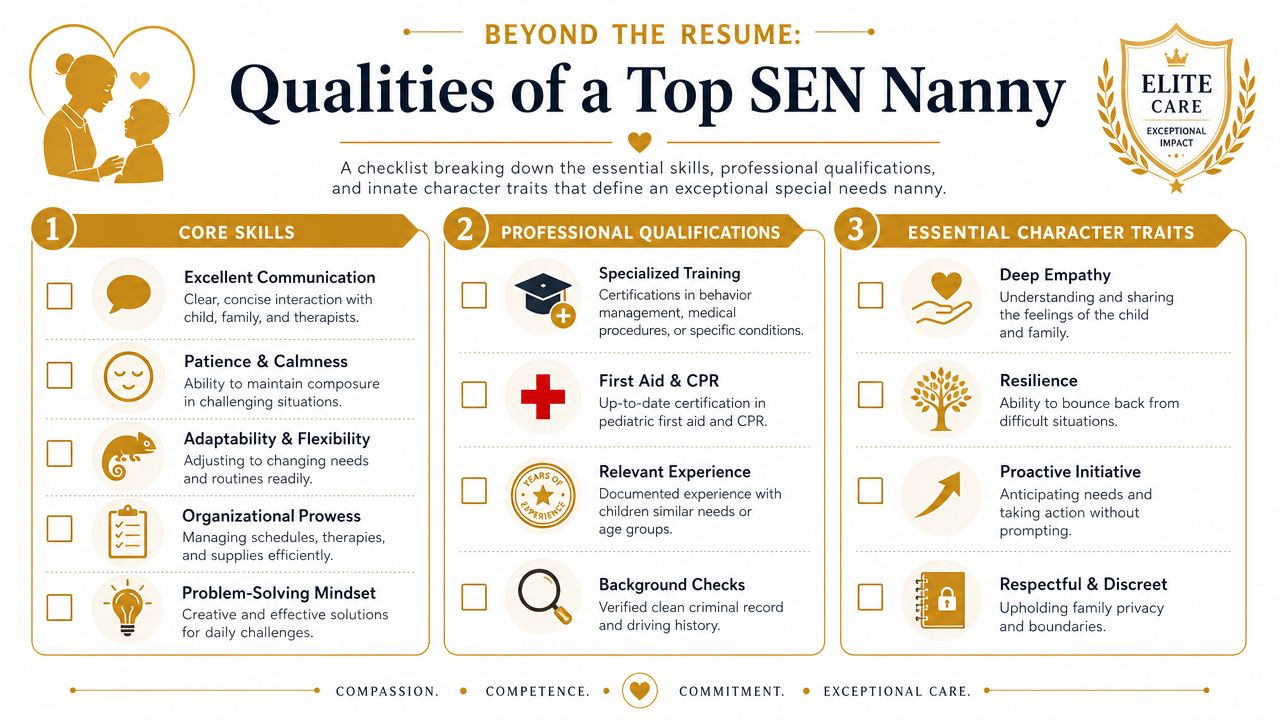
Guidance for this role consistently points to the same benchmark. A special needs nanny must be able to implement structured, individualised support with parents and therapists, using clear instructions, smaller task steps, visual supports, and dependable routines, as outlined in this practical briefing on special needs nanny skills.
The foundation of the role
Before qualifications, there's temperament. Families often underestimate this because CVs are easier to compare than character.
A high-calibre SEN nanny is usually marked by:
- Patience under pressure when a child needs more time, fewer words, or a reset
- Emotional steadiness when plans unravel
- Respect for the child's pace, dignity, privacy, and strengths
- Resilience because some days are repetitive, demanding, or unpredictable
If a candidate presents as endlessly upbeat but can't describe how they stay calm in difficult moments, that's a concern. This work rewards consistency more than charm.
The professional middle layer
A nanny in this category must be more organised than the average childcare professional. Families often need someone who can hold several moving parts at once.
That typically includes:
| Area | What good looks like |
|---|---|
| Communication | Clear daily updates, concise handovers, and accurate notes |
| Routine management | Following agreed strategies rather than ad-libbing |
| Safeguarding | Knowing when a concern is behavioural, medical, emotional, or environmental |
| Practical judgement | Adjusting expectations without lowering standards unnecessarily |
The broader competencies expected of strong childcare professionals still matter. This overview of the top skills every nanny must have is useful background, but SEN roles demand those same skills at a higher level of precision.
Advanced specialist value
Not every family needs formal therapy training. Some do. Others need a nanny who has worked successfully with similar profiles and can evidence it through references and detailed examples.
Look for candidates who can explain:
- How they adapt communication for a child who processes slowly or differently
- How they encourage independence without causing shutdown or frustration
- How they document patterns so parents can spot what helps and what doesn't
A polished CV matters less than a candidate who can explain, calmly and specifically, what they did in real situations and why they chose that approach.
A Day in the Life Core Duties and Collaborative Responsibilities
The daily work of a special needs nanny is rarely dramatic. It's a series of small, well-judged decisions that make the day easier for the child and more manageable for the family.
A typical morning might begin with a wake-up routine that's deliberately predictable. The nanny uses the same sequence, the same cues, and the same pacing each day. Dressing isn't just about getting ready. It may involve sensory preferences, choices that reduce resistance, or extra time for fine motor effort. Breakfast may need visual options, medication awareness, or a quiet environment before the school run.
What the daily routine actually involves
By the afternoon, the role becomes even more nuanced. Many children use a great deal of effort to cope at school, then unravel at home. An experienced nanny doesn't misread that as bad behaviour. They read it as information.
An effective after-school routine may include:
- A low-demand arrival home rather than immediate questions
- A familiar snack and hydration routine before any tasks
- Movement or sensory regulation time before homework or therapy carryover
- Careful observation of signs of overload, fatigue, or dysregulation
Bedtime often follows the same principle. The nanny creates a landing strip for sleep. That may mean dimming the environment, reducing language, sticking to a known order of events, and not overcomplicating the evening.
The teamwork side families often miss
What separates this role from ordinary childcare is the amount of collaboration around the child.
The nanny may be the adult who notices patterns first. Which school days cause the most distress. Which route home works better. Which food, activity, or transition tends to trigger refusal. Which phrasing the child responds to. Those observations are valuable when they're recorded clearly and shared appropriately.
Common collaborative responsibilities include:
- Updating parents with concise, useful handovers
- Following therapist or school strategies exactly as agreed
- Using shared logs or communication books for consistency
- Attending care discussions when the family wants the nanny involved
For a broader look at how these tasks sit within the profession, this guide on what nannies do is a helpful reference point. In SEN placements, the same core duties remain, but each one carries more weight because consistency has a direct effect on the child's day.
The nanny often becomes the thread that keeps home, school, and parent expectations from pulling in different directions.
The Ultimate Hiring Guide Interview Questions and Red Flags
The interview stage matters more here than in almost any other household hire. Skills on paper can look excellent. The core question is whether the candidate can apply them under pressure, in your child's actual context, and in a way that respects your family's values.
A standard interview won't tell you enough. You need scenario-based questions that reveal judgement, self-awareness, and emotional control.
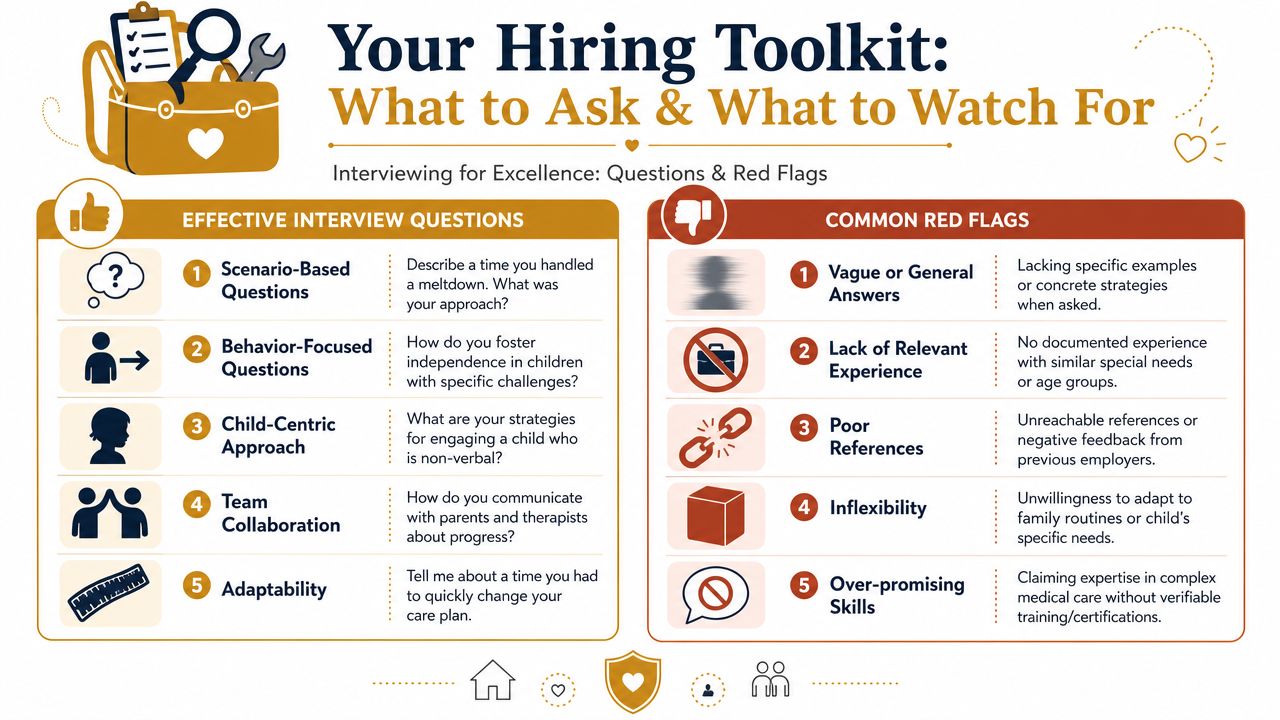
Interview questions that expose real competence
Ask questions that force a candidate to describe a specific moment, not a general philosophy.
Try prompts like these:
Tell me about a time a child became dysregulated in public.
Listen for how they assessed the trigger, protected the child's dignity, and recovered the situation.Describe a routine you helped simplify for a child who struggled with transitions.
Strong candidates will talk about sequencing, visuals, pacing, and trial-and-error.What do you do when a parent's preferred strategy doesn't seem to be working in the moment?
You want respect, not ego. The right answer shows flexibility and communication, not freelancing.How have you supported independence in a child who needed significant help?
Good candidates understand that support should build skill, not create dependence.Tell me about a disagreement with another adult in the child's care team.
This reveals professionalism. You're hiring someone who may interact with teachers, therapists, drivers, housekeepers, or grandparents.
What good answers sound like
Strong candidates usually give clear examples with a beginning, middle, and end. They'll explain what they noticed, what they did, what happened next, and what they learned.
Weak candidates often rely on vague language such as “I'm naturally patient” or “I just connect with children”. That may be true, but it doesn't prove they can manage a demanding placement.
Look for these signs of maturity:
- Specificity instead of general claims
- Reflection instead of defensiveness
- Child-focused thinking instead of performance language
- Respect for limits when discussing medical or therapeutic tasks
Red flags that matter
Some warning signs are subtle. A candidate may sound warm, but still be wrong for the role.
Be cautious if you see any of the following:
- They don't ask detailed questions about your child. Curiosity is a sign of seriousness.
- They over-promise. Confidence is useful. Claims of being able to handle anything are not.
- They speak about previous families carelessly. If they aren't discreet elsewhere, they won't become discreet in your home.
- They seem rigid about routine, but not in a thoughtful way. Structure should support the child, not trap the household.
- They confuse childcare with therapy. A nanny may reinforce agreed strategies. They should not present themselves as a clinician unless they are one.
If a candidate cannot explain how they handle stress, boundaries, communication, and adaptation, stop there. Those are not minor details in this role.
Trial days are equally revealing. Watch whether the candidate waits for the child to trust them, whether they can tolerate silence, and whether they follow the child's existing systems before trying to improve them.
The Superstar Nannies Method Vetting for Discerning Families
At 6:30 a.m., the house is already in motion. Security has a route change for school drop-off, the therapist has moved a session, a parent is taking calls from a different time zone, and the child still needs the same calm, predictable support they rely on every day. In a home like this, a special needs nanny is not working in isolation. They are joining an established care structure where judgement, discretion, and teamwork matter as much as childcare experience.
That is why high-level placements need a different standard of vetting. A candidate may have solid SEN experience and still struggle in a private household with multiple staff members, changing travel plans, strict confidentiality, and parents who expect clear professional communication. Families are not only hiring for skills. They are hiring for fit under pressure.
Why elite placements fail when vetting is shallow
The failures I see are rarely about warmth. They are usually about operating style.
A nanny can do well in a straightforward home and still come unstuck in a UHNW or VIP setting if they misread boundaries, overshare, resist household protocols, or fail to coordinate with the people around them. In a fully staffed residence, that can quickly create tension for everyone involved, especially the child.
The pressure points are usually predictable:
- Boundary problems with principals, relatives, or senior household staff
- Poor confidentiality habits around schedules, travel, routines, or sensitive family information
- Difficulty shifting between settings such as quiet home support, public outings, medical appointments, and travel days
- Weak collaboration with house managers, tutors, therapists, drivers, chefs, and security teams
For some families, there is also a legal layer around decision-making and long-term care planning. That becomes relevant in cross-border households or where formal authority sits with someone other than the day-to-day caregiver, such as in cases involving guardianship for special needs child Texas.
What serious vetting looks like in practice
Strong vetting goes well beyond confirming dates of employment. It tests whether the nanny can protect a child's routine while functioning inside a complex household without adding friction.
That usually includes:
- Detailed reference calls focused on judgement, consistency, discretion, and how the nanny handled stress
- Cross-checking for accuracy across CV, interview answers, certifications, and references
- Assessment of communication standards with parents, clinicians, educators, and household staff
- Scenario testing for travel, rota transitions, public-facing events, and changes to the child's care plan
- Verification of role boundaries so support tasks, therapy carryover, and medical routines are clearly understood
- Contract review against the actual job using a specialist framework such as this UK nanny contract template for elite household roles
In discerning homes, the primary question is not whether a nanny interviews well. It is whether they can sustain standards over time, around other professionals, without losing sight of the child.
One route families use is a specialist placement service such as Superstar Nannies, which handles private household staffing and SEN-related matching for families who need a tighter process. The value is not access alone. It is reducing hiring error in placements where a mismatch can unsettle the child, disrupt the wider team, and create avoidable risk inside the home.
Navigating the Practicalities Costs, Contracts, and Key Questions
This is the part many parents postpone because it feels administrative. In reality, it protects everyone. A specialist role needs a clear written framework, especially when responsibilities sit near education support, behaviour plans, mobility assistance, or daily medical routines.
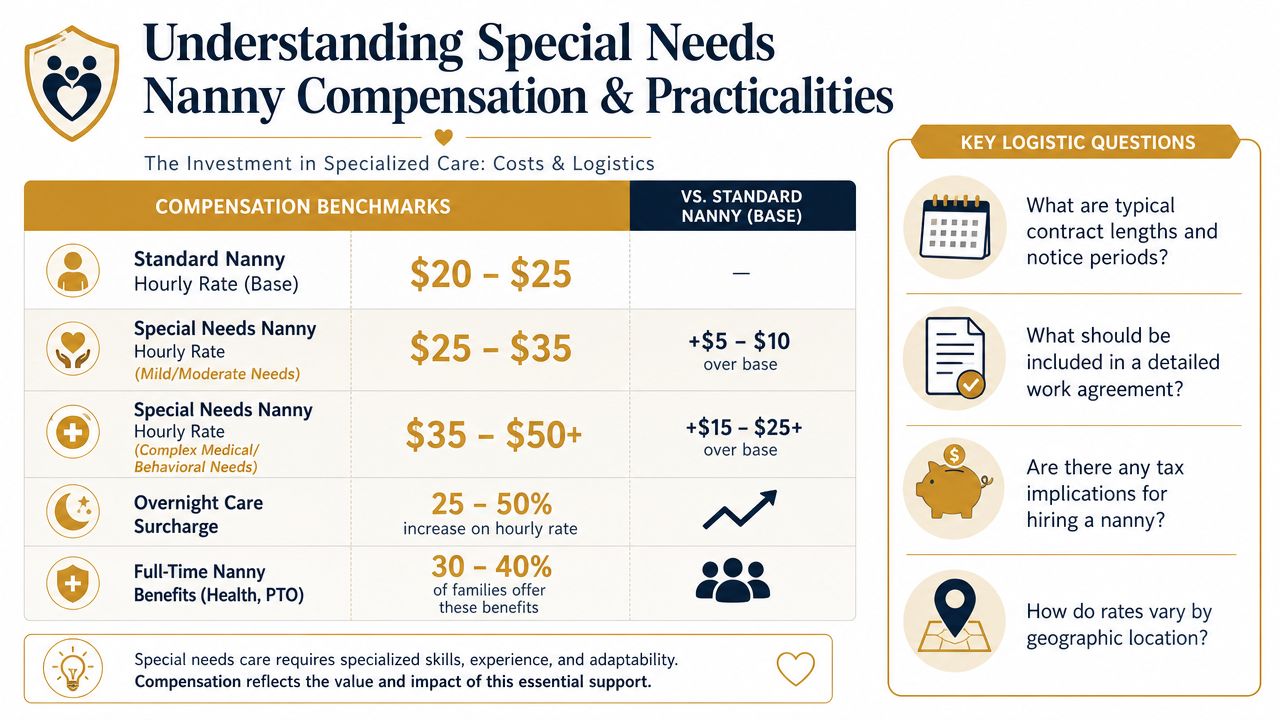
One of the biggest UK content gaps is legal classification. Families often aren't sure whether they're hiring a nanny, a carer, or a personal assistant, and that distinction affects pay, leave, payroll, and the shape of the job. The broader need is significant. The government's Family Resources Survey showed that around 16 million people in the UK had a disability in 2022/23, as summarised in this UK hiring guidance for special needs nanny roles.
Start with the contract, not with assumptions
A strong contract should define the role in plain language. It should state what the nanny is responsible for, what requires specific training, what requires parental approval, and what falls outside scope.
Include clarity on:
- Working pattern such as live-in, live-out, travel, or rota expectations
- Core duties including school runs, meal prep, logs, appointments, and communication
- Boundaries around therapy carryover, intimate care, medication, and transport
- Employment terms such as holiday, sick pay, notice, confidentiality, and payroll
For families who need a practical starting point, this guide to a UK nanny contract template for elite households is useful because it highlights the level of detail specialist placements require.
Questions families ask most often
Can a special needs nanny administer medication?
Sometimes, but only if the arrangement is lawful, clearly documented, and the nanny is properly trained and comfortable doing so. Families should never assume that willingness equals competence. If a child's routine includes complex medical tasks, define those duties precisely before hiring.
Is a special needs nanny the same as a carer?
Not always. Some roles remain childcare roles at their core, with added structure and SEN understanding. Others move closer to care support or personal assistance. The title should reflect the actual duties, not what sounds convenient.
What if we travel often?
Travel can be straightforward if expectations are agreed in writing in advance. Families should discuss schedule changes, privacy rules, accommodation, child supervision expectations, and what happens when the child is off routine in unfamiliar environments.
Can one person cover school support, behaviour support, and therapy carryover?
Sometimes, within reason. But one caregiver shouldn't be expected to replace a school team, clinician, and respite system all at once. The healthiest arrangements are realistic about what home-based support can and can't do.
What if our child will eventually need legal planning as an adult?
That's outside a nanny's remit, but some families begin researching long-term arrangements early. For readers trying to understand how guardianship issues are approached in another legal context, this article on guardianship for special needs child Texas offers an example of the kinds of questions families often start asking as children grow older.
A well-matched special needs nanny can transform daily life, but the transformation usually comes from clarity. Clear scope. Clear communication. Clear routines. Clear legal and employment terms. If you'd like customized support with a specialist childcare placement, Superstar Nannies can help you define the role, assess the right level of expertise, and match your family with a discreet, well-vetted professional.