


For families with demanding schedules, hiring live in nannies can be a game-changer, offering a level of stability and flexibility that other childcare simply can’t match. This is more than just a job; it’s a professional arrangement where a childcare expert lives in your home, becoming a constant and dedicated presence in your family’s life. If you're exploring this childcare solution, this guide will walk you through every critical step, from understanding the role to managing the legalities.
What a Live-In Nanny Really Does
When people think of live in nannies, they often picture basic supervision. But the reality, especially in a high-net-worth household, is far more involved. You’re not just hiring an employee; you’re bringing a highly skilled childcare professional into your home to manage your children's world.
This setup is particularly valuable for families with intense work schedules or frequent travel. Having a trusted nanny living on-site provides a reassuring and consistent figure for your children. It helps maintain a calm, nurturing environment, smoothing over the disruptions that can come with a parent's unpredictable commitments.
Core Responsibilities and Duties
While the specifics of every role will differ, a live-in nanny's duties go far beyond just watching the children. They are specialists who take ownership of the children’s lives from the moment they wake up until they’re tucked into bed.
You can typically expect them to handle:
- Complete Schedule Management: Organising the children's day from top to bottom. This includes the morning rush for school, homework supervision, coordinating playdates and extracurriculars, and managing the bedtime routine.
- Meal Preparation: Planning and cooking nutritious, balanced meals and snacks just for the children. They can also manage specific dietary needs or picky eating habits.
- Educational Engagement: Actively fostering your child's development. Think creative play, reading together, practising letters or numbers, and planning enriching outings to museums, parks, or galleries.
- Child-Related Household Tasks: Keeping the children’s world in order. This means doing their laundry, ensuring their bedrooms and play areas are tidy, and organising their clothes and toys.
The essence of the live-in role is consistency. By living on-site, the nanny develops a deep understanding of each child's personality, needs, and rhythms, allowing for intuitive and highly responsive care that is difficult to replicate with other childcare options.
A Professional Partnership
It is vital to approach this as a professional partnership. Your home is their workplace, which means setting clear boundaries and expectations from the outset is key to a long and successful relationship.
Remember, a live-in nanny's role is focused entirely on the children. They are not a housekeeper for the whole family, a personal assistant, or a private chef. Making this distinction clear is fundamental if you want to attract and keep top-tier talent, as a career nanny is a highly qualified professional dedicated to child development.
To get a clearer picture of the tasks that fall under their purview, you can find out more about what nannies do in our detailed guide.
Ultimately, a great live-in nanny provides seamless, high-quality care that supports your children’s happiness and growth. This partnership frees you to focus on your own professional and personal lives, confident that your children are thriving in the hands of an expert.
Weighing the Benefits and Challenges of a Live-In Nanny
Bringing a professional to live in your home is a major decision, and it’s one that deserves an honest, clear-eyed look at what it truly entails. Before you even think about starting a search for live in nannies, it's crucial to understand the full picture. This arrangement can be a game-changer for busy households, but it also introduces unique personal and logistical complexities that need careful thought.
The single greatest advantage is, without a doubt, the incredible flexibility. For parents with high-pressure careers, unpredictable schedules, or frequent travel, knowing you have consistent, reliable support at home offers unparalleled peace of mind. Gone are the days of scrambling for a last-minute sitter or stressing about a nanny stuck in traffic.
This consistency also fosters a deeply stable and nurturing environment for your children. They can form a genuine, lasting bond with their caregiver, which is more than just a logistical benefit. It’s about weaving a reassuring, constant presence into their lives, something that is invaluable during their formative years.
The Unmatched Advantages
Think of a family we worked with, where both parents were C-suite executives. Their schedules were a whirlwind of early starts, late-night international calls, and sudden business trips. Their home life was a constant logistical puzzle, creating a layer of stress that affected everyone.
When they welcomed a live-in nanny, the entire dynamic of their household shifted. The chaotic morning rush was replaced by a calm, organised routine. When a parent had to fly out on short notice, the children's world remained stable and secure. Their nanny wasn't just an employee; she became a trusted cornerstone of their family's support system, enabling the parents to focus on their careers without compromising their children's well-being.
This visual guide can help you start mapping out which childcare model best aligns with your own family's needs.
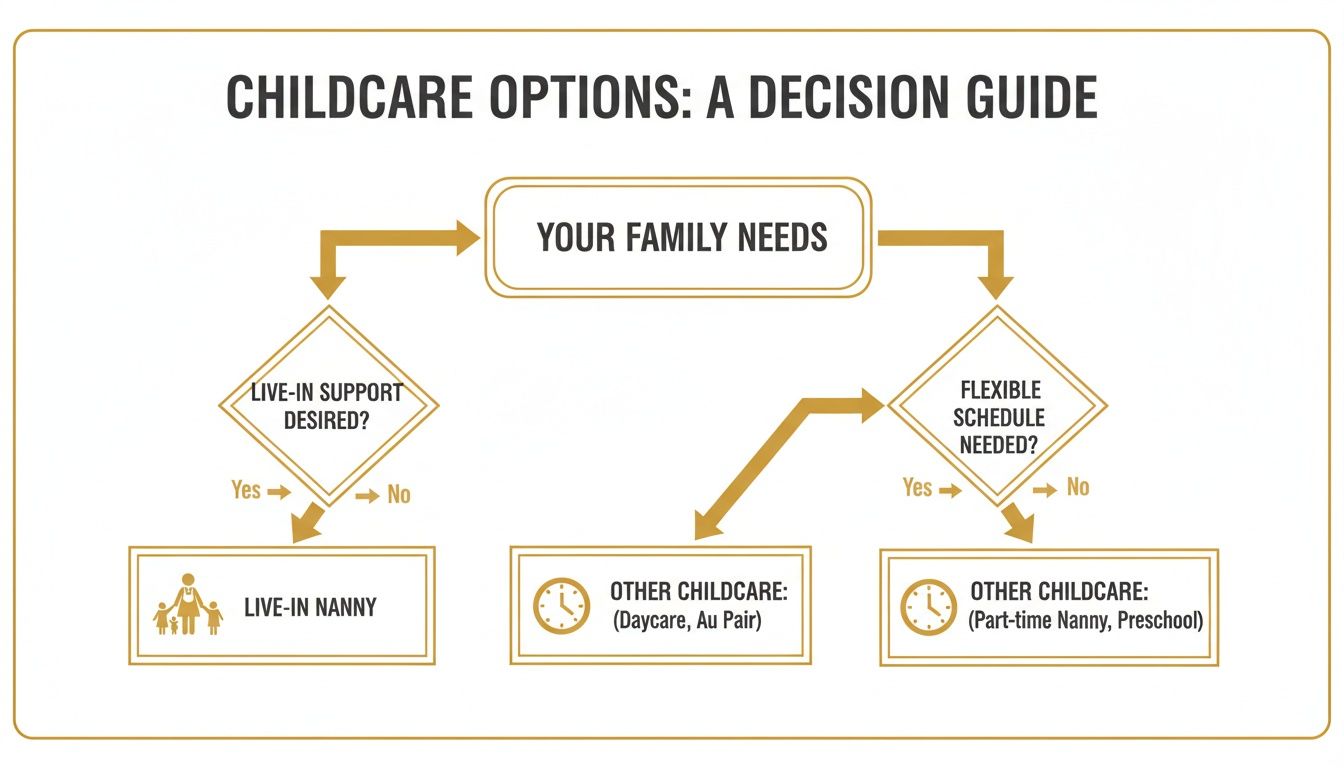
The key takeaway is simple: if your family’s greatest need is for seamless flexibility and deep, integrated support, a live-in arrangement is almost always the most effective solution.
The Practical Realities to Consider
Of course, this level of integration isn't without its own set of challenges—the most significant being privacy. Inviting someone to live in your home means, by definition, sharing your personal space. It's an adjustment for everyone, both for your family and for the professional you hire.
A successful live-in relationship is built on mutual respect for boundaries. It requires a clear understanding that while your nanny is a warm and integral part of your household, she is also a professional with a right to her own private life and personal time.
You also step into a dual role as both a parent and an employer, which is a delicate balance to strike. You're not only guiding your child's development but also managing an employee who lives under your roof. This demands crystal-clear communication, a robust employment contract, and the emotional intelligence to maintain professional boundaries within a warm, respectful home.
To help you weigh these factors, a direct comparison can be incredibly useful. The table below breaks down the key differences between the two main nanny structures.
Live-In Nanny vs Live-Out Nanny: A Quick Comparison
| Feature | Live-In Nanny | Live-Out Nanny |
|---|---|---|
| Flexibility | High; accommodates early starts, late finishes, and travel. | Lower; typically works set hours with overtime by arrangement. |
| Cost | Lower gross salary, but includes accommodation and board. | Higher gross salary, as the nanny covers their own living costs. |
| Privacy | A significant consideration; requires sharing your home space. | Complete privacy for the family when the nanny is off-duty. |
| Bonding | Deeper integration into family life can foster stronger bonds. | Strong bonds are still formed, but within a more formal structure. |
| Responsibilities | Can include light household duties related to the children. | Strictly childcare-focused unless otherwise specified in the contract. |
| Logistics | No commute time; nanny is always on-site. | Subject to travel delays; requires commuting to and from your home. |
Ultimately, navigating these dynamics can be complex, and making the right choice from the start is paramount. For a deeper dive, our guide on the pros and cons of live-in vs live-out nannies explores which arrangement best suits different family lifestyles. Being fully prepared for both the remarkable benefits and the practical challenges is the first step toward a successful and lasting partnership.
Budgeting for Your Live-in Nanny
When you decide to bring a live-in nanny into your home, one of the first questions that comes to mind is, naturally, the cost. But looking at it as just a weekly salary doesn’t quite tell the whole story. The key is to think in terms of a total compensation package.
This approach helps you see the complete picture—not just the wage you pay, but the full value you provide. It’s this comprehensive view that allows you to budget properly and, just as importantly, position yourself as a first-rate employer in a very competitive market. Getting this right from the start is fundamental to building a successful, long-term relationship with your nanny.

Starting with the Weekly Salary
The nanny's gross weekly salary is, of course, the cornerstone of your budget. It’s worth remembering that a live-in nanny’s salary package already includes significant value in the form of accommodation, meals, and utilities. They don’t have these major living expenses, which is reflected in the gross figure.
For an experienced, professional nanny in a major city like London, you should plan for a gross salary of £600 to £900+ per week. Industry data often shows that for roles involving around 60 hours a week, top nannies command between £500 and £700 gross, with their board and lodging provided. This level of pay is a direct reflection of the expertise, discretion, and round-the-clock flexibility that high-calibre nannies bring to a household.
The Costs Beyond the Salary
To put together a truly competitive and legally sound offer, you’ll need to account for several other essential costs. These aren’t optional extras; they are your legal responsibilities as a UK employer.
Your budget must make room for the following:
- Employer's National Insurance Contributions: You are legally required to pay Class 1 National Insurance on your nanny’s earnings once they cross a certain threshold. This is a non-negotiable part of your budget.
- Workplace Pension Scheme: As long as your nanny meets the age and earnings criteria, you must enrol them in a workplace pension scheme and make employer contributions.
- Performance and Discretionary Bonuses: While not mandatory, an annual bonus has become standard practice in many high-net-worth households. It’s a powerful way to show appreciation and encourage your nanny to stay with you for the long term.
- Nanny Payroll Services: The complexities of PAYE, NI, and pension contributions mean most families use a specialist nanny payroll service. The annual fee is a worthwhile investment for ensuring total compliance and saving yourself a great deal of administrative work.
Planning for these additional costs from day one is the mark of a well-prepared and professional employer. It shows that you respect your nanny’s financial wellbeing and prevents any unexpected financial strain down the road.
Factoring in Household and Lifestyle Costs
Finally, don’t forget the day-to-day practical costs of having another professional living as part of your household. These expenses can differ quite a bit depending on your family’s lifestyle and the specific demands of the job.
Think through these potential outgoings:
- Providing a Vehicle: If your nanny will be driving the children, you’ll need to provide a safe, insured car for them to use on duty. You should also budget for the running costs, like fuel.
- Activity Fund or “Kitty”: It’s standard to give your nanny a weekly cash float or a pre-paid credit card. This is for covering the children’s activities, entry fees, classes, and any other small, agreed-upon expenses.
- Increased Utility Bills: It’s a small but real consideration. Having an extra adult at home will naturally lead to a slight increase in your bills for gas, electricity, and water.
By creating a budget that covers all these elements, you’ll be in the best possible position to attract and retain an exceptional live-in nanny. For a more detailed breakdown and tools to help you calculate your total investment, take a look at our complete guide on live-in nanny costs.
Navigating Contracts and Legal Duties
When you bring a live-in nanny into your home, you’re not just hiring help; you’re officially becoming an employer. This is a significant shift, and it comes with a handful of legal responsibilities that are vital to get right from day one. Taking care of the legal framework isn't just about compliance—it's the bedrock of a professional, respectful, and long-lasting relationship.
At the very centre of it all is the employment contract. In our experience, a professionally drafted contract is non-negotiable. It’s the document that turns assumptions into clear, agreed-upon terms, protecting both your family and your nanny from the friction that ambiguity can cause down the road.
Why a Watertight Contract is Non-Negotiable
Think of the contract as the definitive guide to your working relationship. A vague or poorly written one is a recipe for problems, while a clear, comprehensive, and fair document is your best tool for ensuring the placement is a success.
We always insist that a contract clearly defines these key areas:
- Working Hours and Flexibility: Spell out the standard weekly hours and which nights might be needed for babysitting. It's also crucial to detail how any extra hours will be tracked and compensated.
- A Full List of Duties: This is where you prevent "scope creep." Be exhaustive. List all expected responsibilities, from preparing children's meals and managing their schedules to educational play and tidying their spaces.
- Remuneration and Pay Schedule: State the gross salary (weekly or monthly), the exact date of payment, and how it will be paid. Clarity here builds trust.
- Holiday and Sick Pay Entitlement: Define the paid holiday allowance—the legal minimum in the UK is 5.6 weeks per year—and the process for booking time off. You'll also need to outline sick pay arrangements that meet statutory rules.
- Notice Periods: Agree on the notice period required from either side if the arrangement needs to come to an end. This provides security for everyone involved.
Getting these details right is paramount. For a closer look at how to put this essential document together, our guide to crafting the perfect UK nanny contract offers templates and specific advice for elite households.
Your Legal Duties as a UK Employer
Signing the contract is just the first step. Now, you need to step into your role as a formal employer. In the UK, this means managing a few key obligations correctly to stay on the right side of the law.
Becoming an employer is a formal legal status. It requires you to engage with government systems like tax and pensions, just as any small business would. Ignoring these duties can lead to significant financial penalties.
Before your nanny’s first payday, you must register as an employer with His Majesty's Revenue and Customs (HMRC). This sets you up to run a PAYE (Pay As You Earn) scheme, making you responsible for calculating and deducting the correct income tax and National Insurance contributions from your nanny’s salary and paying them to HMRC.
To get to grips with what’s required, many families find it helpful to consult a practical guide to employment law and adapt its principles for a household setting. This ensures every part of the employment is handled with the professionalism it deserves.
The Accommodation Offset and Minimum Wage
One of the unique financial aspects of hiring live in nannies is the "accommodation offset." This isn't about deducting market rent from your nanny's pay—that’s not allowed. Instead, it’s a specific, government-set figure that you can legally count towards their total earnings in recognition of the accommodation you provide.
The current offset is £9.99 per day. This is a critical number. It means your nanny's total earnings (their gross salary plus the value of the accommodation offset) must always meet or exceed the National Minimum Wage for every hour they work. It’s the only compliant way to factor accommodation into their pay, ensuring they are compensated fairly and lawfully for their professional expertise.
Building a Positive and Lasting Partnership

Once the ink on the contract is dry, the real work of building a successful live-in arrangement begins. It’s a partnership that extends far beyond legal agreements, flourishing only with genuine mutual respect and refreshingly open communication. This is where your focus needs to shift: to creating a home environment where a professional relationship can thrive.
This isn't about becoming best friends or blurring the lines between employer and employee. It's about a fundamental understanding that your home is simultaneously your nanny’s workplace and their private refuge. Getting this balance right is the single most important factor in retaining a fantastic nanny long-term, which in turn provides the consistency your children need.
Establishing Professional Boundaries and Respect
From the very first day, clear and consistent boundaries are non-negotiable. This means having a shared, practical understanding of what "on-duty" and "off-duty" truly look like in your home. When your nanny is off the clock, their time is their own. Full stop.
Think of their private room or apartment as a true sanctuary, not just a spare room. It’s the space where they can completely switch off, recharge, and be themselves. Honouring this boundary is absolutely essential for their mental well-being and overall job satisfaction.
Of course, these boundaries are a two-way street. Your nanny must also respect that family time is sacred. This clarity is what allows a professional dynamic to be maintained, even within the uniquely intimate setting of a family home.
The Power of Scheduled Check-ins
In all our years of experience, we’ve found one of the most effective tools for nurturing a healthy partnership is the weekly check-in. Don't leave important conversations to chance or wait for a small misunderstanding to snowball into a significant problem.
Set aside a dedicated 15–20 minutes each week to sit down with your nanny, without the children around. This simple habit creates a reliable, safe space to discuss everything.
- The week ahead: A quick review of schedules, appointments, and any upcoming plans or travel.
- The children's world: A chance to share observations about their development, celebrate their wins, or discuss any new challenges.
- An open forum: The perfect opportunity for either of you to raise questions or gently address minor issues before they fester.
- Positive reinforcement: A moment to genuinely acknowledge their hard work and the positive impact they're having.
A scheduled check-in shifts communication from being reactive to proactive. It signals that you see your nanny as a valued partner and a key member of the team, which is the absolute cornerstone of long-term trust.
This structured communication is also a powerful retention strategy. Nanny turnover is a real issue; in the UK, the industry saw a 22% turnover rate in 2023, frequently tied to burnout and a lack of feeling supported. By fostering a respectful and communicative environment, you directly combat these common pitfalls. You can dive deeper into these trends in the full report from The National Nanny Association.
Making Your Nanny Feel Valued
Beyond the formal check-ins, it's often the small, thoughtful gestures that make the biggest difference. Acknowledging their birthday, remembering a dietary preference when you order a meal, or a simple, heartfelt "thank you" reinforces that their effort is seen and appreciated.
The ultimate goal, after all, is to build a professional partnership that lasts. When you hire live in nannies, you are inviting a dedicated professional to play an integral role in your family's life. By treating them with respect, communicating clearly, and honouring their personal time, you create the exact conditions they need to perform at their best. This not only makes your nanny feel valued but also ensures your children get to grow up in the stable, positive, and nurturing atmosphere they deserve.
How a Nanny Agency Simplifies Your Search
Finding the right professional to welcome into your home and entrust with your children can feel like an impossibly huge task. Sifting through applications, checking credentials, and conducting probing interviews is a full-time job in its own right.
This is where a premier nanny agency like Superstar Nannies becomes your most valuable partner. We don’t just play matchmaker; we act as your trusted advisor, drawing on our private, invitation-only network of career childcare professionals. These aren't candidates you’ll find on public job boards. They are proven experts known to us personally for their exceptional work in discerning households.
A Rigorous and Discerning Vetting Process
When you partner with an agency, you gain immediate access to a curated shortlist of candidates who have already cleared a demanding, multi-stage screening process. Our core promise is simple: we only introduce professionals who meet the highest standards of safety, experience, and personal character. We handle the time-consuming and stressful filtering for you.
Our vetting is famously meticulous and includes:
- In-depth Personal Interviews: We sit down with every single candidate to truly understand their background, their childcare philosophy, and their personality. This is crucial for gauging their suitability for the unique environment of an elite household.
- Comprehensive Background Checks: We commission an enhanced DBS check as standard, along with any other verification required to give you complete peace of mind.
- Meticulous Reference Verification: We don’t just check references; we have detailed conversations with previous employers. This gives us a 360-degree view of a candidate’s reliability, skills, and on-the-job conduct.
Think of us as your personal recruitment director for your family. We manage the entire complex process—from sourcing and screening to contracts and onboarding—so you can focus on the most important thing: finding the perfect personality fit for your children.
Expert Guidance and Ongoing Support
The journey to finding the right live-in nanny is about more than just a CV. It’s about creating a successful and lasting placement. We guide you through every step. Our team offers expert advice on structuring a competitive salary package, clearly defining duties in the employment contract, and navigating the delicate employer-employee relationship within your home.
And our support doesn't stop when your nanny walks through the door. We remain on hand for both you and your nanny, offering mediation and advice to help nurture a positive and enduring partnership.
By managing the complexities of the search, an agency like Superstar Nannies saves you countless hours, eliminates the stress of the unknown, and connects you with a professional who will genuinely enhance your family's life. It's the most effective and secure way to find the high-calibre childcare you’re looking for.
Conclusion: Partnering for a Thriving Family
Finding and hiring the perfect live-in nanny is a journey that balances practical considerations with personal connection. The key takeaways for families are to clearly define the role, budget for the complete compensation package, and establish a legally sound employment contract. Most importantly, fostering a relationship built on mutual respect and open communication is the secret to a long and successful placement. By investing in this professional partnership, you secure not just childcare, but a stable, nurturing, and supportive environment where your children can thrive.
Ready to find the perfect professional to support your family? Superstar Nannies specialises in sourcing and placing elite, rigorously vetted live-in nannies for discerning households worldwide. Contact us today for a confidential consultation.
FAQs About Live In Nannies
What are considered normal working hours for a live-in nanny?
For a live-in nanny in the UK, a typical working week is around 10 to 12 hours a day, five days a week. This often looks like a ‘split shift’—being on duty for the busy morning rush and then again for the after-school, dinner, and bedtime routine. Most contracts also include one or two evenings of babysitting. It is crucial to define all hours, babysitting expectations, and overtime pay clearly in the employment contract to prevent future misunderstandings.
What kind of accommodation do I need to provide?
You must provide your nanny with their own private, furnished bedroom. While a dedicated private bathroom isn’t a strict legal mandate, it has become the expected standard for high-calibre placements. Offering comfortable, genuinely private living quarters shows respect for their personal time and is a significant factor in attracting and retaining a top-tier professional. This space is their personal sanctuary where they can fully switch off and recharge.
How do we handle holidays and time off?
In the UK, your live-in nanny has a statutory right to a minimum of 5.6 weeks of paid holiday each year (pro-rata for part-time). It is best to coordinate holiday schedules far in advance. Many families align the nanny’s time off with their own holidays, while others agree on separate dates that work for everyone. Whatever you choose, ensure the process for requesting and approving leave is clearly outlined in their contract to maintain fairness and clarity.