


When you agree on a salary for a new nanny role, that number is just the beginning. What truly matters is your net pay take home—the amount that actually lands in your bank account. This figure is rarely the same as the one on your employment contract, and understanding the difference is essential for both nannies and employers.
This guide will demystify the journey from gross salary to your actual take-home pay. For parents, it will help you create fair and compliant offers. For nannies, it will empower you to manage your finances with confidence.
What is Net Pay? The Real Story of Your Salary
When you accept a job, the headline figure is almost always the gross salary—the total, pre-tax amount your employer agrees to pay you over a year. Your net pay, however, is the money you receive after all the necessary deductions have been taken out.
Think of your gross salary as the whole pie. Before you get your slice, several portions are legally required to be set aside for things like taxes and social security. The remaining piece is your net pay take home.
For a nanny, knowing your precise net pay is fundamental for budgeting, saving, and managing your finances. For a family, understanding the gross-to-net calculation is the bedrock of crafting a competitive, fair, and legally sound employment offer.
Gross Pay vs. Net Pay: A Clear Comparison
Let's break down the two key terms:
| Concept | Description | What It Includes |
|---|---|---|
| Gross Pay | The total salary agreed upon before any deductions. | Your full annual salary, including any agreed bonuses or overtime before taxes. |
| Net Pay | The actual amount of money you receive in your bank account. | Your gross pay minus all mandatory deductions (e.g., tax, National Insurance). |
The journey from the initial offer to your actual take-home pay involves several important steps, primarily managed by your employer on your behalf.
From Gross Salary to Net Pay in the UK
In the United Kingdom, the path from gross to net pay is marked by a few key deductions that your employer is legally obliged to make. These are processed through the Pay As You Earn (PAYE) system and sent directly to HM Revenue & Customs (HMRC).
The main deductions include:
- Income Tax (PAYE): A tax on your earnings, with the rate depending on how much you earn.
- National Insurance (NI): These contributions fund your eligibility for state benefits, such as the State Pension and maternity allowance.
- Pension Contributions: If you are enrolled in a workplace pension scheme, a percentage of your pay is automatically invested for your retirement.
- Student Loan Repayments: If you have an outstanding student loan, repayments are typically deducted straight from your salary.
For a median full-time worker in the UK earning around £39,039 annually in 2025, it's common to see 20-25% of their gross pay go toward income tax and NI contributions. This significantly impacts the final take-home figure.
This is exactly why a gross salary of £45,000 a year doesn't mean you'll see £3,750 in your bank each month. The reality of UK deductions becomes crystal clear with the first payslip.
For instance, the Office for National Statistics reported that average weekly earnings for total pay across Great Britain reached £742 in early 2026. After typical deductions, this would leave a net weekly pay of roughly £550-£600, depending on the individual's tax code and personal circumstances. You can explore more UK earnings data by reading the full ONS report on employment and working hours.
Ultimately, understanding the concept of net pay gives you the financial clarity to negotiate your salary with confidence and build a realistic budget. It empowers you to know exactly what you will earn, providing long-term financial stability and peace of mind.
Decoding Your Payslip: Where Your Money Goes
When you look at a payslip, it’s easy to focus on just two numbers: the big one at the top (your gross salary) and the smaller one at the bottom (what lands in your bank account). The story of how one becomes the other is all about deductions.
Think of your payslip not as a complex financial document, but as a transparent breakdown. It’s a receipt that shows exactly where every pound or dollar from your salary goes before it becomes your net pay take home. For nannies, understanding this is key to managing your finances. For families, it’s about ensuring everything is handled correctly and transparently.
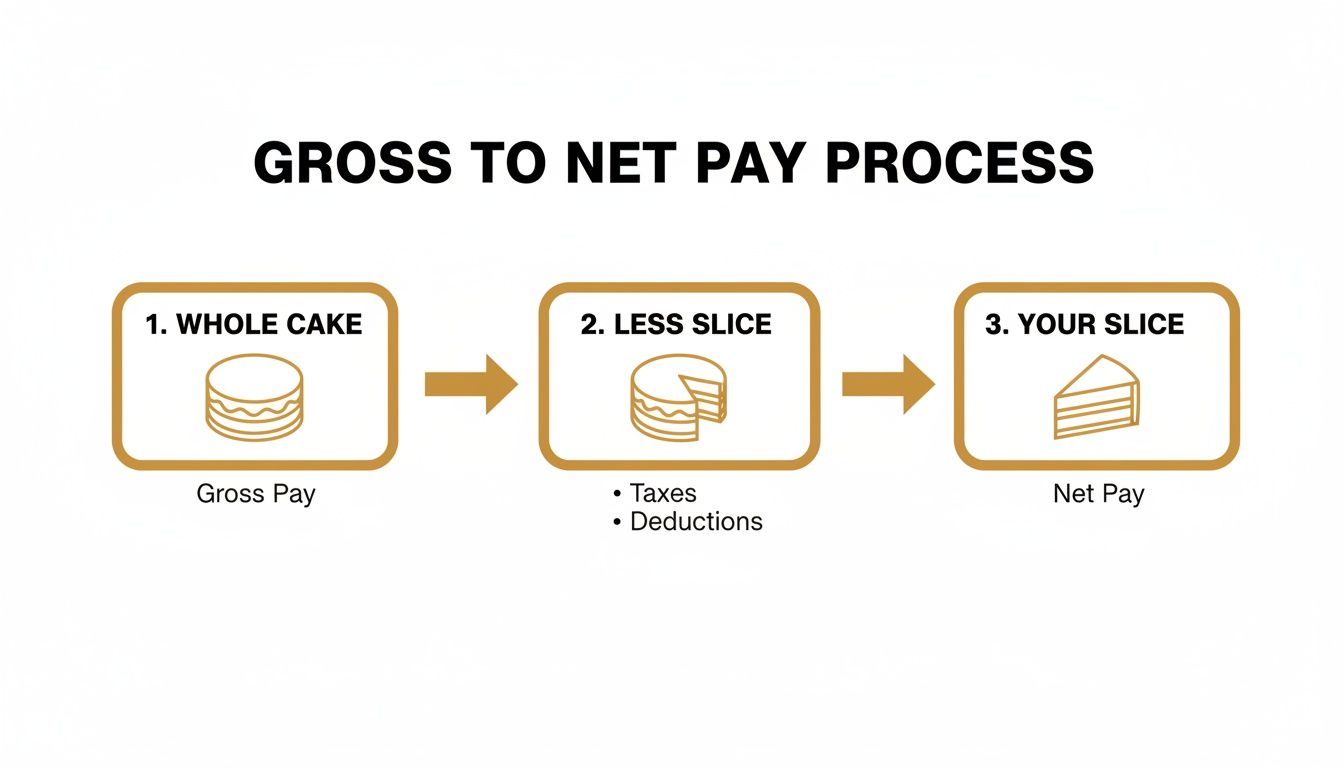
The cake analogy above puts it perfectly. Your gross salary is the entire cake. Before you get your slice, several pieces are taken out for mandatory contributions. What’s left is your net pay—the part you actually get to enjoy. Let’s look at exactly what those slices are.
Income Tax: The Biggest Slice
For almost everyone, the single largest deduction is income tax. In the UK, this is managed through the Pay As You Earn (PAYE) system, where tax is calculated and paid by your employer on your behalf. The US has a similar federal system run by the IRS.
It's not a flat tax. The amount you pay is based on how much you earn and is determined by your personal tax code. This code tells your employer your tax-free personal allowance for the year. You only start paying tax on earnings above that threshold, and it’s done in progressive bands.
Essentially, the more you earn, the higher the rate of tax you’ll pay on the portion of your income that falls into those higher bands. It’s the primary reason your net pay is significantly different from the gross figure we discuss during salary negotiations. For a deeper dive into that starting figure, we explain everything in our guide to what gross salary means.
National Insurance or Social Security Contributions
Next up are social security payments. In the UK, we call them National Insurance (NI) contributions. If you’re in the US, you’ll see these listed as FICA taxes, which are split between Social Security and Medicare.
It’s tempting to see these as just another tax, but they are fundamentally different. These contributions build up your entitlement to crucial state benefits over your lifetime.
- State Pension: What you pay in directly affects the state pension you’ll receive when you retire.
- Maternity or Paternity Pay: Your eligibility for statutory parental pay is tied to your NI contribution history.
- Unemployment Benefits: Should you find yourself out of work, your right to claim benefits is linked to these payments.
Much like income tax, NI is calculated as a percentage of your earnings once you cross a certain threshold. These rates and thresholds are updated by the government each tax year, which can cause small changes to your net pay even if your gross salary stays the same.
Pension Contributions: Securing Your Future
Another common deduction is for your workplace pension. In the UK, auto-enrolment rules mean employers are legally required to put their eligible staff into a pension scheme, with a percentage of your pay automatically deducted and invested for you.
While it does reduce your immediate take-home pay, this is a non-negotiable part of modern employment and a vital tool for your long-term financial health. Your employer also has to contribute, and you get tax relief on your payments, making it an incredibly efficient way to save for retirement.
You technically have the option to opt out, but by doing so, you would be walking away from your employer's contributions—which is essentially free money—and valuable tax advantages.
Other Common Deductions
Beyond those main three, a few other items might appear on your payslip, depending on your situation.
- Student Loan Repayments: If you have a student loan, repayments are taken automatically once your earnings pass the repayment threshold. The deduction is usually a set percentage of your income above that line.
- International Considerations: Tax rules get far more complex when working internationally. A nanny based abroad, for example, will have to navigate a completely different set of local and national tax laws. This guide on taxes for expats in Spain is a great example of how specific this can get.
Looking at the bigger picture, while UK average weekly wages have shown impressive growth from roughly £300 in 2000 to a projected £742 in 2026, these deductions have a real impact. For a Superstar Nanny on a common gross salary of £50,000 per year, their monthly net pay take home will be approximately £3,200 after all of today’s taxes, NI, and potential student loan payments are accounted for.
How Net Pay Works in The Real World: Nanny Case Studies
The numbers on a contract are just the starting point. What really matters is the money that lands in your bank account each month—your net pay take home. This is where the theory gets real, so let's get down to brass tacks.
Seeing how a gross salary is whittled down by taxes and other deductions is the best way to understand its true value. We'll walk through a couple of common scenarios to show you exactly how it works in practice for both families and their nannies.

Case Study 1: A Live-Out Nanny in London, UK
Let's start with Amelia, an experienced live-out nanny who has just accepted a role in London. The family has offered her a competitive gross annual salary of £45,000. So, what does she actually take home?
Here's a simplified breakdown for the 2025/2026 tax year.
Gross Monthly Salary: First, we divide her annual salary by 12, which gives her a gross monthly income of £3,750.
Income Tax: In the UK, every individual has a standard Personal Allowance of £12,570, which is tax-free. Amelia will pay the basic 20% tax rate on the portion of her salary above this threshold (£32,430). This works out to an annual tax bill of £6,486, or £540.50 a month.
National Insurance (NI): As an employee, Amelia also pays Class 1 National Insurance. For someone on her salary, this is calculated at 8% on earnings between the primary threshold and upper limit, resulting in a monthly contribution of around £223.40.
Once we subtract these deductions from her gross monthly pay, we can see her actual take-home figure.
Calculation Summary:
- Gross Monthly Pay: £3,750.00
- Less Income Tax: – £540.50
- Less National Insurance: – £223.40
- Estimated Monthly Net Pay: £2,986.10
From an attractive gross salary of £45,000, Amelia's annual take-home pay is closer to £35,833. This difference is precisely why all parties need to be crystal clear on whether they are discussing gross or net figures.
Case Study 2: A Rota Nanny in New York, US
Now, let's hop across the pond to New York City. David, a specialist rota nanny, has a gross annual salary of $80,000. The US tax system can feel more complex, with deductions needed for federal, state, and sometimes city taxes.
Here’s a simplified look at what David’s deductions might be:
- Federal Income Tax: Based on his salary and filing as a single individual, David’s estimated federal tax withholding would be about $950 per month.
- FICA Taxes (Social Security & Medicare): This is a standard deduction of 7.65% of gross earnings for all employees. For David, this comes to roughly $510 per month.
- State & City Taxes: Both New York State and New York City levy their own income taxes. At his salary level, the combined total would be around $580 each month.
Let's add it all up to find his net pay.
Calculation Summary:
- Gross Monthly Pay: $6,667
- Less Federal Tax: – $950
- Less FICA Taxes: – $510
- Less State/City Taxes: – $580
- Estimated Monthly Net Pay: $4,627
So, from his $80,000 gross salary, David’s annual take-home pay is approximately $55,524. As you can see, the location and its specific tax laws have a massive impact on the final net figure. For a deeper dive into salary benchmarks for top-tier private staff, our Private Staff Salary Guide is an invaluable resource.
Live-In vs. Live-Out Financial Implications
One of the biggest financial questions for both nannies and employers is whether the position is live-in or live-out. While a live-in role might have a slightly lower gross salary on paper, the real-world financial benefits for the nanny can be enormous.
When a family provides accommodation, and often meals and utilities, it's considered a benefit-in-kind. The good news for nannies in the UK is that accommodation is generally not a taxable benefit if living in the family's home is a condition of the job.
This means a live-in nanny’s largest monthly expense—rent—is completely eliminated. With recent studies showing that many people spend over 30% of their take-home pay on housing, this is a game-changer. That money can instead go straight into savings or be used for personal spending, which significantly boosts a nanny’s effective net income and savings potential.
Employer Responsibilities: A Guide to Nanny Payroll and Taxes

When you hire a nanny, you’re doing more than just bringing an expert into your home; you’re stepping into the role of an employer. While agreeing on a salary is a crucial first conversation, the true foundation of a professional relationship is built on getting the payroll right from the very beginning.
Properly calculating your nanny’s net pay take home isn’t just about compliance—it’s about demonstrating respect and creating a transparent, stable environment for a key member of your household staff. This guide will walk you through the essential responsibilities that come with being a household employer.
Step 1: Registering as an Employer
Before your nanny's first payday arrives, you must officially register as an employer with the relevant tax authority. This is a non-negotiable first step.
In the United Kingdom, this means registering with HM Revenue & Customs (HMRC). For our clients in the United States, the equivalent step is obtaining a Federal Employer Identification Number (EIN) from the IRS. This registration signals to the government that you are prepared to handle tax deductions and social security contributions correctly.
For many families, this is their first foray into employment regulations. It can feel daunting, which is why many choose to engage a specialist nanny payroll service to manage the process and ensure nothing is overlooked.
Step 2: Understanding the True Cost of Employment
The gross salary you and your nanny agree upon is only part of the financial picture. As an employer, you are legally required to make your own contributions on top of the salary you pay. These employer-side taxes are entirely separate from the deductions made from your nanny's wages.
In the UK, this takes the form of Employer's National Insurance contributions, which you pay directly to HMRC. In the US, employers are responsible for their portion of FICA taxes (Social Security and Medicare), along with federal and state unemployment taxes (FUTA and SUTA).
It's a wise rule of thumb to budget for these employer contributions adding an extra 10% to 15% to your total payroll costs. Factoring this in from the start prevents any unwelcome financial surprises down the road.
Step 3: Employee vs. Contractor—The Critical Difference
One of the most common—and costly—mistakes a family can make is misclassifying their nanny. A nanny who works in your home, follows a schedule you set, and uses your family’s resources is almost always considered an employee in the eyes of the law, not a self-employed contractor.
The temptation to pay "cash in hand" or label a nanny as a contractor to sidestep payroll obligations is a serious legal risk. This can lead to significant penalties, including back taxes and hefty fines from authorities like HMRC or the IRS.
Here’s the simple distinction:
- Employee: Works under your direction, has set hours, and is an integral part of your household. You are responsible for withholding their taxes.
- Contractor: Runs their own independent business, sets their own rates, and typically works with multiple clients. This classification very rarely applies to a household nanny.
Establishing a formal employment relationship is essential. It provides your nanny with a verifiable income history and access to statutory rights, and it gives you complete peace of mind that you are acting fairly and lawfully. To delve deeper into these crucial payroll distinctions, our Gross Pay vs Net Pay guide offers further clarity for families. Taking these duties seriously is the hallmark of a respectful and professional working environment.
Net Pay Differences Across Key International Markets
For families and nannies who operate on a global stage, understanding local pay structures is absolutely fundamental to a successful placement. The basic idea is universal: a gross salary is offered, and after deductions, what remains is the net take-home pay. However, the journey from that top-line number to what actually lands in a bank account can be wildly different from one country to another.
What’s left for you at the end of the month is entirely dependent on local tax laws, social security frameworks, and other mandatory contributions. A salary that sounds incredibly generous in one location might support a very different lifestyle somewhere else once the government takes its share. This is why getting to grips with these differences is so important—it prevents nasty surprises down the line.
A Look at Contrasting Global Payroll Systems
The way taxes are calculated and paid varies enormously. The UK’s PAYE (Pay As You Earn) system, for instance, is relatively straightforward; the employer simply deducts tax and National Insurance at source every month. But this is far from the only model.
- Switzerland: Here, tax is a complex affair managed at three different levels: federal, cantonal (state), and municipal. This means your net pay can change significantly just by moving from a canton like Zurich to another like Geneva.
- Monaco: Famed for its favourable tax environment, Monaco doesn’t levy personal income tax on most residents (though there are some exceptions for French nationals). This results in a net pay figure that is remarkably close to the gross salary.
- Dubai (UAE): As another major hub for international families, Dubai operates a zero-income-tax policy. For the vast majority of employees, this means the gross salary is the net salary—a powerful magnet for professionals from all over the world.
As families expand their support teams, they sometimes look to Hire LatAm Virtual Assistants, which introduces an entirely different set of payroll and tax rules compared to hiring domestic household staff.
The table below offers a bird's-eye view of how these factors play out in different regions, illustrating just how much the calculation can change depending on your location.
International Net Pay Factors: A High-Level Comparison
| Location | Primary Income Tax System | Social Security/Pension | Key Takeaway |
|---|---|---|---|
| UK | Progressive (PAYE) | National Insurance Contributions (NICs) are mandatory. | A well-established, employer-led system with clear tax bands. |
| USA | Federal, State, and sometimes Local taxes. | Social Security and Medicare (FICA) are key deductions. | Highly variable; net pay depends heavily on the specific state of residence. |
| Switzerland | Federal, Cantonal, and Municipal levels. | Mandatory pension (AHV/AVS) and other social funds. | Complex and hyper-local; your canton determines your final take-home pay. |
| Monaco | No personal income tax for most residents. | Mandatory social security contributions (CCSS). | High net pay retention, but social contributions are still a factor. |
| UAE (Dubai) | No personal income tax. | Pension contributions for GCC nationals; end-of-service gratuity for expats. | Virtually 100% net-to-gross pay, making it a top destination for earning potential. |
This comparison highlights that a global payroll strategy requires deep, location-specific expertise. A one-size-fits-all approach simply doesn’t work.
A UK Perspective on High-Earning Nannies
Even within a single country, net pay can shift dramatically as income rises. A common question we hear at Superstar Nannies from elite UK families is about the real difference in take-home pay between a top-tier nanny and a typical full-time worker.
Let's put it in context. For our clients in London, where the median full-time salary was around £39,039 in 2025, a highly qualified live-out nanny on a £45,000 gross salary might take home approximately £34,000 annually.
However, as salaries climb into the senior nanny territory of £70,000 or more, the tax impact becomes much more pronounced. Income above £50,270 falls into the 40% higher tax rate, and when combined with National Insurance, the effective deduction can easily exceed 30%. You can explore more data on UK earnings by reviewing this report on average full-time annual earnings.
This variation drives home a critical point: a gross salary figure is only half the story. The true value of a compensation package can only be understood by calculating the net pay within the context of local laws.
This is especially true when comparing offers between countries. A nanny weighing a role in London against one in Dubai must look far beyond the gross figures to understand their actual disposable income. The same complexities apply to US-based families, a topic we cover in depth in The 2026 US Household Employee Tax Guide for Elite Families.
Conclusion: Clarity and Confidence in Your Compensation
Understanding your net pay take home is the key to financial clarity for both families and nannies. It moves the conversation beyond headline numbers to what truly matters: the money you have to budget, save, and live on. For employers, mastering these details ensures you create a fair, legal, and attractive offer. For nannies, it provides the confidence to plan for your future.
By being transparent about gross pay, deductions, and the final take-home figure, you build a foundation of trust and professionalism from day one. This clarity prevents misunderstandings and fosters a positive, long-term working relationship.
For expert guidance on structuring competitive and compliant compensation packages for your household staff, contact Superstar Nannies today for a confidential consultation. Find out more at https://superstarnannies.com.
FAQs About Net Pay and Take-Home Salary
How can I calculate my net pay take home from a job offer?
The most reliable way to estimate your net pay is by using official government resources. For those in the UK, the HMRC's official tool offers the most accurate calculation. In the US, the IRS provides a similar estimator. These tools account for current tax codes and personal allowances, giving you a very close approximation of your actual take-home salary. Your first payslip will provide the final, exact figures.
Are bonuses and overtime included in my net pay?
Yes, bonuses and overtime pay are considered part of your earnings and are subject to the same deductions as your regular salary, including income tax and social security. This extra income is added to your gross pay for that pay period, which can sometimes push you into a higher tax bracket for that month. As a result, the net amount you receive from a bonus will be noticeably less than the gross bonus figure.
What is a net salary agreement, and should I use one?
A net salary agreement is when an employer agrees to pay a fixed take-home amount, promising to cover all tax and insurance liabilities on top, whatever they may be. While it sounds simple, these agreements are strongly discouraged by payroll experts and reputable agencies like Superstar Nannies. They create unpredictable and often spiralling costs for the employer and can cause compliance issues. The professional standard is to agree on a gross salary, ensuring transparency and fairness for both parties.
Why is my first payslip's net pay different from the rest?
Your first payslip can sometimes be different due to the timing of your start date and your tax code. If you start mid-month, your pay will be pro-rated. More importantly, your employer might use an emergency tax code until your correct one is supplied by HMRC or the IRS. This can result in higher-than-normal tax deductions initially. Any overpaid tax is typically refunded in subsequent pay periods once your correct tax code is applied, and your net pay take home will stabilize.