


When you're ready to hire a nanny, navigating pay can feel overwhelming. One of the first terms you'll encounter is "gross salary," and understanding what does gross mean salary is crucial for a smooth and professional hiring process. Let's clear up the confusion right away: in any formal nanny contract, the only number that truly matters is the gross salary. This guide will walk you through why.
What is Gross Salary? The Full Picture Of Nanny Pay
Think of a nanny’s gross salary as the whole pizza before anyone takes a slice. It’s the complete, pre-tax figure you agree upon in the employment contract. This amount represents the total compensation before any legally required deductions are made for tax, National Insurance, or pensions. For you as a parent, it's the foundational number for budgeting accurately and avoiding financial surprises.
For families, working with the gross figure is the only way to budget accurately and avoid nasty surprises down the line. For nannies, it’s the key to understanding your true earnings and comparing job offers on a like-for-like basis.
Why The Gross Figure Matters
In the world of professional childcare, especially with elite agencies, all salary negotiations are based on the gross amount. This isn't just a preference; it’s an industry standard that protects both parents and nannies. Agreeing on a net (or ‘take-home’) salary puts all the financial risk on you, the employer, as you’d be liable for any changes to your nanny’s tax code or student loan repayments.
Key Takeaway: A gross salary agreement ensures your costs as an employer are fixed and transparent, while the nanny's tax obligations remain their personal responsibility. This is the hallmark of a formal, legally compliant employment relationship.
Recent industry figures show just how important it is to start with a clear gross salary. The average gross salary for a full-time nanny in the UK is £41,002 per year. But in a high-demand city like London, that figure shoots up to £54,808—a premium of over 30%. This is exactly why getting the gross figure right from the start is so vital for managing everyone's expectations.
You can dig deeper into regional pay differences with the latest Nannytax survey.
Gross vs. Net Salary: What Actually Hits Your Nanny's Bank Account?
When you agree on a salary, it's essential to understand that the headline figure—the gross salary—isn't what your nanny will actually see in their bank account each month. That final, take-home amount is known as net pay. Getting this distinction right from the very beginning is fundamental to a transparent and professional working relationship.
Think of it like this: your nanny's gross salary is the whole pizza you've ordered. Before they can take their slice, the government gets its share (taxes), they set aside a piece for their future (pension), and cover other contributions. What's left on the plate for them is their net pay.
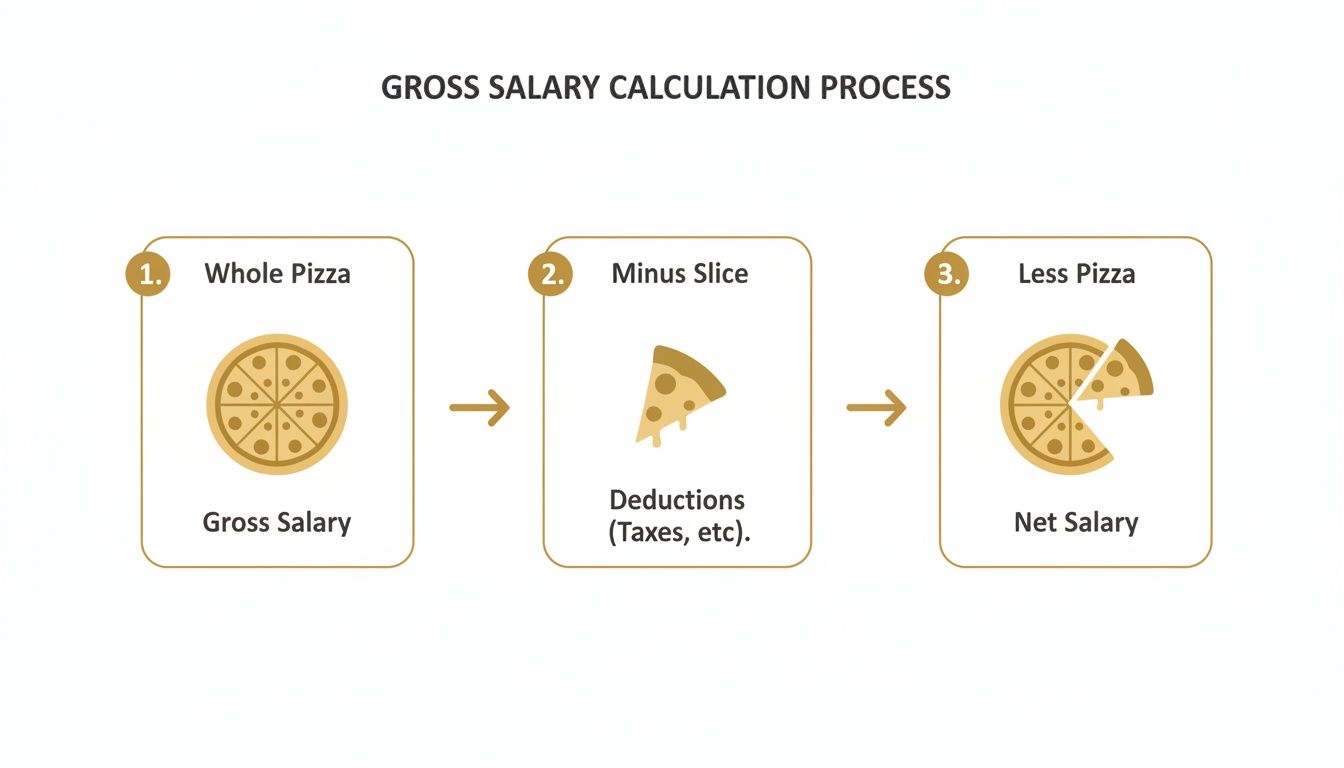
From Gross to Net: Understanding the Deductions
The difference between gross and net pay comes down to a series of standard, legally required deductions. For any nanny employed under a PAYE (Pay As You Earn) system in the UK, these deductions are handled automatically by you as the employer or your payroll provider.
Here are the most common deductions you’ll see:
- Income Tax: This is the tax paid to HMRC on earnings above a certain tax-free threshold, known as the Personal Allowance. The UK uses a progressive system, so the more your nanny earns, the higher the rate of tax they pay on those higher earnings.
- National Insurance (NI): These contributions build eligibility for state benefits, including the State Pension, Maternity Allowance, and bereavement support. It’s a bit like an insurance policy for their financial future.
- Pension Contributions: Thanks to auto-enrolment, a percentage of your nanny's salary is automatically paid into a workplace pension. As the employer, you are also required to contribute, helping your nanny save for retirement.
- Student Loan Repayments: If your nanny has an outstanding student loan, repayments are automatically deducted once their earnings cross the relevant threshold.
To make this crystal clear, let's walk through a typical example.
The Journey From Gross Salary To Net Pay
This table breaks down how a £50,000 annual gross salary for a UK-based nanny might translate into net pay. Please note these are illustrative figures based on 2023/24 tax and NI rates in England.
| Component | Description | Example (On a £50,000 Gross Salary) |
|---|---|---|
| Gross Annual Salary | The full salary agreed upon in the employment contract, before any deductions. | £50,000 |
| Income Tax | Calculated on earnings above the Personal Allowance (£12,570), with different rates for different bands. | -£7,486 |
| National Insurance | Employee's contribution on earnings between the primary threshold and upper earnings limit. | -£3,678 |
| Pension | Employee's minimum 5% contribution under auto-enrolment. | -£1,872 |
| Net Annual Salary | The final take-home pay after all deductions are made. | £37,000 (approx.) |
| Net Monthly Pay | The annual net salary divided by 12, representing the amount received each month. | £3,083 (approx.) |
As you can see, the deductions significantly change the final amount. This is why all salary negotiations must be clear about whether the figures discussed are gross or net.
Why Your Nanny's Payslip is Key
The best way to see this in action is on a payslip. Each month, your nanny should receive a detailed statement that starts with their gross pay and then clearly lists every single deduction, leading to the final net pay figure. It’s the official record of their earnings.
If you’re new to this, learning how to read a payslip is an incredibly useful skill. It demystifies the entire process and ensures everyone is on the same page.
For a more detailed breakdown with specific calculations tailored to the childcare sector, we have a complete guide covering https://www.superstarnannies.com/gross-pay-vs-net-pay/. It's a must-read for ensuring absolute clarity and preventing any payday surprises.
The Most Common Deductions From Nanny Salaries Explained
The difference between a nanny's gross salary and their actual take-home pay all comes down to deductions. These aren't random charges but are standard, mandatory contributions that cover everything from taxes to retirement savings. As a parent hiring a nanny, understanding these is key to managing payroll correctly and transparently.
For families in the UK, these deductions are handled through the Pay As You Earn (PAYE) system. This is simply the process used to send the correct tax and other contributions directly from you, the employer, to HMRC. If you’re an employer, understanding What Is PAYE for Employers? is the first step to managing your nanny’s payroll correctly.
UK Income Tax and National Insurance
In the UK, the two main deductions are Income Tax and National Insurance. Income Tax is progressive, which means everyone has a tax-free Personal Allowance to start. As your nanny earns more, their income moves through different 'bands', and they only pay a higher rate of tax on the portion of their salary that falls into that higher band.
National Insurance (NI), on the other hand, is what builds entitlement to state benefits, like the State Pension or Maternity Allowance. For an employed nanny, you’ll be dealing with Class 1 contributions. It’s a shared cost: a portion is deducted from the nanny's gross pay, and you pay a separate contribution on top as the employer.
- Income Tax Bands: Your nanny's salary is taxed at different rates as it rises through the basic, higher, and additional rate bands.
- National Insurance Contributions (NICs): Calculated on earnings, these payments are essential for accessing the UK's social security system.
US Taxes: FICA, Federal, and State
Over in the United States, the principle is much the same, but the names are different. The main deduction is Federal Income Tax, which also uses a progressive bracket system. On top of that, most states also have their own State Income Tax, with rates and rules that can vary dramatically.
Beyond income taxes, you have the Federal Insurance Contributions Act (FICA).
FICA is a mandatory US payroll tax that funds two major programmes: Social Security (for retirement, disability, and survivor benefits) and Medicare (for federal health insurance for those over 65). Like in the UK, the cost of FICA is split between the employee and the employer.
Workplace Pensions
The final key deduction, certainly in the UK, is for a workplace pension. Thanks to the auto-enrolment scheme, employers are legally required to set up a pension for eligible staff and contribute to it.
The nanny also contributes a small percentage of their earnings, which is taken directly from their payslip before they receive it. This system makes saving for retirement a seamless, shared responsibility between the nanny and their employing family, ensuring a solid plan is in place for the future.
How To Calculate Nanny Salaries: A Practical Walkthrough
Theory is one thing, but seeing the numbers in action is what really makes it all click. To help you get a firm grasp on gross salary, let's walk through exactly how it translates into the money a nanny actually takes home.
We’ll look at two very common scenarios: a live-out nanny in London and a live-in nanny in New York. These real-world examples will show you precisely how to apply the correct taxes, National Insurance or FICA contributions, and pension deductions to a typical gross salary agreement.

Case Study 1: The London Live-Out Nanny
Let’s imagine a family in Chelsea has just hired a wonderful live-out nanny and agreed on a gross salary of £55,000 per year. What will her annual take-home (net) pay actually look like? To figure this out, we need to apply the UK’s tax, National Insurance, and pension rules.
In a placement like this, the gross salary is the starting point for all cost calculations. When we place a professional in a top London household, the family uses this figure to budget for their own contributions, which include 13.8% for employer National Insurance and a 3% pension auto-enrolment contribution. While Payscale for UK Nannies reports a median UK hourly rate around £12.09, top-tier professionals in London command £17-£25+ per hour gross.
Here's how the deductions for our London nanny break down:
- Gross Annual Salary: £55,000
- Income Tax: This is calculated on her earnings above the £12,570 Personal Allowance, which comes to approximately -£9,432.
- Employee National Insurance: A percentage is deducted from her pay, totalling around -£4,178.
- Employee Pension Contribution: The standard 5% employee contribution works out to -£2,122.
Estimated Net Pay: After subtracting these key deductions, our nanny’s approximate annual take-home pay is around £29,268. This breaks down to £2,439 in her bank account each month.
Case Study 2: The New York Live-In Nanny
Now, let's head over to the US. Consider a live-in nanny working for a family in New York City with an agreed gross annual salary of $80,000. The calculation process follows the same principle, but this time, we apply the American tax system.
Live-in roles bring their own set of financial considerations, and it’s important to understand the full picture. For a deeper dive into what these arrangements entail, our guide on live-in nanny costs is an excellent resource.
For this nanny, we'll need to account for Federal, State, and FICA taxes:
- Gross Annual Salary: $80,000
- Federal Income Tax: This would be approximately -$9,185.
- FICA (Social Security & Medicare): A standard 7.65% deduction from her gross pay, which is -$6,120.
- New York State & City Taxes: The combined local taxes would be roughly -$6,815.
Once these deductions are made, the nanny's estimated net pay comes to around $57,880 annually, or $4,823 per month. As you can see, the gross salary is simply the starting line—the real story is in the net pay.
What a Nanny's Gross Salary Means for You, the Employer
When you agree on a gross salary with your nanny, it’s natural to see that figure as the primary expense. But from an employer's perspective, that’s just the starting point. The number on the employment contract is the largest slice of the pie, but it isn't the whole thing.
To budget properly and avoid any unwelcome surprises down the line, it’s crucial to understand the total cost of employment. This includes several mandatory contributions you, as the employer, are legally required to pay on top of the agreed gross salary. For any family, especially those managing significant household staff, getting a firm grip on these total outgoings is the key to sound financial planning.

Your Additional Financial Responsibilities as an Employer
The moment you hire a nanny, you officially become an employer, which comes with its own set of financial duties. Think of these as the non-negotiable costs of doing things correctly and professionally. Here are the main items you’ll need to factor into your budget:
Employer’s National Insurance (NI) Contributions: This is a big one. You are required to pay Class 1 National Insurance on your nanny's earnings over a certain threshold. This is a separate tax paid directly by you and is not deducted from their salary.
Workplace Pension Contributions: Under the UK's auto-enrolment rules, you must contribute to your nanny's pension scheme. This is calculated as a percentage of their qualifying earnings and is paid in addition to their gross pay.
Payroll Administration: Unless you’re a payroll expert, you'll need a specialist service (like Nannytax) to handle the complex calculations. They manage payslips, tax codes, and HMRC submissions, ensuring everything is compliant. These services charge an annual fee.
Employer’s Liability Insurance: This isn't just a good idea; it's a legal requirement in the UK. This insurance protects you financially if your nanny has an accident or becomes ill as a direct result of their work in your home.
When you work with a high-calibre agency, all salary negotiations are based on a gross figure. For example, a top-tier daily nanny in London might command a gross salary between £44,200 and £48,100, according to Norland's latest salary guide. On top of that, you must add employer contributions, which could easily amount to an extra £5,000 per year or more.
To help you visualise this, here’s a typical breakdown of how a gross salary translates into the total cost for an employer in the UK.
Nanny Gross Salary vs. Total Employer Cost Breakdown
| Cost Item | Description | Example (On a £50,000 Gross Salary) |
|---|---|---|
| Nanny's Gross Salary | The agreed-upon annual salary before any deductions. This is your largest single cost. | £50,000 |
| Employer's NI | A mandatory government tax paid by the employer on the employee's earnings. | ~£5,785 |
| Employer Pension | The mandatory employer contribution to the nanny's workplace pension scheme. | ~£1,245 |
| Payroll & Insurance | Fees for a payroll service and the cost of legally required Employer's Liability Insurance. | ~£450 |
| Total Employer Cost | The true annual cost to employ the nanny. | ~£57,480 |
Note: The figures above are estimates for the 2024/25 tax year and can vary based on specific circumstances.
As you can see, the final cost is significantly higher than the gross salary figure alone.
The Bottom Line: A nanny's gross salary is just one part of your financial commitment. Always budget for an additional 15-20% on top to cover your employer contributions for National Insurance, pension, and other essential administrative costs.
Understanding this from the outset is why we walk all our clients through a detailed breakdown of total employment costs. For a deeper dive, take a look at our complete guide to the costs of hiring a nanny. By seeing the complete picture, you can budget with confidence and lay the foundation for a strong, professional, and long-lasting relationship with your nanny.
Negotiating Salary and Finalising Your Nanny Contract
Now that you have a firm grasp on gross salary and the total costs involved, you’re ready for the final, most important part of the hiring journey. This is where clear, honest conversations and professional paperwork come together to build a strong foundation for a brilliant working relationship.
For nannies, this is your moment to confidently discuss a salary that truly reflects your experience, qualifications, and the unique value you offer. Don’t hesitate to state your desired gross salary and explain why you’re worth it, whether that’s down to your Norland training, special needs expertise, or fluency in another language.
Documenting The Agreement
For families, putting together a compelling offer is about more than just the headline salary figure. A truly competitive offer includes the whole picture: pension contributions, private healthcare, and perhaps an annual performance bonus. Presenting this complete package from the outset shows you are a thoughtful, professional employer who is serious about attracting top-tier talent.
The single most important thing you will do at this stage is to get every financial detail documented in the employment contract. The salary must always be stated as a gross figure. This is absolutely non-negotiable. It’s a legal necessity that provides total clarity and protects both you and your nanny from any misunderstandings down the line.
Key Points For Your Contract
After a verbal agreement is reached, the written contract makes it official. It's the blueprint for your professional relationship, so it needs to be crystal clear on all financial matters.
Make sure it explicitly covers:
- Gross Salary: State the annual gross salary figure and how often it will be paid (e.g., monthly).
- Hours of Work: Define the standard working hours and specify the agreed-upon rate for any overtime.
- Benefits: List every additional benefit in detail, such as pension contributions, healthcare provisions, or the use of a vehicle.
- Deductions: Include a clause acknowledging that all legally required deductions, like Income Tax and National Insurance, will be handled professionally via a payroll service.
Finalising a detailed, transparent contract is the best way to start off on the right foot, establishing trust from day one. To take a deeper dive into putting together a world-class offer, have a look at our guide on crafting the elite nanny compensation package. At Superstar Nannies, we specialise in navigating these details, ensuring a smooth and positive outcome for everyone involved.
In Conclusion: Clarity is Key
Understanding what does gross mean salary is the first step toward a transparent and respectful relationship with your nanny. By always negotiating and contracting in gross terms, you protect yourself from unexpected financial risks and establish a professional foundation built on clarity and trust. Budget for your total employer costs, document everything clearly, and you'll be well on your way to a successful partnership with your new nanny.
Frequently Asked Questions About Nanny Salaries
Should we agree on a gross or net salary in the contract?
You should always agree on a gross salary in the contract. Agreeing to a net (take-home) salary is risky for you as an employer. If your nanny's tax code changes or they begin student loan repayments, you would be financially responsible for covering these new costs to ensure their net pay stays the same. A gross salary agreement is the professional standard that provides financial certainty for you and transparency for your nanny.
What is the difference between gross pay and total employer cost?
Gross pay is the full salary you agree to pay your nanny before any deductions are made. The total employer cost is the gross salary plus all the additional mandatory costs you must pay as an employer. This includes employer's National Insurance contributions, employer pension contributions, payroll service fees, and employer's liability insurance. As a rule of thumb, budget for an extra 15-20% on top of the gross salary to cover these costs.
How do benefits like a car or accommodation affect pay?
Perks like a car or accommodation are known as benefits-in-kind (BIKs), and they can impact tax calculations. While accommodation for a live-in nanny is typically tax-exempt in the UK, other benefits are not. For example, a car provided for personal use has a taxable cash value assigned by HMRC. This value is added to the gross salary for tax purposes, increasing the overall tax owed. It is vital to detail all benefits in the contract.
Why are London nanny salaries so much higher?
London nanny salaries are significantly higher due to a combination of powerful market forces. The city's high cost of living is a primary driver. Furthermore, intense demand from high-net-worth and international families creates a highly competitive market for a concentrated pool of exceptionally qualified childcare professionals. Nannies with specialist skills, such as Norland College training or fluency in multiple languages, can command the highest rates in affluent areas.
Navigating the complexities of nanny compensation is our specialty. For a truly professional and seamless hiring experience, contact Superstar Nannies for a confidential consultation at https://superstarnannies.com.