


Most families get this hire wrong because they treat a live-in nanny housekeeper like a convenient shortcut. It isn't a shortcut, it's a hybrid employment model that can work beautifully in an UHNW home only when the duties, hours, privacy rules, and pay are set with precision from day one. If you want harmony, you need structure, not optimism.
Understanding the Live-In Nanny Housekeeper Hybrid Role
The biggest mistake is assuming one person can effortlessly “do everything” and make the arrangement feel smooth. In practice, the live-in nanny housekeeper is not a two-for-one bargain, it's a combined role that sits right at the edge of childcare, household operations, and domestic logistics. UK job listings often describe 10–12 hour days and hybrid duties that blur into a domestic-couple-style workload, which is exactly where expectations and reality start to diverge (Find a Job).
That's why the role should be treated as a structured partnership, not an open-ended solution. The family gets flexibility, but that flexibility can create role ambiguity if nobody defines what “childcare first” means in daily life. For a practical framework on managing household standards without turning the home into a negotiation, the expert guide for home control is a useful reference point.
Why the hybrid model works
It works when the family needs continuity. School runs, evening routines, laundry, children's spaces, meals, and tidy living areas can all be handled by one person if the scope is realistic and the timing is humane.
Practical rule: if you can't describe the job in one sentence without adding “and anything else that comes up”, the role isn't defined well enough yet.
That sentence matters because UHNW households often drift into assuming availability equals capacity. It doesn't. The best live-in placements succeed because the job is designed like a professional role, with limits, priorities, and a clear understanding of what falls outside the remit.
Core Responsibilities and Setting Clear Boundaries
A strong live-in nanny housekeeper contract starts with separating the role into two functions. One side is childcare, the other is housekeeping, and both need to be written down clearly before anyone starts. Without that split, the job expands gradually until the employee is carrying emotional, practical, and physical overload.
Childcare duties
In England, a live-in nanny's responsibilities commonly extend well beyond supervision. They can include children's laundry and ironing, changing bed linen, cooking for the children, organising clothes and toys, and managing school runs and activities (Greycoat Lumleys).
That's the right place to start. Child-focused tasks should be prioritised around the rhythm of the children, not the family's wish list of extra convenience tasks. If the role includes school prep, meal support, play organisation, and activity transport, those items need to be framed as core childcare, not optional add-ons.
Housekeeping tasks
Housekeeping needs the same discipline. Common duties should be limited to the agreed household zone, such as children's areas, family laundry, tidying, meal support, and keeping shared spaces orderly. If the family expects deeper housekeeping, that should be explicitly acknowledged rather than folded into vague wording.
A clean way to structure the conversation is to define a split in the contract, such as 60% childcare and 40% housekeeping, then specify what each percentage means in practice. That prevents role creep and gives both sides a realistic benchmark for performance.
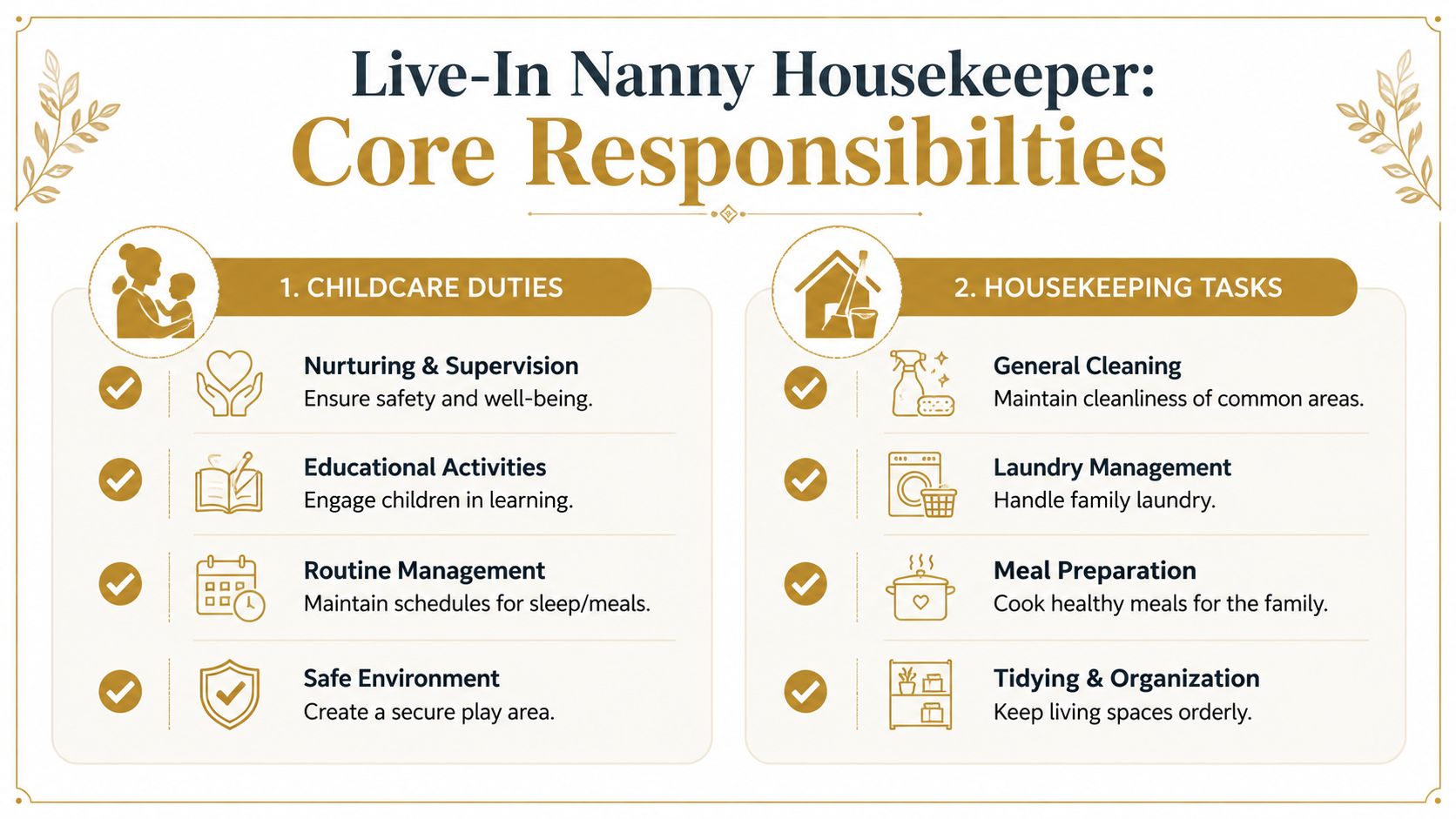
A contract that names duties is far easier to manage than one that relies on goodwill. The more exact the list, the less likely it is that normal family life turns into constant renegotiation.
Evaluating the Pros and Cons for Your Family
The case for a live-in arrangement is obvious to busy households. You get continuity, easier handovers, and one trusted adult who can support the children and the home in a way a fragmented schedule often can't. That can be especially valuable for families with demanding calendars, travel, or irregular routines.
The downside is just as real. A live-in staff member becomes part of the household's daily texture, and that changes privacy, supervision, and expectations inside the home. Families that prize complete separation between work and home life often find the arrangement harder than they expected.
Where the model shines
The strongest households for this role are the ones that want consistency and understand the difference between accessibility and availability. Live-in support is powerful when the family needs a reliable structure for mornings, school logistics, evening rhythm, and household tidiness without juggling multiple employees.
It's also attractive when the home itself has enough space to support a separate living arrangement. If the nanny or housekeeper can't rest properly, the whole model starts to fray.
Where it can fail
It fails when the role is treated like a constant on-call solution. That mindset creates tension fast, especially when one person is expected to absorb childcare, housekeeping, errands, and informal flexibility without the corresponding boundaries or compensation.
The right question isn't whether the role sounds convenient. It's whether your household can support a professional employee without blurring their private time, personal space, and working hours.
Privacy is the deciding factor for many UHNW homes. If your home works best with minimal crossover, you may be better served by rota care, a live-out arrangement, or a split domestic team rather than one resident employee carrying too much of the load.
Crafting the Compensation Package and Employment Contract
Pay has to match the job, not the fantasy version of the job. In London, published salary data shows that a live-in nanny housekeeper can command materially higher pay than the wider UK market, with Jooble's April 2026 estimate for the City of London at £57,036 per year, or £4,753 per month, £1,097 per week, and £28.18 per hour (Jooble). Nannytax's 2025/2026 data also shows a national average gross full-time nanny salary of £45,656, with Inner London at £56,238 and Outer London & Home Counties at £58,864, plus an average gross hourly rate of £16.43 for a London live-in nanny (Jooble).
The gap tells you something important. London placements are priced for the complexity of the role, the cost of living, and the combined nature of childcare plus housekeeping. Budget accordingly, or you'll lose strong candidates before the conversation gets serious.
Legal floor, not a suggestion
HMRC is clear that a live-in nanny who lives in the family home “as part of the family” is still entitled to the National Minimum Wage in the normal way. For 2025/26, the National Living Wage is £12.21 per hour for workers aged 21+, and the accommodation offset is capped at £10.66 per day, so room and board can't be used to drag wages below the legal floor (HMRC).
That's the non-negotiable point. The housing element changes the gross pay structure, but it doesn't erase wage obligations. Live-in staff must also be run through PAYE, with tax and National Insurance handled properly.
What the contract must lock down
A UHNW contract should spell out duties, working hours, overtime expectations if applicable, rest time, accommodation details, confidentiality, notice periods, and travel rules. It should also say what happens when the role expands, because that's where disputes usually begin.
Use a template as a starting point, then tailor it properly. The nanny contract templates page is a sensible place to begin building a compliant draft, but a live-in hybrid role still needs individualisation.
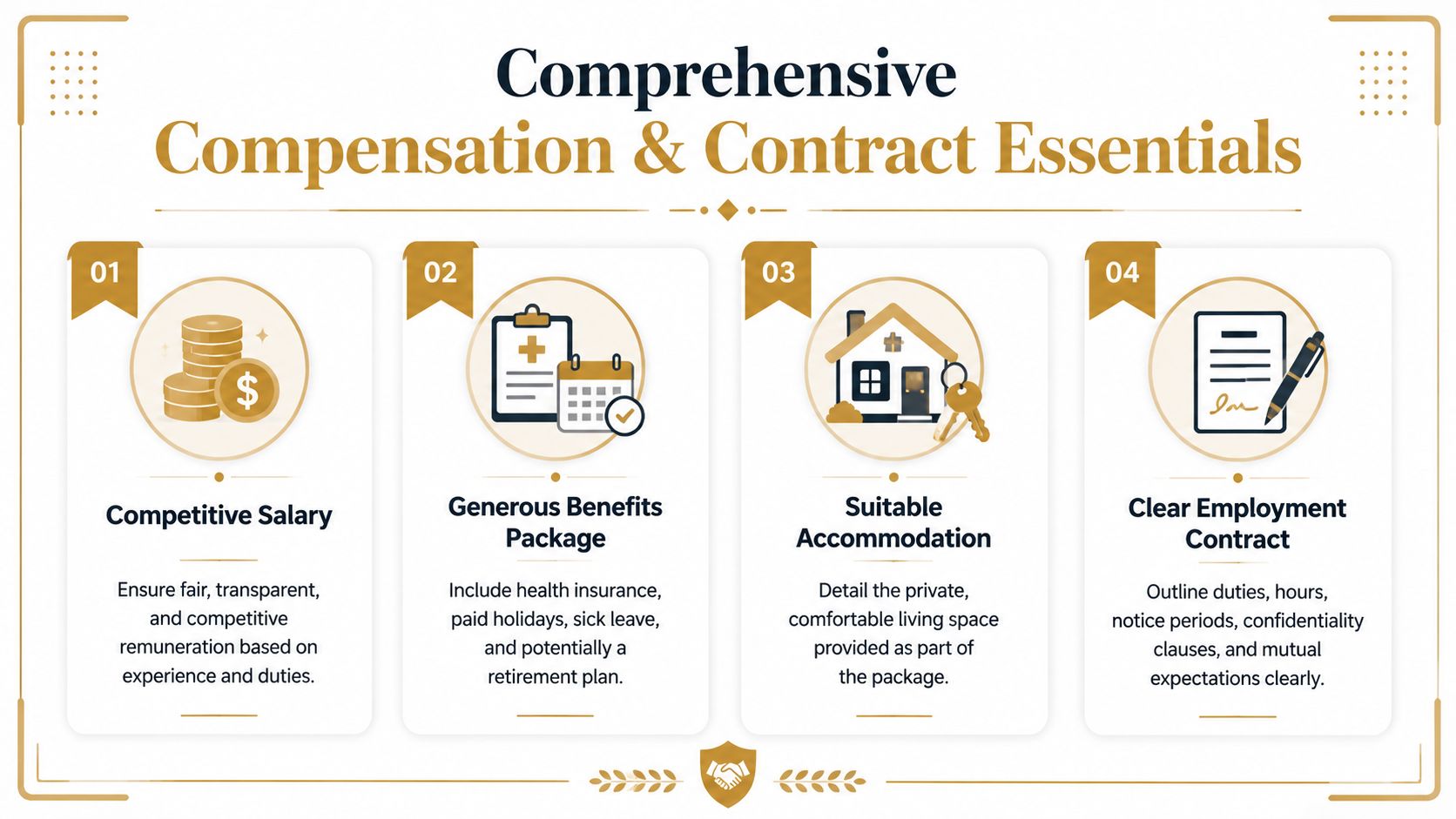
Non-negotiable: if the accommodation is valuable, say so in the package, but never treat it as a substitute for statutory pay.
The Vetting and Hiring Process for Elite Households
For UHNW families, a weak hiring process is a security risk, not an admin issue. The live-in model gives the employee access to the home, the children, and the family's routines, so the vetting standard has to be tighter than a typical domestic hire.
Start with verified identity, detailed references, and proof of relevant live-in experience. Then test for discretion, calm judgement, and the ability to work inside a fully functioning home without creating friction.
What to assess before an offer
A serious interview should cover more than childcare style. Ask how the candidate manages boundaries, how they handle being around principals while still staying professional, and how they deal with changing schedules. If the role includes household coordination, the candidate also needs to show comfort with multiple priorities and a clean communication style.
For deeper due diligence, some families use private detective services as part of wider background sensitivity when the role carries exceptional access and trust. That's not about suspicion, it's about protecting the home, the children, and the household structure.
Why specialist recruitment matters
A specialist agency helps separate credible candidates from people who merely describe themselves well on paper. For international or cross-border hires, the international background checks resource is especially relevant because elite households often need verification that goes beyond a local reference call.
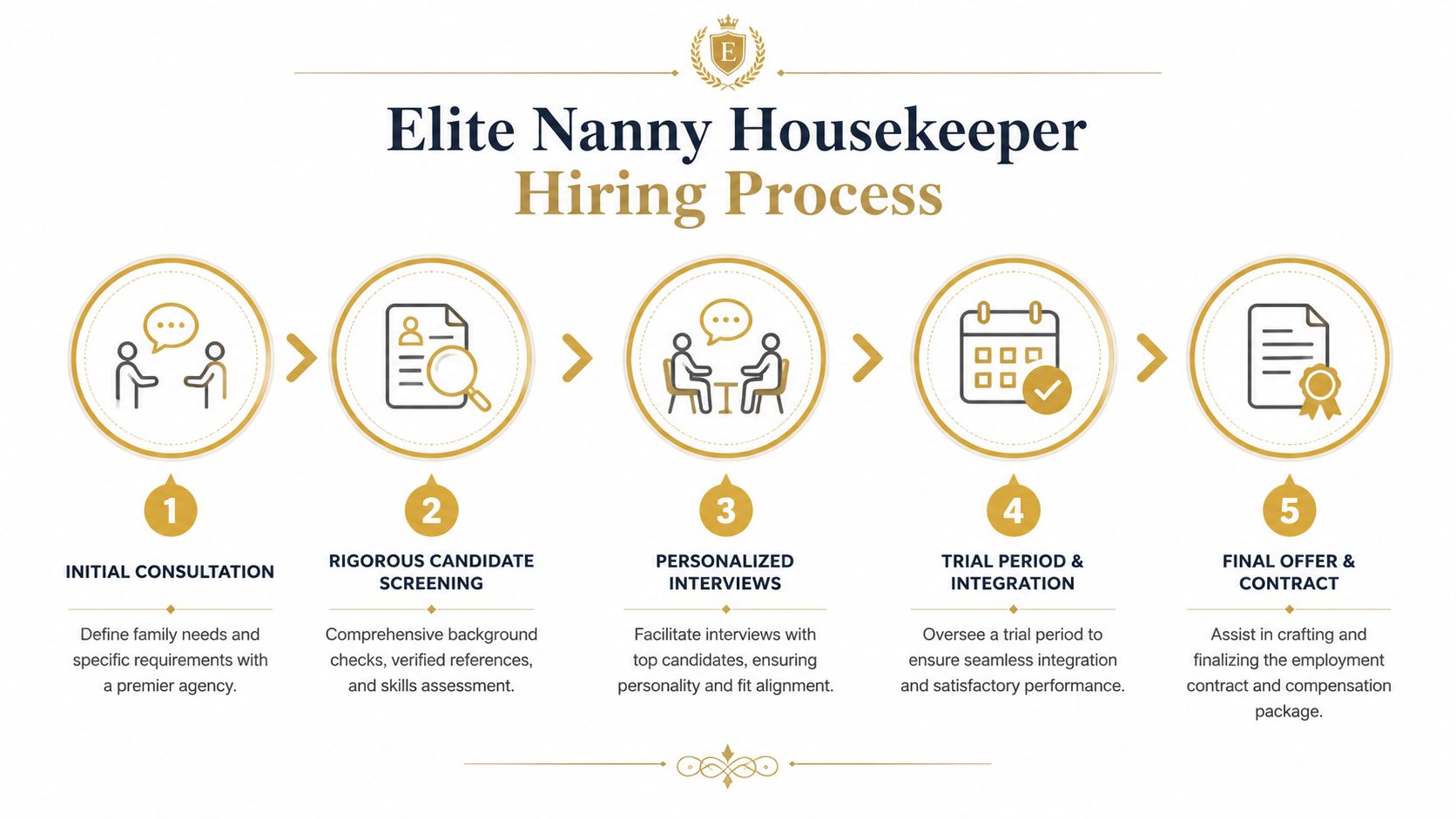
The point is simple. In this category, speed is useful, but rigour is safer. Hire slowly enough to avoid a bad fit, because fixing the wrong live-in placement is expensive in time, morale, and privacy.
Providing Suitable Live-In Accommodation and Support
Good accommodation is retention strategy, not a luxury extra. If you want a loyal, stable placement, the person living in your home needs a private space that feels like their own, not a leftover room at the edge of the house.
The gold standard in UHNW homes usually means a private bedroom, ideally with an en-suite bathroom, and enough separation to create real downtime. If the layout allows for a private entrance or a small kitchenette, that's even better, because it reduces friction and supports professional boundaries.
What fairness looks like in practice
Recent UK guidance for 2026 sets the accommodation offset at £11.10 per day, or £77.70 per week, and live-in job ads often specify long shifts such as 7am to 7pm, which makes clear hours and separate quarters essential (Little Ones London). The message is blunt, live-in does not mean unlimited availability.
That's where the lifestyle side matters. A resident employee can't perform well if they feel observed during every off-duty minute or if their space offers no real privacy. Respecting rest time isn't generous, it's part of running a professional household.
The support standard you should expect
Families should define when the employee is off duty, how meals work, whether guests are allowed, and what personal time looks like. If the arrangement feels ambiguous, the accommodation probably isn't doing its job.
The live-in housekeepers page is useful if you're comparing how residential support is typically structured across household roles. The bigger point remains the same, better living conditions usually mean better longevity, fewer misunderstandings, and a calmer home.

Finding the Perfect Fit for Your Home
A live-in nanny housekeeper can be the right answer for an elite household, but only when the role is built on clarity, fair pay, and respect for the person doing the work. The homes that succeed with this model treat it as a professional arrangement, not a convenience hack.
If you want a discreet, structured placement process, the household staffing agency guide is a sensible next read. Then take the practical step that matters most, define the job properly, set the accommodation standard, and hire someone whose experience matches the workload.
Frequently Asked Questions
How should a live-in nanny housekeeper be paid in the UK?
They must be paid through PAYE, with tax and National Insurance handled correctly. In the UK, the pay floor still applies even when accommodation is provided, and the legal accommodation offset can't be used to push wages below statutory minimums (HMRC).
What should be in the contract if the family travels often?
Spell out whether the employee travels, how travel time is treated, which expenses are covered, and what counts as working time. If the family expects flexibility abroad, that has to be written clearly before the placement starts.
Can extra duties like pet care be added later?
Yes, but only if the contract is updated. Extra duties change the balance of the role, so they should trigger a review of hours, pay, and expectations instead of being assumed informally.
Are London rates really higher than the UK average?
Yes. A 2026 estimate for the City of London places a live-in nanny housekeeper at £57,036 per year, while the national average gross full-time nanny salary is £45,656 (Jooble). That spread reflects both London demand and the combined nature of the role.
Do live-in nannies need private accommodation?
Absolutely. The role only works well when the employee has a private room and genuine downtime. Recent UK guidance also shows that long shifts and accommodation offsets make it essential to define rest, privacy, and boundaries up front (Little Ones London).
If your household needs a discreet, highly structured placement, speak with Superstar Nannies about a specific live in nanny housekeeper search.