

You’re probably reading this between meetings, school emails, and a childcare arrangement that no longer fits the reality of your life. In New York, a nanny search becomes stressful fast when you need more than coverage. You need judgement, discretion, consistency, and someone who can move through your home without creating friction.
That’s where an elite nanny agency new york families can trust becomes useful. Not as a luxury label, but as a risk-management decision. If your schedule is demanding, your privacy matters, or your household runs across multiple properties and time zones, hiring casually is a mistake. You need a process that protects your children and your household.
Finding Exceptional Childcare in New York
A familiar pattern plays out in private households across Manhattan, Brooklyn Heights, Tribeca, the Upper East Side, and beyond. Parents start with referrals, online platforms, or a well-meaning recommendation from a friend. Then the gaps appear. The candidate is warm but not polished. Experienced but not flexible. Reliable locally but not ready for travel, security protocols, or a home with rotating staff and shifting calendars.
That’s why many families stop treating childcare as a simple hire and start treating it as a strategic household placement.

If you’re still weighing nursery, daycare, and in-home care, this ultimate daycare list for infants is a useful reference because it sharpens the practical questions parents often forget to ask under pressure. Once you’ve ruled out a standard solution, the next issue is quality control. That’s where a specialist search matters.
For families hiring at the top end of the market, the primary question isn’t “Can this person care for children?” It’s “Can this person operate well inside our life?” Those are very different standards. An elite search should account for routine, travel, educational expectations, staff dynamics, communication style, and confidentiality from day one.
The right nanny doesn’t just help with childcare. She lowers the temperature in the whole household.
If you want a broader view of how private staffing searches work in this market, this definitive guide to finding elite household staff in NYC is worth reading before you interview anyone.
What Truly Defines an Elite Nanny Agency
Price doesn’t make an agency elite. Branding doesn’t make it elite either. The term only means something when the firm can prove that its process reduces hiring risk.
The clearest benchmark comes from the UK private staffing sector, where standards around childcare placements are often stricter and more formalised than what many New York families encounter locally. In that market, rigorous vetting processes, including enhanced DBS checks and Norland College certification verification, directly correlate with a 92% long-term placement retention rate beyond 12 months, and pre-employment medicals plus reference cross-verification reduce turnover by 65% compared to non-vetted informal hires according to this industry guide on starting and operating a nanny agency. Those numbers matter because they point to one thing. Better screening produces more stable placements.
Process over polish
An elite agency should be able to explain exactly how it screens, why each layer exists, and what happens when concerns appear. If the answer is vague, move on.
Look for these signals:
- Career professionals only: The agency should present childcare as a vocation, not a stopgap role.
- Reference depth: Speaking to one previous employer isn’t enough for a high-trust household.
- Behavioural judgement: Skills matter, but temperament decides whether a placement lasts.
- Confidentiality culture: Privacy must be embedded in the process, not added at the contract stage.
Why the UK standard matters in New York
New York has exceptional nanny talent. But many agencies still operate with a broad consumer model. They fill roles for many kinds of households, often quickly, and their screening may be adequate rather than exacting. That isn’t what UHNW families need.
The UK’s “gold standard” approach, especially around trained candidates and household fit, offers a sharper model. It reflects something many experienced parents learn the hard way. A technically capable nanny can still be the wrong hire if she lacks discretion, emotional steadiness, or the ability to work within a layered household structure.
For families thinking beyond day-to-day logistics, this practical guide for parents and educators is also helpful. Not because it replaces an agency search, but because it clarifies the developmental standards your caregiver should be able to support.
Specialised Services for Discerning New York Families
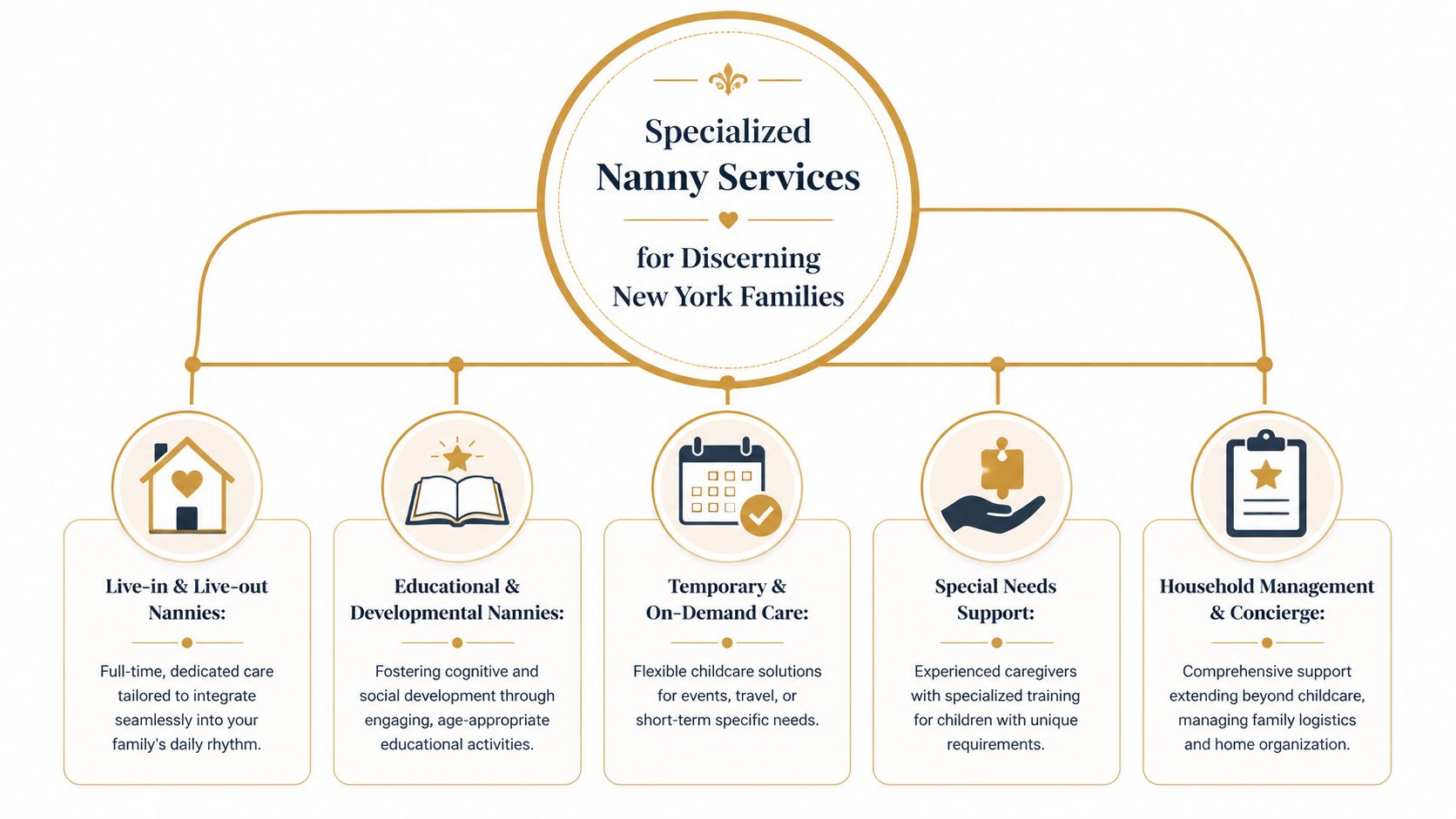
Most families start by saying they need “a nanny”. Often they need something more specific. The role should match the stage your family is in, not the title you happen to know.
The role that covers your daily life
A live-in or live-out nanny is the core placement for many New York families. The difference isn’t status. It’s operational fit. A live-in role suits households with early starts, late nights, travel, or a need for continuity across unpredictable schedules. A live-out role works when boundaries, routine, and local commuting are all stable.
For younger children, an educational and developmental nanny can be the stronger choice. This is often a career nanny with a strong grounding in child development, routine-building, language exposure, and age-appropriate learning. Families who care about behaviour, school readiness, and structured days usually benefit from this profile.
Practical rule: Hire for the life you actually lead, not the life you wish were more organised.
The role that supports transition or complexity
A maternity nurse, newborn care specialist, or night nanny serves a very different purpose. This isn’t just childcare. It’s short-term expertise during the most demanding phase of family life. If you’re welcoming a new baby, recovering from birth, balancing older siblings, or handling twins, specialist support can stabilise the whole household.
A travel nanny becomes valuable when your family moves often between residences, travels internationally, or needs a caregiver who understands airports, packing routines, changing sleep schedules, and how to remain calm in unfamiliar settings. For international households, bilingual nannies add another layer. They support continuity in language and culture rather than treating language exposure as an afterthought.
The role that raises the standard
The Norland nanny sits in a category many US families haven’t encountered properly. Norland College was founded in 1892, trains around 100 graduates per year, and has trained over 5,000 professionals according to the UK market data provided in the brief. In private childcare, that training has become a recognised benchmark. These nannies are known for discipline, polish, child development knowledge, and calm professionalism under pressure.
If your priority is academics and broader childhood structure, a governess or private tutor may be the better fit than a conventional nanny. That’s especially true in homes where schooling, travel, and enrichment need to be coordinated closely.
Some families also need wider household support. In London’s UHNW market, agencies report that elite childcare is often bundled with broader staffing, including house managers with an average salary of £80,000 and private chefs averaging £65,000, with total household packages reaching £150,000 to £300,000 annually according to Nanny & Butler UK insights. The point isn’t to copy London. It’s to recognise the same principle in New York. Childcare works better when the house itself is organised.
The Rigorous Vetting Process Uncovered
The biggest difference between a standard agency and an elite one isn’t the shortlist. It’s what happened before that shortlist reached you.

Top-end firms screen hard and reject often. Top-tier agencies reject up to 95% of applicants, candidates often go through more than 10 stages of screening, and those processes can produce placement success rates of 98% within 4 to 6 weeks according to BAHS and Eden Private Staff. That level of selectivity is not excessive in private homes. It’s sensible.
What serious screening includes
A proper vetting process should include several layers, and each one serves a different purpose.
- Identity and work eligibility: The agency confirms the candidate is legally able to work in the relevant jurisdiction.
- Qualification verification: Certifications, formal childcare training, first aid credentials, and specialist experience must be checked, not assumed.
- Background screening: For international or mobile households, this often means checks across more than one country.
- Reference investigation: Agencies should speak with former employers in depth, not just collect written notes.
- Skills and scenario assessment: Agencies test judgement, not just CV strength.
Fit is not a soft factor
Many families focus on background checks and miss the issue that derails placements most often. Household fit. A nanny can be impeccable on paper and still fail in a home that is fast-moving, highly private, or staffed with exacting standards.
That’s why stronger agencies assess communication style, emotional steadiness, flexibility, and how the candidate responds to real household scenarios. In practice, this matters as much as childcare knowledge. A person who can handle a toddler but cannot handle a principal, a PA, a chef, and a changing travel calendar will not last.
Ask an agency how it evaluates discretion under pressure. If they can’t answer clearly, they aren’t screening for the reality of private life.
Privacy has to be built in
For high-profile families, discretion isn’t a personality trait. It’s a compliance issue. NDAs, confidential file handling, careful reference protocols, and limited disclosure around the family’s identity should all be standard.
If you want a closer look at what a disciplined screening model should involve, this comprehensive guide to the nanny vetting process for discerning families offers a useful benchmark.
Navigating Costs and Timelines in the NYC Market
New York families often ask for a precise salary number too early. That’s the wrong starting point. In elite childcare, cost follows complexity.
The cleanest benchmark available comes from London, which functions as a comparable UHNW market. There, elite nanny salaries range from £45,000 to £65,000, Norland-trained nannies command £55,000 to £75,000, and rota nannies for VIP households earn £70,000 to £120,000 annually according to Greycoat Lumleys and Royal Nannies. Those figures don’t convert neatly into New York salaries, but they do show the hierarchy of value in the private market. Specialist training, rota coverage, and household intensity all increase compensation.
What changes the investment
A straightforward live-out role will price differently from a role that includes travel, bilingual capability, newborn support, educational oversight, or split-residence logistics.
The main cost drivers are usually:
- Schedule design: Rota, overnight, and on-call expectations change the package.
- Child profile: Newborns, multiple children, and special requirements all affect the search.
- Travel load: International movement narrows the candidate pool.
- Training pedigree: UK-trained and highly specialised candidates command premium compensation.
- Household environment: Formal homes often need candidates with prior private-service experience.
How long a search should take
Families often want speed and perfection at once. That combination is rare. The right timeline depends on how narrow your brief is and whether you’re willing to compromise on experience, travel capability, or schedule structure.
A sensible agency should move urgently without sending weak candidates just to create momentum. If you want an informed view of New York compensation and role structures, this elite household guide to average nanny salary in NYC gives useful context.
The Superstar Nannies Difference for Global Families
Most New York agencies understand New York. Fewer understand households that move between New York, London, Palm Beach, the South of France, the Gulf, or the Alps. That’s the key dividing line for global families.
Cross-Atlantic hiring creates legal and cultural problems that many local searches miss. UK regulations require Enhanced DBS checks and UK GDPR adherence, and the source provided also notes a 15% rise in high-net-worth families relocating between the UK and the US. It adds that agencies able to operate confidently across both markets address a meaningful compliance and cultural gap, as outlined in this discussion of why high-net-worth families use elite agencies.
Why the UK gold standard changes the search
For first-time New York clients, the biggest advantage of an international lens is access to a different calibre of candidate expectation. UK-trained professionals often arrive with stronger experience in formal homes, clearer boundaries, and a better understanding of service culture. That doesn’t mean every British-trained nanny is right for a Manhattan household. It means the search can start at a higher operational standard.
This matters if your family wants:
- Cross-border compliance awareness
- Candidates used to discretion and formal service
- Travel readiness and passport flexibility
- Cultural sensitivity for international households
One recommendation for global households
If your family needs access to both US and UK talent pools, Superstar Nannies’ U.S. expansion and luxury childcare staffing model is relevant because it covers nanny placements, maternity support, governesses, and broader private staffing across international markets. That kind of structure is useful when the nanny hire is only one part of a wider household decision.
The mistake I see most often is treating a cross-border hire like a local search with extra paperwork. It isn’t. It requires different screening, better coordination, and a sharper eye for cultural fit.
Your Next Steps to Finding the Perfect Nanny
If you’re hiring your first nanny at this level, keep the process simple and strict. Define the role properly. Choose an agency based on process, not branding. Refuse to rush the final decision just because a candidate is available.
Use these questions in every agency conversation:
- How many screening stages does each candidate complete before you present them?
- How do you verify references from private households, especially international ones?
- What confidentiality protections do you use during the search?
- Have you placed candidates in homes with travel, security, or multiple residences?
- How do you assess personality fit, not just qualifications?
- What happens if the placement isn’t right after the start date?
- Can you source UK-trained or internationally experienced candidates if needed?
A strong agency welcomes detailed questions. A weak one tries to move you to interviews before you understand the process.
For an elite nanny agency new york search, clarity beats speed. Write the brief carefully. Identify the critical requirements. Separate preferences from requirements. Then let the search run with discipline.
Frequently Asked Questions
How is an elite nanny agency different from a standard nanny agency in New York
An elite agency is defined by depth of process. It screens more rigorously, handles privacy more carefully, and understands the operational demands of high-profile or high-pressure households. Standard agencies may still be useful, but they often serve a broader market and may not be built for discretion, travel-heavy roles, or complex household structures.
Should I hire a Norland nanny in New York
If you want strong training, polished professional standards, and a candidate comfortable in formal homes, a Norland-trained nanny is worth considering. It’s not the right fit for every family. But for parents who value routine, child development knowledge, and calm execution, this background can be a meaningful advantage.
How long should I expect an elite nanny search to take
It depends on the role. A narrow brief with travel, rota work, bilingual requirements, or multiple residences will take longer than a more conventional placement. The right agency should balance speed with quality. Fast is useful. Fast and careless is expensive.
What should be included in a nanny contract
You want duties, schedule, compensation, confidentiality expectations, travel terms, time off, sick leave, communication boundaries, and trial or probation terms covered clearly. In private homes, ambiguity causes more trouble than conflict. A detailed agreement protects both sides and makes management easier from the start.
Do global families need different vetting for New York hires
Yes. If your nanny will work across jurisdictions or if you are hiring internationally, local checks alone won’t cover enough. You need work eligibility review, cross-border background screening where relevant, and an agency that understands the legal and cultural expectations in each market involved.
If you’re ready to make a careful, discreet hire, Superstar Nannies offers confidential consultations for families seeking elite childcare and private household staffing across New York, the UK, and international residences.