


You may be tempted to treat hiring help as a lifestyle purchase. It isn't. Once a nanny, housekeeper, chauffeur, or private chef walks into a home, the question becomes far more serious: who employs that person, who pays them, who carries the records, and who owns the risk if something goes wrong.
Elite families often feel the relief of turning to private staff agencies because the search is faster and the screening looks more careful. That relief can disappear quickly if the arrangement is fuzzy. The family still needs to understand whether the agency is introducing a candidate, supplying a worker, or managing a placement with real compliance responsibilities attached.
The Evolving Role of Private Staff Agencies
In the UK, an agency that introduces candidates and an employment business that supplies workers are regulated differently, and that difference decides who employs the person in your home. Families in the US face a similar practical question, even if the legal labels differ by state: who is on the payroll, who carries the records, and who takes the risk if the placement goes wrong.
The sector did not stay a simple introductions market. By the start of the 1980s, private agencies were placing about 500,000 workers annually into temporary roles, compared with 79,000 from state job centres, while state job centres still handled about 1.5 million permanent placements and private agencies about 600,000 ONS background on temporary employment agencies. By 2021, the UK reportedly had more than 20,000 temporary employment agencies and about £5 billion in annual turnover. That scale matters because it shows how far the industry has moved into workforce supply, not just candidate introduction.
For an elite household, the core issue is operational, not cosmetic. A serious agency should be able to place a rota nanny, maternity nurse, private chef, or bilingual family assistant while explaining exactly where the employment responsibility sits. If the answer is vague, the arrangement is already weak.
Private households need discretion, speed, and certainty. Agencies that have adapted now handle more of the screening, documentation, and matching than many families realise, and that is where the service becomes useful.
A clear rule applies: if the agency cannot explain the employment structure in plain English, do not assume it has one.
For families that expect the same standard of coordination from staffing that they expect from travel support, luxury travel concierge insights offers a useful parallel. Careful coordination only works when each party knows its role, and the same standard should apply before anyone enters your home.
If you want a formal baseline on the category itself, what is a luxury staffing agency is a useful starting point before you assess the employment model underneath it.
How Agencies Structure Placements
The first question is who employs the staff. In UK terms, the difference between an employment agency and an employment business changes who pays the worker and who carries employment-law responsibility GOV.UK guidance on employment agencies and businesses. For a private household, that answer belongs on the table before any interview starts.
Three models that matter
An introducer connects candidate and family. If the household hires directly, the family becomes the employer and must handle the contract, payroll, insurance, and statutory duties.
A temporary supply model works differently. The employment business usually pays the worker, which removes some administration from the household, but the home still needs to know what the agency covers and what remains its responsibility.
A managed service or payroll-led arrangement sits between those two. It can suit complex households, but only when the paperwork matches the service description. A brochure label is worthless if the contract says something different.
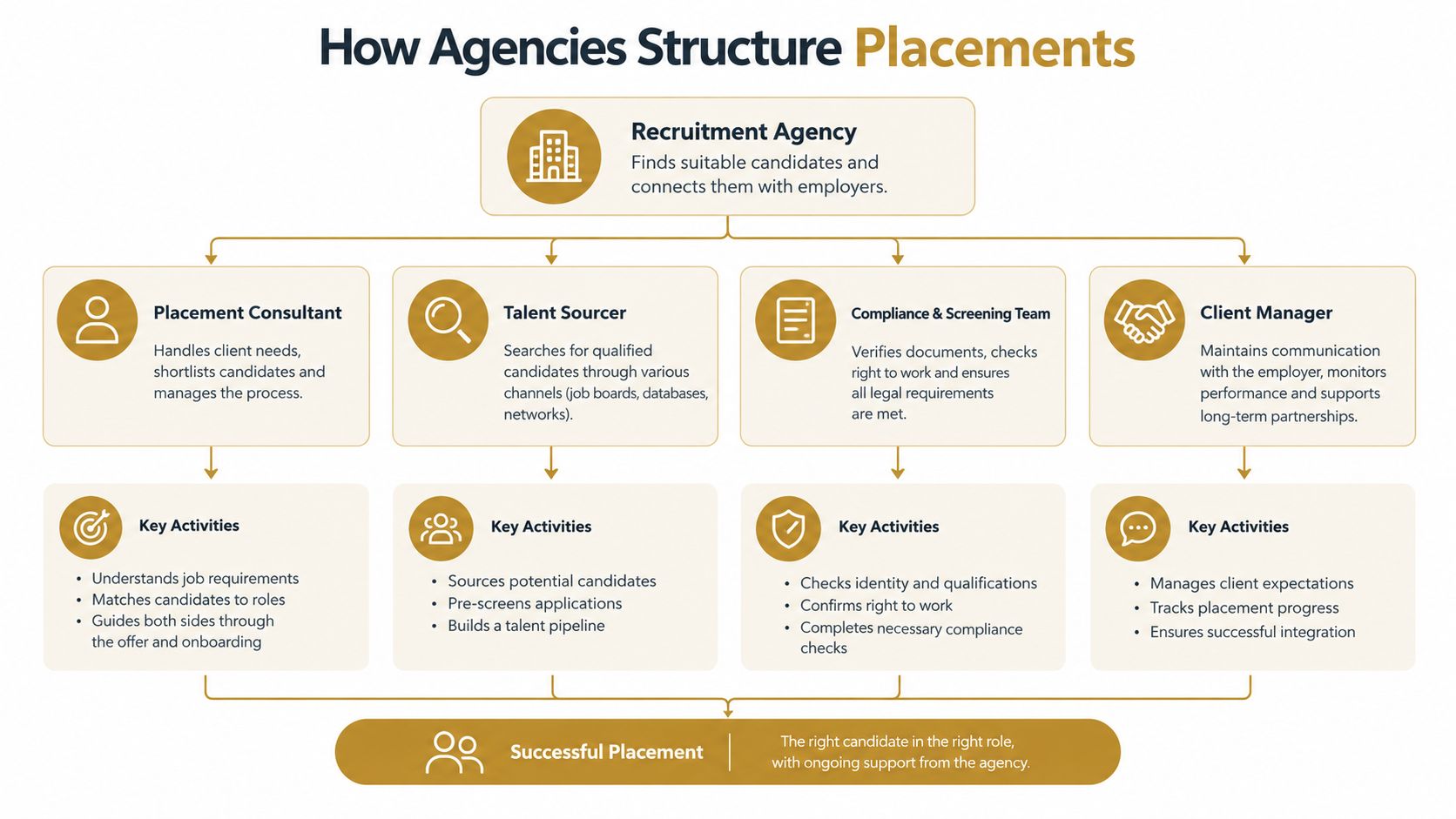
Ask direct questions. Who invoices whom? Who runs holiday pay? Who handles sickness absence? Who deals with disputes if the placement breaks down? If the answers change from one document to the next, the structure is too loose for a household with real exposure.
The operational detail matters more than the sales pitch. A family should know whether the agency is acting as a finder, a payer, or a manager of the placement. That is the difference between clean accountability and confusion once the staff member is in post.
For a household comparing service scope and structure, domestic staffing agencies gives a useful reference point.
Best practice: decide the employment model before the candidate is presented to the family, not after everyone has already fallen for the profile.
Understanding Rigorous Vetting Standards
A private staff agency proves its value in the file, not the pitch. For an elite household, the key question is who can show a candidate's history in a way that stands up to scrutiny, especially when the placement involves children, travel, driving, or live-in access.
Vetting has to leave a paper trail
UK rules require agency records to capture identity, contractual terms, training, experience, qualifications, authorisations, work requirements, introduced hirers, resulting engagements, start dates, and relevant contracts, and those records must be reproducible in legible form and kept for at least one year Conduct of Employment Agencies and Employment Businesses Regulations 2016. Once a file meets that standard, you are no longer relying on verbal assurance. You can see what the agency documented and what it can justify.
A version-controlled file shows the DBS check date, the date each reference was taken, and any change in the candidate's circumstances between those dates, so the family can see what the agency knew and when. That is the level of discipline that matters when a household is assessing risk, not a one-off passport scan and a reference call. In the UK, the 2016 Regulations set the floor. In the US market, the same principle still applies, because a serious placement file should show the chain of checks, the timing, and the reason the candidate was put forward.

What premium screening should cover
A serious agency should be able to answer these points without delay:
- Identity verification: the person presented is the same person whose documents, references, and work history were reviewed.
- Reference integrity: references are checked for relevance, not just collected for appearance.
- Qualification evidence: claimed training or credentials are matched to documentary proof.
- Role fit: the agency links the candidate's experience to the actual household need, not a generic job title.
- Record retention: the placement file is kept in a way that can support audit, dispute handling, and future review.
Families recruiting across borders should ask for international background checks whenever a candidate has lived or worked in more than one country. That question should come before the interview, not after the offer. Cross-border histories create gaps in verification unless the agency is disciplined about documents, dates, and source quality.
A prudent household staffing partner often keeps more than the minimum required. An elite household is not trying to meet the floor, it is trying to reduce exposure. Good vetting does not prove a candidate is perfect. It proves the agency can explain why that person was placed in front of your family.
Permanent versus Temporary Staffing Models
Families often ask for the wrong thing first. They say they need a nanny, but what they really need is continuity, coverage, or flexibility. Permanent and temporary staffing solve different problems, and the right answer depends on the household rhythm, not on habit.
Compare the structure, not just the title
Permanent placement works well when a family wants a stable relationship, clear routines, and long-term alignment with children's schedules and household culture. It suits governess roles, full-time nannies, house managers, and other positions where familiarity matters as much as competence.
Temporary supply is better when the need is seasonal, rotational, or linked to a period of transition. That can include maternity cover, travel support, bridge coverage between permanent hires, or a rota arrangement where the family needs continuity without a single full-time commitment. A live-in domestic couple, a short-term newborn specialist, and a long-term governess are not interchangeable needs, even if they all come through an agency.
| Staffing Model | Primary Benefit | Best Suited For |
|---|---|---|
| Permanent placement | Long-term continuity and cultural fit | Ongoing household roles, full-time childcare, senior domestic support |
| Temporary supply | Flexibility and fast coverage | Maternity cover, rota schedules, travel periods, interim support |
Choose the model that fits the home
The wrong model creates friction later. If a home needs highly consistent child routines, a short-term solution can become expensive in hidden ways. If the need is irregular or tied to travel, forcing a permanent structure can create waste and frustration.
Many agencies oversimplify the conversation at this point. They sell “a nanny” when the actual need is “a trusted person who can work a rota, travel on short notice, and maintain child care standards under changing schedules”.
If you are weighing family office support alongside childcare, a private staffing partner should be able to discuss the fit without pushing one format over the other. In practice, that's the difference between a tidy placement and a durable one.
Clarifying Household Liability and Risk
A family that hires through an agency still carries risk unless the employment structure is clear from the start. The mistake is assuming the agency title alone decides everything. It does not. Who handles PAYE, contracts, insurance, statutory leave, right-to-work checks, and workplace safety depends on who is the employer in practice.
In the UK, a household is usually the employer when it hires a nanny or other worker directly and the person is not self-employed or paid through an agency GOV.UK au pair and employment law guidance.
The legal label matters less than the actual structure
The Health and Safety Executive draws the line cleanly. Domestic servants directly employed by a private householder are excluded from the Health and Safety at Work Act, while domestic workers employed by an agency or another business are covered by that employer's liability insurance HSE domestic workers guidance. Families should treat that as a working rule, not background detail.
If the agency only introduces the candidate, the household usually becomes the employer. If the agency supplies the worker under an employment business model, the agency typically remains responsible for paying the worker and carrying the employment-law burden, as noted earlier. The contract must say which model applies, and the invoices should match it.

What a family should insist on in writing
Before the placement starts, the household should require a written allocation of responsibility for payroll and PAYE, holiday and sick pay, right-to-work checks, insurance cover, and workplace safety. If those points are vague, the family inherits uncertainty later, and uncertainty becomes cost.
A practical way to review that risk is through employment liability coverage. A polished introduction does not protect a home on its own.
The same issue applies in the US, even though the terminology differs. A household in California, New York, Florida, or elsewhere still needs to know who is the employer in fact, not just who found the candidate. The right question is simple: which party carries the legal responsibility if something goes wrong?
If an agency says, “don't worry, we handle everything,” ask for the document that proves it.
Choosing the Right Staffing Partner
The right partner is not the one with the slickest presentation. It is the one that can describe its placement model, explain its compliance process, and stay consistent from introduction to contract to payroll. Families should judge the agency on structure, reach, and discipline, not on slogans.
What to look for before you sign
A serious private staff agency should be able to handle cross-border households, understand live-in and rota arrangements, and work comfortably with both permanent and temporary placements. It should also be able to explain how it screens candidates, how it retains records, and where the family's obligations begin and end.
For an elite household, the strongest agencies behave more like a discreet operations partner than a directory. That is the same kind of coordination you expect from how a luxury concierge works, where the client sees smooth delivery because the moving parts are controlled behind the scenes.
One option families may consider is Superstar Nannies, which provides international nanny and private household staffing for roles such as nannies, maternity nurses, governesses, housekeepers, house managers, butlers, chauffeurs, chefs, and estate staff. The point is not the title. The point is whether the agency can place the right person into the right employment structure with the right paperwork.
If you are choosing between agencies, ask three blunt questions. Who employs the worker? Who carries the records? Who carries the risk if the arrangement changes? The agency that answers those without hesitation is usually the one worth taking seriously.
If you need discreet help structuring a household hire, clarifying the employer model, or filling a permanent or temporary role, visit Superstar Nannies to discuss a placement that fits your family's standards, schedule, and compliance needs.