


The family calendar is full, the school run is messy, and the current arrangement has stopped working. One child needs early starts, another needs late finishes, and your household still needs discretion, continuity, and calm. That is exactly when you need to find a live-in nanny with the discipline to fit a serious home, not just cover a schedule.
Finding the Right Live-In Nanny For Your Family
A live-in hire is rarely about filling a gap. It is about protecting the rhythm of the home when both parents are working, travelling, or carrying a schedule that does not bend for nursery hours. In the UK, the demand is not abstract, 71% of mothers with dependent children were in work in 2024, up from 66% in 2015, and among employed mothers 36% worked part-time while 35% worked full-time in 2024 (Care.com). That pattern explains why in-home support remains so attractive for families who need flexibility, not just supervision.

For high-net-worth households, the primary issue is fit. A live-in nanny touches privacy, travel, sibling routines, guest protocols, and often the wider staff structure. Get that wrong, and the household feels strained within weeks.
Practical rule: if the role will affect your home, your children, and your staff, it needs to be specified like a professional appointment, not described like a casual help role.
The strongest searches start with clarity. The weakest searches start with vague hopes and end with candidates who are either overqualified for the package or underprepared for the reality of the home.
Defining the Role and Crafting Your Job Specification
Start with the job, not the person. If you do not know exactly what the nanny is meant to do, you will attract candidates who interpret the role for themselves, and that is how scope creep begins. A live-in role in the UK usually sits on the same legal foundation as domestic work in a private household, so the job specification has to be practical, lawful, and unambiguous from day one (UrbanSitter).
Decide what the role actually includes
Write down the essentials first. That means childcare duties, school runs, dinner routines, sleep support, travel expectations, and whether the nanny is supporting one child, several children, or a mix of childcare and light household organisation.
Use this internal reference if you are still deciding between formats of support, because the shape of the role changes the search entirely: live-in, live-out, or rota nanny guidance.
Put the job ad under a microscope
A serious job advert should include the job title, detailed responsibilities, qualifications, schedule, location, pay and benefits, childcare philosophy, application instructions, family information, expectations, and safety requirements (Domestic Workers Alliance nanny employment guide). Those details are not admin. They are the filter that stops poor-fit candidates applying in the first place.
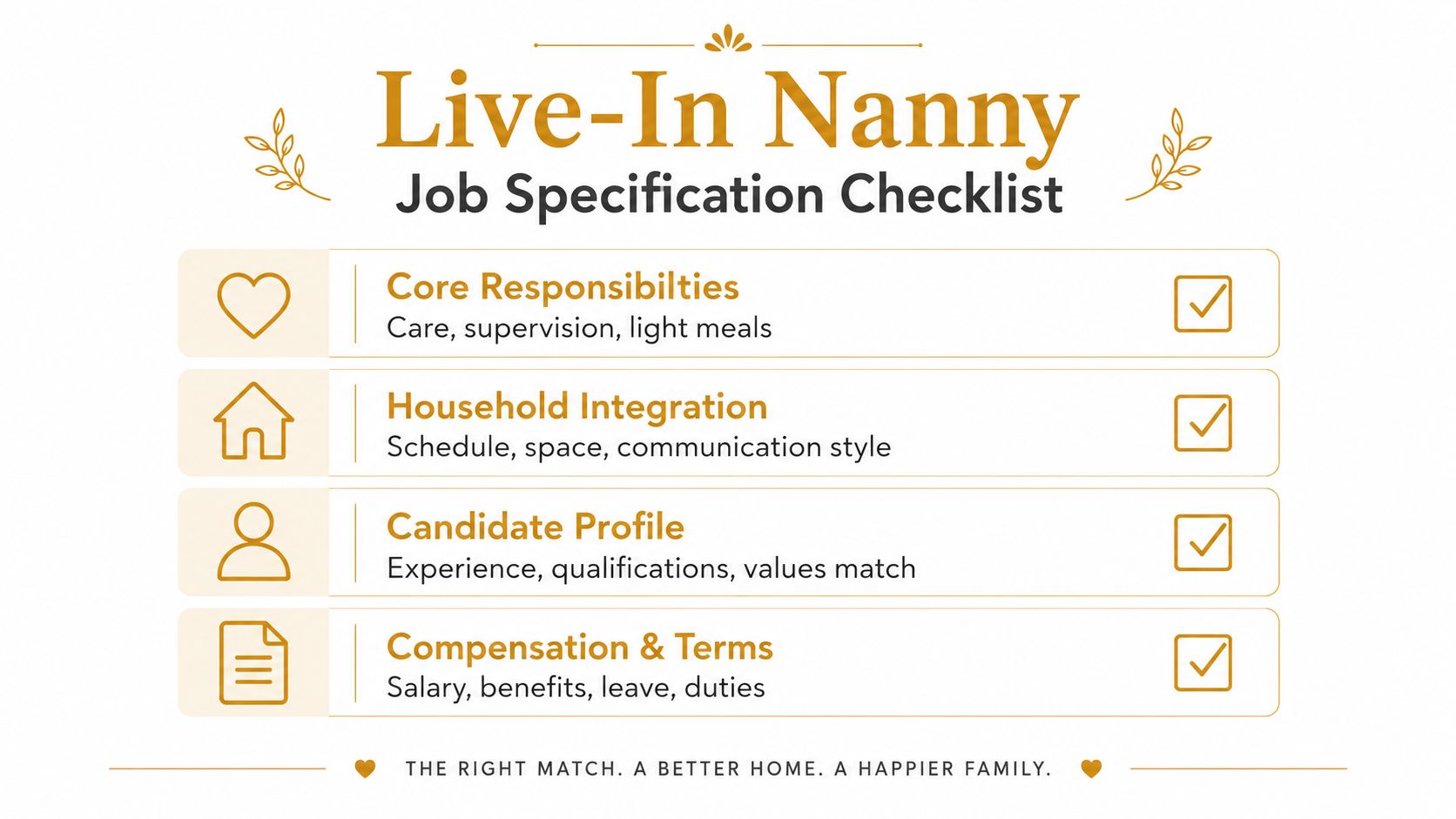
Use this checklist when drafting the brief:
- Core responsibilities: spell out what the nanny owns, from childcare to any agreed light household tasks.
- Household integration: define who the nanny reports to, how they interact with other staff, and where the boundaries sit.
- Candidate profile: state experience level, qualifications, and the values that matter in your home.
- Compensation and terms: describe salary, benefits, leave, accommodation, and schedule expectations.
- Safety requirements: include any safeguarding expectations, travel rules, and emergency procedures.
Clarity is a courtesy to serious candidates. It also saves you from difficult conversations later.
Be explicit about privacy and space
The live-in element is not a vague perk. The nanny should have a private room, and the arrangement should not assume that family spaces become shared workspaces whenever someone is on site (Smart Sitting). If your household has staff already, say how this person will fit into the existing structure. If you expect travel, state how often and what support is required. If you want bilingual support, newborn experience, or strong educational planning, say so in the advert. Good candidates respect precision.
Navigating Search Channels from Agencies to Private Referrals
You can find live-in candidates through premium agencies, specialist institutions, and private introductions, but these channels are not equal. Families who need discretion and reliable pre-vetting should treat this like a sourcing decision, not a popularity contest.
Compare the channels by risk, speed, and depth
Premium agencies are built for households that want structure, shortlisting, and confidentiality. They are usually the cleanest route when the role is sensitive, the timetable is tight, or the household already has several moving parts.
Specialist routes, such as Norland-trained candidates, appeal when educational polish, professionalism, and family-facing presentation matter. Private referrals can work well too, but only when the referee has lived with the person's work habits and can speak to the realities of a live-in arrangement, not just general childcare competence.
Use the channel that matches the household
If your home already runs with housekeepers, chauffeurs, or an estate manager, the search needs more than a name and a CV. It needs discretion, coordination, and a candidate who understands how to enter an established environment without disrupting it.
For families comparing local search options, this internal page is a useful starting point: nanny agency near me.
Choose depth over speed when the role is sensitive
A fast hire can be expensive in ways that do not show up on the first invoice. A candidate who looks polished but does not respect hierarchy, privacy, or boundaries can unsettle children and staff alike. By contrast, a properly managed search gives you time to test communication style, confirm fit, and keep the process discreet.
Here is the blunt truth. If a candidate cannot handle a formal process, they are unlikely to thrive in a formal household.
The In-Depth Vetting and Interview Process
A live-in nanny should be screened like a trusted household professional, not interviewed like a casual sitter. The process has to test competence, judgement, and the ability to live in someone else's home without creating friction.
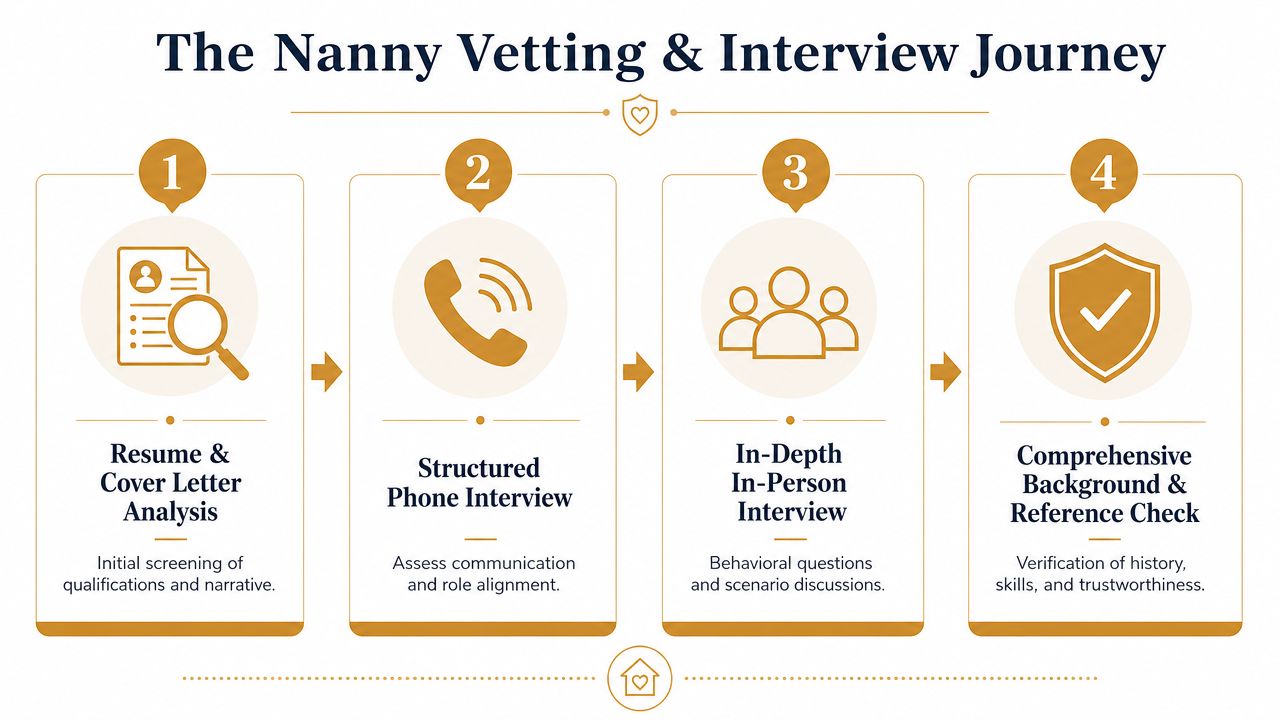
Move through the funnel in stages
Start with a phone or video screen. That first call should confirm availability, schedule fit, room expectations, travel readiness, and salary alignment. Then bring the strongest candidates in person, ideally only two or three, so the family can compare them properly without turning the process into chaos.
A trial period matters, but only after references and checks are complete. Ask for references from families the nanny has lived with, because those references say more about discipline, privacy, and day-to-day behaviour than a generic childcare reference ever will (Care.com live-in nanny hiring guidance).
Ask questions that reveal judgement
Do not ask only about achievements. Ask what they did when a child resisted bedtime, how they handled a difficult parent, or how they balanced warmth with authority in a live-in setting. Behavioural answers tell you how the person thinks under pressure.
A strong live-in candidate does not just describe what they did. They explain why they did it, and what they would change next time.
Check the details that matter in a shared home
Reference checks should include punctuality, discretion, communication style, and how the nanny behaved when off duty and still in the home. If the candidate has experience in high-pressure or high-visibility homes, ask how they handled privacy and guest flow. That is where the key signal sits.
For families who want a more structured due-diligence process, this guide on the nanny vetting process is a sensible companion.
Contracts, Compensation, and Legal Compliance
Many families make avoidable mistakes. In the UK, the baseline for a live-in nanny role sits inside the legal framework for domestic workers, and the headline adult rate recommended by the Low Pay Commission is £12.21 per hour from 1 April 2025 (UrbanSitter). For a standard 40-hour week, that implies about £488.40 per week or roughly £25,397 per year before tax and accommodation deductions, and household employers still need to account for PAYE tax and National Insurance once thresholds are met (UrbanSitter).
Build the package around lawful pay, not assumptions
The live-in label does not remove wage obligations. It changes the structure of the arrangement, not the fact of employment. In a serious household, the package should be written as a professional employment offer that covers salary, accommodation, meals, leave, duties, and any extras you choose to provide.
A live-in role also needs a set schedule and a set weekly rate that remains compliant with minimum wage and overtime law (Smart Sitting). The nanny is not on call all day because they sleep under your roof.
Lock the terms in writing
The contract should separate childcare from household tasks, define shared-space rules, spell out privacy expectations, and record how overtime or travel days are handled. If you want a non-disclosure agreement, include it in the paper trail, but do not use it as a substitute for respectful behaviour. A well-drafted contract is not defensive. It is stabilising.
For a deeper look at the paperwork families often miss, keep this template close at hand: nanny contract template UK.
Treat accommodation as part of the role design
A live-in nanny should have their own room and should not be expected to share with children or lose access to private space when the family is at home (Household Staff Agency). That requirement is operational, not cosmetic. If the room is poor, the arrangement will feel temporary no matter what the contract says.
If you want this role to work, be professional about the legal burden. Families that handle tax, terms, and compliance properly tend to retain better people and avoid unnecessary friction.
Your Partner in Finding the Perfect Nanny
A good live-in hire is not the result of luck. It comes from precise role design, disciplined sourcing, careful vetting, and proper employment paperwork. Families who treat the process like a household appointment, rather than a casual hire, get more stability and far fewer surprises.
There is also a broader operational lesson here. High-functioning homes do not improvise around people management, they standardise it. If you already use a luxury travel concierge to handle logistics with discretion and accuracy, the same standard should apply to household staffing, which is why a resource such as What is a luxury travel concierge can be a useful parallel for thinking about service quality and confidentiality.
Superstar Nannies helps families define the brief, assess candidates, and manage the search with discretion from start to finish. If you want a serious, professional route to hire well, visit Superstar Nannies and begin with a consultation.
Frequently Asked Questions
Do live-in nannies get paid less than live-out nannies?
Not by default. The main question is how the package is structured, because accommodation and meals are part of the arrangement, but they do not excuse poor pay or vague terms. The contract still needs a clear schedule, lawful wages, and a proper explanation of what the family provides in kind.
What space should I provide for a live-in nanny?
A private room is the minimum, and it should feel private. The room should support rest, storage, and off-duty time, not function as an overflow guest room or a space people pass through casually.
Can a live-in nanny cover travel and overnight stays?
Yes, if the role is written that way from the start. Travel and overnight expectations need to be agreed in advance, priced properly, and reflected in the schedule, so the nanny is not asked to absorb extra responsibility just because they live on site.
How do I handle performance issues with a live-in nanny?
Deal with them early and in writing. Do not rely on informal feedback alone. If the issue affects children, privacy, or household harmony, document the concern, reset expectations, and use the contract as the anchor for any next step.
Are references from previous live-in roles important?
Absolutely. They are more predictive than generic childcare references because they show how the nanny behaves inside a home, not just while working in it. Ask about boundaries, discretion, reliability, and how they handled off-duty time in a shared household.
If you need a live-in nanny search handled with care, discretion, and proper due diligence, Superstar Nannies can manage the process from brief to placement. Visit Superstar Nannies to discuss your household, your standards, and the support you need now.