


You're probably seeing the same problem most strong candidates run into with estate manager jobs in Kent. The title looks attractive, the county is full of substantial properties, and the search results suggest there's movement. Then you start clicking and realise half the roles have little to do with running a private estate for a principal who expects military-grade discretion, polished service standards, and calm control across every moving part of the household.
That distinction matters. If your background is in luxury residences, formal households, family offices, boutique hospitality, or complex private property operations, you need a very different strategy from someone applying for generic estates or property roles.
Your Career as an Estate Manager in Kent Starts Here
Kent is one of the few counties where the role can be what accomplished candidates hope it is. Historic country houses, coastal properties, commuter-belt residences, and multi-property family holdings all create the right conditions for senior estate leadership. But the job title causes confusion.
On major platforms, “estate manager” often bundles together public-sector estates work, commercial property management, and private household leadership. Indeed and Reed results in Kent show that keyword mismatch clearly, with listings spanning very different job families rather than one consistent private-service market, as seen in Kent estate manager search results on Indeed.
What the title should mean to a serious private-service candidate
In the private UHNW world, an estate manager doesn't just maintain buildings. The role usually sits at the top of the household structure. You're expected to coordinate people, standards, systems, budgets, projects, vendors, security awareness, and principal preferences without creating noise.
That's a different career track from:
- Commercial property management, where the focus is tenancy, compliance, and portfolio performance
- Public-sector estates management, where processes, procurement, and institutional stakeholders shape the work
- Maintenance-led estates roles, which may be excellent jobs, but don't carry the same service brief or level of principal exposure
Candidates who understand that split move faster because they stop wasting energy on the wrong market. If you want a broader view of the national private-service sector, review these UK estate manager roles and market insights.
The strongest applicants don't chase every role with the right title. They pursue the roles with the right reporting line, household structure, and level of trust.
Identifying and Targeting Premier Opportunities
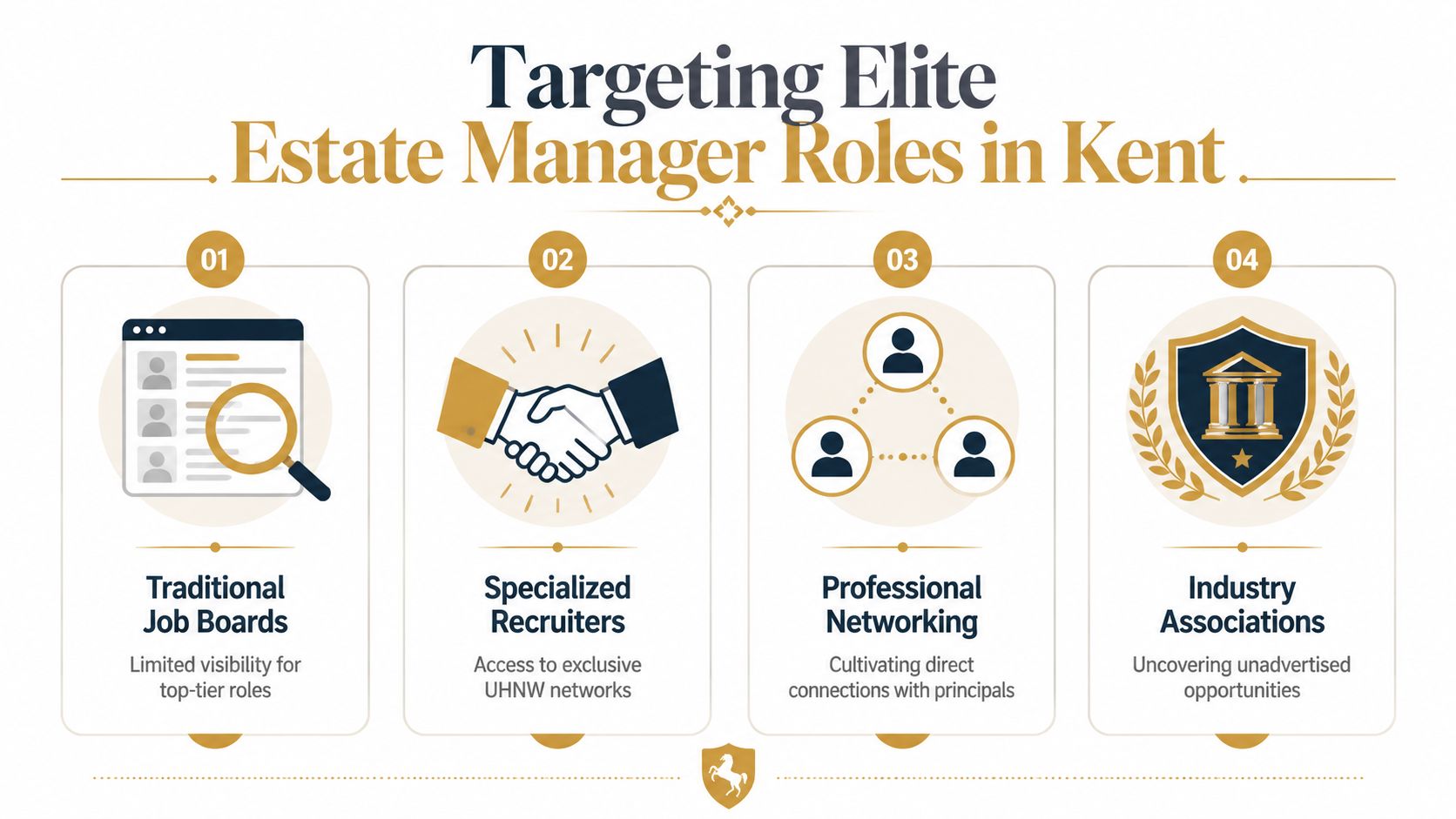
Public job boards are useful, but only to a point. They tell you whether there is visible activity in Kent. They rarely tell you where the best work sits.
Totaljobs listed 106 estate manager vacancies in Kent in one search snapshot, which confirms there is an active market rather than a one-off niche. But that same visible market is only part of the picture, because the most prestigious private household roles are often filled discreetly through specialist channels to protect the principal's privacy, as reflected in Totaljobs estate manager vacancies in Kent.
Where strong candidates waste time
A lot of capable estate managers rely too heavily on volume channels. They refresh the same boards, apply broadly, and assume scarcity is the issue. Usually, the problem is access, not capability.
What doesn't work well:
- Over-applying to generic listings that don't define whether the role is private, institutional, or commercial
- Using one CV for every application, regardless of household size or reporting structure
- Waiting for public advertisements instead of building visibility with the people who handle confidential searches
What works better in Kent
The highest-value searches tend to move through trusted intermediaries, referrals, and long-standing private-service networks. That's especially true where the principal wants discretion from the first conversation.
Focus your effort in four places:
Specialist recruiters in private household staffing
These firms pre-qualify candidates, protect confidentiality, and understand the difference between a polished house manager and a true estate lead. Candidates looking for discreet introductions should monitor private household staff opportunities in the UK.Referral networks
Former principals, family office contacts, chiefs of staff, private PAs, and retained service providers often know about vacancies before the market does.Niche professional circles
Luxury hospitality, yachting, private aviation, and house management communities often produce estate managers with the right standards and instincts.Selective use of job boards
Use them to read language patterns, compare role scope, and spot shifts in demand. Don't treat them as your only route in.
Practical rule: If a role looks perfect and fully public, assume there are already trusted introductions in play. Your application needs to be sharper, faster, and more targeted than average.
Essential Skills and Qualifications for Kent's Elite Estates
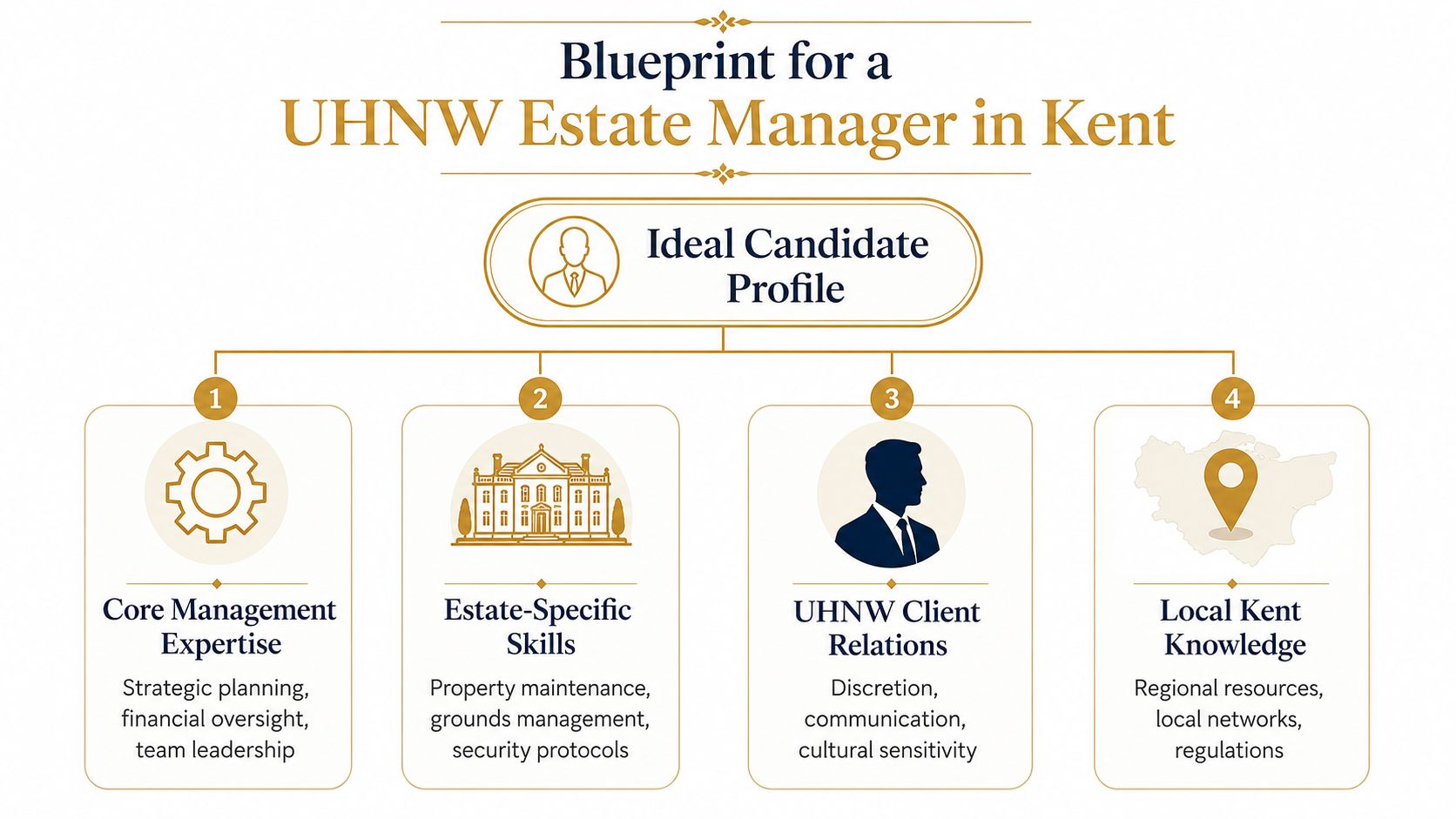
In Kent's upper tier, the role has become broader and more technical. Employers expect an operator who can run a residence like a private enterprise while preserving the tone of a home.
One recruitment brief used in this market sets a clear benchmark: top-tier estate manager candidates are expected to have a minimum of five years' experience in luxury property management or high-end hospitality, along with proficiency in property-management software, advanced Excel, smart-home systems, staff supervision, and financial oversight, as outlined in this estate manager hiring guide.
Hard skills that actually move you forward
You don't need to present yourself as a generic “all-rounder”. You need evidence of control in complex environments.
Financial management
You should be comfortable with budgeting, vendor oversight, payment tracking, reconciliations, and reporting. Advanced Excel still matters because many principals and family offices want clean, readable oversight.Property operations
This includes planned maintenance, contractor supervision, refurbishments, snagging, grounds coordination, and practical risk management across the estate.Technology fluency
Modern homes rely on integrated systems. If you can't speak confidently about smart-home platforms, security interfaces, access controls, and household software, you'll look dated.Team leadership
Running butlers, housekeepers, chauffeurs, gardeners, nannies, chefs, and external specialists requires structure and diplomacy. This isn't about issuing instructions. It's about maintaining standards without creating friction.
Soft skills that decide whether you're appointable
Often, many technically solid candidates lose ground. In a private household, trust is part of the job description even when it isn't written down.
A credible estate manager shows:
- Discretion under pressure
- Measured communication with principals
- Cultural sensitivity
- Judgement about what to escalate and what to resolve independently
- Consistency in service standards
- Emotional control when plans change at short notice
For candidates managing refurbishments, staffing transitions, or multi-supplier projects, it helps to sharpen your systems thinking. These project management insights are useful because they focus on practical execution rather than theory.
A quick self-audit
Ask yourself these questions before pursuing senior Kent roles:
| Area | What principals want to see |
|---|---|
| Leadership | Calm authority, not ego |
| Administration | Accurate reporting and follow-through |
| Technology | Confidence with software and smart systems |
| Household culture | Respect for privacy and service hierarchy |
| Property oversight | Preventive thinking, not reactive scrambling |
If you want a more precise benchmark for how UHNW households define this post, review this detailed estate manager job description for private households.
A principal rarely hires the most impressive storyteller. They hire the person who makes complexity feel controlled.
Crafting Your CV and Cover Letter for Impact
Most CVs for estate manager jobs in Kent fail for one reason. They read like duty lists.
A principal, family office, or recruiter doesn't need a page telling them you “managed staff”, “oversaw maintenance”, and “liaised with contractors”. That language is too flat for a role built on judgement and range. Your documents need to show scope, standards, and the level of trust you've already held.
What your CV should signal immediately
Your opening profile should establish three things within seconds:
- Environment you've worked in, such as formal private estates, staffed residences, family offices, or luxury hospitality
- Scale of responsibility, including team supervision, property complexity, and cross-functional oversight
- Style of management, especially discretion, structure, and service-led leadership
Then use experience bullets to show outcomes qualitatively. If you can't use hard figures, use clear operational language instead.
Stronger phrasing sounds like this:
- Directed a multi-disciplinary household team across front-of-house, housekeeping, grounds, and driver support
- Implemented structured maintenance and contractor oversight, reducing disruption to principal schedules
- Managed confidential vendor relationships and household logistics across daily operations and private events
- Introduced clearer reporting routines for finance, maintenance, and staff communication
Your cover letter should do one job well
It should make the reader feel safe putting you near the principal.
That means less autobiography and more proof of fit. Explain why your background suits a private estate in Kent. Mention operational calm, staff leadership, experience in high-standard environments, and your understanding that discretion is active work, not a personality trait.
Your application should answer an unspoken question: “Can this person protect the household while running it well?”
A good cover letter also avoids over-familiarity. Keep the tone polished. Be warm, but never casual. In this sector, confidence should come across as quiet precision.
Navigating the Interview and Offer Stage

Interviewing for a private estate role in Kent rarely follows a standard corporate pattern. You may meet a recruiter first, then a chief of staff, family office representative, existing house manager, or the principal directly. Each conversation tests something different.
A recruiter screens for presentation, credibility, and match. A family office looks for control, reporting discipline, and judgement. A principal often pays closest attention to temperament. They want to know whether you bring order or bring drama.
Questions you should expect
The most useful preparation isn't memorising polished answers. It's preparing operational examples that show how you think.
Be ready for scenarios such as:
- A contractor failure before a major family arrival
- A conflict between long-serving staff members
- An unrealistic request with time pressure and privacy concerns
- A security-sensitive issue that needs escalation without alarm
- A household transition where new standards must be introduced tactfully
Your answers should show sequence. What did you assess first, who did you inform, what did you delegate, what did you document, and how did you protect the principal's routine?
Reading the offer properly
General Kent job data can show a training rate of £15.83 per hour and annual earnings of £32,103 based on 39 hours per week in one estate-manager listing context, but that data is not representative of senior private UHNW household appointments, where compensation is usually negotiated case by case and often includes wider benefits, as shown in this Indeed Kent estate manager pay example.
That means you should evaluate an offer as a package, not just a salary line.
Look closely at:
- Accommodation if the role is live-in or includes estate housing
- Vehicle provision where travel between properties is expected
- Health cover or other insured benefits
- Bonus structure if performance and retention are rewarded
- On-call expectations and whether they're realistic
- Holiday use in households with seasonal peaks
- Relocation support if the principal expects local presence
A strong offer is clear about authority, reporting, living arrangements, and boundaries. Ambiguity at offer stage usually becomes strain in post.
Candidates sometimes focus so hard on headline pay that they miss the bigger question. Can you succeed in the structure being offered? A beautifully paid role with vague reporting lines, blurred household boundaries, or inconsistent principal expectations can become expensive to leave.
Partner With a Specialist to Find Your Ideal Role
The Kent market rewards precision. The title is broad, the public listings are mixed, and the most desirable private household appointments are usually handled discreetly. Strong candidates do best when they target the right niche, present themselves with discipline, and assess roles for structure as well as prestige.
If you're pursuing senior private-service work rather than generic estates positions, it helps to understand exactly how elite households define leadership, discretion, and operational fit. This guide to private estate manager recruitment in UHNW households is a useful next step for candidates who want to align with that level of expectation.
The right role in Kent won't usually reward a broad, public job-search approach. It tends to go to the candidate who is already operating at principal level in how they search, communicate, and present.
Your Questions on Kent Estate Manager Roles Answered
Are most Kent estate manager roles live-in
Not all of them, but live-in arrangements are common in the private household market where principals want steady oversight, rapid response, and continuity across the estate. Some roles are better described as resident operational leadership than office-hours management. Whether live-in suits you depends on boundaries, accommodation quality, and how clearly the household defines time off.
What's the difference between an estate manager and a house manager
A house manager usually focuses on the main residence, service flow, and day-to-day household execution. An estate manager normally carries a wider brief that can include grounds, maintenance planning, project oversight, external contractors, staff structure, and sometimes multiple properties. In smaller households, the titles may overlap.
What backgrounds translate well into this role
Luxury hospitality, formal private service, yachting, boutique hotel operations, and high-end property oversight all translate well if you've handled standards, discretion, and people management. Candidates exploring adjacent sectors can also study how leading recruiters position talent across service-led environments. This overview of top UK hospitality jobs agencies is helpful for understanding that broader ecosystem.
Should I apply directly or work through a recruiter
For public roles, direct application can work. For discreet private household searches, specialist recruiters usually provide a better route because they can frame your profile properly, manage confidentiality, and clarify whether the household is a suitable fit before you commit time.
If you're ready to pursue estate manager opportunities in Kent at the highest private-household level, Superstar Nannies can help you access discreet roles, present your experience with authority, and move through the process with confidence and complete professionalism.