


Families usually start searching for a nanny agency near me when the need has already become urgent. School hours no longer cover the day. A parent's travel schedule has changed. A baby has arrived, or household routines have outgrown patchwork childcare. At that point, search results can feel noisy, repetitive, and oddly vague about the checks that matter most.
A smart search begins with three filters. First, look for agencies that explain their process clearly. Second, check whether they understand your type of household, not just childcare in general. Third, favour rigour over speed. A polished website is useful, but a serious placement partner should also explain vetting, employment realities, and how they assess fit.
For families who want a deeper view of what distinguishes a placement firm from a listing platform, this guide to why discerning families choose a nanny placement agency is a sensible starting point.
Introduction Finding Your Family's Perfect Match
Typing nanny agency near me into a search engine sounds simple. The hard part starts after that. You're not choosing a takeaway or a cleaner. You're deciding who will have daily access to your children, your home, your routines, and often the most sensitive parts of family life.
That's why proximity alone isn't the sole test. The right agency should combine local market knowledge, disciplined screening, and the judgement to tell the difference between a pleasant interview and a durable placement. Families with demanding schedules, multiple residences, security concerns, or existing household staff need even more than that. They need an agency that can manage complexity discreetly.
The most effective search is selective from the start. Keep a short list. Read closely. Ask direct questions early. A refined process saves time because it eliminates unsuitable agencies before they ever send a profile.
Where to Begin Your Search for a Nanny Agency

Most families begin online, but the first page of results shouldn't make the decision for you. Search visibility and professional standards aren't the same thing. Some agencies are excellent but understated. Others market speed heavily and explain very little about screening.
Build a shortlist with intention
Start by reviewing how each agency describes its service. A credible firm should be specific about the roles it places, the areas it serves, and the standards it applies before introducing a candidate.
Use this initial checklist:
- Read the process page. If an agency can't explain how it sources, interviews, and verifies candidates, move on.
- Check role specialisation. Families seeking rota cover, bilingual care, newborn support, or a nanny who can travel need an agency that handles those briefs routinely.
- Review language around safeguarding. Good agencies describe checks plainly. Weak agencies hide behind broad phrases such as “fully vetted” without saying what that means.
- Look for household fluency. If your home includes housekeepers, security staff, a PA, or multiple properties, the agency should speak that language naturally.
- Test responsiveness. The first reply often tells you a lot. Clear, measured communication usually signals a more organised search.
A useful comparison point is Superstar Nannies' nanny search approach, which shows the level of detail a family should expect before engaging an agency.
Speed is attractive, but depth matters more
A common mistake is choosing the agency that promises the fastest shortlist. That often sounds reassuring, especially when childcare is already pressing. It can also produce rushed interviews, shallow referencing, and weak matching.
Practical rule: If an agency talks more about availability than verification, keep looking.
Safeguarding quality and speed are often in tension. One overlooked issue in the UK market is that childcare demand remains high while trustworthy, fully vetted candidates are scarce. Families therefore need to ask how agencies verify references, right-to-work status, DBS checks, and childcare qualifications. As noted by this discussion of safeguarding quality versus speed in nanny recruitment, many search results don't explain which checks are standard, which are optional, or how specialist roles are handled.
Read for judgement, not just polish
Website copy can be immaculate and still tell you very little. What you're looking for is evidence of judgement.
A strong agency usually does three things well in its public materials:
| What to look for | Why it matters |
|---|---|
| Clear explanation of vetting | It shows process discipline |
| Defined placement categories | It signals real market experience |
| Discussion of contracts or onboarding | It suggests support beyond introductions |
The aim at this stage isn't to find “the one”. It's to narrow the field to agencies that appear serious enough to deserve a conversation.
The Non-Negotiable Vetting and Safety Checklist
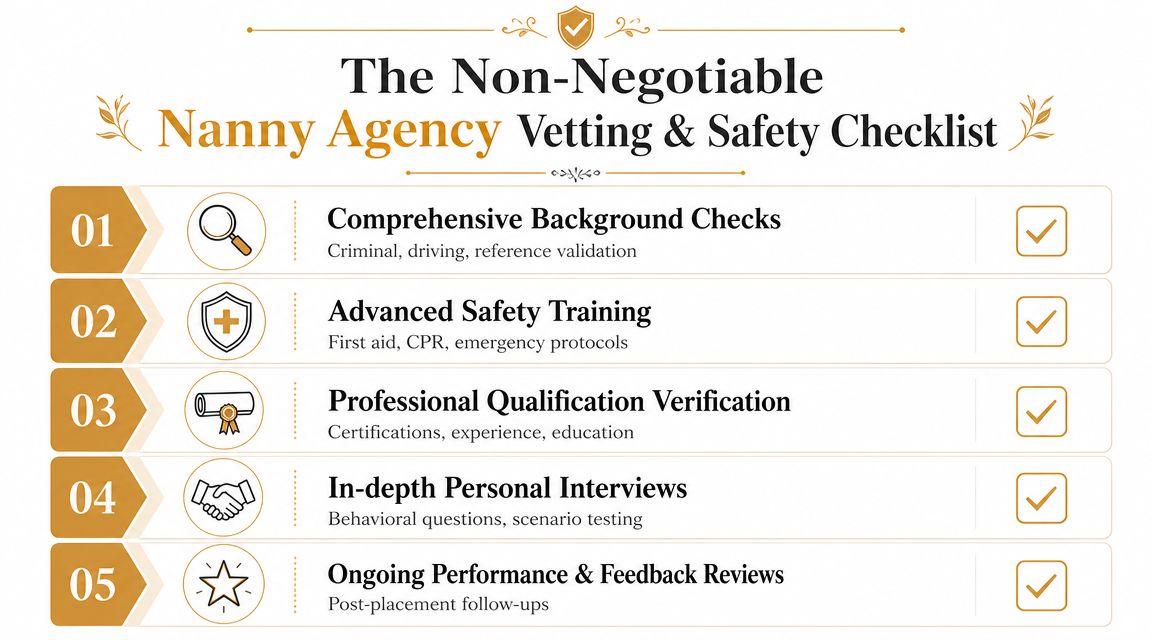
The value of a nanny agency near me isn't convenience. It's the quality of risk control. A first-rate agency should protect your family from preventable mistakes before a candidate reaches interview stage.
The two-stage screen that matters
For UK families, the most reliable approach is a two-stage screening funnel. First, verify legal right-to-work and identity. Then validate childcare competence through references, DBS checks, and structured interviews. UK Government DBS guidance also makes clear that an Enhanced DBS check may include checks against the children's barred list for roles involving regulated activity with children, which is the key compliance benchmark for agency-vetted childcare staff, as outlined in this guidance on UK nanny screening and Enhanced DBS expectations.
That sounds straightforward. In practice, many agencies blur the difference between basic admin and serious scrutiny.
What a robust vetting file should include
Ask whether the agency verifies the following before shortlist presentation:
- Identity and right-to-work evidence. Passport and visa status should be reviewed, not merely noted.
- Address and employment chronology. Gaps aren't always a problem, but they should be explained.
- Recent childcare references. Speaking to referees directly matters more than collecting written testimonials.
- Structured interview notes. Agencies should test judgement, safety awareness, and communication style.
- Relevant qualifications. Childcare training and first aid should be checked against the actual brief.
For families doing preliminary due diligence on public records or identity consistency, a reputable online background screening tool can be helpful as an early research layer. It doesn't replace agency vetting, but it can help a household office organise basic checks before formal interviews begin.
A rushed placement can look efficient right up until the first inconsistency appears.
Questions that reveal whether an agency really vets
Paper process alone isn't enough. You also need to know how consultants think.
Ask questions like these:
- Who speaks to references, and what do they ask?
- What would stop you from presenting a candidate who looks strong on paper?
- How do you assess judgement for overnight care, travel, or sole-charge situations?
- What do you do when references conflict subtly rather than obviously?
- Do you adapt your screening for rota, live-in, or travel roles?
The strongest answers are specific. A weak agency stays generic, leans on buzzwords, or sounds irritated by scrutiny.
A useful benchmark for families comparing agencies is this detailed overview of a comprehensive nanny vetting process. It reflects the depth of checking that serious households should expect before any offer is discussed.
How to Interview an Agency to Ensure a Perfect Fit

Once an agency has passed the safety test, the next question is whether it can represent your household properly. Many families ask too little at this stage. They focus on fees first and skip the points that determine whether the search will be smooth, awkward, or subtly unsuccessful.
Listen for commercial clarity
A serious agency should explain the search as both a childcare placement and an employment relationship. If the consultant talks only about “finding someone lovely”, that's not enough. Household hiring involves role design, trial structure, reporting lines, confidentiality, and practical onboarding.
Ask how the agency approaches:
- Family briefing. Do they map routines, travel expectations, parenting style, and household structure?
- Candidate calibration. How do they decide who is suitable for your specific home?
- Placement support. What happens if expectations shift after interviews begin?
- Replacement terms. Is there a clear process if a placement doesn't settle well?
Ask for examples, not slogans
Good consultants can describe difficult searches without breaching confidentiality. They should be able to explain how they handled a role with unusual hours, a split residence arrangement, or a household with existing staff. Their answer shows whether they understand placement dynamics or merely circulate CVs.
Ask this directly: “Tell me about a brief that changed during the search. How did you handle it?”
That single question often reveals how adaptable and honest the agency is. Strong consultants discuss expectation management, market feedback, and candidate recalibration. Weak ones default to sales language.
Fit is operational as well as personal
Most families understand personality fit. Fewer think about operational fit. A nanny may be warm, capable, and experienced, but still struggle in a home with formal service standards, close security protocols, or a principal who travels without much notice.
Interview the agency as if you were appointing an advisor. Because that's what you're doing.
Decoding Contracts, Fees, and Placement Timelines
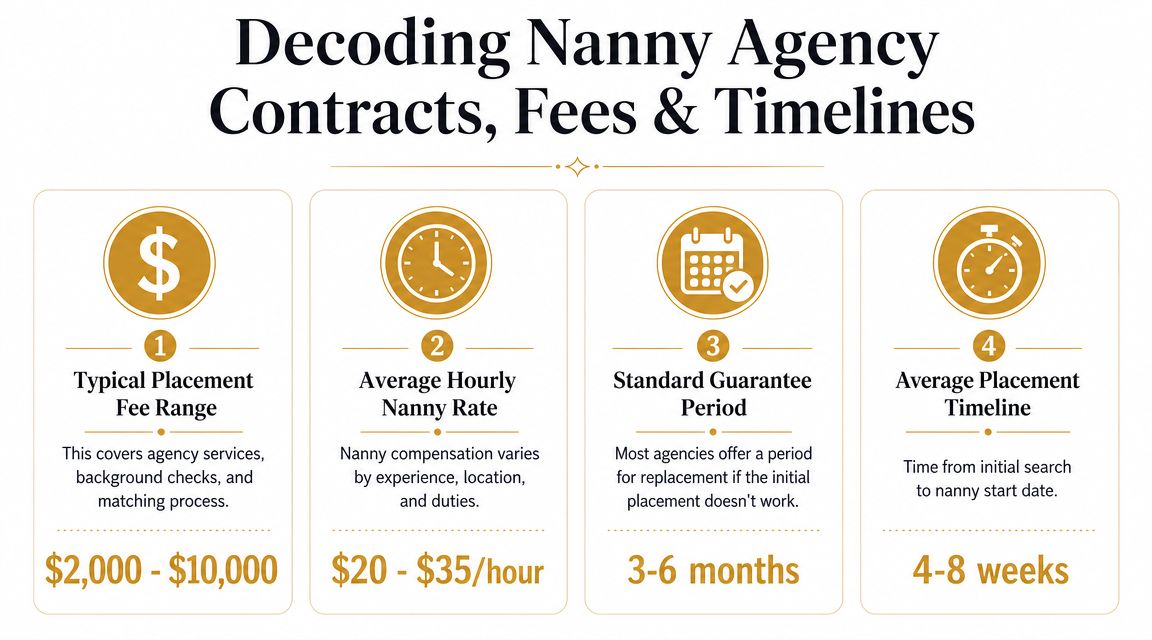
The financial side of hiring often catches families off guard, especially when they've only compared hourly or weekly pay. Agency fees matter, but they're only one part of the picture. The larger question is whether the role has been priced and structured realistically.
Look at total employment cost
When a family hires a nanny, the working budget should include more than salary. The actual cost can also include payroll administration, pension auto-enrolment, holiday pay, employer's National Insurance, and overtime if the schedule requires it. This is why comparing a professional nanny to a casual babysitter rate usually produces a failed search.
Another point many families miss is regional variation. UK market benchmarking indicates that professional nanny costs vary by region and role scope, so agencies should quote against local norms rather than one flat national rate. Independent UK pay guidance also indicates that live-out nannies in London commonly command higher compensation than outside the capital, and candidates with newborn, rota, bilingual, or proxy-parenting experience often sit at the upper end of the market, as noted in this discussion of localised nanny pay benchmarking.
Contract language should match the actual household
For straightforward family schedules, contracts are usually manageable if written clearly. For VIP, international, or multi-residence homes, generic templates tend to fail. The contract should reflect how the role operates in practice.
Key points to review include:
- Duties and boundaries. Childcare, nursery duties, travel support, and staff liaison should be separated clearly.
- Schedule structure. Daily hours, flexibility expectations, overnights, and travel periods need precise wording.
- Confidentiality provisions. Homes with public profiles often require tighter clauses and more careful drafting.
- Notice and trial terms. These should be balanced and understandable, not buried in legal language.
A practical budgeting reference is this guide to nanny costs, which helps families think beyond headline pay and focus on the full structure of employment.
Timelines should be realistic
Families often ask how quickly a placement can be completed. The honest answer depends on the specificity of the brief, local candidate availability, and how selective the household needs to be. The more specialised the role, the less useful an arbitrary deadline becomes.
For UHNW and VIP households, the timeline should also account for confidentiality briefings, reference depth, schedule negotiations, and coordination with other staff. Fast can be done. Hasty usually becomes expensive later.
Specialist Advice for VIP and International Placements
A family may start with a search for nanny agency near me on the evening they realise the role is no longer standard. The children are splitting time between London, Geneva, and a yacht in August. The principal's diary changes with little notice. Security is tight, the home is fully staffed, and a good local nanny who suits a straightforward after-school routine may still be the wrong appointment for this post.
For households operating at this level, proximity matters far less than judgement. The agency needs to understand private service, protect confidentiality from the first conversation, and assess whether a candidate can function calmly across residences, time zones, and changing schedules.
Discretion has to be built into the search
In high-profile homes, confidentiality is part of daily operations. It should be addressed before profiles are circulated and long before a trial is arranged. A well-run search covers NDAs, social media boundaries, photography, guest privacy, security awareness, and the practical habit of saying less, not more.
I have seen capable nannies struggle in VIP households for one reason. They were excellent with children, but too informal with information. In this segment of the market, poor boundaries create risk quickly.
In VIP placements, fit often breaks down at the level of judgement, privacy, and protocol before childcare quality is ever in question.
International travel changes the role
Travel roles require more than a nanny who is happy to fly. The work may involve back-to-back long-haul trips, overnight support, itinerary changes, liaison with family offices, and periods away from the nanny's normal support network. Some candidates enjoy travel in theory and become unsettled once the pace becomes repetitive, isolating, or highly changeable.
A capable agency should test for specifics, including:
- Travel pattern. Scheduled trips, last-minute requests, and how much flexibility is needed.
- Documents and mobility. Passport status, visa practicality, and whether the candidate can legally and realistically travel where the family needs them.
- Working conditions while away. Sleeping arrangements, privacy, rest periods, and who remains in charge during transit and at destination.
- Pay structure. Travel days, overnight cover, standby time, and how disruption to personal time is reflected properly.
Staff integration decides whether the placement lasts
Many failed placements in staffed homes are not failures of childcare. They are failures of structure. If no one defines who handles the children's wardrobe, who confirms schedule changes, or how the nanny coordinates with the housekeeper, chef, PA, or security team, tension appears early.
The agency should prepare for that before shortlist stage. Some nannies are at their best in warm informal homes. Others are stronger in polished, protocol-driven residences where communication is tighter and service standards are more formal. Matching temperament to household culture is as important as matching nursery experience to the children's ages.
This is one reason city searches often become broader than families expect. In major hubs such as London, demand is dense, roles are layered, and the strongest candidates are often comparing several offers. Agencies are used not only for access to candidates, but for filtering for discretion, travel readiness, and the ability to work well inside an existing private-service structure, as outlined in this overview of nanny market demographics and workforce context.
A specialist brief needs operational detail
For specialist searches, a vague brief costs time. “Warm, flexible, experienced” is not enough for a VIP or international appointment. The brief should spell out pace of life, number of residences, travel frequency, expected autonomy, reporting lines, privacy standards, and whether the principals prefer a formal or relaxed style of communication.
That level of detail protects everyone. The right candidates can assess the post properly. The wrong ones usually remove themselves early, which is far better than discovering a mismatch after the family has invested weeks in interviews and trials.
Conclusion Your Path to Confidence and Peace of Mind
Finding the right nanny agency near me has far less to do with geography than most families assume. The agencies worth speaking to are the ones that combine rigorous vetting, thoughtful matching, transparent employment guidance, and enough judgement to handle the realities of your household.
The safest route is deliberate. Shortlist carefully. Test the agency's process. Ask the questions that reveal how they think, not just how they market. Budget for the full employment picture, not the headline rate. If your family requires discretion, travel support, or integration with existing staff, insist on experience in those areas from the outset.
Done properly, the process delivers more than childcare cover. It gives your household stability, trust, and room to breathe.
Frequently Asked Questions
Is using a nanny agency near me better than hiring directly?
Often, yes, especially if you want support with screening and the wider hiring process. A major issue in the UK is compliance and employment risk. Many families don't realise that if they hire directly, they may become the legal employer responsible for PAYE, National Insurance, holiday pay, and pension duties, as noted in this explanation of nanny hiring compliance obligations.
What checks should I expect from a nanny agency?
You should expect identity and right-to-work checks, reference verification, a suitable DBS process for childcare work, and structured interviews. Good agencies should also be able to explain how they assess judgement, communication, and suitability for your exact household setup.
How local should my agency be?
Local knowledge helps, especially if school runs, commuting patterns, or regional pay expectations matter. But strict proximity isn't always the deciding factor. For bilingual, rota, travel, or VIP roles, the right agency may need a wider candidate network and stronger specialist experience.
Why do some nanny searches take longer than expected?
Because good agencies don't fill a role with the nearest available person. They test the brief, screen carefully, compare references properly, and make sure the candidate can function well inside your household. That slower discipline is often what prevents a fast but expensive mismatch.
If you're ready to approach your search with more clarity and less guesswork, Superstar Nannies can help you define the brief, assess the market, and run a discreet, properly vetted placement process for your family.