


Bringing a new baby home in New York often looks elegant on paper and chaotic in real life. The nursery is ready, the calendar is blocked, and the baby is finally here. Then the nights begin. Feeding decisions feel loaded, sleep becomes fragmented, and even very capable parents can find themselves making tired choices they wouldn't make in daylight.
That's usually the moment families start searching for a newborn care specialist NYC and realise they're not just looking for “extra help”. They're looking for someone who can protect recovery, steady the household, and keep the newborn period calm, safe, and well managed. In private homes, especially those with demanding schedules, travel, security concerns, or limited local family support, that distinction matters.
The right specialist sits at the intersection of four things: newborn expertise, safe sleep practice, feeding support, and parent guidance. They don't just hold the baby so you can sleep. They help create a more organised postpartum period, reduce avoidable errors during exhausted night hours, and give parents confidence from the start.
Many families also want to support friends or relatives entering this phase, and thoughtful practical gifts can help. If you're also trying to find thoughtful gifts for new families, it's worth choosing items that make feeding, rest, and recovery easier rather than only decorative.
Introduction The Expert Support Your Family Deserves
A newborn changes the rhythm of a home immediately. In New York, where long workdays, compact living arrangements, traffic, and privacy concerns can already complicate family life, those early weeks can feel especially intense. Parents usually want the same thing. A healthy baby, a smoother recovery, and a household that feels contained rather than reactive.
A newborn care specialist is best understood as a short-term infant specialist. The strongest ones combine practical newborn handling with disciplined observation and calm parental education. They know how to set up overnight care so that feeding, settling, hygiene, and handovers happen consistently.
Practical rule: In the first weeks, consistency is often more valuable than enthusiasm. Families do better when the same standards are followed at every feed, every settling, and every overnight wake-up.
What separates a high-level placement from generic baby help is judgement. A well-qualified specialist notices patterns early, keeps records that are useful, and works in a way that supports the parents rather than replacing them. For families who value discretion and order, that is often the difference between coping and recovering properly.
What a Newborn Care Specialist Actually Does
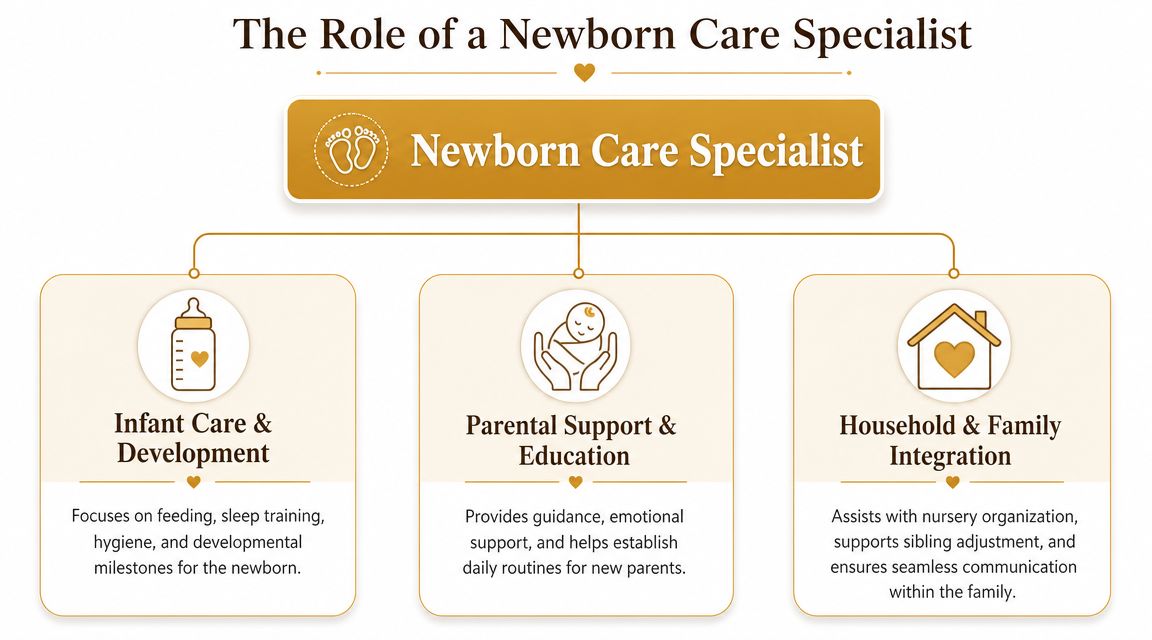
A strong Newborn Care Specialist brings structure to the most vulnerable hours in a household. The work is hands-on, but its essential value is clinical discipline, judgment, and consistency under fatigue.
Infant care is structured, observant work
The daily scope usually includes feeding, burping, nappy changes, bathing support, bottle preparation and hygiene, settling, laundering baby items, and tracking output and sleep. In a well-run placement, those tasks are carried out the same way every time so the baby is not dealing with a different system on every shift.
Observation matters just as much as execution. A qualified specialist notices whether a baby is feeding efficiently, showing unusual discomfort, becoming increasingly hard to settle, or developing patterns that parents and clinicians should know about. In private homes, especially overnight, that level of observation lowers risk and keeps small concerns from becoming messy problems at 3 a.m.
Safe sleep is part of that standard of care. The expectation is a clear sleep space, a firm flat mattress, and placement on the baby's back for every sleep. Families should hear those standards stated plainly and followed without exception.
Feeding support often determines whether the household feels manageable
Feeding is where many families feel immediate strain. An NCS should be comfortable supporting breastfeeding routines, expressed milk, formula preparation, paced bottle feeding where appropriate, sterilisation, and clear logging. The record keeping is not busywork. It gives exhausted parents an accurate picture of intake, output, and timing, and it gives medical professionals something useful if questions come up.
Crying is another area where experience shows quickly. Online advice can offer broad orientation, including guides on how to soothe a crying baby, but a high-level specialist works from observation rather than guesswork. Hunger, trapped wind, overstimulation, overtiredness, temperature, and feeding flow issues can look similar at first. The right person sorts through those possibilities calmly and documents what is changing.
Parent guidance is part of the assignment
A polished specialist does not keep parents dependent on hired help. They explain what they are seeing, show parents how to handle feeds and settling with confidence, and flag when a concern belongs with the pediatrician, lactation consultant, or another clinician. That transfer of knowledge matters in NYC homes where schedules are demanding and support teams often rotate.
Training is one indicator of seriousness, but it needs context. As noted in Infant Care Training's salary overview, advanced certification is increasingly associated with higher-tier roles. The certificate alone is not the point. Families are paying for stronger judgment, cleaner technique, better communication, and a specialist who can protect the household from avoidable errors during a period when everyone is sleep-deprived.
NCS vs Night Nanny vs Maternity Nurse Clarifying the Roles
At 2:00 a.m., titles stop mattering and scope becomes very clear. A family may ask for a night nanny, then discover they need someone who can troubleshoot feeding patterns, keep disciplined logs, spot early concerns, and guide exhausted parents without creating dependence. In New York, that mismatch is one of the most common reasons a hire feels disappointing even when the caregiver is kind and experienced.
The first question is not, “What title sounds right?” It is, “What level of judgment does this household require in the first six to twelve weeks?”
Comparing newborn support roles
| Role | Primary Focus | Typical Training | Scope of Work |
|---|---|---|---|
| Newborn Care Specialist | Structured newborn support, feeding, sleep routines, logging, parent guidance | Specialist infant-care training, CPR/First Aid, hands-on newborn experience | Short-term, intensive newborn care with an emphasis on systems and education |
| Night Nanny | Overnight relief | Varies widely | Night feeds, changes, settling, general overnight support |
| Maternity Nurse | Temporary postnatal support for mother and baby | Often aligned more closely with UK maternity nursing expectations | Intensive early care, maternal recovery support, newborn routines, hands-on guidance |
A newborn care specialist is usually the right fit when the assignment calls for more than coverage. The role is designed around newborn-specific judgment, predictable routines, careful observation, and parent handoff. In well-run homes, an NCS supports the baby and protects maternal recovery, household calm, and decision quality during a period when sleep deprivation can distort everything.
A night nanny is often engaged for practical overnight relief. That can work well when parents want a trusted professional to handle wakes, feeds, diapering, and settling through the night. The trade-off is scope. Some night nannies are excellent, but the title itself does not reliably signal formal newborn specialization, detailed recordkeeping, or the kind of structured parent guidance many first-time or high-pressure households expect.
A maternity nurse is a familiar term for many UK and international families, and the expectations attached to it are often broader. The role tends to include direct support for both mother and baby in the immediate postnatal period, with more emphasis on recovery, rest, and practical instruction in the home. Families comparing British and American expectations often find this guide to maternity nurse vs nanny and elite newborn support helpful because it explains where titles overlap and where they do not.
One title can hide very different standards.
That is why serious families review duties before they review labels. Ask who handles bottles and pump parts, whether logs are kept consistently, how feeding concerns are escalated, whether the specialist coaches parents directly, and what happens if reflux, poor weight gain, latch issues, or unusual fussiness appear. Those details determine whether you are buying relief for the night or securing a short-term expert who reduces avoidable stress across the household.
The safest hire is the one whose actual scope matches the family's real need. Duties, training, judgment, and discretion matter more than whatever title appears in the introduction.
This distinction also affects how families assess value. An NCS should not be viewed as a renamed nanny. In the right home, the role functions more like a targeted postpartum support investment. It shortens the learning curve, protects recovery, improves consistency between caregivers, and lowers the chance of preventable mistakes during the most fatigued stage of early parenthood.
The NYC Market Rates Schedules and Availability
A family leaves the hospital expecting to “get nights covered,” then realizes by day three that scheduling is the key pressure point. The question is rarely just hourly cost. It is whether the coverage pattern protects maternal recovery, keeps feeding support consistent, and holds up if the baby is unsettled, a parent is recovering from surgery, or travel enters the picture earlier than expected.

What families should expect in New York
New York pricing is usually built around coverage structure, not a single universal rate. An experienced specialist may be booked for 12-hour overnights, 24-hour temporary care, a five-to-seven night weekly schedule, or a more customized rotation for households managing twins, multiple residences, security constraints, or frequent handoffs between caregivers.
That is why families see wide variation in quotes.
At the top of the market, rates reflect more than time on the clock. They reflect judgment under fatigue, strong feeding observation, accurate logs, discretion inside a private home, and the ability to steady a household during the most sleep-deprived weeks. Lower market figures do exist, but they often refer to lighter-duty arrangements, broader childcare roles, or hires with less specialized newborn experience. Serious families should compare scope before comparing price.
A better way to budget is to ask four direct questions: How many hours need to be covered, how many weeks of support are realistic, whether the role is nights only or true around-the-clock care, and how difficult replacement would be if the first hire fails. Those factors usually drive the investment more than the title alone. Families who want a broader benchmark can review this guide to maternity nurse cost per week and elite newborn care pricing.
Scheduling realities in the NYC market
Availability is often tighter than families expect, especially for specialists with strong references, agency history, twin experience, or the polish required in high-profile homes. The strongest candidates are commonly reserved well before delivery, and last-minute searches narrow the field quickly.
Schedules also affect outcome. Consecutive overnights can work beautifully for one household and create strain in another if daytime support is weak and parents are still carrying too much of the feeding or household load. A 24-hour arrangement may sound like the highest-touch option, but it only makes sense when the home can support that rhythm properly and the contract defines rest periods, coverage expectations, and handover routines clearly.
In practice, the best schedule is the one that protects recovery without creating avoidable confusion. A well-matched NCS is not solely filling hours. The role is helping the family establish calm, safe systems during a short but demanding stage, and in New York, access to that level of support depends as much on timing and structure as on budget.
Agency vs Private Hire The Pros and Cons in New York
The hiring route affects your outcome almost as much as the candidate. A brilliant specialist in the wrong structure can still produce a poor experience. Most problems don't begin with baby care. They begin with weak vetting, vague expectations, or no backup plan.
Private hire can work, but it asks more of the family
A private search gives families direct control. Some parents prefer that. They may already have referrals through friends, estate staff, or existing childcare networks. For experienced employers with time to run a careful process, that can be entirely workable.
The issue is bandwidth. Private hiring means the family must handle:
- Candidate sourcing: finding enough viable specialists to compare properly
- Reference verification: speaking with former employers in detail, not just collecting names
- Contracting and payroll: defining shifts, overtime expectations, confidentiality, and cancellation terms
- Replacement planning: deciding what happens if the placement breaks down during the newborn period
When a baby has just arrived, most households don't want that project on their desk.
Agency hiring reduces uncertainty
A reputable agency creates structure around a highly emotional purchase. That includes shortlist quality, deeper screening, expectation-setting, and replacement support if the fit isn't right. For households with security concerns, public profiles, multiple residences, or travel-heavy schedules, that layer matters more, not less.
A strong agency doesn't simply introduce people. It narrows risk before the hire is made.
The practical advantage is that agencies see patterns families can't. They know which candidates perform well in fully staffed homes, who manages boundaries gracefully, who can work beside involved grandparents, and who remains calm when the baby's routine shifts unexpectedly. If you're evaluating the broader staffing field, this guide on finding elite household staff in NYC is a sensible starting point.
Your Hiring Checklist and Key Interview Questions
Most families focus first on warmth. Warmth matters, but it's not enough. The best hiring process tests competence, communication, and fit under pressure.
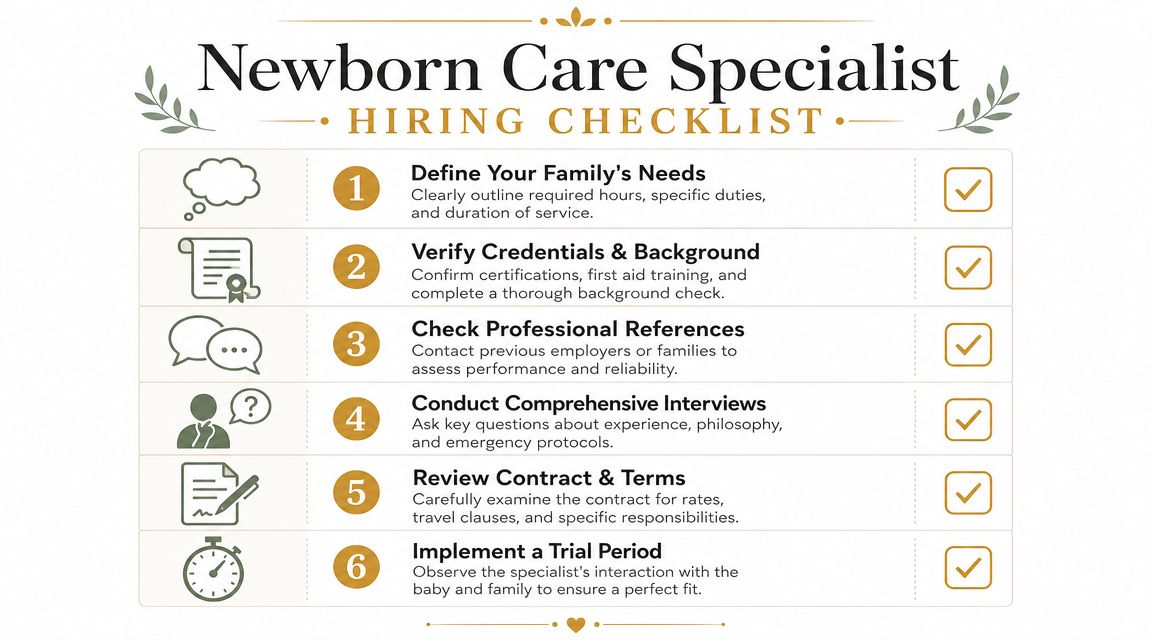
A hiring checklist that actually protects the family
Use this as a working filter, not a formality:
Define the brief clearly
Decide whether you need nights only, 24-hour cover, short-term recovery support, or a more educational role for first-time parents.Check credentials with context
CPR and First Aid matter, but so does where and how the candidate has worked before. Newborn expertise in a quiet suburban home isn't always the same as newborn expertise in a staffed Manhattan residence.Verify references properly
Ask former employers what happened at night, how records were kept, whether communication was calm, and whether the specialist improved parental confidence.Review safeguarding checks
Families should understand exactly which screening steps have been completed. If you need a baseline for child-related vetting, this overview of checks for working with children is useful.Assess discretion and adaptability
This matters particularly in homes with security teams, household staff, press sensitivity, or frequent travel.
Interview questions that reveal real skill
Skip generic prompts such as “Do you love babies?” Instead, ask questions that force the candidate to explain judgement.
“How do you set up safe sleep in a home where different family members have different opinions?”
You're looking for calm authority, not rigidity.“What would you log during an overnight shift, and how would you hand that over in the morning?”
Good candidates answer with structure.“How do you support a mother who wants to breastfeed but is exhausted and losing confidence?”
This reveals whether the candidate can protect feeding goals without becoming doctrinaire.“If a baby becomes unusually sleepy, feeds poorly, or seems difficult to rouse, what do you do?”
The answer should show clear escalation judgement, not casual reassurance.“How do you work in homes with parents who are very involved?”
The strongest specialists support parental authority. They don't compete with it.
Hire for calm judgement first. Technique can be taught more easily than steadiness.
A final point often gets missed. Trial shifts are helpful, but they are most revealing when they include handover, feed prep, settling, and live communication with the parents. A polished interview is one thing. Real-time judgement at 3 a.m. is another.
Contracts Travel and Bespoke Considerations
The contract should protect both sides and remove ambiguity early. At minimum, it should define duties, hours, overnight expectations, sleeping arrangements if live-in, confidentiality, travel terms, payment structure, cancellation conditions, and the process for ending the engagement. In higher-profile homes, privacy language needs to be drafted carefully and enforced consistently.

Travel changes the brief. Families often assume a specialist who performs well in one residence will automatically perform well on the move. That isn't always true. Travel care requires flexibility, discretion, stamina, and the ability to preserve newborn routines across time zones, hotels, security arrangements, and rotating household teams.
For senior-level vetting, operational benchmarks help. The US Nanny Association's Certified Newborn & Infant Care standard requires at least 20 clock hours of newborn or infant training, 4,000 documented paid childcare hours, current CPR and First Aid, and an 80% pass mark on a proficiency exam, according to the US Nanny Association credential standard. It isn't a UK legal requirement, but it is a useful screening framework when families want evidence of serious preparation.
Bespoke briefs may also include bilingual capability, twin experience, comfort working alongside maternity teams, or proven success in fully staffed households. The more complex the home, the more the contract should reflect its actual operating environment rather than a generic childcare template.
Frequently Asked Questions About Newborn Care Specialists
When should I book a newborn care specialist NYC placement
Earlier is usually better, especially if you want a narrow profile such as bilingual support, travel availability, or experience in fully staffed homes. The strongest candidates are often secured well before the due date because families aren't only hiring for skills. They're hiring for trust, composure, and fit.
Can a specialist help with twins
Yes. Twins change the workload and the level of organisation required. Families should look closely at how the candidate manages logging, feed preparation, settling patterns, and communication between shifts. Twin care is less about having “more hands” and more about having a disciplined system.
What qualifications should I prioritise first
Start with meaningful newborn experience, current CPR and First Aid, strong references, and clear safe-sleep and feeding knowledge. After that, look at how the person thinks. A specialist who communicates clearly and escalates concerns appropriately is usually safer than one with an impressive title but vague practice.
What if my baby needs more specialised support
If there are medical concerns, prematurity, feeding complications, or a more complex postnatal picture, the brief should be adapted carefully and discussed with the relevant healthcare professionals. The right specialist can support the household well, but they should also know the limits of their role and when clinical oversight is needed.
If you want discreet guidance on hiring the right newborn professional for your household, Superstar Nannies can help you identify a specialist who fits your schedule, standards, and family dynamic with the level of care and precision this period deserves.