


Typing hire nanny near me New York usually happens at a pressure point. A work schedule has changed, a baby is on the way, school hours no longer cover the day, or a recent hire looked fine on paper and failed in practice. In New York, families don’t just need childcare. They need reliability, judgement, discretion, and someone who can function calmly inside a fast-moving household.
The problem is that the local search results rarely reflect how complex this market is. New York has depth, but it also has noise. A listing may tell you almost nothing about how a nanny handles boundaries, long days, travel, privacy, staff dynamics, or a child who needs steadiness rather than entertainment.
For international families, the gap is wider. BAHS notes that UK data reveals 15% of London-based high-net-worth families maintain secondary residences in NYC with rotational nanny needs, yet only 2% of NYC nanny listings address bilingual UK-US cultural alignment or visa sponsorship for UK nannies. That’s one reason a generic search can leave discerning households under-served.
Your Guide to Navigating the New York Nanny Search
A parent in Manhattan often starts the same way. They open three browser tabs, message a few candidates, compare profiles, and realise very quickly that they’re not comparing like with like. One candidate has warm references but limited experience with the family’s children’s ages. Another looks polished but can’t manage the schedule the role requires. A third says she can travel, but only occasionally and without much notice.
That’s where the New York search becomes difficult. You are not choosing a service provider in the abstract. You are selecting the adult who may become the most constant non-parent in your child’s week.

Why New York searches go wrong
Many families focus too early on availability and personality. Those matter, but they’re not enough. The stronger approach is to test four things first:
- Role fit: Does this person match the scope of the job, or only part of it?
- Lifestyle fit: Can they work within your real routine, not the ideal version of it?
- Professional fit: Have they handled households with similar expectations, pace, and privacy?
- Long-term fit: Are you setting up a stable role someone excellent would want to keep?
Practical rule: If a role is unclear at the start, the search becomes reactive. Families then hire for relief instead of fit.
International and bi-coastal households need to be even more exact. A nanny who is excellent in a local live-out role may still be the wrong choice for a family moving between London and New York, or for parents who expect polished communication, familiarity with British routines, and ease around staffed homes.
A better search starts with structure, not urgency. If your household needs a wider staffing lens as well as childcare support, this guide to elite household staff in NYC is a useful companion read.
Defining Your Family's Nanny Needs in NYC
The term “nanny” is too broad to be useful. In New York, the right hire depends on your children’s ages, your hours, your home set-up, your travel pattern, and how much operational support you expect in the day.
A family with a newborn and older school-age child usually needs a different profile from a family with one toddler and a predictable weekday routine. Likewise, a dual-career household in Tribeca may need schedule flexibility, while a family splitting time between New York and the UK may need cultural fluency and confidence with handovers across homes.
Start with the real shape of the role
Write the role as it is lived, not as you wish it to be. Include school runs, travel, nursery duties, homework support, bath and bedtime, proxy parenting, and any overlap with tutors, housekeepers, chefs, or security. If the role includes family assistant work, say so. If it doesn’t, protect the childcare focus.
These are the most common role types families ask for in NYC:
| NYC Nanny Types at a Glance | Primary Focus | Typical Schedule | Best For |
|---|---|---|---|
| Live-out nanny | Daily childcare in the family’s home | Set weekday hours, sometimes with flexibility | Families who want clear separation between work and home life |
| Live-in nanny | Childcare with residential convenience | Longer coverage across the week with agreed rest time | Households with early starts, late finishes, or demanding logistics |
| Night nanny | Overnight newborn care and parental recovery support | Nights only | New parents needing specialist overnight help |
| Maternity nurse or newborn care specialist | Early infant care, feeding rhythm, settling, recovery support | Short-term intensive schedule | Families in the newborn stage |
| Bilingual nanny | Childcare plus language exposure | Varies by household | International families or those prioritising dual-language development |
| Governess-style nanny | Childcare with strong educational structure | Often after-school plus holidays, or full days for younger children | Families focused on routines, manners, learning, and school support |
| Rota nanny | Seamless childcare across rotational schedules | Alternating blocks of time | UHNW families with long hours, travel, or multiple residences |
Match the role to your household, not the trend
Some families ask for a live-in nanny because it sounds convenient. It can be. It can also blur boundaries if you don’t have proper accommodation, a realistic schedule, and a clear understanding of privacy on both sides.
Others ask for a rota nanny because they’ve heard that’s what well-established families do. In reality, rota only works when the household can support a highly structured, premium arrangement and when the role justifies that level of continuity.
The best nanny searches get narrower before they get easier.
A few practical prompts help sharpen the brief:
- Age-specific care: Newborn care is not the same skill set as toddler development or school-age scheduling.
- Hours that hold: If your day regularly overruns, build that into the role from the start.
- Travel expectations: Mention frequency, destination patterns, and whether the nanny will share rooms, fly with children, or cover jet-lagged transitions.
- Educational input: Some families need play-led childcare. Others need a nanny who can support reading, school routines, and polished behaviour.
- Cultural alignment: For expat families, small details matter. Food routines, manners, communication style, and handover etiquette can make or break a placement.
If you can describe a successful week in your home, you can write a strong job specification. That document will save time, improve interviews, and reduce the risk of hiring someone who is lovely but wrong for the role.
Budgeting Realistically for a New York Nanny
New York rewards clarity. If your budget is vague, your shortlist will be vague too. Families often begin with an hourly number in mind and then discover that the true cost sits well beyond base pay once taxes, benefits, and market expectations are included.

Sittercity reports that in 2026, average full-time nanny costs in New York, including taxes and benefits, range from $55,000 to $72,000, with experienced nannies in Manhattan commanding rates of $28-35 per hour, reflecting costs 30-50% above the national average. That should reset expectations for any family entering the market for the first time.
What families often miss in the budget
Base pay is only the start. A serious budget usually needs to account for:
- Employer obligations: Payroll compliance is part of lawful household employment.
- Benefits: Paid time off, sick leave, and other agreed benefits affect retention and candidate quality.
- Schedule design: Long days, regular overtime, or split schedules change what the role costs and who will accept it.
- Role complexity: Travel, multiple children, specialist experience, and formal household experience push the package upwards.
Sittercity also notes practical legal thresholds in New York, including unemployment taxes if paying cash wages above the stated quarterly threshold, workers’ compensation requirements for qualifying household workers, and the NYC minimum wage baseline. Those details matter because household employment is not an off-the-books arrangement for families who want stability and proper protection.
Boroughs and role design change the picture
The market is not uniform. Manhattan tends to command the highest rates. Brooklyn may sit slightly lower. Suburban markets can differ again. But families make a mistake when they focus only on geography.
The stronger budgeting question is this: what calibre of nanny are you trying to retain, for what kind of role, over what period of time?
Cheap hiring is often expensive hiring. Families pay twice when they under-budget, then restart the search after a mismatch.
If you want a deeper market-by-market breakdown, this guide to the average nanny salary in NYC for 2026 is worth reviewing before you interview anyone.
The Great Debate Agency versus Private Hiring
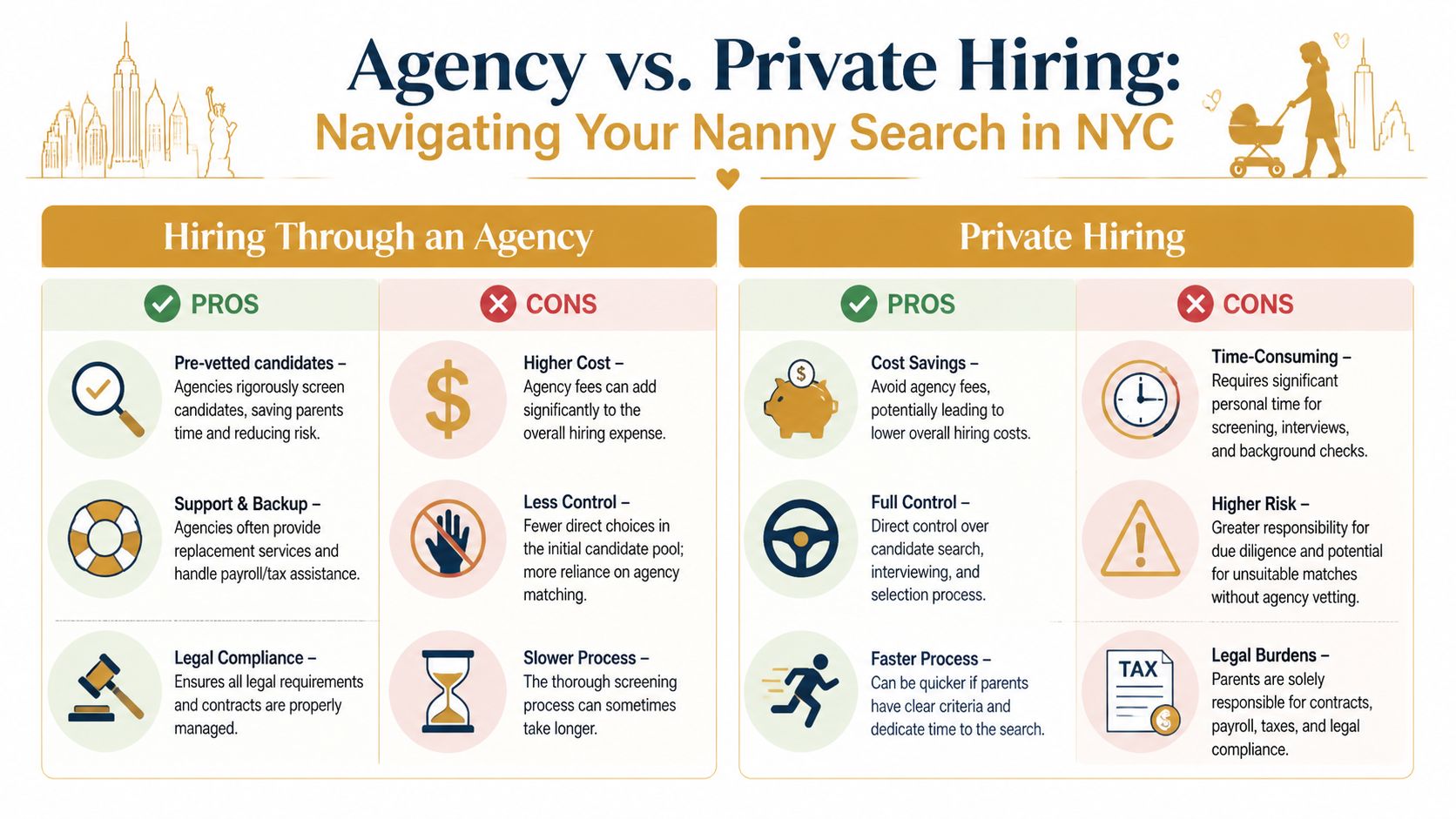
Once the role and budget are clear, families usually face a practical choice. Do you run the search yourself, or do you use an agency?
Both routes can work. They do not carry the same demands, risk, or level of support.
When private hiring makes sense
A private search suits families who have time, strong judgement, and the appetite to manage the full process. That means writing the brief, sourcing candidates, screening profiles, interviewing, checking references thoroughly, arranging trials, and handling compliance.
The advantage is control. You decide where to search, whom to interview, and how quickly to move. For some households, especially those with straightforward schedules and confidence in hiring, that may be enough.
The drawback is exposure. Parents often underestimate how difficult it is to separate a charming interview from a durable placement. A private search can also become slow when every stage sits on your diary rather than on a recruiter’s.
When an agency is the better tool
An agency becomes more valuable as the role becomes more sensitive, specialised, or high-stakes. Families with demanding schedules, travel-heavy lifestyles, privacy concerns, dual residences, or international requirements usually benefit from a more structured search.
The key differences are practical:
- Candidate curation: Better agencies narrow the field before you ever meet a candidate.
- Reference depth: A proper vetting process checks consistency, not just likeability.
- Search management: Interviews, feedback loops, and offer terms move faster when someone owns the process.
- Discretion: This matters for public figures, prominent families, and households with complex staffing structures.
A family should not have to become an employment specialist just to make a good childcare hire.
An agency does cost more than a private search, and that’s a fair trade-off to consider. But for many discerning households, the essential question is not fee versus no fee. It is whether you want to absorb the hidden cost of time, risk, and a failed placement.
If you’re weighing those routes carefully, this article on why discerning families choose a nanny placement agency gives a fuller decision framework.
Mastering the Vetting Process Interviews and Trials
A strong CV should earn a conversation, not a job offer. Families who hire well in New York move candidates through three distinct filters. Interview. references. trial.
Ask questions that expose judgement
Most interviews fail because parents ask broad questions and get polished answers. “How do you work with children?” tells you very little. Better questions force a candidate to show how they think under pressure and how they behave when the day doesn’t run neatly.
Use questions like these:
- Behavioural judgement: “Tell me about a difficult transition with a child and what you changed.”
- Boundaries: “How do you handle a parent working from home when a child wants to interrupt repeatedly?”
- Professional maturity: “What helps you succeed in a household, and what makes a role unsustainable?”
- Discretion: “How do you manage privacy when working in a visible or staffed home?”
- Routine ownership: “How would you structure an after-school afternoon with activities, homework, and downtime?”
Listen for specifics. Good candidates answer with examples, sequence, and reflection. Weaker candidates stay general, overstate flexibility, or tell you what they think you want to hear.
Reference checks should test consistency
References are not a box-ticking exercise. They are where patterns emerge. Speak to former employers live if possible. Written references can be useful, but they rarely tell you how a placement ended, whether expectations shifted, or what sort of support the nanny needed to perform well.
Ask former employers:
- What were the nanny’s actual responsibilities day to day?
- How did she handle feedback or change?
- Would you hire her again for the same age group and household pace?
- What type of family suits her best?
A hesitant pause often tells you more than a glowing adjective.
The right reference call does not just confirm employment. It clarifies fit.
Structure the trial properly
A paid trial gives you what interviews cannot. It shows how a nanny enters your home, reads the room, responds to your child, and manages practical details without constant prompting.
Make the trial long enough to reveal something useful. During that period, watch for:
- Child connection: Warmth matters, but so does calm authority.
- Initiative: Does the nanny wait to be told everything, or can she take appropriate ownership?
- Professional presence: Is she punctual, organised, and steady when plans change?
- Communication: Does she keep you informed without overloading you?
For a more detailed framework, this guide to the nanny vetting process for discerning families is a practical reference.
Crafting an Employment Contract and Ensuring Longevity
Families often relax once they’ve chosen the nanny. That is the moment to become more precise, not less. A verbal understanding might carry you through the first week. It won’t protect the relationship through a demanding season, a schedule change, or a disagreement about duties.
A proper contract creates calm because both sides know what the role is, what it isn’t, and how the employment relationship will be managed.
What the contract must cover
A strong nanny agreement should address the details families most often leave blurry:
- Duties and limits: Childcare, nursery duties, travel support, academic support, family assistant tasks, and what sits outside scope.
- Hours and scheduling: Regular hours, flexibility rules, overtime handling, overnight expectations, and travel terms.
- Compensation and benefits: Pay structure, paid leave, sick time, bonuses if offered, and reimbursement policy.
- House rules: Confidentiality, visitors, social media, use of photos, driving, and communication protocols.
- Exit terms: Notice periods, severance if applicable, and what happens if the role materially changes.
For New York families, compliance matters alongside clarity. Household employers should review official employment obligations through New York State labour guidance rather than relying on informal advice from online forums.
Retention is built before the first day
Tiny Treasures states that NYC's nanny market sees up to 35% higher turnover compared to other regions, and that figure drops significantly for nannies with tailored contracts that cover benefits and professional expectations. That tracks with what experienced household employers already know. Good nannies leave unclear roles, not just difficult ones.
Retention usually comes down to three things. Fair terms. Consistent communication. Respect for the role as skilled work.
Some broader strategies for retaining talent also apply well in domestic settings, especially around clear expectations, recognition, and stable leave planning. A nanny doesn’t need corporate language. She does need a household that communicates professionally and honours the agreement.
A contract is not about mistrust. It is about reducing friction before friction arrives.
Your Next Step to Finding a Superstar Nanny
Hiring well in New York requires more than a quick local search. The families who get this right define the role carefully, budget for the full employment picture, choose the hiring route that matches their risk tolerance, vet thoroughly, and formalise the relationship with a clear contract.
That approach turns hire nanny near me New York from a stressful search term into a workable hiring plan.
If you want a discreet, bespoke search handled to a high standard, book a confidential consultation with a specialist who understands elite households, international family structures, and the realities of the NYC market.
Frequently Asked Questions About Hiring a Nanny in NYC
How long does it take to hire a nanny in NYC
It depends on how specific the role is and how decisively the family moves. Straightforward roles can move faster. Specialist roles, travel-heavy schedules, and international requirements usually take longer because the shortlist is narrower and the vetting needs to go deeper.
Should I hire local or consider candidates from outside New York
If the role is simple and the local market offers strong options, local can work well. If you need specialist experience, cultural alignment, rota coverage, or a very polished professional profile, a wider search often produces better matches.
Is a trial really necessary
Yes, in most cases. Interviews show communication. Trials show behaviour. A paid trial gives you direct evidence of how the nanny interacts with your child, handles your routine, and fits your household rhythm.
What makes a nanny stay long term
Clarity, fairness, and professional respect. The strongest placements usually combine a realistic schedule, a proper contract, responsive communication, and a role that matches what was promised at interview.
If you want expert help finding the right fit without carrying the full search yourself, Superstar Nannies supports elite and international families with discreet, highly customized nanny placements in New York and beyond.