


You're probably reading this between meetings, school pick-up logistics, and a text from your current caregiver saying they need to leave early again. This is a common experience for many New York parents. Your work is demanding, your time is limited, and the stakes around childcare feel far too high for guesswork.
An elite nanny placement agency NYC for professional families isn't a luxury add-on. It's a risk-management decision. If you need consistent, discreet, developmentally sound care, you shouldn't be scrolling job boards at midnight and hoping a polished CV tells you everything you need to know.
The right agency does more than send candidates. It filters risk, protects your privacy, and helps you make one strong hire instead of three expensive mistakes.
The Professional's Childcare Dilemma in NYC
New York punishes weak systems. If your childcare arrangement is fragile, your whole week can unravel by Tuesday morning. A delayed train, a cancelled class, a sick child, a late investor call, and suddenly you're trying to parent and lead at full speed in opposite directions.

That's why families who start with “we just need someone reliable” often realise they need much more than reliability. They need judgement. They need discretion. They need a nanny who can manage a child's routine, communicate clearly with two busy parents, and operate calmly inside a fast-moving household.
Why the DIY route usually fails
Most parents don't lack standards. They lack bandwidth.
You can absolutely post a role yourself, review dozens of applicants, verify references, compare childcare philosophies, assess professionalism, and sort through inconsistencies. But if you're billing by the hour, running a company, or travelling regularly, that process becomes sloppy fast. Important signals get missed.
Common failure points include:
- Surface-level vetting: A basic online profile doesn't tell you how someone performs under pressure.
- Poor role definition: Families often advertise one job but require another, such as nanny-family assistant, rota nanny, or newborn specialist.
- Compatibility blind spots: Strong childcare skills don't automatically translate into a good fit for your home culture.
- Rushed hiring: Desperation leads to shortcuts, and shortcuts in childcare are expensive.
Practical rule: If a candidate search feels hurried, stop and tighten the process before you hire.
A serious agency steps into that gap. It gives structure to a decision most families make under stress. If you're still weighing whether to use an agency, start with this New York nanny hiring overview for local families. It helps clarify what level of support your household needs before you interview anyone.
Decoding the Elite Nanny Agency Model
Monday starts at 6:15 a.m. One parent is on calls before breakfast. The other is headed downtown. Your child needs consistency, your home needs discretion, and you do not have time to sort through candidates who look polished on paper but fall apart in a real household. That is the gap an elite agency is supposed to close.
A proper elite agency works like a private recruiter with childcare judgment. It builds a search around your family's actual operating style, then filters hard before anyone reaches your inbox.
What separates elite from average
The difference starts long before interviews. Strong agencies maintain private candidate relationships over time, not just active job postings. They know who performs well with two-career parents, who can handle travel without losing structure, who thrives in a staffed home, and who needs a simpler setup to succeed.
That knowledge matters because childcare hiring is not just a credentials exercise. A nanny can have strong references and still be wrong for your pace, communication style, privacy expectations, or household rhythm. Elite agencies screen for fit with the same discipline they screen for experience.
That is the model. Fewer introductions. Better judgment behind each one.
What you are actually paying for
You are paying for decision quality.
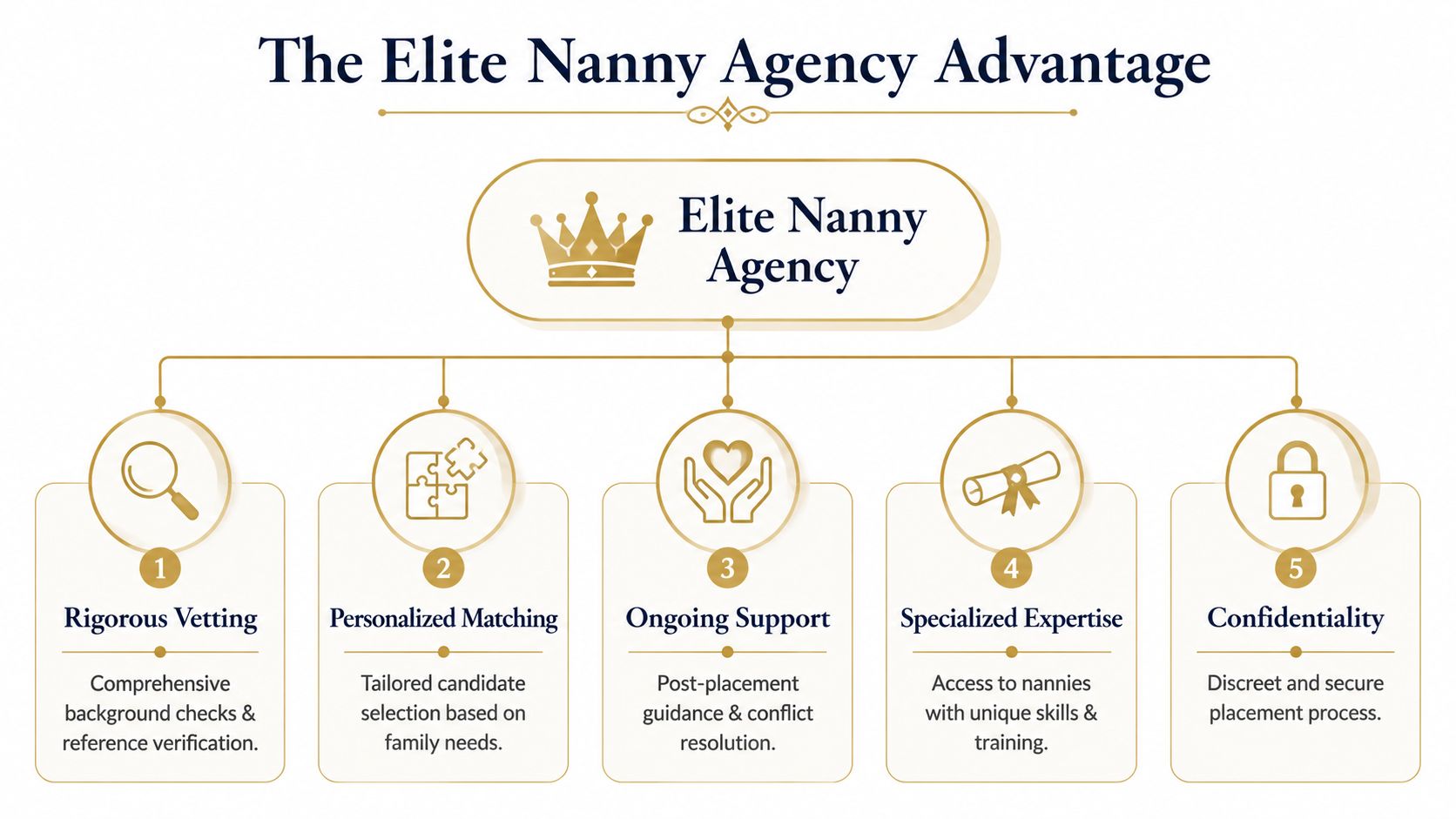
A strong agency should deliver five things:
- A precise intake: Your schedule, parenting preferences, travel expectations, confidentiality needs, and household dynamics should be documented clearly before the search begins.
- Serious screening: Employment history, references, background checks, and consistency across the candidate's story should be reviewed before you meet anyone.
- Clear match reasoning: The agency should tell you why this nanny fits your family specifically, not just why she interviewed well.
- Structured process management: Interviews, paid trials, feedback, offer terms, and start-date planning should be handled cleanly.
- Support after placement: Good agencies stay involved when compensation questions, communication issues, or early adjustments come up.
If you want a fuller explanation of what discerning families should expect from that process, read this guide on why discerning families use nanny placement agencies.
How to read the model like a client, not a shopper
Do not judge an agency by how many candidates it can send. Judge it by how well it narrows the field and how clearly it explains each recommendation.
That shift matters. Families who hire well treat agency selection as a strategy decision, not an administrative task. They want a placement that holds up six months from now, during travel weeks, school transitions, illness, shifting work demands, and the ordinary pressure of New York family life.
Ultimately, the value is in reducing hiring mistakes.
Professional families often focus on speed first. That is understandable. But speed without structure creates turnover, and turnover hits children first. A premium agency earns its fee by tightening every part of the hiring chain: search definition, candidate screening, trial design, offer terms, and early-stage support. That is how you get a placement that lasts.
How to Choose Your Agency in NYC
Don't ask an agency whether they're selective. Every agency says yes. Ask how they define selective, how they screen, and what happens when a placement goes wrong.
That's the standard. You're not hiring a vendor. You're hiring the people who will shape access to your home, your children, your routines, and your private life.
Non-negotiables to assess
Start with specialisation. Some agencies are broad household staffing firms. Others are childcare-first. Neither model is automatically better, but you need to know whether they regularly place the exact profile you need. A family needing a bilingual live-out nanny for school-age children should not be using the same search logic as a family hiring a rota nanny for frequent travel.
Then assess process depth. If the agency can't clearly explain how they vet references, evaluate temperament, and identify fit, move on. “We have wonderful candidates” isn't a process.
Here's the checklist I'd use.
Agency evaluation checklist
| Evaluation Criteria | What to Look For | Agency A Score (1-5) | Agency B Score (1-5) |
|---|---|---|---|
| Role expertise | Places your exact nanny type regularly | ||
| Vetting depth | Multi-stage interviews, references, background screening | ||
| Confidentiality | NDA practice, discreet communication, privacy protocols | ||
| Match quality | Clear rationale for each introduction | ||
| Trial process | Structured paid trial guidance | ||
| Contract support | Helps clarify terms, schedule, boundaries, benefits | ||
| Post-placement support | Available for check-ins and issue resolution | ||
| Communication style | Responsive, direct, organised |
Questions worth asking on the first call
Use the consultation to test whether the agency thinks sharply. Ask questions that force specifics.
How do you define the role I'm hiring for?
If they can't refine your brief, they can't run your search well.How many candidates do you typically present?
A strong agency curates. It doesn't flood.How do you assess fit beyond childcare experience?
Thoughtful agencies separate themselves from transactional ones through this type of assessment.What does your reference process look like?
You want detail, not vague assurances.How do you handle confidentiality for high-profile families?
Their answer should sound operational, not aspirational.What support do you offer after placement?
Early friction is normal. Silence from your agency is not.
Ask this directly: “If the nanny is excellent on paper but wrong for our household culture, how would you catch that before placement?”
If you're comparing firms, this NYC nanny agency selection resource is a useful benchmark for what a more structured search should include.
Red flags that should end the conversation
Some agencies disqualify themselves quickly. Watch for these:
- They overpromise speed instead of discussing fit and process.
- They speak vaguely about vetting and won't describe their screening steps.
- They push one candidate too hard rather than presenting a balanced shortlist.
- They avoid discussing replacement terms or follow-up support.
- They don't ask enough about your family. If they're not curious, they're not matching.
My opinion is simple. In this market, polished branding means nothing. Process means everything.
Navigating Nanny Specialities Contracts and Costs
Monday starts with a 7:00 a.m. call. Your partner is traveling. School drop-off changed. The baby was up twice overnight. If you hire “a great nanny” without defining the actual role, you create stress where you meant to buy relief.
The right hire starts with role design. Professional families do better when they choose childcare based on pressure points, schedule patterns, and household standards, not titles that sound impressive.

Which type of nanny fits your household
A live-out nanny fits a family with a predictable Manhattan or Brooklyn routine, reasonable commute tolerance, and consistent end times. A live-in nanny fits households with early starts, late finishes, frequent parent travel, or children whose schedules change week to week.
A maternity nurse or newborn care specialist solves a short-term infant problem. Hire this role if you need feeding support, sleep structure, parent recovery support, and calm overnight coverage. Do not assume that person is also your long-term nanny.
A rota nanny suits families who need continuous coverage, often across travel, multiple properties, or very demanding work schedules. This model costs more because it requires polished handovers, consistency between caregivers, and candidates who can operate at a high level without supervision.
You may also need a more specialized brief:
- Bilingual nannies for true language exposure during daily routines
- Norland-trained nannies for families who want formal training and polished childcare standards
- Family assistant hybrids for homes that need childcare plus school logistics, children's calendars, packing, travel prep, and admin
Here is the rule I give clients. Hire for the job you live, not the job title you like.
What the market is actually rewarding
Specialized childcare is no longer a narrow category. Families with demanding schedules are paying more for nannies who bring clear strengths, whether that is newborn expertise, bilingual education, travel confidence, or family assistant capability.
That does not mean you should collect credentials for status. It means you should pay for the skills your household will use every week. A polished infant specialist is wasted on a school-age role. A wonderful traditional nanny can fail in a family assistant position if the job requires calendar management, travel packing, and coordination with tutors, drivers, and house staff.
This is the strategic part many families miss. Compensation should follow scope, schedule strain, discretion requirements, and scarcity of skill. If you want flexibility, judgment, and long-term stability, budget accordingly from day one.
Contracts deserve director-level attention
Most placement problems do not start with personality. They start with vague terms.
Your contract should define the working relationship in plain language:
- Schedule: Guaranteed hours, start and end times, overtime, weekends, overnights, and travel expectations
- Duties: Child-focused responsibilities, plus any family assistant or household support spelled out line by line
- Privacy: Confidentiality rules, social media restrictions, photography boundaries, and guest policies
- Benefits: Paid time off, holidays, sick days, health stipend if offered, and reimbursement procedures
- Performance and exit terms: Trial period, notice, replacement terms, severance if applicable, and how either side can end the relationship
Read every clause with your real week in mind. If your hours drift, your contract should say so. If you expect travel, write the travel terms. If discretion matters, use specific language. General wording creates conflict.
If you want a sharper sense of the legal and practical issues families often miss, this guide to hidden contract terms is worth reviewing before you sign anything.
Budget for the full employment structure
Salary is one number. Your actual cost is much broader.
Build a budget that includes payroll taxes, paid leave, health support if you offer it, agency fees, backup coverage, travel costs, overtime, and any premium attached to a specialized role. Families who only budget base salary usually end up compromising on quality or stretching the role beyond what was agreed.
One practical option in this market is working with a specialist firm such as Superstar Nannies, which places roles including rota, bilingual, Norland, live-in, and live-out nannies for private households. The agency matters less than the discipline of the search. You want a firm that can define scope clearly, price the role accurately, and prepare you for a clean offer.
Before you finalize terms, review this high-net-worth family nanny interview guide so your interview process matches the level of the role.
Your Practical Guide to Interviewing and Onboarding
Monday, 8:15 a.m. You are heading into a client call. Your child is stalling over shoes. The nanny is standing in your kitchen for her first full week, reading your cues and your household in real time. This is the moment that decides whether the placement becomes support or another management problem.
The shortlist is only a filter. The actual work starts after the agency sends candidates. Families who treat interviews and onboarding as formalities usually end up rehiring within months. Families who run a disciplined process get stability.

Interview for judgement under pressure
Charm does not keep a household running on a hard Tuesday. Judgement does.
Your interviews should test how a nanny prioritises, communicates, and protects routine when several things need attention at once. Ask for specific examples, then press for detail. If the answer stays polished but vague, keep digging.
Use questions like these:
- Routine management: “Walk me through your plan for the window between school pick-up and bedtime when homework, activities, dinner, and baths all compete for time.”
- Discretion: “How have you handled sensitive information about a family's home, schedule, travel, or employers?”
- Pressure: “Tell me about a day that went off track. What happened first, what did you change, and what did you report to the parents?”
- Boundaries: “How do you stay aligned with involved parents without creating inconsistency for the children?”
- Development: “How do you encourage independence while still giving a child enough support to succeed?”
Listen for sequence, not slogans. Strong candidates explain what they did, why they did it, and what they would change next time.
Use paid trials to test the real job
A proper trial answers the questions the interview cannot. You see timing, tone, initiative, and whether the candidate can settle into your home without making herself the centre of it.
Keep the trial close to the actual role. If your nanny will handle school transitions, sibling dynamics, dinner prep, and parent handoffs, the trial should include those moments. Do not reduce it to a polite play session while everyone is on their best behaviour.
Watch for four things:
- Arrival and presence: calm, prepared, respectful, no performance
- Child engagement: warm, clear, age-appropriate, not forced
- Transition handling: meals, resistance, delays, and sibling friction managed without drama
- Parent communication: concise updates, good observations, no constant reassurance-seeking
A candidate who needs heavy direction during a trial will usually need heavy direction after hire.
Onboard with structure, especially if parents work from home
Many strong placements wobble in this regard. Parents assume physical proximity makes care easier. It usually creates more friction unless roles are defined with precision.
If you work from home even part of the week, set household operating rules in the first few days. Your nanny should not have to guess whether you want interruptions, whether you will step in during tantrums, or whether a child can walk into your office during calls. Children read that ambiguity immediately and test it just as quickly.
Define these points in week one
Authority during working hours
Decide who leads unless there is a safety issue. If a parent steps in unpredictably, routines weaken and children start negotiating with everyone.Communication rules
Set what merits an immediate text, what belongs in an end-of-day recap, and what should go into a shared note.Household zones
Mark parent work areas, child play areas, nap spaces, and any rooms that require permission before entry.Daily handoffs
Standardise the morning start, school pickup updates, meal notes, and end-of-day reporting. Predictability lowers friction.Schedule changes
Give notice for late meetings, travel adjustments, dinner changes, and guest arrivals as early as possible. Last-minute surprises create avoidable tension.
A clean 30-day onboarding plan
| Stage | Family action | Why it matters |
|---|---|---|
| Before day one | Send the written schedule, emergency contacts, allergies, house routines, and preferred communication method | Prevents avoidable confusion |
| First week | Keep routines steady, limit mixed signals from parents, and clarify questions the same day | Helps the nanny build confidence fast |
| Second week | Hold a short review on what is working, where timing slips, and what the children are reacting to | Fixes small issues before they become habits |
| First month | Confirm long-term rhythms around school, activities, downtime, parent involvement, and reporting | Turns a promising start into a durable placement |
One more recommendation. Schedule a formal check-in at the end of week one and another at the end of week three. Busy families skip this because things seem fine. That is a mistake. Early check-ins catch mismatched expectations before they become resentment.
If you want sharper questions, a stronger paid-trial format, and a clearer scorecard for comparing candidates, use this high-net-worth family nanny interview guide.
Partnering for Your Family's Peace of Mind
The right childcare hire should make your life quieter, not more complicated. That only happens when the search is structured properly, the agency is held to a high standard, the role is defined accurately, and onboarding is handled with discipline.
For professional parents in New York, the issue usually isn't whether you can find applicants. You can. The issue is whether you can identify the right person, under time pressure, without exposing your family to avoidable risk.
That's why I recommend treating this as a strategic household decision. Choose an agency with a real process. Insist on depth, not volume. Interview for judgement. Run a paid trial. Put clean terms in writing. Set boundaries early.
Do that, and you stop managing childcare chaos. You start building childcare stability.
Frequently Asked Questions for Professional Families
How long should we expect an elite nanny search to take
In New York, a good search takes enough time to protect the outcome. Families who rush usually pay for it later with a poor fit, a restart, or both.
Expect a process that starts with a precise brief, then a tightly selected shortlist, structured interviews, reference work, and a paid trial. If an agency promises a perfect match immediately, question the depth of its screening.
Is it better to hire a live-in or live-out nanny in NYC
Choose based on the job, not the idea of the job. A live-out nanny fits homes with predictable hours, clear handoffs, and parents who want stronger separation between private space and staff space.
A live-in arrangement makes more sense for long workdays, frequent travel, rotating schedules, or early and late coverage. The right decision comes from your weekly reality, not your first instinct.
What should we do if the placement feels off in the first month
Act in the first week, not the fourth.
Early friction usually points to one of three problems: the role was defined too loosely, communication styles do not match, or boundaries were never set properly. Tighten expectations in writing, address the issue directly with your nanny, and bring the agency in before frustration hardens into mistrust. Strong agencies help correct course early. Weak ones disappear after placement.
How important is confidentiality in a nanny placement
Confidentiality should be built into the process from the start. Professional families need discretion around schedules, schools, travel, security, household routines, and who has access to what information.
Treat privacy as an operational standard. Ask how candidate information is handled, how your family details are shared during the search, and what discretion expectations are set before placement begins.
Should we prioritise experience or personality fit
Prioritise judgment, then fit, then experience in the exact format your home requires.
Years on a CV do not guarantee a stable placement. You need someone who makes sound childcare decisions, communicates well under pressure, respects your household culture, and can sustain the pace of your family life. That is how long-term placements are built.
If you are ready to hire, approach the search like a long-term household investment. Define the role clearly, choose an agency with a disciplined process, and do not compromise on fit. Superstar Nannies handles searches for professional families who want discretion, structure, and a placement that holds up in real life.