


Let's get one thing straight: the old idea that part-time work is a professional step-down is long gone. By 2026, experienced nannies are increasingly seeing part time nannying jobs not as a compromise, but as a savvy career choice that offers flexibility without impacting their professional worth or income. If you're a childcare professional seeking a better work-life balance or a parent needing expert support, this guide breaks down everything you need to know.
Why Part Time Nannying Is a Premier Career Move
The way we think about part-time work has completely changed, particularly in the professional childcare world. What was once seen as a temporary gig is now a deliberate and often highly profitable move for top-tier nannies. It's a new reality driven by some powerful market shifts.
A big part of this change comes from high-demand households, including UHNW (Ultra-High-Net-Worth) families. They aren’t looking for just any babysitter; they need specialist, high-calibre support for specific, crucial parts of the day. Think focused academic help after school, managing complex weekend schedules, or providing enrichment activities. They're investing in an expert.
At the same time, the pool of qualified childcare professionals has been shrinking. We've seen a noticeable decline in the number of registered home childcarers, which has flipped the script and created a 'candidate-led' market. This scarcity means families are prepared to offer premium hourly rates and attractive packages to secure the very best part-time talent.
For a skilled childcare professional, this is a golden opportunity. Part-time roles are no longer about settling for less; they're about using your expertise to gain more control over your schedule and earnings.
This shift empowers you to design a career that actually fits your life. The advantages are crystal clear:
- Real Flexibility: You can finally pursue that degree, manage your own family commitments, or simply reclaim a healthier work-life balance.
- Higher Hourly Rates: To attract the best, part-time roles frequently offer a higher hourly wage to compensate for the condensed hours.
- Focused, Quality Time: Working fewer hours means you can bring more energy and creativity to your role, which is incredibly rewarding for both you and the children.
If you're mapping out your future in this field, knowing how to choose a career path is the first step toward seizing these kinds of opportunities. The bottom line is that part-time nannying has evolved into a sophisticated career track, proving you can absolutely have both professional fulfilment and personal freedom.
Know Your Worth: What to Charge for Part-Time Nannying
Let's talk money. Figuring out what to charge is one of the biggest hurdles when you're looking for part-time nannying roles. The great news is that part-time positions often pay a higher hourly rate than full-time ones. Families are absolutely willing to pay a premium for your flexibility and expert support during their most hectic hours.
Don't fall into the trap of thinking part-time hours mean a small-time income. The opposite is often true. Because you’re stepping in during high-demand periods—like the after-school rush or busy weekends—your time is incredibly valuable. You’re not just a babysitter; you’re providing peace of mind and focused, high-quality care when it matters most.
This is a fantastic time to be in the industry. The demand for skilled professionals is high, and the desire for more flexible work arrangements is pushing wages up.
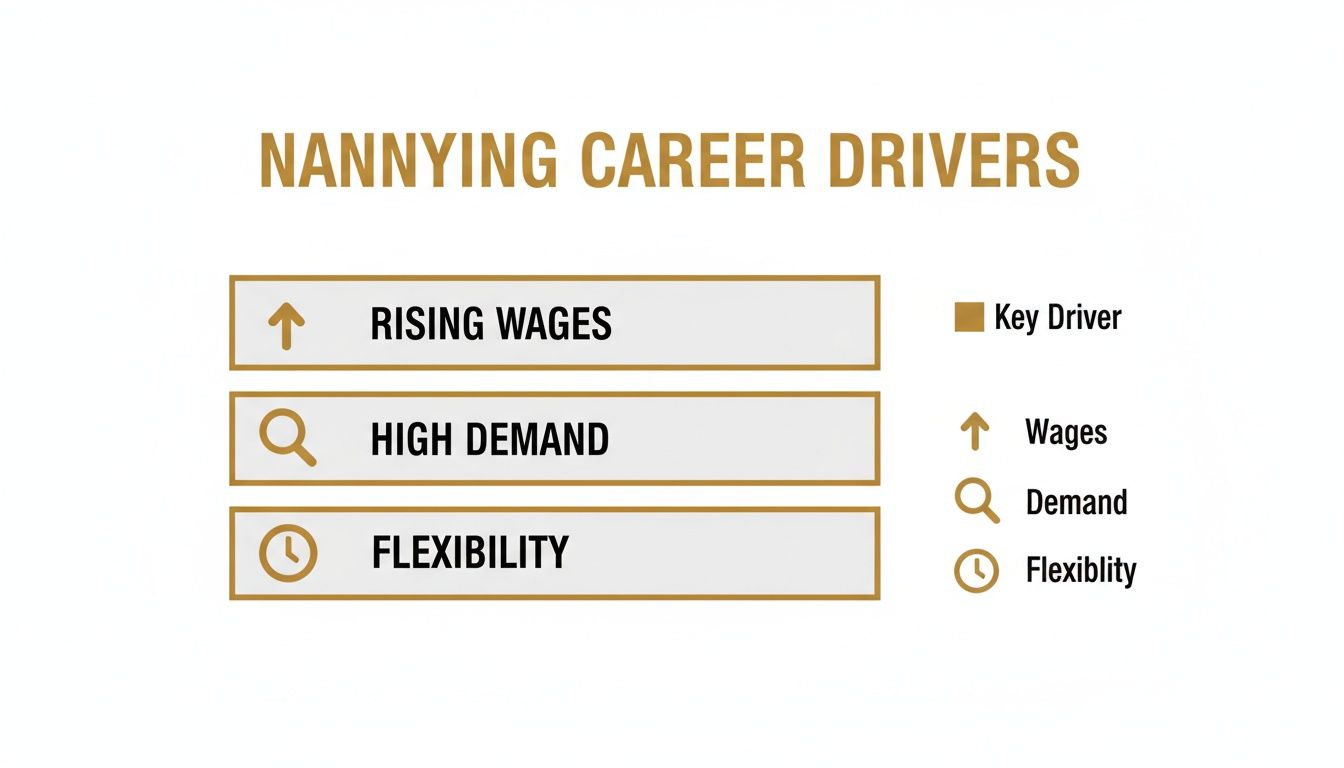
As you can see, the market dynamics are definitely working in your favour.
Getting a Feel for the Going Rate
In a busy market like London, what can you realistically expect to earn? According to the 2026 London Nanny Salaries Guide, after-school nannies working live-out can expect £22-£25 gross per hour. If you’re offering weekend support, those rates can climb even higher, often between £20-£30 per hour.
These strong rates are partly because there are fewer registered childcarers available, which means experienced professionals like you are more sought after than ever.
To put this into perspective, let's look at a couple of common scenarios:
- An after-school role for 20 hours a week at £22/hour works out to £440 gross weekly.
- A weekend nanny working 12 hours at £25/hour would earn £300 gross for just two days of work.
To give you a clearer idea of potential earnings, here’s a snapshot of typical rates for different part-time roles in London.
Part Time Nanny Salary Snapshot 2026 (London)
| Role Type | Typical Gross Hourly Rate (£) | Example Weekly Gross Earnings (15 Hours) |
|---|---|---|
| After-School Nanny | £22 – £25 | £330 – £375 |
| Weekend Nanny | £20 – £30 | £300 – £450 |
| Part-Time Nanny-Housekeeper | £19 – £23 | £285 – £345 |
| Temporary/Holiday Nanny | £25 – £35+ | £375 – £525+ |
These figures are a great starting point for negotiation and show how lucrative part-time work can be, especially when you bring specialised skills to the table.
Remember: Families aren't just paying for your time. They are investing in your expertise to cover the most critical parts of their week, and your rate should reflect that strategic value.
How Your Skills Can Earn You a Top-Tier Salary
Your base rate is just that—a base. If you have specific qualifications or sought-after skills, you're in a strong position to negotiate a premium. This is especially true for high-net-worth families, who actively look for nannies with credentials that match their children's educational needs and their own lifestyle.
These are the qualifications that consistently command a higher salary:
- Norland or Chiltern Training: A diploma from one of these prestigious colleges is an immediate mark of excellence. It tells families you have an elite-level understanding of child development, etiquette, and professionalism.
- Bilingual or Multilingual Skills: In a cosmopolitan city like London, nannies who can introduce or reinforce languages like French, Spanish, or Mandarin are in extremely high demand.
- Special Needs (SEN) Experience: If you have proven experience supporting children with autism, ADHD, or other learning differences, your expertise is highly specialised and warrants a significantly higher rate.
- Governess or Tutoring Skills: Can you provide structured academic support, manage homework, and communicate effectively with schools? This blend of childcare and education puts you in a top-tier salary bracket.
When you’re talking about salary, always think in terms of gross pay versus your take-home amount. It’s important to be clear on this. For a helpful guide on how tax and National Insurance affect your pay, have a look at our breakdown on understanding your net pay. Getting your head around this will make you a much more confident negotiator and help you manage your finances much more effectively.
How Nannies Can Secure Elite Part Time Positions
Finding an incredible part-time nannying job is a different ball game entirely. It’s not just about filling a few hours; it’s about becoming an essential part of a family's routine, often in a high-demand, high-expectation household. To land one of these top-tier roles, you need to move far beyond a standard application. It's about showing a family that you are the precise solution they’ve been looking for.

It all starts with how you present yourself on paper and in person, articulating the unique value you bring as a dedicated part-time professional.
Polish Your Professional Portfolio
Your CV is the first, and often only, chance you get to make a strong impression. For part-time roles, it needs to do more than just list your experience—it has to solve a problem. Families hiring for specific hours usually have a clear pain point, whether it’s navigating the after-school chaos or needing reliable support on weekends.
This means you must tailor your CV for every single application. Ditch the generic summary and write a sharp, compelling professional profile that speaks directly to the family's advertisement. If they need after-school help, your profile should highlight your expertise in homework support, coordinating extracurriculars, and preparing healthy evening meals.
Under each role, use your bullet points to show your impact, not just your duties.
- Instead of: "Cared for two children."
- Try this: "Managed a dynamic after-school schedule for two primary school children, improving their homework completion rates and fostering a love for reading."
This simple tweak immediately reframes your contribution from passive supervision to proactive, results-driven care. That’s exactly what discerning families want to see.
Frame Your Flexibility as a Strength
Many brilliant nannies worry that their limited availability for part time nannying jobs is a disadvantage. The trick is to reframe it as a conscious professional decision that directly benefits the family.
You're not just "available part-time"; you're choosing to work focused hours, which means you bring 100% of your energy and attention to the role every single day.
Frame your part-time availability as a professional choice that allows you to be fully present and energised during your working hours. This isn't a limitation; it’s a commitment to quality over quantity.
In an interview, you can confidently explain this. For instance: "By focusing my professional energy on after-school hours, I can ensure your children receive my undivided attention for academic support and creative play when they need it most." This shows you're a strategic professional who understands the family’s priorities.
Leverage Professional Networks and Agencies
While online job boards can be useful, the most sought-after part-time positions, especially with UHNW or high-profile families, are rarely advertised publicly. These roles are typically filled discreetly through professional networks and specialist agencies like Superstar Nannies.
Working with a top-tier agency gives you a serious competitive edge:
- Access to Exclusive Roles: Reputable agencies have built trust with elite families over many years and are their first call when a need arises.
- Expert Guidance: A great consultant acts as your career partner, helping you polish your CV, ace tough interviews, and negotiate the best possible contract.
- Credibility by Association: Simply being represented by a well-respected agency signals your calibre and professionalism to potential employers.
Don't underestimate the power of your own network, either. Attend industry events, stay active in professional online groups, and always maintain excellent relationships with past employers. A glowing, personal referral is often the final piece that secures the job.
Master the Part Time Nanny Interview
An interview for a part-time role has a specific focus. Your childcare expertise is a given; what the family really wants to assess is your adaptability, initiative, and discretion.
Be ready for scenario-based questions that relate directly to their schedule. They might ask how you’d handle a last-minute change to an activity or what you would do if a child was struggling with their maths homework. Your answers need to showcase confident problem-solving and a positive, can-do attitude. It’s also wise to have a few age-appropriate activity ideas prepared, showing you've already thought about how to make your time with the children valuable and fun.
Finally, demonstrating a real commitment to your own professional development is a powerful way to stand out. Mentioning your dedication to staying current with qualifications, like becoming an Ofsted-registered nanny, cements your status as a top-tier professional. You can learn more about the benefits of OFSTED registration for nannies in our detailed guide, which explains how this credential adds significant value to your profile.
A Family's Guide to Hiring a Part-Time Nanny
Finding the right support in a bustling family home isn't just about managing schedules; it's about creating a sense of calm and organisation. For many, hiring a professional for one of the many available part time nannying jobs is the ideal solution. It brings focused, expert care into your home during the most hectic hours of the day.
This guide is designed to help you hire safely and effectively, ensuring you find a candidate who doesn’t just fill a gap in your schedule but becomes a trusted and valuable part of your family’s life.
Defining Your Ideal Candidate
Before you even think about writing a job advert, you need to get absolutely clear on what you’re looking for. Are you trying to manage the after-school whirlwind of homework, clubs, and dinner prep? Or do you need a reliable hand for busy weekends, giving you a chance to recharge or attend events without worry?
A well-defined role is your best tool for attracting top-tier talent right from the start. Think through these specifics:
- The Schedule: What are your non-negotiable days and hours? Be precise. "Monday to Thursday, 3 PM to 7 PM" is infinitely more helpful to a candidate than "a few afternoons a week."
- The Duties: Go beyond just "childcare." Create a list. Do you need someone to help with Year 4 maths homework, prepare healthy vegetarian meals, or handle the driving to and from football practice? The details matter.
- The Must-Haves: What skills are non-negotiable for your family's peace of mind? Perhaps it’s a confident driver with a perfect driving record, or maybe current first-aid certification is your top priority.
Securing Your Peace of Mind: The Vetting Process
Once the applications start coming in, a thorough vetting process is absolutely non-negotiable. This is where you transform a promising CV into a confirmed, trustworthy professional you can welcome into your home. While a premier agency like Superstar Nannies takes care of this heavy lifting, if you're managing the search yourself, these steps are vital.
Comprehensive background checks are the bedrock of safe hiring. In the UK, the Enhanced DBS (Disclosure and Barring Service) check is the gold standard. It reveals spent and unspent convictions, cautions, and warnings, and checks against official lists of individuals barred from working with children.
Next, you need to verify their references—and I don't just mean confirming dates. Pick up the phone and have a real conversation with previous employers. Ask probing, open-ended questions.
- "Could you walk me through what a typical day with her looked like in your home?"
- "Can you give me an example of how she managed a challenging behaviour or an unexpected change in plans?"
- "How would you describe her communication style, both with you and the children?"
A glowing reference that speaks to a nanny's reliability, initiative, and genuine warmth is often the clearest sign of a future successful placement. It gives you a real-world picture of who they are and what they’re capable of.
Understanding Your Role as an Employer
Hiring a nanny, even on a part-time basis, makes you an employer in the eyes of the law. This comes with responsibilities that are critical to get right from the outset. Getting this right not only ensures you're compliant but also helps you build a competitive and fair employment package that will attract and keep the best talent.
The UK's nanny workforce has seen some real challenges lately, with reports of a decline in registered professionals. This scarcity has increased demand for flexible, part-time roles, pushing London weekend rates as high as £20-£30 gross per hour. By offering a professional and legally sound package, you immediately stand out as an employer of choice. You can learn more about these workforce trends from the National Nanny Association's insightful 2025 report.
As an employer, you'll need to handle:
- PAYE (Pay As You Earn): You must register as an employer with HMRC to manage your nanny's Income Tax and National Insurance deductions.
- Pension Contributions: If your nanny meets the age and earnings criteria for auto-enrolment, you are required to set up and contribute to a workplace pension for them.
- A Proper Contract: A formal employment contract isn't just good practice; it's a legal requirement. It must clearly outline all terms, including duties, pay rate, hours, holiday entitlement, and sick pay.
Setting the Stage for a Great Partnership
The secret to a lasting, positive relationship with your part-time nanny is setting clear expectations and fostering mutual respect from day one. This isn't about micromanaging; it’s about creating a predictable, supportive environment where your nanny feels confident and empowered.
Good communication is everything, and simple tools like a shared family calendar for babysitters can be a game-changer for coordinating appointments and schedules.
Think about your nanny’s first after-school shift. A clear plan can make all the difference. Give her a written guide with emergency contacts, notes on allergies, house rules (like screen time limits), and a general flow for the afternoon. A simple document like this gives her the tools to handle her role with confidence.
Working with an agency like Superstar Nannies removes these complexities from your plate. We handle the rigorous vetting, guide you through your employment duties, and help you define your needs to find the perfect professional, so you can focus on what truly matters—your family.
Crafting a Rock-Solid Part-Time Nanny Contract
A verbal agreement over a cup of tea is a lovely start, but I’ve seen too many brilliant placements turn sour because the initial details weren’t put in writing. A detailed, written contract is the absolute bedrock of a professional relationship between a family and a nanny.
For anyone involved in part-time nannying jobs, a contract isn't just a piece of paper. It’s your roadmap, your safety net, and your best tool for preventing misunderstandings down the line. It turns grey areas into black and white, setting the stage for a positive and long-lasting partnership.

Think of this document as your shared understanding. It should meticulously outline every aspect of the role, leaving no room for assumptions. From pay rates to holiday policies, getting it all down on paper is the key to a smooth and respectful working relationship.
Financials and Compensation Clarity
Let’s be honest: money is the number one cause of friction. Your contract must be absolutely transparent about every financial detail, starting with the agreed-upon gross salary. This is particularly crucial in competitive markets like London.
For instance, Nannytax’s recent analysis of over 10,000 payrolls shows that the full-time equivalent salary in London can be around £54,808 annually, or £21.08 per hour. These figures aren't just numbers; they reflect the high value of professional childcare and the importance of ensuring your contract mirrors regional pay standards. You can find more salary insights from Nannytax to get a full picture of the financial landscape.
Your contract's financial section must explicitly state:
- Gross Hourly Rate: The wage before any tax or National Insurance deductions.
- Payment Schedule: When and how you’ll be paid—weekly or monthly, and on what specific day.
- Overtime: The rate for any hours worked beyond the agreed-upon schedule. The industry standard is typically 1.5 times the normal rate.
- Expenses: A clear system for reimbursing job-related costs like mileage for school runs, children's activity fees, or ingredients for their meals.
Defining Duties and Responsibilities
"General childcare" is a recipe for disaster. It's a vague term that often leads to "scope creep," where a nanny's role slowly expands. A strong contract prevents this by listing specific duties, so the nanny knows exactly what’s expected and the family gets the support they need.
The best practice is to create two distinct lists: one for child-related duties and another for any light household tasks.
Child-Related Duties May Include:
- Planning and preparing nutritious meals and snacks.
- Organising age-appropriate educational and play-based activities.
- Helping with homework and school projects.
- Driving children to and from school, clubs, and appointments.
Household Duties May Include:
- Laundry specific to the children.
- Tidying children’s bedrooms and dedicated play areas.
- Loading and unloading the dishwasher with children’s plates and cups.
By clearly delineating responsibilities, you prevent a childcare role from unintentionally morphing into a housekeeper position. This clarity protects the nanny’s focus and manages the family's expectations.
Essential Legal and Logistical Clauses
Beyond pay and duties, a truly comprehensive part-time contract must cover key legal and logistical points. These clauses are the safety net for both parties, providing clear procedures for everything from time off to unexpected issues.
For a more detailed look at crafting an agreement suitable for high-calibre households, I recommend reviewing our guide on the essential elements of a UK nanny contract template.
Here are a few clauses you absolutely cannot afford to skip:
- Holiday Entitlement: For a part-time role, this must be calculated on a pro-rata basis. The UK statutory minimum is 5.6 weeks per year. So, a nanny working two days a week is entitled to 11.2 days of paid leave.
- Sick Pay and Procedure: The contract must outline the sick pay policy—whether it’s Statutory Sick Pay (SSP) or an enhanced contractual rate—and the exact process for reporting an absence.
- Confidentiality and Social Media: This is completely non-negotiable, especially when working with high-profile or UHNW families. The clause should prohibit sharing any information, photos, or details about the family without explicit written permission.
- Disciplinary and Grievance Procedures: A formal, fair process for addressing any workplace issues or disagreements. This protects everyone and ensures problems are handled professionally.
- Termination and Notice Period: Specify the notice required from both the nanny and the family to end the employment. After a probationary period, this is typically four weeks.
Conclusion: Find Your Superstar Placement Today
Ultimately, securing the right part-time nanny role—or the perfect nanny for your family—comes down to professionalism, clear communication, and mutual respect. For nannies, this means showcasing your unique skills and reframing part-time availability as a strength. For families, it means defining your needs clearly, vetting thoroughly, and understanding your responsibilities as an employer.
When both sides approach the process with a focus on getting the details right, the outcome is always better for everyone. A detailed contract that covers everything from salary to duties isn't just a formality; it's the foundation of a successful, long-lasting partnership.
Navigating this on your own can be overwhelming. Working with a specialist agency like Superstar Nannies takes the guesswork out of the equation. We are experts at connecting exceptional, fully vetted talent with discerning families who appreciate true professionalism. Contact Superstar Nannies today for a consultation.
For talented nannies seeking a fulfilling new part-time role, we invite you to explore our current part time nannying job opportunities today.
FAQs on Part-Time Nannying Jobs
When it comes to the world of part-time nannying jobs, a lot of questions come up for both families and nannies. Let's clear up some of the most common ones we hear from experienced professionals and hiring families alike.
How are holidays calculated for a part-time nanny in the UK?
In the UK, all employees, including part-time nannies, are legally entitled to 5.6 weeks of paid holiday per year. For a part-time position, this is calculated on a pro-rata basis. For example, if a nanny works 3 days a week, their annual holiday entitlement would be 16.8 days (3 days × 5.6 weeks). It's crucial to outline this calculation clearly in the employment contract to avoid any confusion.
Can I hire a self-employed part-time nanny to avoid tax and NI?
It’s a common misconception that you can hire a nanny on a self-employed basis to sidestep PAYE obligations. The reality is, in almost every single case, a nanny is legally classified as an employee. Because the family sets the hours, defines the duties, and provides the place of work, HMRC considers it an employment relationship. Attempting to classify a nanny as self-employed can lead to significant penalties. Using a payroll service or working with an agency like Superstar Nannies ensures full compliance.
What is the average hourly rate for a part-time nanny outside of London?
While London rates are certainly the highest, skilled part-time nannies are highly valued across the entire UK. Based on 2025-2026 data, the average gross hourly rates in the Home Counties and other major cities fall between £15 and £20. Of course, the final rate will always depend on a few key factors: the nanny's depth of experience, the complexity of the duties, and the current demand in your specific area.
As a Nanny, should I accept a job that pays cash in hand?
No. While the offer might seem tempting on the surface, accepting cash-in-hand payments is not only illegal but also a huge risk to your professional and financial future. It means you aren't paying the tax or National Insurance contributions you're required to. This has serious long-term consequences, affecting your eligibility for a state pension, maternity pay, and other crucial benefits. A formal employment contract with PAYE payroll provides legal protection, ensures you receive paid holidays and sick pay, and builds a verifiable employment history for your future career progression.
What should be included in a part-time nanny's job description?
A great job description for a part-time nanny is specific and clear. It should include the exact work schedule (days and hours), a detailed list of child-related duties (e.g., homework help, meal prep, school runs), and any light household tasks expected. You should also list essential requirements, such as a valid driver's license, first-aid certification, or specific experience (e.g., with toddlers or special needs). This clarity helps attract the right candidates and sets clear expectations from the very beginning.
At Superstar Nannies, we are passionate about building secure, professional, and lasting relationships between families and nannies. If you need expert guidance on finding or filling part-time nannying jobs, get in touch with our team. Learn more at Superstar Nannies.