

You're likely reading this while balancing calendars, school decisions, travel plans, and the constant question every busy parent asks in private. Who can I trust in my home, with my children, without creating more risk, friction, or noise?
That's why the search for a nanny agency New York families can rely on feels very different at the top end of the market. For high-net-worth and high-profile households, childcare isn't just about coverage. It's about judgement, discretion, stamina, security awareness, and the ability to move smoothly between a quiet family evening in Tribeca and international travel with no drop in standards.
Your Guide to Finding Elite Childcare in New York
A family relocating to Manhattan often starts with the same assumption. They think the hardest part will be finding someone with strong childcare experience. In practice, the harder part is finding someone who can operate well inside the reality of New York private life: changing schedules, multiple residences, formal households, privacy expectations, and children who need consistency even when the adults' world moves quickly.

The families who hire well don't begin by collecting the largest possible stack of CVs. They begin by getting clear on the role itself. Do you need a live-out nanny with strong school-age experience, a rota professional for a fully staffed home, a bilingual nanny who can travel, or a candidate who can work comfortably alongside house managers, security staff, and private PAs? The answer changes everything, including which agency tier can serve you properly.
A smart starting point is understanding how elite household searches are structured in practice. This definitive guide to finding elite household staff in NYC is useful because it frames childcare within the wider private staffing picture. That matters in New York, where a nanny is rarely hired in isolation.
Practical rule: If your household requires discretion, travel flexibility, or seamless coordination with other staff, treat the search as a private staffing assignment, not a casual childcare search.
The goal isn't just to hire fast. It's to hire once, hire well, and create stability at home.
Decoding New York's Nanny Agency Tiers
New York has plenty of agencies, but they don't all solve the same problem. Families often waste time because they approach the market as if every agency offers the same candidate quality, search depth, and post-placement support. They don't.
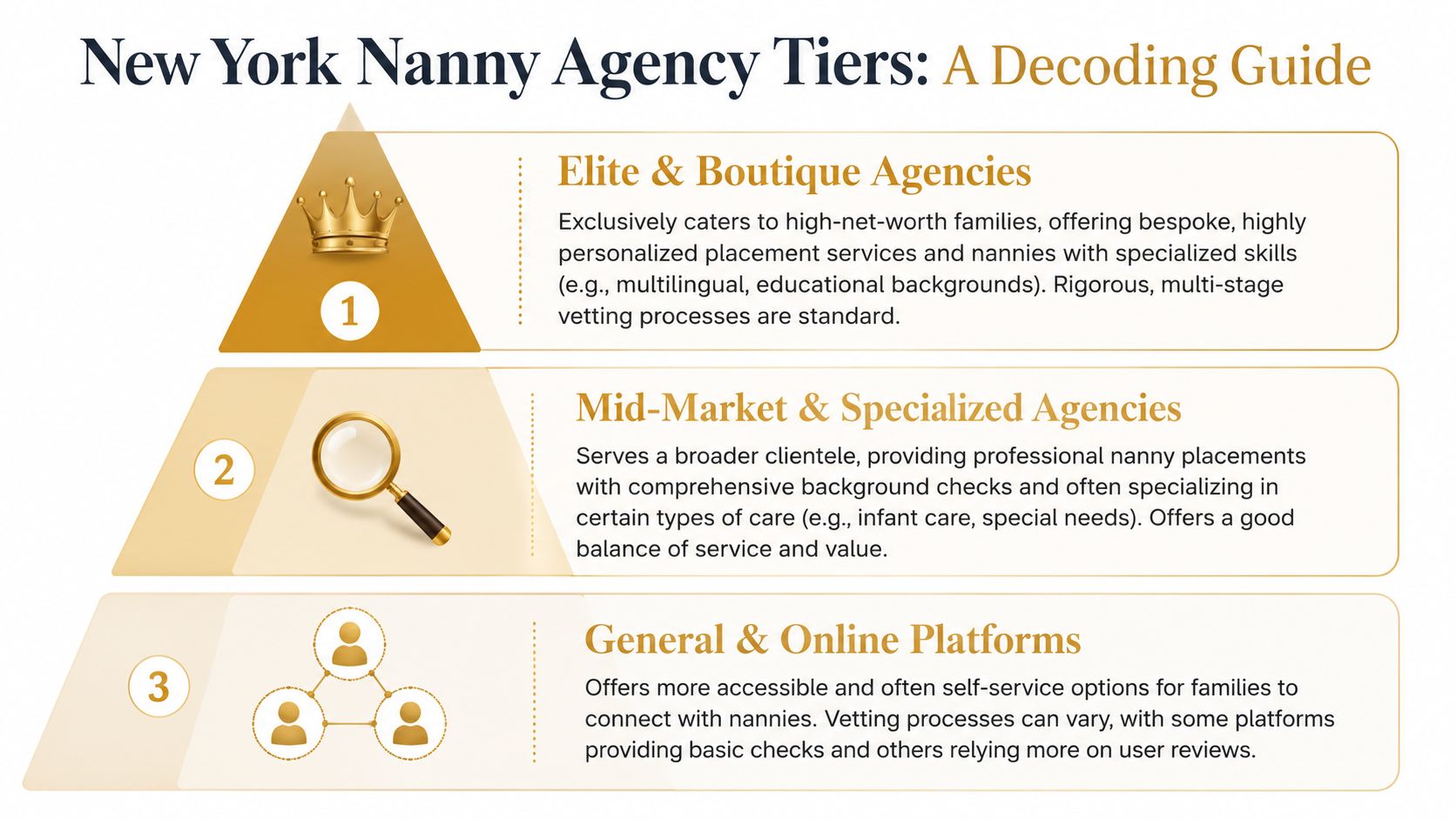
General and online options
These are the most accessible routes into the market. They can work for straightforward roles, especially when a family is comfortable taking on more screening, more scheduling, and more risk management themselves.
What usually works at this level:
- Simple live-out roles: One home, predictable hours, no travel, no media exposure.
- Hands-on family management: Parents who want to run sourcing, interviews, and reference follow-up directly.
- Speed over tailoring: Useful when the search brief is broad and flexibility is high.
What often doesn't work:
- Complex privacy needs: Online profiles and light-touch screening don't give enough assurance for many prominent households.
- Specialised roles: Bilingual, rota, educationally focused, or internationally experienced candidates are harder to assess without agency expertise.
- Multi-staff homes: Candidates may be excellent with children yet unprepared for formal service structures.
Mid-market and specialist agencies
This tier often suits professional families who want meaningful support without needing highly bespoke global recruitment. These agencies usually present more curated shortlists and provide stronger process management.
They're often a good fit when you need:
- A refined brief: Infant care, after-school support, temporary coverage, or a nanny with a specific childcare methodology.
- Guidance on market norms: Salary expectations, schedule structure, and interview management.
- A more efficient search: Less self-service, more recruiter-led filtering.
This is the tier where many families get good value. It's also where mismatch can happen if the household is more complex than it first appears. A role may look like standard childcare on paper, but the actual requirement may include travel packing, security sensitivity, coordination with tutors, or polished conduct in highly visible environments.
Families don't usually hire the wrong nanny because the candidate lacked warmth. They hire the wrong nanny because the role was underspecified.
Elite and boutique agencies
This is the right lane for households where fit, discretion, and operating style matter as much as childcare credentials. Elite agencies tend to operate with greater discretion, ask more detailed intake questions, and reject far more candidates before any profile reaches a client.
They're better suited to families who need:
- Absolute confidentiality: Especially for public figures, executives, and internationally mobile families.
- High-calibre specialisms: Norland-trained nannies, rota professionals, bilingual candidates, governess-style support, or staff used to formal residences.
- Cross-border awareness: Candidates who've travelled extensively, worked across jurisdictions, and understand household protocols.
A true nanny agency New York families at this level rely on doesn't just “send candidates”. It interprets household culture. That includes pace, hierarchy, communication style, service standards, and how the children are expected to move through the day.
The Vetting Process Demystified for VIP Families
The phrase “fully vetted” gets used too loosely in this market. For VIP families, that should concern you. A quick database check and a pleasant interview are not enough when someone will have daily access to your home, your routines, your children, and very often your private information.
Why selectivity matters
Top-tier agencies are selective for a reason. Some report that only about 6% of applicants pass their process, which includes extensive background checks, credential verification, and in-depth reference validation, according to A Nanny Match's published vetting overview. That low acceptance rate tells you something important. The critical work happens before a family sees a shortlist.
A serious process filters for more than warmth and experience. It looks for consistency across the candidate's story, professional maturity, and evidence that they've performed well in homes with high standards.
If you want a deeper look at what discerning families should ask for, this comprehensive guide to the nanny vetting process maps out the layers that matter.
What strong vetting usually includes
The strongest agencies tend to investigate in layers rather than relying on one pass or one source of truth.
Look for evidence of:
- Identity and work history review: Titles, dates, locations, and the logic of the candidate's career progression.
- Credential verification: Childcare qualifications, first aid status, and specialist training where relevant.
- Reference validation by conversation: Not just collecting written references, but speaking directly with former employers when possible.
- Lifestyle fit screening: Whether the candidate has already worked in staffed, private, or highly scheduled homes.
- Digital judgement checks: Social media and public online presence reviewed for professionalism and discretion.
The gaps families should ask about
One of the biggest weaknesses in this sector is lack of public transparency around how agencies vet. Many agencies say they screen thoroughly, yet say very little about the depth of that process, as reflected in this industry gap analysis on nanny vetting standards. That leaves families guessing.
Ask direct questions:
- Who speaks to references, and how many?
- How is overseas work history checked if the candidate has worked abroad?
- What happens if dates, duties, or titles conflict?
- Does the agency assess discretion and judgement, not just childcare ability?
Private household insight: The best vetting doesn't stop at proving a candidate can do the job. It tests whether they can do it in your world.
Navigating Agency Fees Contracts and Nanny Salaries
Families are often comfortable discussing salary. They're less comfortable discussing the full hiring structure. In New York, that can lead to confusion early and friction later.
What agency fees usually look like
In New York, agency placement fees typically range from 15% to 25% of first-year gross annual salary, based on Seaside Nannies' published guide to top nanny agency costs. The same source notes full-time placements at 18%, part-time at 20%, and initiation fees averaging $850. It also states that full-time nanny salaries in New York often range from $72,800 to $93,600 annualised, with gross hourly rates around $35 to $45.
That means the placement fee is not a token admin charge. It's a meaningful investment. For the right family, it's often justified by time saved, stronger pre-screening, tighter matching, and support when a search becomes nuanced.
Here's a simplified view of the published market figures.
| Role Type | Typical Gross Hourly Rate | Estimated Gross Annual Salary (Full-Time) | Typical Agency Placement Fee (% of Salary) |
|---|---|---|---|
| Full-time nanny | $35 to $45 | $72,800 to $93,600 | 15% to 25% |
| Part-time nanny | Varies by schedule | Not stated in verified data | 20% |
| Full-time placement via some agencies | Not separately stated | Within full-time range above | 18% |
For a more role-specific pay discussion, this elite household guide to average nanny salary in NYC is a useful companion when building a competitive offer.
What the fee should buy you
Families should ask what is included before agreeing to terms. At the premium end, the value isn't just access to candidates. It's process control.
A good placement structure often includes:
- Role design support: Clarifying duties, reporting lines, travel expectations, and schedule logic.
- Shortlist discipline: Fewer, better-matched introductions rather than volume.
- Offer management: Alignment on compensation, start date, and working arrangements.
- Replacement terms: Clear language on what happens if the match ends early.
- Post-placement support: Practical guidance during the first stage of the employment relationship.
Contracts that prevent future problems
Most hiring issues don't begin as dramatic disputes. They start as vague assumptions. A clear work agreement protects everyone.
For high-standard households, the contract should address:
- Guaranteed hours: Spell out the weekly structure and how additional needs are handled.
- Paid time off: Define holiday planning and how dates are approved.
- Travel expectations: Cover notice, schedule changes, accommodation, and conduct while travelling.
- Confidentiality: If your family values privacy, an NDA should sit alongside the employment agreement rather than being treated as an afterthought.
- Household boundaries: Clarify whether duties are child-focused only or extend to nursery organisation, child-related packing, liaising with schools, or coordination with other staff.
Salary is only one part of retention
A high salary can attract attention, but it doesn't automatically create stability. The strongest offers feel professional, clear, and sustainable.
Another market gap becomes apparent. Agencies discuss rates, but there is little public transparency around retention, cost-of-living adjustments, or how wage competitiveness affects long-term placement stability, as highlighted in this review of current gaps in NYC nanny market transparency.
The nanny who stays is rarely the one who accepted the highest number on day one. It's usually the one who entered a role with clear boundaries, fair expectations, and a household that knows how to employ well.
Mastering the Interview and Onboarding Process
When a shortlist is strong, the interview is no longer about spotting obvious red flags. It's about understanding how a candidate thinks, how they carry themselves under pressure, and whether their version of professionalism matches yours.

Questions that reveal more than experience
A weak interview sticks to childcare basics. A strong one asks for examples of judgement.
Useful questions include:
- “Tell me about a household with changing schedules. How did you stay organised?”
- “How do you handle information that's private but not formally labelled confidential?”
- “Describe a time you disagreed with a parent's approach. What did you do?”
- “What helps you settle children during travel or transitions between homes?”
- “How do you adapt when working alongside chefs, housekeepers, drivers, or security?”
The point isn't to trap the candidate. It's to hear how they think in real settings. Their answers should sound measured, practical, and free of drama.
If your home also depends on non-childcare staff, it can help to compare interviewing standards across roles. Some families find this resource on efficiently hiring your personal assistant useful because it highlights many of the same judgement, discretion, and fit considerations.
How to run a paid trial properly
Trials are valuable, but only if they're structured. Otherwise, families end up reacting to charm or surface chemistry.
A useful trial usually tests:
- Child connection over enough time to observe transitions, not just a greeting.
- Household awareness such as punctuality, presentation, and respect for routines.
- Communication style with parents and, where relevant, other staff.
- Initiative without overreach. You want confidence, not someone who starts rewriting your systems on day one.
This guide to interviewing a nanny for a high-net-worth family is worth reviewing before final interviews because the best questions are often role-specific.
A polished candidate can interview well for an hour. A trial shows how they read a room, manage a child's emotions, and respond when the plan changes.
The first weeks matter more than most families expect
Families sometimes assume the hard part ends once the offer is signed. It doesn't. Early onboarding often determines whether a good hire becomes a lasting one.
Set the relationship up properly with:
- A written household brief: Key routines, allergies, school logistics, preferred communication style, and family values.
- Clear authority lines: Who gives day-to-day direction if both parents, a PA, or a house manager are involved?
- Regular check-ins: Short, calm reviews in the early weeks prevent small misunderstandings from becoming larger ones.
The best nannies don't need micromanagement. They do need clarity.
Conclusion Building a Lasting Partnership
Choosing a nanny agency New York families can trust is the opening move, not the finish line. The strongest outcomes usually come from three decisions made well at the start. Choosing the right agency tier, demanding real vetting rather than vague assurances, and building a professional offer with clear expectations.
From there, fit becomes everything. A nanny may be excellent on paper and still feel wrong for your household rhythm. Another may seem understated in interview and become indispensable because they bring calm, consistency, and good judgement into every part of family life. That's why the interview, trial, and onboarding stages deserve as much care as the search itself.
A successful hire should reduce mental load, protect your privacy, and give your children continuity. It should also feel sustainable for the person you employ. The best placements aren't built on urgency alone. They're built on mutual clarity, trust, and respect.
Ready to find the exceptional caregiver your family deserves? Contact Superstar Nannies today for a confidential consultation and discover our bespoke approach to private staffing.
Frequently Asked Questions
How long does it take to hire through a nanny agency in New York
It depends on how specific the brief is. A straightforward live-out role can move more quickly than a search involving travel, bilingual requirements, rota experience, or formal household exposure. Families often slow the process themselves by keeping the role too vague at the start. Clear duties, schedule expectations, and decision-makers help the search move efficiently.
What's the difference between a nanny and a governess
A nanny is typically centred on day-to-day childcare, routines, emotional support, developmental engagement, and practical child-related organisation. A governess usually leans more heavily into education, etiquette, structured learning, and academic oversight. Some families need a blend, but combining both roles into one position only works when expectations are carefully defined.
Should high-profile families always require an NDA
In practice, many do, and for good reason. An NDA helps formalise privacy expectations, but it shouldn't be your only safeguard. Discretion should also be assessed during vetting, reference conversations, interviews, and trial days. A candidate who treats confidentiality as basic professional conduct is usually a stronger fit than one who sees it as a legal technicality.
Is live-in or live-out better in New York
Neither is universally better. Live-in can work well for long hours, early starts, travel-heavy schedules, or families who want built-in flexibility. Live-out can be ideal when boundaries, privacy, and independent off-duty time matter most to both sides. The right answer depends on schedule design, available accommodation, commute realities, and the household's preferred rhythm.
What benefits should families discuss besides salary
Salary matters, but serious candidates also care about guaranteed hours, paid leave, travel expectations, clarity around overtime, and whether the household is professionally run. If the role includes regular schedule changes, multiple residences, or close work with other staff, spell that out early. Strong candidates usually prefer transparency over a polished but incomplete offer.
If you want discreet, bespoke help securing exceptional childcare, Superstar Nannies supports elite families with carefully matched private staffing solutions across New York and beyond.